Baseline insights into the food practices and needs of a South African resource-constrained community
Abstract
We report here on one phase of a broader research project that focused on the development, implementation and effect of a school-based health promotion intervention. We explored food-related practices and needs in a resource-constrained community, with the aim of developing and implementing a school-based health promotion intervention. The focus was on community practices regarding food choice, production, preparation and consumption. We followed an interpretivist qualitative approach and implemented a multiple case study design. We generated data with 45 primary school teachers (Grades 4-6) and 23 parents, sampled via criterion and snowball sampling techniques. In this article, we specifically report on the first phase of the broad research project, referring to the current food-related practices and associated needs of the participating community. We aim to contribute to the current understanding of food practices in resource-constrained contexts in South Africa, as a platform against which health promotion interventions can be designed and implemented. We argue for the importance of understanding the underlying reasons for food-related habits when wanting to address unhealthy food and nutrition-related practices. This argument confirms the importance of tailor-made interventions that can be utilised to promote healthy eating habits in specific communities, against the background and importance of broader systems and holistic transformation that can support food security on a wider level. SIGNIFICANCE: Our findings highlight the specific food-related practices and needs of a resource-constrained community in South Africa. These findings can serve as baseline information to inform the development of health promotion interventions that can potentially contribute to sustainable food systems in South Africa. By grounding interventions in the expressed needs of communities, initiatives can be better tailored to local realities and more likely to support positive change. Moreover, if targeted at a specific community, interventions can encourage healthier dietary habits at ground level, thereby contributing to the broader efforts of supporting food and nutrition security goals in South Africa.
food consumption behaviour; food and nutrition-related needs; health promotion intervention; resource-constrained community; South Africa
Introduction
Both scientific and non-scientific literature indicate the impacts of malnutrition, non-communicable diseases, food and nutrition insecurity, as well as hunger within sub-Saharan Africa. Scholars and practitioners should work together in addressing this global challenge at international, national, regional and local levels. Therefore, communities, academics, health services officials and public and private agencies should engage with one another to improve community-wide health - working together in developing interventions that can support sustainable food systems across the globe, but specifically in developing countries.
Several South African government policies have been put into effect in an attempt to address household food and nutrition insecurity. For example, the Integrated School Health Policy12
In this article, we report on the first phase of a broader funded research project that focused on the potential role of schools in facilitating positive change. The project focused on the development, implementation and effect of a school-based health-promotion intervention on a resource-constrained community's food-related practices. We specifically focus on the baseline data generated on the food-related practices and needs of a South African resource-constrained community, that subsequently informed the development of a health-promotion intervention. Our presentation of these findings may create a platform against which other strategies and interventions can be designed to support healthier food-related practices in related communities in the country.
In undertaking our research, we were guided by the Millennium Development Goals, and subsequent Sustainable Developmental Goals3
Therefore, even though the existing literature indicates that interventions should move beyond a narrow focus on individual knowledge and initiatives, thereby following a transformative approach, we propose tailor-made interventions as pathways to support positive change on a broader level. We realise that changed food- and nutrition-related behaviour on a small scale, without the necessary efforts to change larger systemic drivers of food insecurity, will not necessarily result in sustainable changes on a broader socio-economic level.4
we believe that small-scale efforts hold value as building blocks towards larger change efforts, especially if focused on the specific needs of the participants of an intervention.
Malnutrition in South Africa
The United Nations Food and Agriculture Organization indicates that sub-Saharan Africa and Asia have the highest malnutrition rates, accounting for almost 89% of the world's most malnourished individuals.5678,910,1112
Therefore, the prevalence of malnutrition in South African resource-constrained communities is typically determined by factors such as inadequate access to food, limited healthcare services and an unhealthy environment, as well as broader social, economic and political forces that perpetuate poverty and inequality, neglect human rights and deny people access to essential resources.11,13141516
Many households in resource-constrained communities in South Africa face the challenge of food accessibility, rather than food availability.171813,18 9,19
As a result of acculturation after urbanisation, the transformed eating habits of South Africans residing in urban, resource-constrained communities are characterised by an increased consumption of proteins, fats, salts and sugar. Additionally, the intake of plant proteins, dietary fibre and complex carbohydrates has generally decreased.20,21112219,23
Ecological perspective on community food practices
The state of food and nutrition insecurity in South Africa can be explained in terms of Bronfenbrenner's2425,26
To elaborate, food and nutrition insecurity at the household level (microsystem) can be ascribed to factors such as insufficient food production at household level together with a reliance on purchased food. In addition, food and nutrition insecurity can result in households having to cope with additional costs related to transport to medical facilities, as well as medical and/or even funeral expenses.2624,25 24,2525,26
Methodology
We adopted interpretivism as a meta-theory based on the possibility of obtaining information-rich, in-depth data on the perceptions, opinions and experiences of the participants.2728
Research design and selection procedures
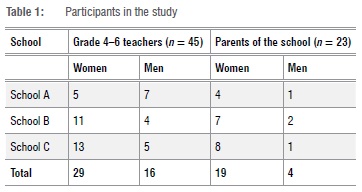
According to Creswell2930127,2827,28Table 1.
The two groups of participants provided baseline information that ultimately informed the development of a health-promotion intervention. The intervention was later implemented in the three schools with all the Grade 4 to 6 learners. The baseline data that we report on concerns the two groups of participants' perceptions of the food-related practices and needs of the community prior to implementation of the intervention, in terms of the community's choice, production, preparation and consumption of food. During this phase of the broader project, we worked alongside two master's in education students who formed part of the research team.
Data generation, documentation and analysis
We applied Participatory Reflection and Action (PRA) principles during the qualitative data generation process.3131
We followed a multi-method data-generation approach. To determine the baseline information for the broader project, we facilitated two series of PRA-guided work sessions - one with teachers and one with parents. Each group of participants was involved in three data-generation sessions of 2 h each. For these sessions, small groups of participants discussed certain prompts posed to them, while capturing their views in the form of PRA-matrices, after which they reported their ideas to the larger group of participants, entering into a discussion on the topic on the table.31
In support, we relied on observation-as-context-of-interaction32332828
We then completed a reflexive thematic analysis.3433
Ethics
We followed the guidelines for ethical research, as stipulated by the Declaration of Helsinki. We thus attended to the principles of ethical awareness, protection of human rights and social justice, with our ethical decision-making being informed by reflexivity, shared dialogue and collegial consultation with co-researchers to ensure ethically justifiable research.34
We gained the necessary ethics approval and permissions from the University of Pretoria Ethics Committee (UP12/09/02), the national Department of Basic Education (D2016/339A) and the principals and governing bodies of the selected schools before commencing with our research. In obtaining informed consent from the participating teachers and parents, we informed them about the nature, procedures and potential consequences of the study, their right to voluntary participation and the option to withdraw. We honoured the principle of respect and obtained consent for participation, the recording of discussions, observing the participants and taking photographs.35
We respected the ethical principles of beneficence, by not exposing participants to dangerous situations and preventing them from being harmed in any way; of privacy, by dealing with all information confidentially; of anonymity, by protecting the identities of the participants and safekeeping all data sources; and avoidance of deception, by not misleading the participants or misrepresenting any information.35
Results
We identified four main themes concerning the food and nutrition-related practices and associated needs of the selected community.
Critical need for knowledge about healthy dietary habits
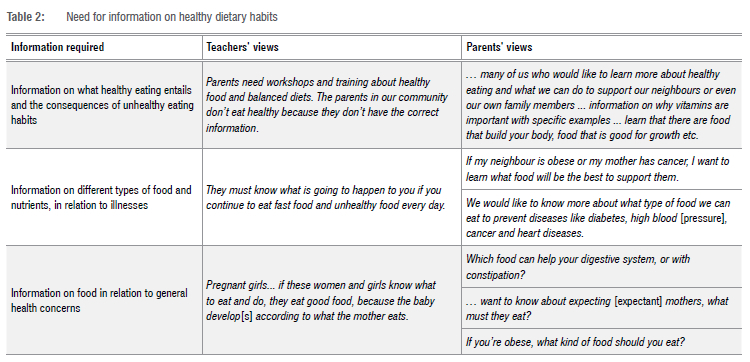
Both the teachers and parent-participants indicated the need for the school community to be better informed about healthy dietary habits. They referred to information pertaining to various related aspects, as captured in Table 2.
The examples captured in Table 2 attest to the critical need for community members to be informed about healthy dietary habits, for them to be able to guard against general illnesses and live healthier lives. Some of the teachers referred to specific examples of information required that could guide community members, such as guidelines on not to consume junk food, to eat fruits and vegetables, to choose white instead of red meat, brown instead of white sugar, Rooibos or green tea instead of coffee, water instead of fizzy drinks, and olive instead of sunflower oil. In support, the parents referred to several general health concerns, emphasising their need for information on how to avoid and treat these. In the words of one of the parents:
We need information on what we can do and eat to prevent us from getting sick ... need to get information about what can happen to you if you are obese, what can happen to your body, your blood sugar levels, your blood pressure...... also need information on where they can get effective medical help, what they must eat and what they must avoid......how they can live and eat healthier even if they don't have a lot of money.
Overall, Theme 1 therefore emphasises the need for health-promotion interventions to include an educational component that deals with basic information on healthy eating and what this entails. More specifically, people need to be informed about healthy, affordable food options and the value of specific nutrients. In gaining such knowledge, communities can be supported to prevent diseases from occurring and aspire to use healthy eating as an avenue to overall well-being and support.
Needs related to food production
The second theme focuses on the community's need for guidance on food production, with a strong emphasis on initiating and maintaining home-based vegetable gardens. Both the teachers and parents saw this as a pathway to address the challenges related to food availability and affordability, yet acknowledged that successful gardening would require specialised knowledge and skills. In the teachers' view: "Our community members need a professional somebody to teach them about good food production techniques ... to be able to produce their own food." The teachers seemed willing and able to provide some guidance to the community themselves, stating that they could "inform them about good food production techniques and we can provide them with guidance on aspects such as nutrition".
The participants engaged in lengthy discussions about home-based vegetable gardens. Despite many parents sharing their experiences of vegetable gardening, they identified a need for information on the following specific aspects:
• Garden planning and maintenance:
Can learn how to start a vegetable garden at home where they can plant vegetables such as spinach, maize, cabbage and other vegetables ... spinach, tomatoes, onions, carrots, cabbage and beetroot.
The maintenance of a vegetable garden is something we want to learn about.
We know some basic things but want to learn strategies we can use to be successful. If we know how to maintain our vegetable gardens effectively, we will be able to produce more food for ourselves and other community members.
• Soil preparation and compost:
... be able to identify the different soil types.
How do we have to prepare the soil in order to produce good vegetables from our garden?
Information on compost for gardening and how to produce this.
• Pest and disease control:
H ow can we manage pests such as insects that eat our vegetables?
What can we do to get rid of these worms?
• Food production skills:
Want to be informed about the seasonal production and planting of vegetables; about small-scale farming and the acquisition of farming skills.
This will empower community members and might also give them a source of income.
As background to these needs, the participants mentioned several benefits of home-based vegetable gardens, such as food provision, enrichment of the school feeding scheme, the possibility of income generation and community cohesion. In this regard, for example, they said:
If we have vegetable gardens at home we can start contributing to our neighbours and to the school feeding scheme here at the school. Some people can even sell their vegetables.
Many older community members are in need of food, especially health food such as vegetables.
Home-based vegetable gardens can bring a community together.
In summary, Theme 2 captures the need for health-promotion interventions to include a food production component, focusing on topics such as home-based vegetable gardening skills. In addition to including information on the topic, the acquisition of skills was regarded as important for the resource-constrained community to benefit from such an intervention. In addition to valuing home-based vegetable gardens for food provision, the participants seemingly recognised the potential value of this action for resilience and even dignity, enabling people to provide for their own families as well as others in the community.
Needs related to food preparation
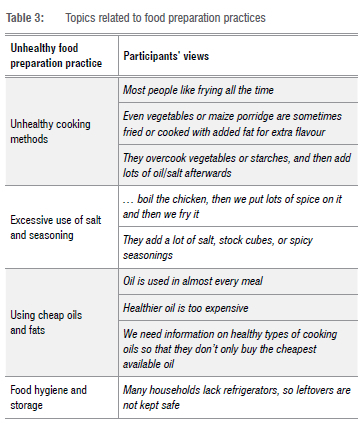
The third theme relates to the way in which food is prepared in the community, which often diminishes the nutritional value or contributes to health problems, because community members do not have the necessary knowledge and/or skills. The participants identified specific examples of unhealthy food preparation practices on which the community required guidance, as captured in Table 3.
According to the teacher-participants, community members therefore require directed guidance on healthy food preparation practices. They stated that, "...community members need somebody who can teach them how to prepare food in a healthy way". The teachers indicated healthy and alternative cooking methods as an important possible topic of discussion, saying that, "Steaming is encouraged, as well as grilling and baking." Other teachers added that community members could benefit from information on suitable cooking times in order to avoid over-cooked meals, saying that, "they should actually know the importance of boiling and also when you boil you mustn't over boil". The parent-participants agreed and indicated that community members could benefit from information on healthy food preparation practices, to be able to preserve nutrients when cooking. They said: "We want to learn how to cook and bake in a healthier way, ... need information on different cooking methods and the right manner to cook food."
The teacher-participants also referred to the need for community members to learn how to read and interpret the information on food labels, for them to be able to prepare healthy meals. They indicated the importance of people knowing how to check expiration dates and preservatives added to food products. Parent-participants shared this view and emphasised their need to understand the expiration dates of canned foods and the reasons for cans sometimes expanding when still within the expiration date. Closely related, both the teachers and parents indicated that community members had to be informed about the storage and preservation of food, saying that, "They should learn how to preserve dry food more, like dry spinach and dry biltong."
In summary, Theme 3 foregrounds the importance of including a section on healthy food preparation methods when developing health-promotion interventions for resource-constrained communities. By focusing on healthier cooking methods and the ingredients used in dishes, people can be guided to retain nutrients when preparing food and, in the process, reduce risk factors. Even though certain habits may have been established in such communities, knowledge of alternative food preparation methods may facilitate positive change.
Factors affecting the community's food practices and needs
The final theme captures the contextual factors affecting the community's practices and needs, as discussed in the previous themes. Both the teachers and parents were aware of the fact that systemic issues such as poverty, unemployment and the local food environment determine the food choice, production, preparation and consumption behaviour of the community, thereby resulting in the related need for guidance.
Poverty was foregrounded as a prominent factor affecting the community's food and nutrition-related practices and needs. Participants described the cycle of poverty leading to a lack of sufficiently healthy food items or the consumption of cheap alternatives, which in turn results in malnutrition and poor health. In this regard, a teacher said: "Poverty causes hunger and malnutrition, as it determines the food consumption practices of community members across the ages." In concrete terms, households with a limited income will focus on obtaining food that is affordable and accessible - regardless of its nutritional value. This may lead to the consumption of high volumes of maize meal, bread or inexpensive snacks sold by street vendors.
Closely related, the participants linked poverty to unhealthy dietary practices in the community, specifically the tendency to not consume breakfast on a daily basis. They indicated that: "Many people that live in this community don't eat breakfast" and that "There are several kids and parents in our community that don't eat anything at all early in the morning". For those who did eat breakfast, foods rich in carbohydrates were commonly consumed, or alternatively, food that was left over from a previous day. This trend is evident from contributions such as the following:
At home most of the time we eat porridge, bread and we drink tea.
Community members usually eat pap ... or the previous night's leftovers. Some of them will eat pap and meat and some will eat pap and tea, and 80% of families in our community eat tea and bread.
Poverty similarly affected the food consumed during lunch and dinner. For lunch, families reportedly preferred carbohydrates with some vegetables. The participants indicated that, "Community members usually eat pap with cabbage or potatoes, beans or tomatoes" and "...pap with vegetables such as spinach and cabbage". The teacher-participants reported that the children of the community were, however, "...eating here at the school ... all the schools in our community have a feeding scheme where learners are being fed from". For dinner, community members similarly preferred carbohydrates (such as maize meal, bread and rice), vegetables and, in addition, a protein (such as chicken, fish and Mopani worms). They would, for example, eat "chicken feet and chicken neck, with pap or sometimes just pap and morago"; "...starches such as rice and vegetables such as cabbage, with chicken necks" and "...usually eat samp and beans, and sometimes fish or chicken, especially the braai pack". Community members occasionally added meat to their meals, in the form of gizzards, chicken livers, chicken heads and chicken necks, or tin fish (with pap)". Mention was further made of unhealthy fast food as popular lunch options, such as sphatlo (bread with fillings such as atchar, cold meat and chips), bunny chow (a quarter loaf of white bread with fried potato chips as main filling) and spikos (usually eaten on bread, consisting of atchar, tinned fish, polony and tinned spaghetti).
Even though unemployment, poverty and the local food environment therefore have negatively affected the food- and nutrition-related practices of the community, this theme emphasises some level of resilience, with individuals doing what they can to cope with what they have. This highlights the importance of health-promotion interventions being realistic and context-sensitive, following an ecological approach when wanting to address the needs of a specific community.
Discussion
The baseline data discussed in the previous section informed our development of the health-promotion intervention that was implemented at the participating schools. These findings may also inform related interventions in future, with the aim of supporting change at ground level, potentially impacting sustainable food systems on a broader level. By considering the practices and needs of resource-constrained communities, strategies can be identified to facilitate positive small-scale change, as a pathway to change on a broader level.
Firstly, the participants in our study indicated the need for basic information on nutritious dietary habits as well as the consequences of unhealthy eating habits. In this regard, the South African Departments of Basic Education36 3736,37
Secondly, our research indicates that resource-constrained communities can benefit from guidance on food production and consumption. This finding correlates with the principles of the Sustainable Food Production Programme3638
Thirdly, our research confirms that resource-constrained communities can benefit from guidance on healthy food preparation. Therefore, future interventions can cover topics such as healthy cooking, the use of seasoning, and the interpretation of food labels and nutrition-related information. Our findings on food consumption practices can similarly inform the content of interventions aimed at improving sustainable food-related practices in resource-constrained communities. More specifically, alternative food options and portion guidelines can support community members to make better choices when selecting products or producing food. Healthier food-related practices at ground level may in turn pave the way for positive change on a broader level, in support of sustainable food systems.
Finally, by considering the factors affecting the food- and nutrition-related practices of resource-constrained communities, leaders of future interventions can consider real conditions when determining the content of initiatives for a specific context. By considering the impact of poverty as a root cause of malnutrition and household food insecurity14
Conclusion
When wanting to address unhealthy food- and nutrition-related practices, it is important to consider the underlying reasons for these habits. In resource-constrained communities, the availability, accessibility and limited consumption of healthy food are strongly influenced by poverty.
In the same way, the frequency of household meal consumption will affect household food security, which is once again influenced by factors such as unemployment and poverty.
This argument confirms the importance of tailor-made interventions to promote healthy eating habits in specific communities. If targeted at a specific community, such interventions can encourage nutritious dietary habits, healthy food production and preparation, as well as the establishment of e.g. vegetable gardens for food production. In particular, the inclusion of targeted information in interventions is underscored by our research, with healthy lifestyle practices on ground level and the strengthening of sustainable food systems on a broader level, as potential outcomes.
Funding
The Institute for Food, Nutrition and Well-being (IFNuW) at the University of Pretoria and Multotec are thanked for providing funding.
Data availability
The data supporting the results of this study are available upon request to the corresponding author.
Declarations
We have no competing interests to declare. We have no AI or LLM use to declare. This work is based on K.B.'s PhD thesis entitled 'Development and implementation of a school-based health promotion intervention in a resource-constrained community'.39
Authors' contributions
R.F.: Conceptualisation, methodology, data collection, sample analysis, data analysis, validation, writing - the original draft, writing -revisions, student supervision, project leadership, funding acquisition. K.B.: Conceptualisation, methodology, data collection, sample analysis, data analysis, validation, data curation, writing - the original draft, student supervision, project management, funding acquisition. Both authors read and approved the final manuscript.
Acknowledgements
We acknowledge Deliwe Maria Kumalo (MEd Educational Psychology) and Elzaan Smuts (MEd Educational Psychology), who completed their master's studies under our supervision as part of the broader research project, for fulfilling the role of field workers and co-researchers.
References
- 1. South African Department of Health, Department of Basic Education. Integrated school health policy. Pretoria: Government Printers; 2012.
- 2. South African Department of Basic Education. Guidelines for full-service/inclusive schools. Pretoria: Government Printers; 2010.
- 3. United Nations. The 2030 Agenda and the Sustainable Development Goals: An opportunity for Latin America and the Caribbean (LC/G.2681-P/Rev.3). Santiago: United Nations; 2018.
-
4. Battersby J, Haysom G. Linking urban food security, urban food systems, poverty, and urbanisation. In: Battersby J, Watson V editors. Urban food systems governance and poverty in African cities. London: Routledge; 2018. p. 56-67.https://doi.org/10.4324/9781315191195-4
» https://doi.org/10.4324/9781315191195-4 - 5. FAO, IFAD, UNICEF, WFP, WHO. The state of food security and nutrition in the world 2019: Safeguarding against economic slowdowns and downturns. Rome: FAO; 2019.
- 6. UNICEF. Child food poverty. Nutrition deprivation in early childhood. Child Nutrition Report. New York: UNICEF; 2024.
- 7. UNICEF, WHO, World Bank. Levels and trends in child malnutrition: Key findings of 2021 malnutrition estimates. Geneva: World Health Organization; 2021.
-
8. Otang-Mbeng W, Otunola GA, Afolayan AJ. Lifestyle factors and co-morbidities associated with obesity and overweight in Nkonkobe Municipality of the Eastern Cape, South Africa. J Health Popul Nutr. 2017;36, Art. #22. https://doi.org/10.1186/s41043-017-0098-9
» https://doi.org/10.1186/s41043-017-0098-9 -
9. Goetjes E, Pavlova M, Hongoro C, Groot W. Socioeconomic inequalities and obesity in South Africa - A decomposition analysis. Int J Environ Res Public Health. 2021;18(17), Art. #9181. https://doi.org/10.3390/ijerph18179181
» https://doi.org/10.3390/ijerph18179181 - 10. United Nations Development Programme (UNDP). The impact of social and economic inequality on economic development in South Africa. New York: United Nations; 2014.
-
11. Govender L, Pillay K, Siwela M, Modi A, Mabhaudhi T. Food and nutrition insecurity in selected rural communities of KwaZulu-Natal, South Africa: Linking human nutrition and agriculture. Int J Environ Res Public Health. 2016;14(1), Art. #17. https://doi.org/10.3390/ijerph14010017
» https://doi.org/10.3390/ijerph14010017 -
12. Scaglioni S, De Cosmi V, Ciappolino V, Parazzini F, Brambilla P, Agostoni C. Factors influencing children's eating behaviours. Nutrients. 2018;10(6), Art. #706. https://doi.org/10.3390/nu10060706
» https://doi.org/10.3390/nu10060706 -
13. Siddiqui F, Salam RA, Lassi ZS, Das JK. The intertwined relationship between malnutrition and poverty. Front Public Health. 2020;8, Art. #453. https://doi.org/10.3389/fpubh.2020.00453
» https://doi.org/10.3389/fpubh.2020.00453 - 14. World Bank. Comparability over time at the country level for international poverty measures. Washington, DC: World Bank Group; 2019.
- 15. Statistics South Africa. Quarterly labour force survey 2024. Pretoria: Statistics South Africa; 2024.
-
16. Napier C, Warriner K, Sibiya MN, Reddy P. Nutritional status and dietary diversity of pregnant women in rural KwaZulu-Natal, South Africa. Health SA. 2019;24, Art. #1114. https://doi.org/10.4102/hsag.v24i0.1114
» https://doi.org/10.4102/hsag.v24i0.1114 - 17. UNICEF. Children, food and nutrition: Growing well in a changing world. New York: UNICEF; 2019.
-
18. Wing J, Jivan D. Targeting composite treatment of type 2 diabetes in middle-income countries - walking a tightrope between hyperglycaemia and the dangers of hypoglycaemia. S Afr Med J. 2015;106(1):57-61. https://doi.org/10.7196/SAMJ.2016.v106i1.10284
» https://doi.org/10.7196/SAMJ.2016.v106i1.10284 -
19. Govender L, Pillay K, Siwela M, Modi AT, Mabhaudhi T. Assessment of the nutritional status of four selected rural communities in KwaZulu-Natal, South Africa. Nutrients. 2021;13(9), Art. #2920. https://doi.org/10.3390/nu13092920
» https://doi.org/10.3390/nu13092920 - 20. Faber M, Kunneke E, Wentzel-Viljoen E, Wenhold F. Dietary intake assessment - 24 hour recall. Pretoria: DST-NRF Centre of Excellence in Food Security/South African Medical Research Council; 2016.
-
21. Drewnowski A, Kawachi I. Diets and health: How food decisions are shaped by biology, economics, geography, and social interactions. Big Data. 2015;3(3):193-197. https://doi.org/10.1089/big.2015.0014
» https://doi.org/10.1089/big.2015.0014 -
22. Martins JH. The household food budget of the wealthy and the poor in South Africa. J Fam Ecol Consum Sci. 2005;33:37-45. https://doi.org/10.4314/jfecs.v33i1.52867
» https://doi.org/10.4314/jfecs.v33i1.52867 -
23. Napier C, Oldewage-Theron W. Dietary intake and nutritional status of adolescent girls and young women in Durban, South Africa. J Fam Ecol Consum Sci. 2015;43:1-15. Available from: https://www.ajol.info/index.php/jfecs/article/download/116672/106254/0
» https://www.ajol.info/index.php/jfecs/article/download/116672/106254/0 -
24. Bronfenbrenner U. The ecology of human development: Experiments by nature and design. Cambridge, MA: Harvard University Press; 1979. https://doi.org/10.4159/9780674028845
» https://doi.org/10.4159/9780674028845 -
25. Eriksson M, Ghazinour M, Hammarström A. Different uses of Bronfenbrenner's ecological theory in public mental health research: What is their value for guiding public mental health policy and practice? Soc Theory Health. 2018;16:414-433. https://doi.org/10.1057/s41285-018-0065-6
» https://doi.org/10.1057/s41285-018-0065-6 -
26. Suwannawong PR, Auemaneekul N, Powwattana A, Chongsuwat R. Ecological system theory and community participation to promote healthy food environments for obesity and NCD prevention among school-age children. Public Health Nutr. 2023;26(7):1488-1500. https://doi.org/10.1017/S136898002300040X
» https://doi.org/10.1017/S136898002300040X - 27. Denzin NK, Lincoln YS, editors. The Sage handbook of qualitative research. 4th ed. Thousand Oaks, CA: Sage; 2011.
- 28. Flick U. An introduction to qualitative research. Thousand Oaks, CA: Sage; 2022.
- 29. Creswell JW. Educational research: Planning, conducting, and evaluating quantitative and qualitative research. Upper Saddle River, NJ: Pearson; 2015.
- 30. Yin RK. Applications of case study research. 3rd ed. Los Angeles, CA: Sage; 2012.
-
31. Chambers R. Can we know better? Reflections for development. Rugby: Practical Action Publishing; 2017. https://doi.org/10.3362/9781780449449.000
» https://doi.org/10.3362/9781780449449.000 - 32. Angrosino MV, Mays de Perez KA. Rethinking observation: From method to context. In: Denzin NK, Lincoln YS, editors. Handbook of qualitative research. 2nd ed. Thousand Oaks, CA: Sage; 2000. p. 673-702.
- 33. Bless C, Higson-Smith C, Sithole SL. Fundamentals of social research methods: An African perspective. Cape Town: Juta & Company; 2013.
- 34. Braun V, Clarke V. Thematic analysis: A practical guide to understanding and doing. London: Sage; 2021.
-
35. Haverkamp BE. Ethical perspectives on qualitative research in applied psychology. J Couns Psychol. 2005;52(2):146-155. https://doi.org/10.1037/0022-0167.52.2.146
» https://doi.org/10.1037/0022-0167.52.2.146 - 36. South African Department of Basic Education. Action plan to 2014: Towards the realisation of schooling 2025. Pretoria: Government Printers; 2011.
- 37. South African Department of Health. The national health promotion policy and strategy 2015-2019. Pretoria: Government Printers; 2014.
-
38. Roseman MG, Riddell MC, Haynes JN. A content analysis of kindergarten-12th grade school-based nutrition interventions: Taking advantage of past learning. J Nutr Educ Behav. 2011;43(1):2-1. https://doi.org/10.1016/j.jneb.2010.07.009
» https://doi.org/10.1016/j.jneb.2010.07.009 -
39. Botha CJ. Development and implementation of a school-based health promotion intervention in a resource-constrained community [PhD thesis]. Pretoria: University of Pretoria; 2022. https://repository.up.ac.za/handle/2263/87741
» https://repository.up.ac.za/handle/2263/87741

Revised: 17 Apr. 2025
Accepted: 25 Apr. 2025
Published: 11 Aug. 2025
Funding: University of Pretoria, Multotec