Microbiological analysis of banknotes circulating in the Venda region of Limpopo province, South Africa
Abstract
WE EXAMINED USED AND NEW BANK-notes in various denominations, circulating in the Limpopo province of South Africa, for the presence of microorganisms using the rinse method. Used banknotes were collected from open-air markets, banks, filling-stations, supermarkets, residential homes and hostels. Bacteria and/or fungi were isolated from 96% of the used banknotes, and none from the new (control) notes. Twelve bacterial and one fungal species were isolated, with Staphylococcus epidermidis (13%), Candida albicans (13%), Klebsiella species (11%) and Staphylococcus aureus (11%) being the most prevalent. The low-denomination notes (R10 and R20) were the most contaminated. Infected currency is identified as a potential public health hazard, as pathogens can be spread by circulating banknotes. Immunocompromised persons stand the risk of acquiring opportunistic infections, such as C. albicans, through handling of contaminated currency.
Introduction
Money in the form of notes or coins is handled by everyone, and 'dirty' money (money contaminated with pathogenic microorganisms) is always in circulation.1,2 Contamination may occur during production, during storage after production, and during use.3 Staphylococcus epidermidis, Pseudomonas aeruginosa and Klebsiella aerogenes have been reported to survive well on the skin,and are known to be transferred from fabrics to hand as well as from hand to fabrics.4
Currency contamination is of importance to public health as it can provide a vehicle for easy transmission of pathogens between handlers. Bosch and Steyn5 Escherichia coli, Proteus species, Staphylococcus aureus, Streptococcus spp. and Klebsiella species. The corresponding figure reported for Nigerian banknotes is 83%,6 1
The objective of this study was to identify microbial contaminants of South African banknotes in circulation in the Venda region of Limpopo province, and to highlight the implications for public health in this locality.
Materials and methods
See appendix.
Results
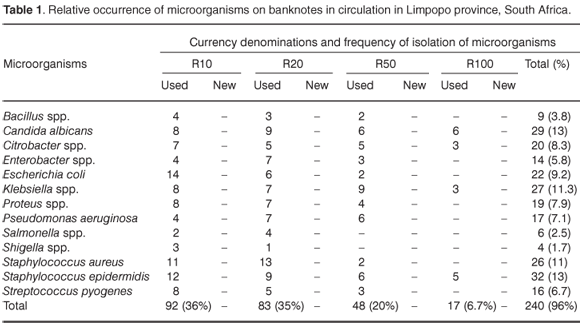
Two hundred and forty (96%) of the sample banknotes analysed were contaminated by bacteria or fungi. Eighty-four to one hundred per cent of all the banknotes obtained from the various sources were contaminated with bacteria. Twelve different bacterial species were isolated, with the most common isolates being Staphylococcus epidermidis (13%), Klebsiella species (11%), Staphylococcus aureus (11%) and Escherichia coli (9.2%). Only one fungus, Candida albicans (13%), was isolated. Enteropathogens comprised E. coli (9.2%), Enterobacter (5.8%), Salmonella species (2.5%) and Shigella (1.7%) (Table 1). Most of the banknotes had more than one microbial contaminant (data not shown).
Discussion and conclusion
Ninety-six per cent of the sample bank-notes were found to be contaminated. Since no microorganisms were isolated from new banknotes used as controls, the source of contamination of the circulating notes must be from usage and handling. Although microbial contamination of new banknotes has been reported,1 1,2,5,6 The reason for this may possibly be due to differences in hygienic practices and handling of banknotes in the different study areas. Currency notes of lower denominations (R10, R20) were the most contaminated and this is consistent with a previous report.1 Shigella and Salmonella in the present study indicates faecal contamination. Common unhygienic practices in the open-air markets in rural areas, where traders and buyers eat market products after handling contaminated currency notes, may place the individuals at risk of ingesting enteropathogens. The frequency of occurrence of Candida albicans was the second highest in the present study (13%). Candida albicans, though a normal flora in humans, is a common opportunistic infection in HIV/AIDS, causing extensive oral candidiasis.11–13 The presence of this organism on banknotes in a region with a relatively high HIV prevalence (approximately 16%)14 Pseudomonas aeruginosa has been consistently reported,1,2,4 and in the present study it was detected with a frequency of 7.9%. Pseudomonas aeruginosa is a successful survivor on hands4 15
This study has shown that South African banknotes in circulation in the Vhembe region of Limpopo province are contaminated with potential pathogens and that users and handlers of banknotes are the sources of contamination. We therefore advocate a greater sensitivity in the handling of money, either as bank-notes or coins. Hygienic measures such as a thorough hand-washing with soap after shopping should be observed. The practice of keeping money in brassieres, handkerchiefs and in shoes should be discouraged. Public education on proper handling and care of currency is advocated, in order to reduce currency contamination.
References
- 1. Tswana S.A., Chihota V.N., Moyo S.R., Chigonde S.C. and Nzara M.J. (2000). Contamination of Zimbabwean banknotes by microorganisms – a pilot study. S. Afr. J. Epidemiol. Infect. 15(1), 14–18.
- 2. Abrams B.L. and Waterman N.G. (1972). Dirty money. Am. Med. Assoc. 219(9), 1202–1203.
- 3. Hugo W.B., Denyer S.P., Norman A.H., Gorman S.P. and Russel A.D. (1983). In Pharmaceutical Microbiology, pp. 124–146. Blackwell Scientific Publications, Oxford.
- 4. Mackintosh C.A. and Hoffman P.M. (1984). An extended model for transfer of microorganisms via hands: difference between organisms and the effect of alcohol disinfection. J. Hyg. 92, 315.
- 5. Bosch A.M.T. and Steyn P.L. (1997). Microorganisms of South African banknotes. S. Afr. J. Food. Sci. Nutr. 9(1), 24–26.
- 6. Ugobor O.F. (1998). Prevalence of microorganisms in Nigerian currencies. J. Natl Appl. Sci. 4, 18–22.
- 7. Hambreaus A. (1973). Transfer of Staphylococcus aureus via nurse's uniform. J. Hyg. 6(71), 799.
- 8. Farero S.M., Dade M.C. and Robertson J.J. (1968). Microbiological sampling of surfaces. J. Appl. Bacteriol. 31, 36.
- 9. Anjellottie R. and Foster M.J. (1958). A comparative evaluation of methods of determining the microbial contamination of surfaces. Food Res. 23,175.
- 10. Koneman E.M., Allen S.D, Janda W.M., Schreebenberger P.C. and Winn W.C. (1997). Colour Atlas and Text book of Diagnostic Microbiology, 5th edn, pp. 265–268. Lippincott, Philadelphia.
- 11. Gugnanai H.C., Becker K., Fegeler W., Basu S., Chattopadhya D., Baveja L., Satyanarayana S, Kalghatgi T. and Murlidhar A. (2003). Oropharyngeal carriage of Candida species in HIV-infected patients in India. Mycoses 46(8), 299–306.
- 12. Blignaut E., Messer S., Hollis R.J. and Pfaller M.A. (2002). Antifungal susceptibility of South African oral yeast isolates from HIV/AIDS patients and healthy individuals. Diagn. Microbiol. Infect. Dis. 44(2), 169–174.
- 13. Kamiru H.N, and Naidoo S. (2000). Oral HIV lesions and oral health behaviour of HIV-positive patients attending the Queen Elizabeth II hospital, Maseru, Lesotho. S. Afr. Dent. J. 57, 479–482.
- 14. Department of Health (2003). National HIV and syphilis antenatal sero-prevalence survey in South Africa: 2002, pp. 6–7. Pretoria.
- 15. Igumbor E.O., Gwanzura L., Chihirara M., Obi C.L. and Muza D. (2000). Antibiotic susceptibility and plasmid profiles of Pseudomonas aeruginosa. Centr. Afr. J. Med. 46(11), 296–299.