The decomposition dilemma: Why forensic science needs both humans and pigs
Abstract
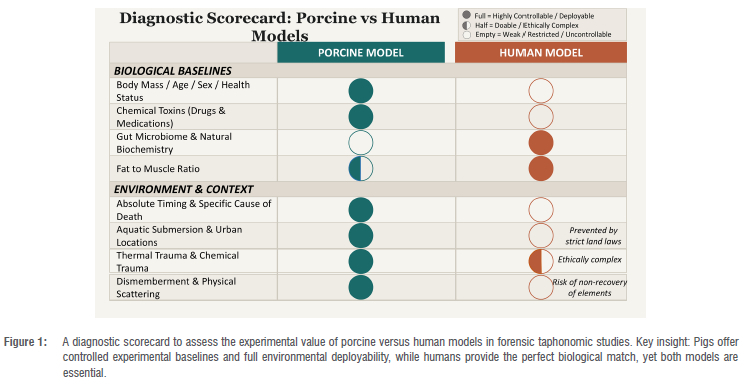
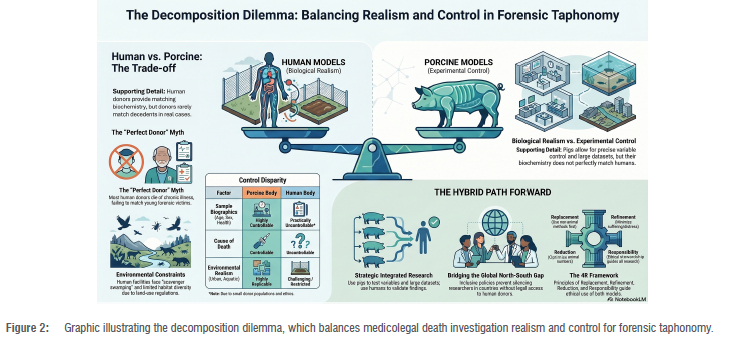
SIGNIFICANCE: This Commentary reframes the human-versus-non-human-animal model dilemma by emphasising experimental design and forensic realism over model type. It highlights that human donor programmes often rely on body donations with biographics that fail to match real-world forensic profiles. High donor density in experimental field deployments likely distorts forensically realistic environments as well as insect and scavenger behaviour. Animal models remain essential for providing experimental control, study replication and robust sample sizes. Importantly, rejecting animal-based research outright marginalises research from the Global South where human donors are unavailable, hindering research equity. An integrated framework ensures forensic science remains ethically sound, scientifically robust and globally inclusive.
taphonomy; forensics; human taphonomy facilities; forensic realism; Global South
 Thumbnail
 Thumbnail