The decomposition dilemma: Why forensic science needs both humans and pigs
Abstract
SIGNIFICANCE: This Commentary reframes the human-versus-non-human-animal model dilemma by emphasising experimental design and forensic realism over model type. It highlights that human donor programmes often rely on body donations with biographics that fail to match real-world forensic profiles. High donor density in experimental field deployments likely distorts forensically realistic environments as well as insect and scavenger behaviour. Animal models remain essential for providing experimental control, study replication and robust sample sizes. Importantly, rejecting animal-based research outright marginalises research from the Global South where human donors are unavailable, hindering research equity. An integrated framework ensures forensic science remains ethically sound, scientifically robust and globally inclusive.
taphonomy; forensics; human taphonomy facilities; forensic realism; Global South
Introduction
Forensic anthropology, which can be defined as the study and analysis of human (and non-human) remains found in medicolegal, humanitarian and human rights contexts, plays a critical role in addressing South Africa's growing crisis of unidentified decedents. Developing countries such as South Africa have high rates of unidentified decedents at forensic pathology laboratories (almost 10% in South Africa's case).1-4 Forensic anthropologists contribute a broad, interdisciplinary approach to cases involving decomposed, fragmented, burnt, commingled or skeletonised remains, where conventional autopsy methods are insufficient and identification and reconstruction of postmortem circumstances can be particularly challenging. Drawing on knowledge from biological anthropology, anatomy, pathology, ecology and related fields, forensic anthropologists can reconstruct biological profiles (i.e. estimates of age-at-death, biological sex, population affinity and stature); analyse skeletal trauma, skeletal taphonomy and pathology; estimate postmortem intervals; and contribute towards clarifying the circumstances surrounding death - all of which are essential to successful forensic identification and, ultimately, to justice and familial closure.1,2
Despite its clear value, forensic anthropology remains underutilised and poorly formalised within South Africa's medicolegal death investigation system.223,4 Formalisation of forensic anthropology would not only improve identification rates and reduce the burden on an already stretched system of only ±50 forensic pathologists for 70 000 unnatural deaths per year, but would also establish forensic anthropology as a legitimate, funded pillar of South Africa's response to what is, at its core, a humanitarian crisis.1-4
Forensic taphonomy
When a person dies, the body begins a predictable but complex process of decomposition. Understanding this process is crucial in forensic science, particularly for estimating the time since death (also known as the postmortem interval) and reconstructing events leading up to the discovery of a body. The field that studies these changes - forensic taphonomy - has become a cornerstone of contemporary medicolegal death investigations.
Yet, in South Africa, forensic taphonomy is critically underutilised in forensic settings - a situation which is in part caused by and in part contributes to diminished research focus. The country's unique environmental conditions, including its diverse climate zones, varied fauna and open, often remote depositional landscapes, mean that bodies recovered in forensic contexts frequently exhibit advanced decomposition, skeletonisation, damage or scattering. These taphonomic factors directly impede identification, and yet locally derived research on decomposition rates, scavenging patterns and postmortem interval estimation is scarce. Without local environment-specific data, forensic investigators are forced to rely on reference standards developed in the Global North or in misaligned South African environments, which are unsuitable for the vast diversity of South African conditions.
Research into forensic taphonomy is occurring at a few academic institutions that are affiliated with forensic pathology services experiencing the most acute need for the data - principally in Gauteng and the Western Cape, where the burden of unidentified decedents is heaviest. To ensure relevance and applicability, research must be experimentally designed to mirror realistic case-work scenarios and use the most technologically advanced methods.33-6
A prominent international debate in the discipline that is affecting us locally is the decomposition dilemma: whether experimental field-based forensic taphonomic research should rely exclusively on donated human bodies as experimental samples or if non-human animal models, specifically pigs, remain a valid and necessary alternative.5,7,8 But there is a big problem: although the goal is to understand how human bodies decompose, most countries lack access to donated human bodies for this type of research. As a result, researchers often rely heavily on animal models, especially pigs, which resemble humans in some - but not all - aspects of decomposition. But this choice exposes researchers to the inevitable question about the relevance of the results obtained, specifically whether they can be reliably extrapolated to understand human forensic cases - the foundation of the decomposition dilemma.
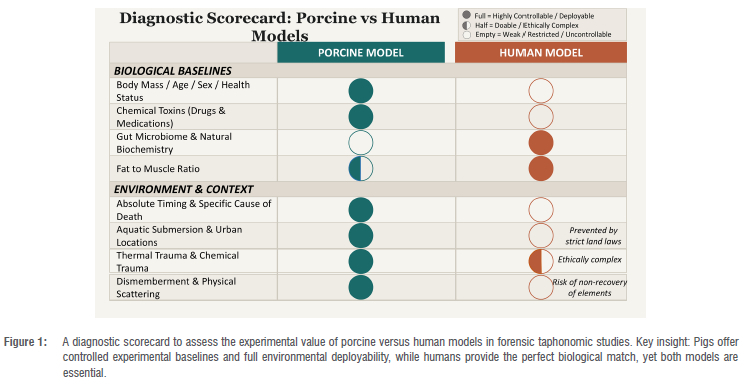
The remainder of this article will focus on the findings from our new Commentary9Figure 1).
The myth of the perfect human donor
It seems logical that human decomposition research should rely primarily (maybe even solely) on human donors. In a world with unlimited resources, legal support, land, security and ethically sourced donors, this might be true. In reality, only a few countries operate human taphonomy facilities - colloquially known as 'body farms'. Countries across Africa, Asia, South America and most of Europe cannot legally or practically conduct such research or set up facilities for such research.
Even when human donors are available, they come with major scientific limitations and restricted forensic realism (see Figure 1):
• Most are elderly, often over 70 years old.
• Many die from chronic illness, not sudden trauma.
• They frequently have complex medical histories, including medication use.
• Key factors like age, sex, lifestyle and health are not controllable or always available.
This creates a fundamental flaw: the medications and chronic illnesses of elderly donors introduce chemical variables that do not necessarily exist in victims encountered in medicolegal circumstances. In jurisdictions such as South Africa, forensic cases frequently involve young, healthy adults who died from sudden traumatic injuries resulting from interpersonal violence or accidents. For these investigations, the data from elderly donors are often biologically irrelevant.
If the human bodies used in research differ biologically from those encountered in real cases, how realistic are the results?
This biological gap matters because it compromises the accuracy of criminal investigations. If the baseline data come from a study sample with biographic characteristics significantly different from those of the victim, the rate of decay could differ, which would result in the estimated timeline for a homicide being fundamentally flawed. Relying on perfect donors who do not match the encountered victims is a recipe for scientific failure.
Why pigs (and other animal models) still matter
Pigs are the primary non-human analogue in forensic science, and they offer a level of experimental control that human donor programmes cannot match (see Figure 1). While their gut microbiology and some anatomy differ, they enable researchers to build the large, statistically meaningful data sets required for the courtroom.7,8
Using pigs, researchers can meticulously isolate variables that are often unknown or uncontrollable with human donors, such as:
• precise age and body size,
• diet,
• specific cause of death (natural or trauma),
• documented health status and body fat levels,
• the exact minute between death and placement, and
• replicated forensic scenarios and environmental exposure.
Pigs are not a second-rate choice; such control allows studies to isolate variables (cause and time of death), test hypotheses systematically, develop validated pilot studies for human replication and build large data sets - essential for identifying meaningful patterns in decomposition. Human donor programmes rarely have enough bodies to fulfil teaching requirements, making non-human models often the only feasible way to conduct robust controlled research before validating findings with human donors.
Human taphonomic facility limitations: Realism is not guaranteed
Another challenge is environmental realism. People often imagine human taphonomy facilities as replicas of real forensic scenes. In truth, facilities have space limitations, are heavily fenced (restricting natural scavenger access), and are tightly regulated - factors that distance them from the unpredictability of a real-world forensic scenario. These constraints introduce several scientific issues:
1. Bodies are placed too close together: Most forensic cases involve a single body, yet many facilities place multiple donors only a few metres apart. To the insect and vertebrate scavengers attracted to the body, these closely spaced bodies are not independent - they are one large food source. This creates 'scavenger swamping', in which the high density of remains reduces the amount of scavenging per body and alters insect activity. This makes the conditions more similar to mass disasters than typical forensic casework. Significantly, it also eliminates experimental independence of replicates - a serious and heavily overlooked scientific flaw in experimental design that is pervasive through forensic taphonomy.10
2. Scavengers behave unnaturally: Animals such as jackals, raccoons and mongooses quickly learn that these sites offer a reliable, stationary food source. This can create hyper-accelerated and unnatural scavenging patterns that would rarely occur at a genuine, isolated crime scene.
3. Human disturbance is constant: Real crime scenes remain undisturbed until the moment of discovery. In contrast, research facilities are subject to constant visits from researchers, which can subtly but significantly disrupt the natural behaviour of insects and vertebrate scavengers. These impacts are not trivial, given that insects and vertebrate scavengers are responsible for much of decomposition.
4. Facilities represent a narrow range of habitats: Most human taphonomy facilities are located on rural, private plots, yet many real forensic cases occur in urban lots or diverse landscapes. These tightly regulated facilities cannot replicate the ecological variety found in the real world, leaving a massive gap in our forensic understanding.
These constraints mean human taphonomy facilities, despite their importance, do not automatically mirror real-world forensic case scenarios. This gap has been largely overlooked.
Ethical pushback - and global inequality
A growing movement argues that non-human animal-based forensic research should stop unless it directly improves human health. Some reviewers and journals are also rejecting taphonomy studies using animal models, even when ethical standards are met. This approach is deeply problematic, not least because it ignores the fact that most countries in Africa, Asia and South America lack legal access to human donor programmes, producing significant inequities and participation barriers:
• Countries without access to human donors depend on animal models to participate in decomposition research.
• If their work is rejected, these researchers - especially in the Global South - are effectively silenced in the global dialogue.
• Climate-specific data from diverse environments do not enter the global literature.
• Innovation slows and becomes concentrated in the few countries able to conduct human-based research.
This academic gatekeeping reinforces geographic and structural exclusion. Global research equity is not just about fairness; it is about scientific accuracy. Forensic science is only as strong as the diversity of the environments and populations it studies.
A hybrid way forward
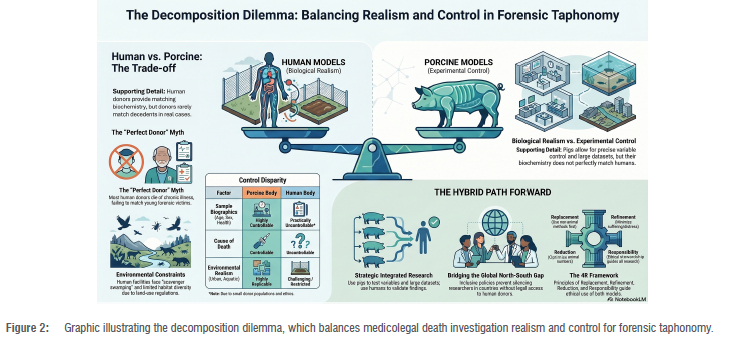
The future of forensic science requires a shift from the argument of human versus non-human animal models to a collaborative, standardised global system of experimental forensic taphonomy (Figure 2). This hybrid path uses animal models to explore variables and test experimental designs, while human donors can be strategically used to validate findings. We propose a practical, inclusive scientific framework:
1. Use non-human animal models to test experimental designs and explore variables (pilot studies). They allow for systematic investigation and adequate sample sizes.
2. Validate findings with human donors when possible. Human donor-based studies remain essential - but they should be used strategically because they rely upon a scarce supply of donors.
3. Standardise research methods and reporting. Research should utilise comparable methods to make global data sets stronger and more meaningful.
4. Embrace the 4Rs - replacement, refinement, reduction, responsibility. These principles guide the ethical use of both human and non-human models.
5. Promote global research equity. Value contributions from all regions, including those with limited resources but unique ecological and/or forensic contexts, and recognise that scientific diversity strengthens knowledge, enlightens forensic interpretations and is the birthplace of innovation.
By integrating both models, the scientific community can move toward a system that is ethically responsible, globally representative and scientifically rigorous. This inclusive approach ensures that researchers in the Global South are not overlooked or excluded from the dialogue that shapes justice, both at home and abroad (Figure 2).
The big picture - serving the living
Forensic taphonomy is not just a scientific puzzle; it is a service to the cause of justice. The goal is to build a system that is globally representative and genuinely useful for real investigations, rather than one that relies on the myth of the 'perfect' donor. Collectively, we all want to build a forensic science system that is:
• scientifically rigorous,
• globally representative,
• ethically responsible, and
• genuinely useful for real investigations.
Both human and non-human animal models are essential to achieving these ambitions. Together, they build more accurate and reliable methods for interpreting the dead - and in doing so, promote justice and better serve the living.
Funding
We acknowledge financial assistance from the South African National Research Foundation (NRF) through various programmes. This Commentary draws on the authors' broader programmes of research and field-based work. The opinions expressed and conclusions arrived at are those of the authors and are not necessarily to be attributed to the NRF.
Declarations
We have no competing interests to declare. We acknowledge the use of AI-based editorial tools to assist with grammar refinement, clarity improvements and formatting suggestions. All final content, ideas and interpretations are our own. Additionally, Figure 2 was generated with Google Notebook LM based on the content of our submission with some edits done by the authors. All authors read and approved the final version.
Acknowledgements
We acknowledge and appreciate the contribution that unidentified decedents make to improving identification. We thank the personnel and staff of the Western Cape and Gauteng Forensic Pathology Services, the South African Police Service (particularly the Victim Identification Unit) and academics/researchers for their dedication and service to medico-legal death investigations in South Africa.
References
-
1. Gibbon VE, Heathfield LJ, Smith K, Sealy JC, Martin LJ. A transdisciplinary integrated approach to improve identification outcomes for decomposed decedents in medicolegal death investigations. Forensic Sci Int Synergy. 2025;10, Art. #100579. https://doi.org/10.1016/j.fsisyn.2025.100579
» https://doi.org/10.1016/j.fsisyn.2025.100579 -
2. Gibbon VE, Finaughty C, Moller I, Finaughty DA. Pressing need for national governmental recognition of forensic anthropology in South Africa as illustrated in a medico-legal case. Sci Justice. 2022;62:411-417. https://doi.org/10.1016/j.scijus.2022.05.003
» https://doi.org/10.1016/j.scijus.2022.05.003 -
3. Baliso A, Heathfield LJ, Gibbon VE. Informing regional taphonomy research using retrospective forensic anthropology cases in the Western Cape, South Africa. Sci Justice. 2023;63:164-172. https://doi.org/10.1016/j.scijus.2022.12.003
» https://doi.org/10.1016/j.scijus.2022.12.003 -
4. Keyes CA, Mahon TJ, Gilbert A. Human Decedent Identification Unit: Identifying the deceased at a South African medico-legal mortuary. Int J Legal Med. 2022;136(6):1889-1896. https://doi.org/10.1007/s00414-022-02893-z
» https://doi.org/10.1007/s00414-022-02893-z -
5. Finaughty DA, Pead J, Spies MJ, Gibbon VE. Next generation forensic taphonomy: Automation for experimental, field-based research. Forensic Sci Int. 2023;345, Art. #111616. https://doi.org/10.1016/j.forsciint.2023.111616
» https://doi.org/10.1016/j.forsciint.2023.111616 -
6. Adams KS, Finaughty DA, Gibbon VE. Forensic taphonomic experimental design matters: A study assessing clothing and carrion biomass load on scavenging in Cape Town, South Africa. Int J Legal Med. 2024;138:1669-1684. https://doi.org/10.1007/s00414-024-03171-w
» https://doi.org/10.1007/s00414-024-03171-w - 7. Miles KL, Finaughty DA, Gibbon VE. A review of experimental design in forensic taphonomy: Moving towards forensic realism. Forensic Sci Res. 2020;5:249-259.
-
8. Matuszewski S, Hall MJR, Moreau G, Schoenly KG, Tarone AM, Villet MH. Pigs vs people: The use of pigs as analogues for humans in forensic entomology and taphonomy research. Int J Legal Med. 2020;134:793-810. https://doi.org/10.1007/s00414-019-02074-5
» https://doi.org/10.1007/s00414-019-02074-5 -
9. Finaughty DA, Gibbon VE, Keyes CA, Brits D. Re-evaluating forensic taphonomy experimental design: Relevance of non-human animal models vs. human donor bodies. Sci Justice. 2025;65(6), Art. #101348. https://doi.org/10.1016/j.scijus.2025.101348
» https://doi.org/10.1016/j.scijus.2025.101348 -
10. Moreau G, Lutz L, Boudreau DR, Michaud JP, Schoenly KG. Design and analysis of field studies in carrion ecology. In: Benbow ME, Tomberlin JK, Tarone AM, editors. Carrion ecology, evolution, and their applications. Boca Raton, FL: CRC Press; 2025. p. 63-85. https://doi.org/10.1201/9781003610885-5
» https://doi.org/10.1201/9781003610885-5