A first record of biological soil crusts in the Cape Floristic Region
Abstract
To date, the biological soil crusts (BSCs) of southern Africa are thought to be dominated mainly by cyanobacteria, with the exception of the lichen fields of the Namib Desert. Because soil microorganisms can physically modify, maintain or create habitat for other organisms -including soil biota and plants - they have been considered ecosystem engineers. Therefore, the presence of BSCs may be a good indicator of ecosystem resilience. Although BSCs are found throughout the world, recent work has suggested that the absence of BSCs in the fynbos of South Africa may be as a result of the inherent acidity of soils. We surveyed one area within the fynbos biome for the presence of BSCs and determined the relative cover of vegetation and different crust types. We found a widespread presence (up to 80% of surface soil) of BSC communities in fynbos soils. We conclude that soil acidity may not be a constraining factor in the development of BSCs in fynbos soils and that previous reports on the absence of BSCs in fynbos soils may have been based on insufficient field observations. We encourage future studies in this region in order to determine the currently unexplored spatial distribution of soil microbial communities and the taxonomic composition of microorganisms in fynbos soils.
Introduction
Biological soil crusts (BSCs) are formed by an association of soil mineral particles and microorganisms which live in the top few millimetres of the soil.12,3 BSC formation is often initiated by filamentous cyanobacteria, such as Microcoleus spp., during episodic events of available moisture with the subsequent entrapment of mineral particles by a matrix of extracellular polysaccharides.4567
BSCs are found in almost every habitat in the world, including hot regions (e.g. Mojave Desert8691011 12131415
A recent study1616,17 cover vast areas devoid of vascular plants and take most of their available moisture from fog. In the dry savannas of southern Africa, including on Kalahari Sand soils, BSCs are dominated by cyanobacteria.16,18 Büdel et al.16
Fynbos vegetation occurs within the Cape Floristic Region (CFR) at the south-western tip of Africa, which is recognised as a global biodiversity hotspot.1920212216
Materials and methods
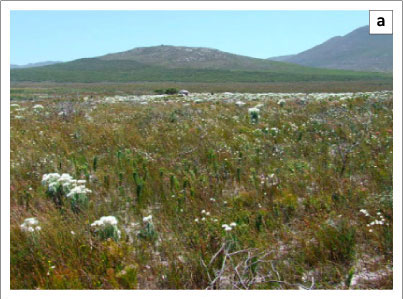
We surveyed an area within Table Mountain National Park, between October and December 2010. The site selected (34.14340 S, 18.24177 E) was located at Olifantsbosch in the Cape of Good Hope Nature Reserve portion of the Table Mountain National Park. The annual rainfall is about 650 mm, with maximum and minimum temperatures of 24 °C and 9 °C, respectively. The landscape (60 m to 80 m above sea level) is flat to moderately sloping (Figure 1a) on light-grey quartzite Table Mountain Sandstone. This site was selected based on the availability of its climatic, edaphic and botanical information, and because BSC formation was recently reported as absent.16
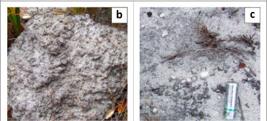
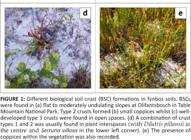
Four types of BSCs were used in this study from the classification given in Dougill and Thomas23242526
Results
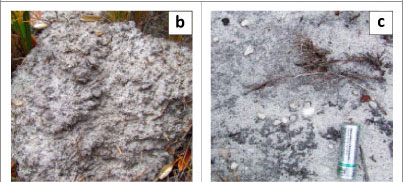
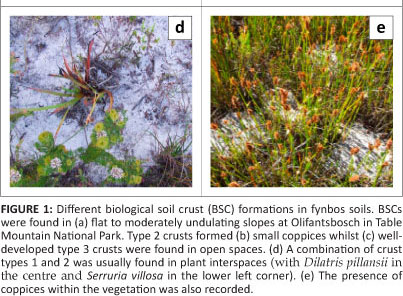
BSCs covered between 5% and 80% of the surface (when considering 1 m x 1 m quadrats). BSCs varied from a weakly consolidated crust with no obvious surface colouration to a dark well-consolidated surface with microtopography (Figure 1c and 1d), with crust types 1 and 2 as the most dominant types. Well-established BSCs were common and could be removed in large pieces with algal filaments visible within the sheath. The sheath is thought to be mostly composed of carbohydrates.14Figure 1b and 1e). These small coppices have, to our knowledge, never been described before. A widespread presence of lichens on rocks was also observed in the reserve. Algal patches (greening of the surface) were observed on the soil surface at several sites after summer rainfall showers or periods of increased humidity. Based on light microscopy, BSCs from the observed sites were mainly dominated by cyanobacteria and algae, but the identification of species was not possible at this magnification.
Soil texture was predominantly characterised by medium sand, with a pH ranging from 4.5 to 5.5. Plant cover ranged between 5% and 100% of the surface. The vegetation forms part of the Peninsula Sandstone Fynbos, dominated by a wide range of genera of Asteraceae, Ericaceae, Fabaceae, Proteaceae and Restionaceae. BSCs were commonly found under the protection of small shrubs such as Metalasia and were present despite the high cover of fynbos vegetation such as Elegia cuspidata.
Discussion
Soil microbial diversity and relative abundance are generally characterised after isolation of DNA followed by an analysis of the 16S rDNA sequence by amplification through polymerase chain reactions22
Among soil properties, soil pH is important for the establishment and diversity of microorganisms.27162812983031
The reported absence of BSCs in the fynbos could also be related to a combination of several biotic and abiotic factors that affect the development of BSCs. BSCs can be present under all conditions of soil moisture and their cover is generally not reduced during droughts, as microorganisms can remain dormant throughout long drought periods.3 3
We conclude that the previously reported16
Competing interests
We declare that we have no financial or personal relationships which may have inappropriately influenced us in writing this article.
Authors' contributions
D.M.M. was responsible for the experimental and project design. D.M.M. and C.H. wrote the manuscript.
Acknowledgements
We thank SANParks Conservation Board for allowing access to the sites and Suzaan Kritzinger-Klopper for helping in the identification of plant species.
References
- 1. Belnap J, Büdel B, Lange OL. Biological soil crusts: Characteristics and distribution. In: Belnap J, Lange OL, editors. Biological soil crusts: Structure, function, and management. Berlin: Springer-Verlag, 2003; p. 3-30.
- 2. Ullmann I, Büdel B. Biological soil crusts of Africa. In: Belnap J, Lange OL, editors. Biological soil crusts: Structure, function, and management. Berlin: Springer-Verlag, 2003; p. 107-118.
-
3. Belnap J. The world at your feet: Desert biological soil crusts. Front Ecol Environ. 2003;1/4:181-189. http://dx.doi.org/10.1890/1540-9295(2003)001[0181:TWAYFD]2.0.CO;2
» http://dx.doi.org/10.1890/1540-9295(2003)001[0181:TWAYFD]2.0.CO;2 -
4. Mazor G, Kidron GJ, Vonshak A, Abeliovich A. The role of cyanobacterial exopolysaccharides in structuring desert microbial crusts. FEMS Microbiol Ecol. 1996;21:121-130. http://dx.doi.org/10.1111/j.1574-6941.1996.tb00339.x
» http://dx.doi.org/10.1111/j.1574-6941.1996.tb00339.x - 5. Zaady E, Kuhn U, Wilske B, Sandoval-Soto L, Kesselmeier J. Patterns of exchange in biological soil crusts of successional age. Soil Bio Biochem. 2000;32:959-966.
- 6. Belnap J, Gardner JS. Soil microstructure in soil of the Colorado Plateau: The role of the cyanobacterium Microcoleus vaginatus. Great Basin Nat. 1993;53(1):40-47.
- 7. Hu C, Zhang D, Huang Z, Liu Y. The vertical microdistribution of cyanobacteria and green algae within desert crusts and the development of the algal crusts. Plant Soil. 2003;257:97-111.
-
8. Thompson DB, Walker LR, Landau FH, Stark LR. The influence of elevation, shrub species, and biological soil crust on fertile islands in the Mojave Desert, USA. J Arid Environ. 2005;61:609-629. http://dx.doi.org/10.1016/j.jaridenv.2004.09.013
» http://dx.doi.org/10.1016/j.jaridenv.2004.09.013 - 9. Heckman KA, Anderson WB, Wait DA. Distribution and activity of hypolithic soil crusts in a hyperarid desert (Baja California, Mexico). Biol Fert Soils. 2006;43(2):263-266.
- 10. Vincent WF. Cyanobacterial dominance in the Polar Regions. In: Whitton BA, Potts M, editors. The ecology of cyanobacteria: Their diversity in time and space. Dordrecht: Kluwer Academic Publishers, 2000; p. 321-340.
- 11. San José JJ, Bravo CR. exchange in soil algal crusts occurring in the Trachypogon savannas of the Orinoco Llanos, Venezuela. Plant Soil. 1991;135:233-244.
- 12. Büdel B. Biological soil crusts of South America. In: Belnap J, Lange OL, editors. Biological soil crusts: Structure, function, and management. Berlin: Springer-Verlag, 2003; p. 51-55.
- 13. Türk R, Gartner G. Biological soil crusts of the Subalpine, Alpine, and Nival Areas in the Alps. In: Belnap J, Lange OL, editors. Biological soil crusts: Structure, function, and management. Berlin: Springer-Verlag, 2003; p. 67-74.
-
14. Mager DM, Thomas AD. Extracellular polysaccharides from cyanobacterial soil crusts: A review of their role in dryland soil processes. J Arid Environ. 2011;75:91-97. http://dx.doi.org/10.1016/j.jaridenv.2010.10.001
» http://dx.doi.org/10.1016/j.jaridenv.2010.10.001 - 15. Chenu C, Stotzky G. Interactions between microorganisms and soil particles: An overview. In: Huang PM, Bollag J-M, Senesi N, editors. Interactions between soil particles and microorganisms: Impact on the terrestrial ecosystem. Chichester: John Wiley & Sons, 2002; p. 3-40.
- 16. Büdel B, Darienko T, Deutschwitz K, et al. Southern African biological soil crusts are ubiquitous and highly diverse in drylands, being restricted by rainfall frequency. Microb Ecol. 2009;57:229-247.
-
17. Lalley JS, Viles HA. Recovery of lichen-dominated soil crusts in a hyper-arid desert. Biodivers Conserv. 2008;17:1-20. http://dx.doi.org/10.1007/s10531-007-9153-y
» http://dx.doi.org/10.1007/s10531-007-9153-y - 18. Shushu DD. Blue-green algae as indicators of changes in soil conditions in semi-arid Botswana. In: Ringrose S, Chanda R, editors. Towards sustainable management in the Kalahari Region - Some essential background and critical issues. Gaborone: Directorate of Research and Development, University of Botswana, 2000; p. 120-124.
-
19. Myers N, Mittermeier RA, Mittermeier CG, da Fonseca GAB, Kents J. Biodiversity hotspots for conservation priorities. Nature. 2000;403:853-858. http://dx.doi.org/10.1038/35002501
» http://dx.doi.org/10.1038/35002501 - 20. Richards MB, Cowling RM, Stock WD. Soil factors and competition as determinants of the distribution of six fynbos Proteaceae. Oikos. 1997;79(2):394-406.
-
21. Richards MB, Stock WD, Cowling RM. Soil nutrient dynamics and community boundaries in the fynbos vegetation of South Africa. Plant Ecol. 1997;130:143-153. http://dx.doi.org/10.1023/A:1009742225383
» http://dx.doi.org/10.1023/A:1009742225383 -
22. Slabbert E, Kongor RY, Esler KJ, Jacobs K. Microbial diversity and community structure in fynbos soil. Mol Ecol. 2010;19:1031-1041. http://dx.doi.org/10.1111/j.1365-294X.2009.04517.x
» http://dx.doi.org/10.1111/j.1365-294X.2009.04517.x - 23. Dougill AJ, Thomas AD. Kalahari sand soils: Spatial heterogeneity, biological soil crusts and land degradation. Land Degrad Dev. 2004;15:233-242.
- 24. Mager DM. Carbohydrates in cyanobacterial soil crusts as a source of carbon in the southwest Kalahari, Botswana. Soil Bio Biochem. 2010;42:313-318.
- 25. Anderson JM, Ingram JSI. Tropical soil biology and fertility. A handbook of methods. 2nd ed. Oxon, UK: Commonwealth Agricultural Bureau; 1993.
- 26. Alef K, Nannipieri P. Methods in applied soil microbiology and biochemistry. London: Academic Press; 1995.
- 27. Dominic TK, Madhusoodhanan PV. Cyanobacteria from extreme acidic environments. Curr Sci India. 1999;77:1021-1023.
- 28. Herrero A, Flores E. The cyanobacteria: Molecular biology, genetics and evolution. Norfolk, UK: Caister Academic Press; 2008.
- 29. Rivera-Aguilar V, Godínez-Alvarez H, Moreno-Torres R, Rodríguez-Zaragoza S. Soil physico-chemical properties affecting the distribution of biological soil crusts along an environmental transect at Zapotitlán drylands, Mexico. J Arid Environ. 2009;73:1023-1028.
- 30. Whitton BA, Potts M. The ecology of cyanobacteria: Their diversity in time and space. 1st ed. Dordrecht: Kluwer Academic Publishers; 2000.
- 31. Sánchez-Baracaldo P, Hayes PK, Blank CE. Morphological and habitat evolution in the cyanobacteria using a compartmentalization approach. Geobiology. 2005;3:145-165.
 Correspondence to:
Denise Mager
Private Bag X1,
Matieland 7602, South Africa
Email:
Accepted: 27 Mar. 2012
Published: 12 July 2012