Prevalence of asymptomatic intestinal coccidian parasite infections among non-diarrhoeic HIV-positive children in Zaria, Nigeria
Abstract
Opportunistic coccidian parasites, amongst other infections, frequently complicate human immunodeficiency virus (HIV) infection by causing chronic diarrhoea. The magnitude of these parasitic infections in HIV-positive patients requires careful attention in developing countries. There have been inadequate studies addressing this problem in Nigeria. The investigation reported here was conducted at Ahmadu Bello University Teaching Hospital, Zaria, Nigeria, with the objective of determining the prevalence of these parasitic infections among HIV-positive children. Eighty-eight stool samples were collected during the wet humid months of July and August 2006 from 60 non-diarrhoeic, HIV-positive and 28 HIV-negative children less than 10 years old. The samples were examined for intestinal coccidian parasites by microscopy and modified Kinyoun's acid fast staining methods. Coccidian parasites, Cyclospora cayetanensis, Cryptosporidium parvum and Isospora belli, were identified in 51% (45/88) of all the stool samples examined. The parasite oocysts were identified in 68% (41/60) of the HIV-positive patients presenting at the hospital and in 14% (4/28) of the controls (P < 0.01). The HIV patients were found to be thirteen times more likely to have been infected with coccidian parasites than the control children (odds ratio = 13.0, 95% CI = 3.9-42.6). Cyclospora cayetanensis was the most prevalent parasite identified in the study (36%). Dual infections caused by C. cayetanensis and C. parvum were found in 17% of HIV-positive patients. Female children were found to have more (53%: 25/47) coccidian oocysts in their stools than the boys (49%: 20/41) (P > 0.05). We found an increase in parasite prevalence with age of the patient. This study indicates that coccidian parasites may be important opportunistic infection agents in non-diarrhoeic HIV-infected children. The prevalence of these parasites and their potential for compounding the health problems of HIV-infected patients suggest that the diagnosis and treatment of coccidian parasites should be a part of routine HIV care.
Introduction
The World Health Organization reported in 1998 that 33% of global deaths are a consequence of infectious and parasitic diseases, whereas the effect of mortality and morbidity are as a result of some parasitic infections.1 2 Giardia lamblia, Entamoeba histolytica and Balantidium coli and, lately, coccidian parasites like Isospora belli, Cryptosporidium parvum, Microsporidia and Cyclospora cayetanensis.3–5
Coccidian parasites are protozoans belonging to the phylum Apicomplexa6 7,8 Today, these opportunistic parasites cause chronic diarrhoea in humans, especially in those who are immunocompromized.4,5,8,9 The parasites are transmitted to humans through contaminated drinking and recreational water, food, and contact with infected animals and persons.8
Cryptosporidium, Cyclospora and Isospora have been shown to complicate HIV infection by causing chronic diarrhoea. This facilitates progression to AIDS.9–14 Diarrhoea occurs in up to 80% of persons with HIV infection.15 16 17 17
Materials and methods
See Appendix.
Results
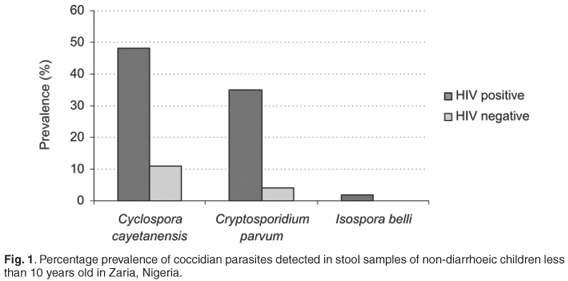
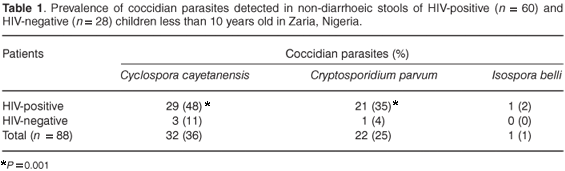
Coccidian parasite oocysts were recorded in 45 (51%) of the 88 non-diarrhoeic stool samples analysed in total. Oocysts were recorded in 68% (41/60) of the HIV-positive children and in 14% (4/28) of the control children. The parasites were significantly associated with HIV-positive children (P < 0.01). The HIV patients were thirteen times more likely to have been infected with coccidian parasites than the controls (odds ratio = 13.0, 95% CI = 3.9–42.6). Cyclospora cayetanensis was the most prevalent parasite found in the study (36%: 32/88), followed by Cryptosporidium parvum (25%: 22/88) (Fig. 1). Cyclospora cayetanensis and C. parvum were found to be significantly associated with HIV infection (P < 0.01), with C. cayetanensis occurring with the highest frequency (48%: 29/60). Isospora belli was detected in only one HIV-positive child (Table 1). Cyclospora cayetanensis and C. parvum were detected in three and one HIV-negative stools, respectively. Dual infections comprising C. cayetanensis and C. parvum occurred in only 17% (10/60) of HIV-positive patients.
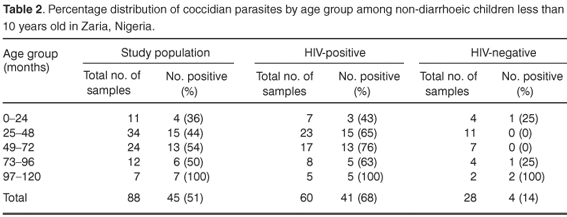
Girls were found to have more (53%: 25/47) coccidian oocysts in their stools than the boys (49%: 20/41); this was not statistically significant (P > 0.05). The age of the children ranged from six to 108 months. There was an increase in parasite load with patient age; with the highest prevalence in children in the age group 97–120 months (100%: 7/7) (Table 2). Children of less than 24 months had fewer stool oocysts, with none found in children of less than 12 months. The only Isospora belli oocyst detected was in the stool of an 84-month-old child. No significant association between patient age and the detection of parasitic agents was found (P > 0.05).
Discussion
This study shows that coccidian parasites are common in children in Zaria in view of their rate of detection (51%) in non-diarrhoeic stools. This prevalence is higher than previously reported in a similar study164,9,11,17,19 The parasite oocysts were found in 68% of the HIV-positive and in 14% of the control children. This indicates a correlation between coccidian pathogens and HIV infection and implies that infections by these parasites increase during HIV infection as has already been suggested by others.5,11 Detection in both patients and controls could be a reflection of poor environmental and personal hygiene practices that facilitate the parasites' mode of transmission.
Our study also shows C. cayetanensis to be the most prevalent pathogenic coccidian parasite found (36%). This is in contrast to a previous report from Nigeria4 Cryptosporidium was identified as the most prevalent protozoan pathogen. In agreement with other reports,4,11,12 C. cayetanensis and C. parvum were found to be significantly associated with HIV infection, implying that HIV predisposes patients to these parasitic infections. The oocysts of coccidian parasites have been found more commonly in the stools of older children, with all children within the age group 97–120 months being infected. We attribute this to the more active nature of older children, and the consequences of increased risk of infective contact with contaminated food and water.
Combined coccidian parasitic infection comprising C. cayetanensis and C. parvum is shown to be common in HIV patients and absent in the control group. Another Nigerian study4 Cyclospora or Cryptosporidium and Isospora belli was not detected in this study, in contrast to previous reports.4,19
The result of this and other studies4,17 shows a steady increase in the reported incidence of Cryptosporidium and Cyclospora infections in Nigeria. This may have arisen from greater awareness of these pathogens among clinicians and laboratory scientists. Another reason could be the HIV/AIDS pandemic, which is claimed to increase coccidian parasite infection.11
In summary, our results make an important contribution to the detection and identification of coccidian parasites in non-diarrhoeic stool samples of HIV-positive children in Zaria, Nigeria. Our study also shows that Cyclospora cayetanensis is the most prevalent intestinal coccidian parasite in these patients. We have identified a need to collect more information on asymptomatic infections with these emerging pathogens and their relation to HIV/AIDS, and will continue investigations.
Our recommendations are that health practitioners should receive more intensive education on emerging diarrhoeal pathogens and the importance of targeting these common infections while treating HIV-positive patients for opportunistic infections. Asymptomatic infection with these parasites requires only time before symptomatic conditions develop, leading to chronic diarrhoea that may facilitate HIV infection and progression to clinical AIDS. Routine examination of stool samples for coccidian parasites will also benefit HIV-infected individuals significantly through reduction of morbidity and improving quality of life. The need for intervention measures at community level, with the purpose of reducing risk factors of acquiring coccidian diarrhoeal diseases, is emphasised through screening for the presence of parasites in both patients and controls.
We thank W.N. Ogalla, O. Ogunrinde, L.W. Umar, and the nurses at the Pediatric HIV Clinic of ABUTH for involving their patients in this study.
References
- 1. World Health Organization (1998). The state of world health. In The World Health Reports 1998. Life in the 21st century: a vision for all, pp. 57–58. WHO, Geneva.
- 2. Ochoa C.I. and Martinez A.R. (2001). Uniform staining of coccidian oocysts by modified acid fast staining techniques. J. Clin. Microbiol. 35, 730–733.
- 3. Wilson M.L. (1999). Emerging infections: the once and future diseases. Am. J. Clin. Pathol. 112, 595–596.
- 4. Alakpa G.E and Fagbenro-Beyioku A.F. (2002). Cyclospora cayetanensis and intestinal parasitic profile in stool samples in Lagos, Nigeria. Acta Protozool. 41, 221–227.
- 5. Wiwanitkit V. (2006). Intestinal parasitic infection in HIV infected patients. Curr. HIV Rev. 4, 87–96.
- 6. Visvesvara G.S., Moura H., Kovacs E.N. and Wallace S. (1997). Staining and identification of coccidian parasites in persons with HIV infection. Am. J. Trop. Med. Hyg. 63, 231–235.
- 7. Marshall M.M., Naumavitz D., Ortega Y. and Sterling C.R. (1997). Waterborne protozoan pathogens. Clin. Microbiol. Rev. 10, 67–85.
- 8. Norman J.P., Fernando J.B., Susan B.S. and Alexandre J.D. (2006). Prevalence of intestinal parasites in HIV infected patients. Emerg. Inf. Dis. 23, 4–5.
- 9. Kumar S.S, Ananthan S. and Saravanan P. (2002). Role of coccidian parasites in causation of diarrhea in HIV infected patients in Chennai. Indian J. Med. Res. 116, 85–89.
- 10. Mansfield L.S and Gajadhar A.A. (2004). Cyclospora cayetanensis, a food and water borne coccidian parasite. Vet. Parasitol. 126, 73–90.
- 11. Pinlaor S., Mootsikapum P., Pinlaor P., Pipitgool V. and Tuangnadee R. (2005). Detection of opportunistic and non-opportunistic intestinal parasites and liver flukes in HIV-positive and HIV-negative subjects. Southeast Asian J. Trop. Med. Publ. Hlth 36, 841–845.
- 12. Hunter G., Bagshawe A.F., Baboo K.S., Luke R. and Prociv P. (1992). Intestinal parasites in Zambian patients with AIDS. Trans R. Soc. Trop. Med. Hyg. 86, 543–545.
- 13. Chintu C., Luo C., Baboo S., Khumalo-Ngwenya B., Mathewson J., DuPont H.L. and Zumla A. (1995). Intestinal parasites in HIV-seropositive Zambian children with diarrhoea. J. Trop. Pediatr. 41, 149–152.
- 14. Tarimo D.S., Killewo J.Z., Minjas J.N. and Msamanga G.I. (1996). Prevalence of intestinal parasites in adults patients with enteropathic AIDS in northeastern Tanzania. E. Afr. Med. J. 73, 397–399.
- 15. Bowers M. (1997). Diarrhea. Bull. Expt. Treat. AIDS 6, 1–14.
- 16. Houpt E.R, Bushen O.Y, Sam N.E. and Kohli A. (2005). Asymptomatic cryptosporidiosis infections among HIV infected patients in Tanzania. Afr. Med. J. 31, 520–522.
- 17. Nwokediokwo S.C and Ozumba U.C. (2005). Intestinal helminthes in relationship to chronic diarrhea in HIV seropositive adults in Enugu. Nig. Post Grad. Med. J. 9, 88–91.
- 18. World Health Organization (1991). Basic Laboratory Methods in Medical Parasitology. Geneva.
- 19. Certad G., Arenas-Pinto A., Pocaterra L., Ferrara G., Castro J., Bello A. and Nunez L. (2005). Cryptosporidiosis in HIV-infected Venezuelan adults is strongly associated with acute or chronic diarrhea. Am. J. Trop. Med. Hyg. 73, 54–57.
- 20. Cheesbrough M. (2005). Parasitological tests. In District Laboratory Practice in Tropical Countries, Pt 1, 2nd edn, pp. 178–309. Cambridge University Press, Cambridge.
Material and methods
The Ethical and Research Committee of the Ahmadu Bello University Teaching Hospital, Zaria, Nigeria, approved the study. Sixty asymptomatic HIV-positive children receiving antiretroviral (ARV) drugs at the hospital's Pediatric HIV Clinic were selected as study participants, while controls were 28 HIV-negative children attending the same hospital. The children were aged <10 years and comprised 41 males and 47 females. Stool samples were collected according to WHO standard procedure.18
Stool samples were first concentrated by the formalin-ether sedimentation method.20 6 Cryptosporidium parvum (4–6 µm in diameter) is round in shape and contains 4 sporozoites within a thick-walled oocyst; Cyclospora cayetanensis (8–10 µm in diameter) is round to oval in shape, whereas Isospora belli (25–30 µm in diameter) is oval in shape. Coccidian species stained pinkish-red against a uniform green background. Oocysts stained red and were easily recognized against a green background of yeast and faecal debris.
Data were analysed with the SPSS 11.0 version statistical package. Differences with P-values >0.05 were considered insignificant at 95% confidence intervals (CI).