The impact of solar ultraviolet radiation on human health in sub-Saharan Africa
Abstract
Photoprotection messages and 'SunSmart' programmes exist mainly to prevent skin cancers and, more recently, to encourage adequate personal sun exposure to elicit a vitamin D response for healthy bone and immune systems. Several developed countries maintain intensive research networks and monitor solar UV radiation to support awareness campaigns and intervention development. The situation is different in sub-Saharan Africa. Adequate empirical evidence of the impact of solar UV radiation on human health, even for melanomas and cataracts, is lacking, and is overshadowed by other factors such as communicable diseases, especially HIV, AIDS and tuberculosis. In addition, the established photoprotection messages used in developed countries have been adopted and implemented in a limited number of sub-Saharan countries but with minimal understanding of local conditions and behaviours. In this review, we consider the current evidence for sun-related effects on human health in sub-Saharan Africa, summarise published research and identify key issues. Data on the prevalence of human diseases affected by solar UV radiation in all subpopulations are not generally available, financial support is insufficient and the infrastructure to address these and other related topics is inadequate. Despite these limitations, considerable progress may be made regarding the management of solar UV radiation related health outcomes in sub-Saharan Africa, provided researchers collaborate and resources are allocated appropriately.
Introduction
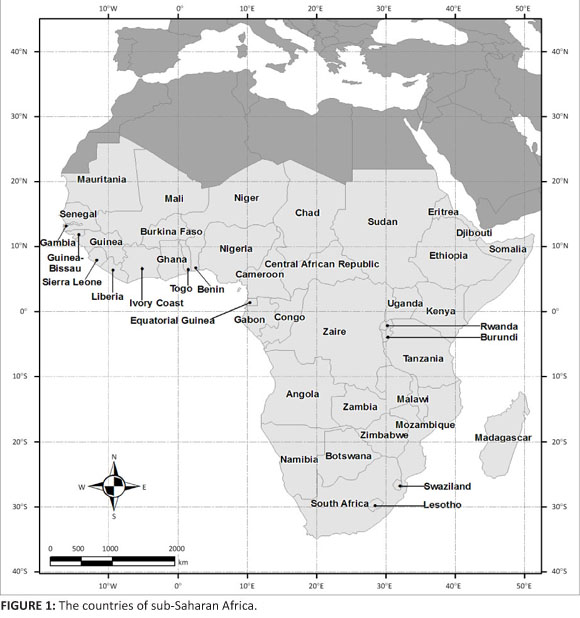
Sub-Saharan Africa consists of 43 countries south of the Sahara (Figure 1). This area spans latitudes 13°N to 33°S with an average annual daytime temperature of 21 °C. The UV Index is often higher than 10 (extreme) and rarely drops below 7, except at high altitudes and towards the tip of South Africa in the winter months (June, July and August). The land varies from equatorial rainforest to dry woodland, savannah, grassland and mountain grassland.
The major beneficial outcome of solar ultraviolet radiation (UVR) exposure on human health lies in the endogenous production of vitamin D, while adverse outcomes of excess exposure include skin cancers and eye diseases.1
Search strategy
A systematic approach was used to identify key published resources of substance and appropriate scientific merit. Databases searched were African Journals Online, SABINET, Academic Search Premier, Pubmed, SciELO, Medline, JSTOR, Web of Science and Scopus. Keywords entered were "solar UV radiation" AND health AND [country]; "sun exposure" AND health AND [country]; sunburn AND [country]; "skin cancer" AND [country]; albinism AND "sun exposure" AND [country]; [range of sun-related eye diseases] AND "sun exposure" AND [country]; "sun protection" AND [country]; "sun behaviour" AND [country]; and "sunsmart awareness programme" AND [country]. Reference lists of collected articles including reports of the World Health Organization (WHO) were examined. Using the same keywords, Google was searched for grey literature, a particularly important source in the African context. The websites of national departments of health and cancer associations were investigated for information on 'SunSmart' programmes and sun-related health statistics.
Results
Skin cancers
Sun exposure is the major environmental risk factor for melanoma and for the non-melanoma skin cancers (NMSCs), basal cell carcinoma (BCC) and squamous cell carcinoma (SCC). The lifetime risk of these tumours is low in those with black skin and highest in those with fair skin, estimated at a difference of up to 60-fold. There are other major differences depending on skin colour.2
The occurrence of NMSCs in sub-Saharan Africa is rarely monitored. However, the UVR-attributable disease burden caused by SCCs and BCCs for some of the countries in this region was calculated for the year 2000 using three levels of skin pigmentation, models for global assessment and country-specific population-weighted average daily ambient UVR.3,4 Using actual results, the annual incidence of SCC in Black individuals was estimated as 1 in 100 000 in a township near Soweto, Johannesburg in 1966-1975,567
For melanoma, which accounts for more than 80% of skin cancer deaths, there are also few figures available regarding incidence and prevalence for sub-Saharan Africa, although, as for the NMSCs, the UV-attributable disease burden from this tumour was calculated as approximately 5100 deaths for the year 2000 in this area of the world.489
Accurate figures on the prevalence of skin cancers in all subpopulations in sub-Saharan Africa are required, especially to record any changes in incidence. Such data are needed to inform the public regarding photoprotection and to improve clinical awareness.
Melasma
Melasma is an uneven hyperpigmentation which appears as dark, macular, pigmented patches on the face.101112
Few statistics are available for sub-Saharan Africa regarding the prevalence of other skin disorders induced by either acute sun exposure, such as sunburn, or by chronic sun exposure, such as photoageing and actinic keratoses, the latter recognised as premalignant lesions.
Oculocutaneous albinism
Oculocutaneous albinism (OCA) is a genetically inherited, autosomal recessive condition characterised by hypopigmentation of the skin, hair and eyes as a result of a lack of, or reduced, melanin. There are many people living with OCA in sub-Saharan Africa; estimates indicate a prevalence of 1 in 4728 in Zimbabwe, 1 in 3900 in South Africa and as high as 1 in 1000 in the Tonga tribe in Zimbabwe.13,14 Individuals with OCA are at increased risk from the adverse effects of sun exposure, such as extreme sun sensitivity and photophobia. SCCs of the neck and head are the most common cutaneous tumours seen in African patients with OCA,1514
Ophthalmohelioses
There is a range of eye diseases associated with sunlight exposure - ophthalmohelioses. These diseases include photoconjunctivitis, photokeratitis and activation of ocular herpes simplex virus following acute exposure to solar UVR, and NMSCs of the lid and conjunctiva, ocular melanoma, pinguecula (local degeneration of conjunctiva), pterygium (inflammation, proliferation and invasive growth on conjunctiva and cornea), climatic droplet keratopathy (epithelial degeneration), age-related cataracts and possibly age-related macular degeneration following chronic exposure to solar UVR.
Few data are available for sub-Saharan Africa that estimate the scale of health problems caused by these ophthalmohelioses, although it is recognised that this area has the highest regional burden of blindness at 20% of the world's blindness and only 11% of the world's population.161718192021
Figures for the incidence and prevalence of corneal and other external eye diseases in sub-Saharan Africa are not generally available for recent years, although such disorders are recognised to be very common. For example, corneal diseases, the majority being pterygium and climatic droplet keratopathy, were found in more than 20% of a mixed race community in the north-western Cape (South Africa),222324
Concern has been expressed recently that sub-Saharan Africa is not on track to achieve the main goal of 'VISION 2020: The Right to Sight' - to eliminate avoidable blindness by 2020.252526
Immunosuppression and effects on diseases
UV-induced downregulation of immunity to a variety of antigens has been demonstrated in humans. The pathways involved are complex,272829303132
From many studies covering a variety of approaches, it can be concluded that UVR and/or vitamin D have the potential to protect against some inflammatory diseases and autoimmune diseases, such as multiple sclerosis, while decreasing the immune surveillance against skin tumours and infectious diseases. Each of these categories is discussed briefly below.
In the context of diseases in sub-Saharan Africa, the lightsensitive dermatoses (e.g. polymorphic light eruption where there is a lack of immunosuppression following sun exposure with development of an allergic response) do not constitute a major health problem as they are much less common in people with pigmented skin and occur rarely in regions near the equator.3334
UVR not only causes mutations but also downregulates immunity, an effect which is recognised to be critical in the development of skin tumours. For the same dose of UVR, fair-skinned people exhibit more DNA damage,3536
It is unclear whether UV-induced immunosuppression can affect the course of human infectious diseases, apart from triggering the reactivation from latency of herpes simplex virus. Some human infections exhibit a strong seasonal incidence. For example, influenza is highly seasonal in southern Africa with the peak incidence occurring in the drier cooler winter months: the seasonality becomes less pronounced with closeness to the equator.3738313940
Vaccination represents a major public health strategy in sub-Saharan Africa in attempts to control common infections, particularly in childhood. The potential of UVR to decrease the efficacy of vaccination by downregulating immunity has not been rigorously assessed for human vaccines although there are reports indicating that a less effective immune response is induced if the vaccine is administered in the summer compared with the winter, and in tropical compared with temperate regions.4142
Sun-related exposure, protection, perceptions and awareness
The people of sub-Saharan Africa are genetically diverse: migrants from other countries have settled here since the Greeks, Romans and Arabs 3000 years ago, Europeans since the 1600s and Asians since the 1800s. If this heterogeneity is added to the range of environments and social conditions in sub-Saharan Africa, it can be anticipated that solar UVR will not have straightforward health outcomes. In addition, the only country to possess solar UV monitoring instruments in this region is South Africa, where a four-station network has been in operation since the early 1990s. The network aims to provide measured data to the media daily to inform the public regarding times of intense solar irradiation.
Personal sun exposure studies in sub-Saharan Africa are nonexistent, inaccessible or sparsely documented. One of the few studies, based in Durban (South Africa), emphasised the risk of sunburn and NMSC for children and outdoor workers.43
Knowledge about sun protection is not widespread in sub-Saharan Africa. Sunscreen use and environmental awareness were investigated in White Cape Town beachgoers; the results showed that only 50% wore sunscreen, although 90% of respondents cited skin cancer as a potential adverse effect of excess sun exposure and a few acknowledged other health effects.4445
Sun protection is of special importance for individuals with OCA to prevent skin damage and thus lessen the risk of skin cancer. Most OCA cases present late in the tumour process and patients do not complete treatment because of a lack of funds or for cultural reasons. Education regarding protective clothing, sunscreens, indoor occupations and early treatment of skin lesions would be beneficial. An investigation in Tanzania of albinos' understanding of skin cancer risk and attitudes toward sun protection showed that 78% of respondents believed skin cancer was preventable, 63% knew that skin cancer was related to the sun and 77% thought sunscreens afforded sun protection.4647
Few sub-Saharan countries have active, sun-related awareness and disease prevention campaigns although some work has been carried out to improve primary health care for the management of cataracts and skin cancer. The non-governmental African Organisation for Research and Training in Cancer promotes cancer control and palliative care, and several sub-Saharan countries have cancer societies. The Cancer Association of South Africa is one of the few with a SunSmart programme. As outlined above, there are currently insufficient data to assess the extent of sun-related health effects and the relevance of any interventions in sub-Saharan Africa.
Challenges and opportunities
Several challenges will need to be overcome and opportunities created to improve the understanding of the health impacts of solar UVR and to implement interventions locally for a sustained improvement in public health. The WHO INTERSUN programme is one possible mechanism. For this programme to be effective in sub-Saharan Africa, fundamental research is needed on local disease prevalence and incidence, exposure patterns (occupational, early life and recreational) and sun awareness, especially the lack thereof but also how awareness is affected by cultural beliefs and practices. The capacity to initiate and manage public health information to support such research is required. For example, a National Cancer Registry has only recently been re-instated in South Africa. There are additional unknowns such as any consequence of climate change in sub-Saharan Africa. Ground-based monitoring of ambient solar UVR is limited, mainly because of financial and personnel restrictions. Little research has been done on potential interactions of solar UVR with local diseases, such as HIV, AIDS, malaria and tuberculosis, and with vaccine responses. Research is also needed on personal solar UVR exposure and sun protection studies on at-risk subpopulations should be conducted. The potential of solar UVR to decrease the efficacy of vaccination by immunosuppression also merits investigation.
Sun education needs to be tailored for sub-Saharan Africa and its multi-ethnic subpopulations. Sun protection and health intervention programmes targeted at children with OCA have proved relatively successful48
Competing interests
We declare that we have no financial or personal relationships which may have inappropriately influenced us in writing this paper.
Authors' contributions
C.W. was the project leader, conceptualised the article content and compiled the sun protection and albinism sections. M.N. compiled the immune system section, B.S. compiled the melasma section, L.D. compiled the skin cancer section and M.O.O. compiled the ophthalmohelioses section. C.W., M.N., B.S., L.D. and M.O.O. wrote the manuscript. G.C. gave input to the challenges and opportunities section.
Acknowledgements
The preparation of this manuscript was funded, in part, by a CSIR Parliamentary Grant to C.W. and a South African Medical Research Council Career Award to L.D.
References
-
1. Norval M, Lucas RM, Cullen AP, et al. The human health effects of ozone depletion and interactions with climate change. Photochem Photobiol Sci. 2011;10:199-225. http://dx.doi.org/10.1039/c0pp90044c
» http://dx.doi.org/10.1039/c0pp90044c -
2. Gloster HM, Neal K. Skin cancer in skin of colour. J Am Acad Dermatol. 2006;55:741-760. http://dx.doi.org/10.1016/j.jaad.2005.08.063
» http://dx.doi.org/10.1016/j.jaad.2005.08.063 - 3. Lucas RM. Solar ultraviolet radiation. Assessing the environmental burden of disease at national and local levels. Environmental Burden of Disease Series number 13. Geneva: World Health Organization; 2006.
- 4. Lucas RM. Solar ultraviolet radiation. Assessing the environmental burden of disease at national and local levels. Environmental Burden of Disease Series number 17. Geneva: World Health Organization; 2010.
-
5. Isaacson C. Cancer of the skin in urban blacks of South Africa. Br J Dermatol. 1979;100:347-350. http://dx.doi.org/10.1111/j.1365-2133.1979.tb06210.x
» http://dx.doi.org/10.1111/j.1365-2133.1979.tb06210.x -
6. Mohammed AZ, Edino ST, Ochicha O, Gwarzo AK, Samila AA. Cancer in Nigeria: A 10-year analysis of the Kano registry. Niger J Med. 2008;17:280-284. http://dx.doi.org/10.4314/njm.v17i3.37396
» http://dx.doi.org/10.4314/njm.v17i3.37396 -
7. Nthumba PM, Cavadas PC, Landin L. Primary cutaneous malignancies in sub-Saharan Africa. Ann Plast Surg. 2011;66:313-320. http://dx.doi.org/10.1097/SAP.0b013e3181e7db9a
» http://dx.doi.org/10.1097/SAP.0b013e3181e7db9a - 8. Mqoqi N, Kellet P, Sitas F, Jula M. Incidence of histologically diagnosed cancer in South Africa, 1998-1999. Johannesburg: National Cancer Registry of South Africa, National Health Laboratory Service; 2004.
- 9. Davids LM, Kleemann B. Combating melanoma: The use of photodynamic therapy as a novel, adjuvant therapeutic tool. Cancer Treat Rev. 2011;37(6):465-475.
-
10. Victor FC, Gerlber J, Rao B. Melasma: A review. J Cutan Med Surg. 2004;8:97-102. http://dx.doi.org/10.1007/s10227-004-0158-9
» http://dx.doi.org/10.1007/s10227-004-0158-9 - 11. Guinot C, Cheffai S, Latreille J, et al. Aggravating factors for melasma: A prospective study in 197 Tunisian patients. J Eur Acad Dermatol Venereol. 2010;24:1060-1069.
-
12. Jobanputra R, Bachmann M. The effect of skin diseases on quality of life in patients from different social and ethnic groups in Cape Town, South Africa. Int J Dermatol. 2000;39:826-831. http://dx.doi.org/10.1046/j.1365-4362.2000.00073.x
» http://dx.doi.org/10.1046/j.1365-4362.2000.00073.x -
13. Hong ES, Zeeb H, Repacholi MH. Albinism in Africa as a public health issue. BMC Public Health. 2006;6:212. http://dx.doi.org/10.1186/1471-2458-6-212
» http://dx.doi.org/10.1186/1471-2458-6-212 - 14. Asuquo ME, Otei OO, Omotoso J, Bassey EE. Letter: Skin cancer in albinos at the University of Calabar teaching Hospital, Calabar, Nigeria. Dermatol Online J. 2010;16:14.
-
15. Yakabu A, Mabogunje OA. Skin cancer in African albinos. Acta Oncologica. 1993;32:621-622. http://dx.doi.org/10.3109/02841869309092440
» http://dx.doi.org/10.3109/02841869309092440 - 16. Resnikoff S, Pascolini D, Etya'ale D, et al. Global data on visual impairment in the year 2002. Bull World Health Org. 2004;82:844-851.
-
17. Lewallen S, Courtright P. Blindness in Africa: Present situation and future needs. Br J Ophthalmol. 2001;85:897-903. http://dx.doi.org/10.1136/bjo.85.8.897
» http://dx.doi.org/10.1136/bjo.85.8.897 - 18. Congdon N, West SK, Buhrmann RR, Kouzis A, Munoz B, Mkocha H. Prevalence of the different types of age-related cataract in an African population. Invest Ophthalmol Vis Sci. 2001;42:2478-2482.
-
19. Entekuma G, Patel J, Sivasubramaniam S, et al. Prevalence, causes, and risk factors for functional low vision in Nigeria: Results from the national survey of blindness and visual impairment. Invest Ophthalmol Vis Sci. 2011;52:6714-6719. http://dx.doi.org/10.1167/iovs.11-7293
» http://dx.doi.org/10.1167/iovs.11-7293 - 20. Cook CD, Stulting AA. Prevalence and incidence of blindness due to age-related cataract in the rural areas of South Africa. S Afr Med J. 1995;85:26-27.
-
21. Bucher PJ, Ijsselmuiden CB. Prevalence and causes of blindness in the Northern Transvaal. Br J Ophthalmol. 1988;72:721-726. http://dx.doi.org/10.1136/bjo.72.10.721
» http://dx.doi.org/10.1136/bjo.72.10.721 - 22. Hill JC. The prevalence of corneal disease in the coloured community of a Karoo town. S Afr Med J. 1985;67:723-727.
- 23. Ashaye AO. Pterygium in Ibadan. West Afr J Med. 1991;10:232-243.
-
24. NwosuSN. OcularproblemsofyoungadultsinruralNigeria.IntOphthalmol. 1998;22:259-263. http://dx.doi.org/10.1023/A:1006338013075
» http://dx.doi.org/10.1023/A:1006338013075 -
25. Lewallen S, Kello AB. The need for management capacity to achieve VISION 2020 in sub-Saharan Africa. PloS Med. 2009;6:e1000184. http://dx.doi.org/10.1371/journal.pmed.1000184
» http://dx.doi.org/10.1371/journal.pmed.1000184 - 26. Lecuona K, Cook C. South Africa's cataract surgery rates: Why are we not meeting our targets? S Afr Med J. 2011;101:510-512.
-
27. Schwarz T, Schwarz A. Molecular mechanisms of ultraviolet radiation-induced immunosuppression. Eur J Cell Biol. 2011;90:560-564. http://dx.doi.org/10.1016/j.ejcb.2010.09.011
» http://dx.doi.org/10.1016/j.ejcb.2010.09.011 -
28. Schwalfenberg GK. A review of the critical role of vitamin D in the functioning of the immune system and the clinical implications of vitamin D deficiency. Mol Nutr Food Res. 2011;55:96-108. http://dx.doi.org/10.1002/mnfr.201000174
» http://dx.doi.org/10.1002/mnfr.201000174 -
29. Prentice A. Vitamin D deficiency: A global perspective. Nutr Rev. 2008;66:s153-164. http://dx.doi.org/10.1111/j.1753-4887.2008.00100.x
» http://dx.doi.org/10.1111/j.1753-4887.2008.00100.x -
30. Feleke Y, Abdulkadir J, Mshana RM, et al. Low levels of serum calcidiol in an African population compared to a North European population. Eur J Endrocrinol. 1999;141:358-360. http://dx.doi.org/10.1530/eje.0.1410358
» http://dx.doi.org/10.1530/eje.0.1410358 - 31. Wejse C, Olesen R, Rabna P, et al. Serum 25-hydroxyvitamin D in a West African population of tuberculosis patients and unmatched healthy controls. Am J Clin Nutr. 2007;86:1376-1383.
-
32. Thacher TD, Fischer PR, Pettifor JM, et al. A comparison of calcium, vitamin D, or both for nutritional rickets in Nigerian children. N Engl J Med. 1999;341:563-568. http://dx.doi.org/10.1056/NEJM199908193410803
» http://dx.doi.org/10.1056/NEJM199908193410803 -
33. Honigsmann H. Polymorphous light eruption. Photodermatol Photoimmunol Photomed. 2008;24;155-161. http://dx.doi.org/10.1111/j.1600-0781.2008.00343.x
» http://dx.doi.org/10.1111/j.1600-0781.2008.00343.x -
34. Dean G, Bhigjee AI, Bill PL, et al. Multiple sclerosis in black South Africans and Zimbabweans. J Neurol Neurosurg Psychiatry. 1994;57:1064-1069. http://dx.doi.org/10.1136/jnnp.57.9.1064
» http://dx.doi.org/10.1136/jnnp.57.9.1064 - 35. Tadokoro T, Kobayashi N, Zmudzka BZ, et al. UV-induced DNA damage and melanin content in human skin differing in racial/ethnic origin. FASEB J. 2003;17:1177-1179.
-
36. Kelly DA, Young AR, McGregor JM, Seed PT, Potten CS, Walker SL. Sensitivity to sunburn is associated with susceptibility to ultraviolet radiation-induced suppression of cutaneous immunity. J Exp Med. 2000;191:561-566. http://dx.doi.org/10.1084/jem.191.3.561
» http://dx.doi.org/10.1084/jem.191.3.561 -
37. Gessner BD, Shindo N, Briand S. Seasonal influenza epidemiology in sub-Saharan Africa: A systematic review. Lancet Infect Dis. 2011;11:223-235. http://dx.doi.org/10.1016/S1473-3099(11)70008-1
» http://dx.doi.org/10.1016/S1473-3099(11)70008-1 -
38. Fares A. Seasonality of tuberculosis. J Glob Infect Dis. 2011;3:46-55. http://dx.doi.org/10.4103/0974-777X.77296
» http://dx.doi.org/10.4103/0974-777X.77296 -
39. Martineau AR, Nhamoyebonde S, Oni T, et al. Reciprocal seasonal variation in vitamin D status and tuberculosis notifications in Cape Town, South Africa. Proc Natl Acad Sic USA. 2011;108(47):19013-19017. http://dx.doi.org/10.1073/pnas.1111825108
» http://dx.doi.org/10.1073/pnas.1111825108 -
40. Akaraphanth R, Lim HW. HIV, UV and immunosuppression. Photodermatol Photoimmunol Photomed. 1999;15:28-31. http://dx.doi.org/10.1111/j.1600-0781.1999.tb00049.x
» http://dx.doi.org/10.1111/j.1600-0781.1999.tb00049.x -
41. Norval M, Woods GM. UV-induced immunosuppression and the efficacy of vaccination. Photochem Photobiol Sci. 2011;10:1267-1274. http://dx.doi.org/10.1039/c1pp05105a
» http://dx.doi.org/10.1039/c1pp05105a -
42. Colditz GA, Brewer TF, Berkey CS, et al. Efficacy of BCG vaccine in the prevention of tuberculosis. JAMA. 1994;271:698-702. http://dx.doi.org/10.1001/jama.1994.03510330076038
» http://dx.doi.org/10.1001/jama.1994.03510330076038 -
43. Guy CY, Diab RD. A health risk assessment of ultraviolet radiation in Durban. S Afr Geographical J. 2002;84:208-213. http://dx.doi.org/10.1080/03736245.2002.9713772
» http://dx.doi.org/10.1080/03736245.2002.9713772 - 44. Von Schirnding Y, Strauss N, Mathee A, Robertson P, Blignaut R. Sunscreen use and environmental awareness among beach-goers in Cape Town, South Africa. Public Health Rev. 1991/92;19:209-217.
- 45. Oduntan OA, Carlson A, Clarke-Farr P, Hansraj R. South African university student knowledge of eye protection against sunlight. S Afr Optom. 2009;68:25-31.
-
46. McBride SR, Leppard DM. Attitudes and beliefs of an albino population towards sun avoidance: Advice and services provided by an outreach albino clinic in Tanzania. Arch Dermatol. 2002;138:629-632. http://dx.doi.org/10.1001/archderm.138.5.629
» http://dx.doi.org/10.1001/archderm.138.5.629 -
47. Lund PM, Taylor JS. Lack of adequate sun protection for children with oculocutaneous albinism in South Africa. BMC Public Health. 2008;8:225. http://dx.doi.org/10.1186/1471-2458-8-225
» http://dx.doi.org/10.1186/1471-2458-8-225 -
48. Lund PM, Gaigher R. A health intervention programme for children with albinism at a special school in South Africa. Health Educ Res. 2002;17:365-372. http://dx.doi.org/10.1093/her/17.3.365
» http://dx.doi.org/10.1093/her/17.3.365
 Correspondence to:
Caradee Wright
PO Box 395, Pretoria 0001, South Africa
Email:
Accepted: 11 June 2012
Published: 26 Oct. 2012