Second harmonic generation as a technique to probe buried interfaces
Abstract
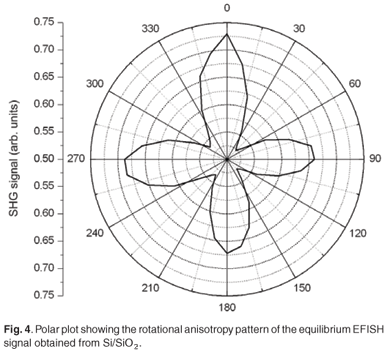
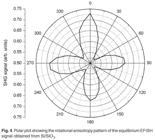
Since the advances of femtosecond laser technology during the last decade, optical second harmonic generation (SHG) has proven itself a powerful tool to investigate the electronic and structural properties of semiconductor materials. Its advantage lies in the fact that it is a contact-less, non-intrusive method that can be used in situ. It is sensitive to systems with broken symmetry, in particular interfaces and surfaces. The Si/SiO2 system is technologically important since it forms a component of most modern electronic equipment. Furthermore, it has been shown that it is possible to induce an electric field across this interface by means of laser irradiation as a result of defect formation and defect population. This electric field can be measured since it determines the SHG signal. The anisotropy of the SHG signal from the Si/SiO2 interface was measured and showed four-fold symmetry, illustrating that the SHG technique was able to characterise the electrical properties of the interface below the 5 nm thick oxide layer.
second harmonic generation; Si/SiO2; charge carrier dynamics; defect detection; charge trapping; interfacial electric fields
 Thumbnail
 Thumbnail
 Thumbnail
 Thumbnail