Contrasting conifer versus angiosperm xylem strategies to explain the domination of the boreal forests by conifers
Anton Scholtz
Independent Researcher, Cape Town, South Africa
Keywords: northern hemisphere, tracheid, sap
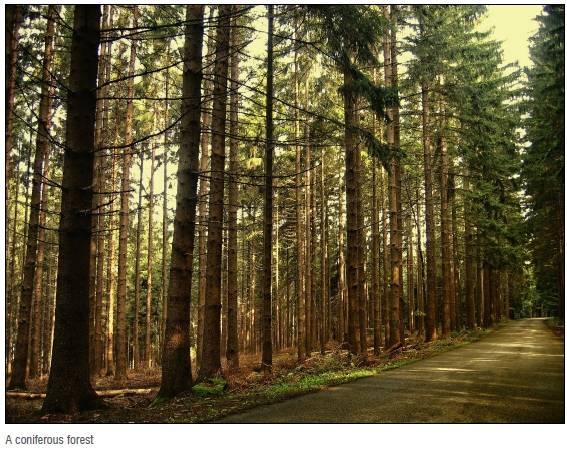
While angiosperm trees dominate woody floras worldwide in most ecological contexts, there is a swathe of coniferous dominated forests across northern Europe. In this short note I make the argument that this dominance is largely to do with the different xylem strategies of conifers versus angiosperms.
The general advantage of angiosperm wood is that it can increase the diameter of its vessels. However, quantitative analysis of xylem from the Great Karoo shows that when the size of vessels is constrained by cold, the wood of angiosperms begins to resemble that of conifers.
Many of these plants are described as 'root splitters', i.e. plants with wood that is prone to shear in the vertical plane. I speculate that this tendency is to do with the relative weakness of the vessel wall/fibre wall bond in angiosperms, compared to the tracheid wall/ tracheid wall bond of conifer wood.
A second factor is how the xylem strategy results in a structure that is optimised to transport sap. With a few exceptions (plants growing near water for example), angiosperms dedicate only about 14% of their cross-sectional area to vessels. This fact, together with the decreasing size of vessels whose development has been constrained by cold, results in a point being reached at which the conifer, whose sap transporting elements - the tracheids which occupy close to 70% of the area in conifers - will transport more sap per unit area than the wood of angiosperms.
I speculate that, in the higher latitudes of the northern hemisphere, conifers in the cold boreal forests are outperforming angiosperms in two ways:
1.by transporting more sap per unit area and,
2.because their wood shears less in the vertical plane, they are able to grow taller and catch the lower rays of the sun.
Correspondence:
Anton Scholtz

Published: 29 January 2020