The feasibility and implications of nuclear georeactors in Earth's core-mantle boundary region
Abstract
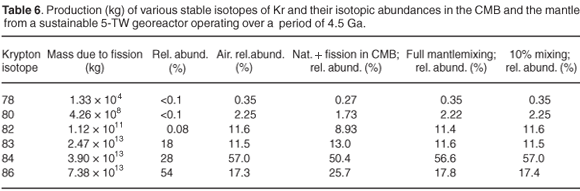
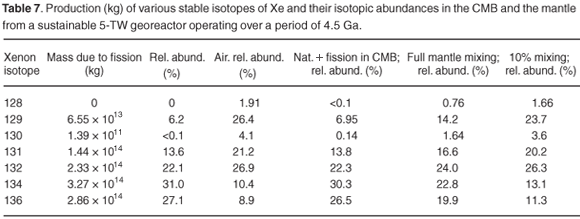
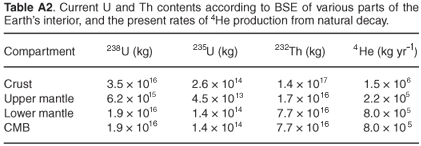
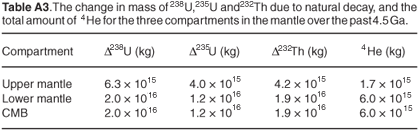
We examine the likelihood and geochemical consequences of the existence of nuclear georeactors in the core-mantle boundary region (CMB) between the Earth's silicate mantle and metallic core. Current geochemical models for the Earth's interior predict that U and Th in the CMB are concentrated exclusively in the mineral calcium silicate perovskite (CaPv), leading to predictable concentration levels of approximately 12 ppm U + Th, 4.5 Ga ago assuming that CaPv is distributed evenly throughout the CMB. Assumption of a similar behaviour for primordial 244Pu provides a substantial flux of neutrons from spontaneous fission. We show that an additional concentration factor of only an order of magnitude is required both to initiate and maintain self-sustaining nuclear georeactors based on fast fission. Continuously operating georeactors with a power of 5 TW (1 TW = 1012 W) can account for the observed isotopic compositions of helium and xenon in the Earth's mantle. Our hypothesis requires the presence of elevated concentrations of U and Th in the CMB, and is amenable to testing by direction-sensitive geoneutrino tomography.