Addressing the research challenges of early career academics: Evaluating a formal development programme
Abstract
Higher education institutions (HEIs) often require early career academics (ECAs) to engage in the production of formal high-quality research. ECAs frequently face numerous challenges related to fulfilling this requirement. Using a pragmatic approach, we evaluated whether a formal ECA development programme at a research-intensive South African university addressed the historical challenges of research for the participants. We aimed to further identify and categorise the obstacles faced by such ECAs and to develop recommendations for improving institutional support provided to them. A two-stage qualitative study was conducted; first, an online questionnaire was administered to 25 ECAs across various faculties, and these findings were then corroborated in Phase 2, in which eight of the Phase 1 participants provided additional context through a focus group discussion. Although the participants receive support through various interventions in the formal development programme, traditional challenges still exist, such as a lack of access to and receipt of funding, increased teaching loads, high administrative burdens, a lack of guidance and mentoring, limited access to and awareness of resources, and various institutional constraints. Developers of formal programmes aimed at supporting ECAs should consider a focus beyond seed funding and generalised mentoring support. SIGNIFICANCE: Understanding the current challenges of ECAs and the impact of the formalisation of a programme aimed at assisting them is key to developing ECAs in an academic environment that requires transformative initiatives, given the historical context of South Africa. This study is confirmatory in that it validates traditional challenges identified in the literature, which require innovative and bespoke interventions to address. HEIs in South Africa often face significant resource constraints; as such, programmes aimed at developing ECAs should carefully consider their effectiveness and continuously seek refinement. This study offers some recommendations in this regard.
early career academic; early career researcher; funding; mentorship; career progression
Introduction
Globally, early career academics (ECAs) are under increased pressure to excel in teaching, research and social impact, which makes the early years of their careers challenging.1231,4 Common challenges identified for ECAs globally include a lack of access to resources, such as time and funding, to facilitate professional learning and development.1,4,5 Other constraints include limited funding, irregular and limited publication of academic journal articles by ECAs, excessive institutional administrative responsibilities and high teaching workloads.4-6
In South Africa, academics in higher education institutions (HEIs) are often expected to teach, engage with their communities and publish.789-20
This case study focused on ECAs at a South African university that is committed to developing its ECAs as part of its strategic objective, consistent with other African universities, to become one of Africa's top research universities.21,22 We explored the impact of mentorship, funding opportunities, publication pressure, and other challenges faced by ECAs by examining institutional and structural factors that may hinder research career progression in a specific early career academic development (ECAD) programme. We also aimed to provide actionable recommendations and strategies to improve institutional support systems for ECAs in establishing a research career.
The goal of this paper is therefore to answer this research question: To what extent does the ECAD programme address the needs and research challenges experienced by ECAs, and what improvements can be made to enhance institutional support?
The objectives covered in this paper were to:
• evaluate whether the ECAD case study programme addresses the needs of ECAs;
• identify and categorise the key challenges experienced by ECAs in the ECAD case study programme; and
• develop recommendations for improving institutional support provided to ECAs through formal development programmes.
A two-stage qualitative approach was employed: Phase 1 was an online questionnaire and Phase 2 was a focus group discussion. The study and questionnaire were based on Rolfe's23
HEIs have a mandate "to prepare socially conscious and critical citizens" and "to contribute to the production of knowledge".722425
The literature consistently identifies funding as one of the most significant barriers that affect ECA research productivity, particularly within developing contexts where institutional resources are constrained.2,26,27 Research funding remains crucial for sustaining research activities and supporting publication output, which increasingly serves as a measure of both individual and institutional performance.28
Secondly, when ECAs take on their academic roles, they frequently lack the necessary training, mentorship and guidance from established researchers in their institutions.2292,26 Kumwenda et al. indicate that ECAs require support in their research careers to progress, even if it is only words of motivation from senior researchers.2621,26,29-31
Thirdly, ECAs are often overloaded with heavy teaching and academic workload responsibilities that hinder their research productivity.2823233,34 In South Africa, academics face increasing pressure to publish in high-impact journals to be acknowledged and compensated for their research efforts, as incentivised by the Department of Higher Education and Training.3522
When reviewing the literature to identify possible ways to improve some of the challenges experienced by ECAs, several possibilities were identified. To enhance the professional and personal development of ECAs, universities must establish an institutional mentoring framework that focuses on the equitable distribution of resources across all campuses, the adaptation of ECAs to the unique university environment, and the promotion of professional relationships between established academics and ECAs.21,36 ECAs value mentoring because it promotes career growth, academic productivity, professional skills development, professional confidence, stress reduction and job satisfaction.12,21,36-38
Although the existing literature consistently identifies funding constraints, heavy workloads and inadequate mentoring as common challenges experienced by ECAs, considerably less attention has been paid to evaluating whether formal institutional development programmes effectively address these challenges from the perspective of programme participants. Most studies focus on describing the challenges encountered by ECAs or examining individual interventions in isolation, rather than evaluating the extent to which a structured ECA development programme responds to their evolving needs. Furthermore, few studies have explored these issues within a South African research-intensive university using a reflective, participant-centred approach that moves beyond identifying challenges to developing practical recommendations for programme improvement. This study addresses these gaps by evaluating a formal ECAD programme through Rolfe's reflective model23
Methodology
The predominantly qualitative nature of the topic led to the adoption of a two-stage approach that incorporated limited descriptive quantitative data to address the research question and research objectives. Phase 1 consisted of an online questionnaire consisting primarily of open-ended questions, together with a single Likert-scale question used to provide descriptive context. Following the initial online questionnaire, which consisted of qualitative and quantitative questions, we tested the propositions that emerged from this stage in a further qualitative study (Phase 2) by conducting a focus group discussion. The questionnaire and the focus group discussion were developed in line with the literature review and the theoretical underpinning of the paper, Rolfe's reflective model232339,40 This often involves methodological pluralism, in which qualitative and quantitative approaches are combined to generate a more comprehensive understanding of the research problem.41
Phase 1 of the research design: Online questionnaire
The aim of the online questionnaire was to identify the challenges and recommendations that ECAs have for better integration into HEIs. The questionnaire consisted of open-ended questions42433
Phase 2 of the research design: Focus group discussion
A focus group discussion was conducted after completion of the online questionnaire by the ECAs. This discussion aimed to gain in-depth insights into the experiences of ECAs and to explore the themes that emerged from the questionnaire in greater detail.44
Population and sample
The university in this case study established an ECAD programme for academics who are viewed as early career researchers. There are no formal entry requirements for the programme as the characteristics of early career academics vary across faculties due to differences in disciplinary traditions and academic career pathways. Applications to the programme are assessed based on merit by a committee. Most ECAs participating in the programme hold a master's degree and are either currently pursuing a PhD or have recently completed one.
A purposive sampling method was used to recruit participants from the ECAD programme. Purposive sampling enabled the intentional selection of participants who were ECAs enrolled in the programme under review and who were therefore well positioned to reflect on their experiences of participating in it. In Phase 1, an online questionnaire was administered to 25 ECAs from various faculties to capture a broad range of experiences across disciplinary contexts. In Phase 2, eight participants from the questionnaire sample were purposively selected to participate in a focus group discussion. These participants were selected because they had completed the questionnaire, expressed a willingness to participate further, and represented a diversity of faculties and experiences. The focus group provided an opportunity to corroborate and further explore the findings.45
Data collection process
In the first phase, the questionnaire was distributed to all members of the ECAD programme in 2025 at the case study HEI (108 members across eight faculties).
All participants who completed the online questionnaire (25) were invited to take part in a focus group discussion. Eight of the participants who completed the online questionnaire agreed to attend the focus group discussion. Typically, a focus group reaches saturation with six to eight participants and does not require large groups; eight participants were therefore deemed sufficient.46,47 The purpose of the study was not statistical generalisation but to obtain rich, context-specific insights into participants' experiences of the ECAD programme. Within qualitative case study research, the sample was considered adequate because it provided diverse perspectives across various faculties and, together with the focus group, generated sufficient depth to address the research question.
We were also members of the ECAD programme and therefore acknowledge our positionality as researchers with an understanding of the programme under investigation. This position offered contextual insight but also had the potential to influence data collection and interpretation. To minimise this risk, we did not participate in the online questionnaire, thereby excluding our experiences from the data set. During the focus group discussion, we acted solely as facilitators, encouraging participants to express their views freely without contributing our own opinions or experiences. Throughout the analysis, we remained cognisant of our positionality and interpreted the findings in relation to the participants' accounts and the existing literature to reduce the potential influence of researcher bias.
In order to ensure the confidentiality of the participants in the online questionnaire and focus groups, responses were anonymised.
Ethical considerations
Ethical clearance was obtained from Stellenbosch University (ethical clearance code: 32790). Participation in both phases was voluntary, and the participants provided informed consent for each phase of the study, based on Stellenbosch University's research polices and guidelines.48
Findings and discussion
The objective of this study was to evaluate whether the ECAD case study programme addresses the needs of ECAs, to identify and categorise the key challenges experienced by ECAs in the ECAD case study programme, and to make recommendations for improving institutional support provided to ECAs through formal development programmes. Rolfe's reflective model23
Phase 1: Findings of the online questionnaire
The total sample comprised 108 ECAs who received the online questionnaire, of which 25 members responded and completed it, which resulted in a response rate of 23%. The sample is appropriate, as more than 10% of the population responded, which is in line with other studies that used online questionnaires.49-51 The attained response rate was therefore deemed sufficient for analysis and interpretation.
Participants from eight different faculties completed the questionnaire. The participants thus varied significantly in terms of characteristics relating to academic and research experience, which provided a diverse range of opinions.
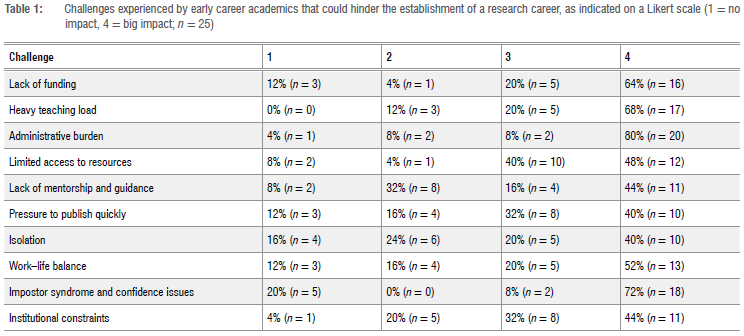
In line with Rolfe's reflective framework23n = 20) of participants indicating that it had a substantial impact on their careers, followed by heavy teaching loads (68%; n = 17) and limited funding (64%; n = 16). These findings suggest that competing institutional responsibilities continue to restrict the time and resources available for research, consistent with previous studies highlighting workload and funding as key barriers to ECA research productivity.2,17,26-28 Psychological challenges were also prominent, with 72% (n = 18) of participants identifying impostor syndrome and confidence-related issues as negatively affecting their research careers, reinforcing growing evidence that psychosocial factors influence early academic career development.32n = 12) and inadequate mentorship and guidance (44%; n = 11), while opinions regarding pressure to publish and institutional constraints were more varied, with many participants expressing neutral views (32%; n = 8 for both).26
One of the most significant findings of the study was that 72% of the participants indicated that impostor syndrome and confidence-related challenges negatively affected their research careers. This finding aligns with existing literature that suggests that ECAs frequently experience anxiety, self-doubt and feelings of inadequacy during the early stages of their academic careers.32
The full results of the Likert-scale questions regarding research challenges experienced by ECAs are presented in Table 1.
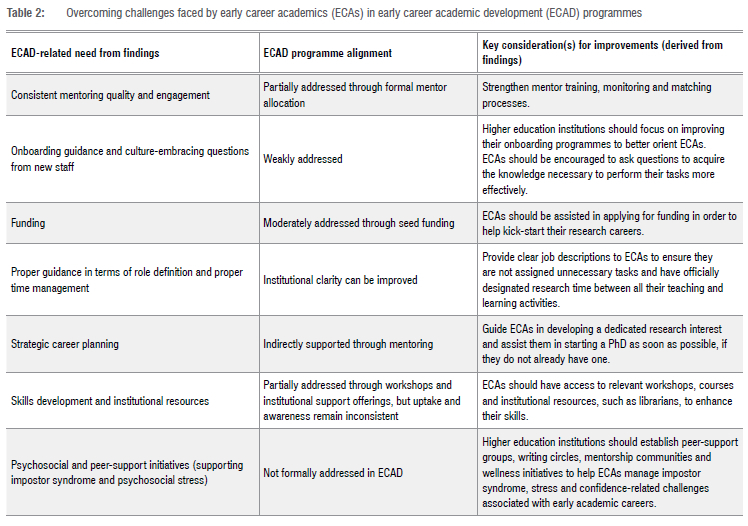
We next discuss how these challenges can be overcome by ECAs and universities using the 'So what?' part of Rolfe's reflective model.23
The 'So what?' phase of Rolfe's2321
Based on the reflective process entailing the 'Now what?' narrative questions from Rolfe's reflective model2321,29 Effective mentoring extends beyond simply assigning a mentor: it requires constructive relationships that provide research guidance, feedback, networking opportunities and career advice.2130,31 The findings therefore suggest that formal ECA programmes should place greater emphasis on careful mentor-mentee matching, clearly defined expectations, and ongoing evaluation of mentoring relationships rather than assuming that mentor allocation alone is sufficient.
Funding and access to financial resources also emerged as a major recommendation. Participants highlighted that awareness of funding opportunities is almost as important as the availability of funding itself. They suggested that a central administrative resource responsible for regularly communicating funding opportunities would improve accessibility and uptake. The participants further recognised that obtaining external research funding is often a complex and time-consuming process, particularly for ECAs who have limited experience in grant writing. This finding aligns with previous studies that identify funding as one of the principal constraints affecting the research productivity and career development of ECAs, particularly in resource-constrained environments.2,26,28 Limited funding not only restricts opportunities to undertake research but also constrains conference participation, collaboration, publication output and access to research infrastructure.2,26
Participants also emphasised the importance of strategic career planning and continuous skills development. Completing a PhD early and deliberately protecting time for research were viewed as important priorities. Participants further highlighted the need for greater support in developing research and academic writing skills through workshops and short courses. As Participant 18 stated, "Attend workshops and short courses on teaching, learning, research, writing and contracts".
The 'Now what?' phase emphasises the need for actionable institutional reform. The participants recommended structured onboarding, improved mentor matching, clearer communication regarding funding opportunities and protected research time. These recommendations extend existing literature by demonstrating that ECAs require not only financial assistance but also tailored institutional integration strategies.
These recommendations can be utilised to address the challenges identified in this paper that ECAs experience. The findings of the focus group discussion are explored next to further validate the results of Phase 1.
Phase 2: Findings of the focus group discussion
In terms of recommendations to overcome the challenges faced by ECAs in establishing a research career, the following additional considerations were identified during the focus group discussion. Firstly, dedicated onboarding guidance needs to be formalised. For example, one participant stated: "I only found out by chance regarding ECAD. There is no clear communication, no orientation, nothing to guide you through what is available." Onboarding is key to helping new staff transition and improving workplace well-being.522836
HEIs can develop strategies to address ECAs' challenges by creating a more sustainable and supportive environment for emerging researchers, which will ultimately enhance research productivity and innovation.
The findings of this study indicate that, while the ECAD programme provides valuable support to ECAs, several structural and developmental gaps remain. The recommendations in Table 2 are directly derived from the study's key findings in response to the research question and offer HEIs guidance on how ECAD programmes can be developed or improved to address the challenges faced by ECAs.
Conclusion
The aim of this study was to examine the extent to which the ECAD programme addresses the needs and research challenges experienced by ECAs in this specific context, and what improvements could be made to enhance institutional support, based on the opinions of participants in this specific case study at a research-intensive residential university in South Africa. ECAs' ability to conduct meaningful research is significantly hindered by these challenges, which include a lack of funding, administrative burdens, excessive workloads, limited mentorship and inadequate institutional backing. Psychological challenges, particularly impostor syndrome, represent a significant but often overlooked barrier to ECA development. Institutions should therefore consider integrating psychosocial and confidence-building support mechanisms into formal ECAD programmes. When developing programmes to assist ECAs with better integration into HEIs, programme developers and policymakers should take ECAs' input regarding their needs into account. The participants indicated that the resources they valued most are funding and financial support, mentorship relationships and training opportunities. According to the participants, these same aspects can be improved in ECAD programmes. Insights from ECAs also suggest practical and attainable solutions that, if adopted, could greatly enhance the research environment for ECAs in South Africa. These include, among others, close collaboration with a mentor, strategic career planning, a focus on skills development and training, and proper onboarding guidance.
This study was limited to the perceptions of ECA participants in South Africa who were part of the ECAD programme at a South African university. Their perceptions might differ from those held by other ECA participants at other universities that offer similar programmes for ECAs or from ECAs who are not part of an ECAD programme. The following areas for future research can thus be explored further: (1) comparative and multi-institutional studies: ECAs across multiple South African universities (e.g. historically advantaged versus disadvantaged institutions) and ECAs with or without access to formal development programmes; (2) longitudinal research on ECAD programmes; (3) exploring various mentorship models; and (4) exploring discipline-specific differences.
While previous studies have identified funding and mentorship as common ECA challenges, this study contributes to the literature by demonstrating that ECAs also require clearer onboarding structures, role clarification and tailored mentor matching within formal institutional development programmes.
Data availability
The data supporting the results of this study are available upon request to the corresponding author.
Declarations
We have no competing interests to declare. We have no AI or LLM use to declare.
Authors' contributions
R.P.E.: Conceptualisation, data curation, formal analysis, investigation, methodology, resources, software, validation, visualisation, writing - original draft, writing - review and editing, supervision, project administration, funding acquisition. A.L.: Conceptualisation, data curation, formal analysis, investigation, methodology, resources, software, validation, visualisation, writing - original draft, writing - review and editing, supervision, project administration, funding acquisition. Both authors read and approved the final manuscript.
References
Literature review
-
1. Smithers K, Gibbs L. Challenges and opportunities for early career researchers: Using the theory of practice architectures to unpack enabling and constraining conditions. Prof Dev Educ. 2025;51(8):2175-2188. https://doi.org/10.1080/19415257.2024.2386661
» https://doi.org/10.1080/19415257.2024.2386661 -
2. Shinkafi ST. Challenges experienced by early career researchers in Africa. Future Sci OA. 2020;6(5), Art. #FSO469. https://doi.org/10.2144/fsoa-2020-0012
» https://doi.org/10.2144/fsoa-2020-0012 - 3. Boyer EL. Scholarship reconsidered: Priorities of the professoriate. Lawrenceville, NJ: Princeton University Press; 1990.
-
4. Christian K, Johnstone C, Larkins JA, Wright W, Doran MR. Research culture: A survey of early-career researchers in Australia. eLife. 2021;10, e60613. https://doi.org/10.7554/elife.60613
» https://doi.org/10.7554/elife.60613 -
5. Mydin F, Rahman RA, Aishah RS, Mohammad WM. Research collaboration: Enhancing the research skills and self-confidence of early career academics. Asian J Univ Educ. 2021;17(3):142-153. https://doi.org/10.24191/ajue.v17i3.14508
» https://doi.org/10.24191/ajue.v17i3.14508 -
6. Cejas D, Rodriguez Acosta F, Rivera-Correa J. Common challenges faced by early-career researchers in Latin American and small US universities. mBio. 2025;16(6), e00238-25. https://doi.org/10.1128/mbio.00238-25
» https://doi.org/10.1128/mbio.00238-25 - 7. Republic of South Africa. The Higher Education Act, No. 101 of 1997. Government Gazette no. 390(18515/1655), 19 December. Cape Town: Government Printer; 1997.
-
8. Portnoi L. Cultivating the next generation of academics in South Africa. Africa Educ Rev. 2009;6(2):187-207. https://doi.org/10.1080/18146620903274704
» https://doi.org/10.1080/18146620903274704 - 9. Garbett D, Tynan B. A lifeline for emerging academics. In: Cantwell RH, Scevak JJ, editors. Academic life: A handbook for new academics. Melbourne: Acer Press; 2010. p. 173-181.
- 10. Msiza V, Mbatha N, Zondi T. Mapping a model for peer assessment: Narratives of academics in a South African teacher education institution. In: Sosibo L, Ivala E, editors. Creating effective teaching and learning spaces: Shaping futures and envisioning unity, diversity and transformation. Wilmington, DE: Vernon Press; 2021. p. 85-97.
-
11. Price E, Coffey B, Nethery A. An early career academic network: What worked and what didn't. J Furth High Educ. 2015;39(5):680-698. https://doi.org/10.1080/0309877x.2014.971106
» https://doi.org/10.1080/0309877x.2014.971106 -
12. Hemmings B. Sources of research confidence for early career academics: A qualitative study. High Educ Res Dev. 2012;31(2):171-184. https://doi.org/10.1080/07294360.2011.559198
» https://doi.org/10.1080/07294360.2011.559198 -
13. McGrail MR, Rickard CM, Jones R. Publish or perish: A systematic review of interventions to increase academic publication rates. High Educ Res Dev. 2006;25(1):19-35. https://doi.org/10.1080/07294360500453053
» https://doi.org/10.1080/07294360500453053 -
14. Budge S. Peer mentoring in postsecondary education: Implications for research and practice. J Coll Read Learn. 2006;37(1):71-85. https://doi.org/10.1080/10790195.2006.10850194
» https://doi.org/10.1080/10790195.2006.10850194 -
15. Leibowitz B, Bozalek V, Van Schalkwyk S, Winberg C. Institutional context matters: The professional development of academics as teachers in South African higher education. High Educ. 2015;69(2):315-330. https://doi.org/10.1007/s10734-014-9777-2
» https://doi.org/10.1007/s10734-014-9777-2 -
16. Stes A, Van Petegem P. Instructional development for early career academics: An overview of impact. Educ Res. 2011;53(4):459-474. https://doi.org/10.1080/00131881.2011.625156
» https://doi.org/10.1080/00131881.2011.625156 -
17. Teferra D. Early career academics in Africa - Induction into the teaching praxis. Stud High Educ. 2016;41(10):1735-1740. https://doi.org/10.1080/03075079.2016.1221651
» https://doi.org/10.1080/03075079.2016.1221651 -
18. Elizabeth V, Grant BM. 'The spirit of research has changed': Reverberations from researcher identities in managerial times. High Educ Res Dev. 2013;32(1):122-135. https://doi.org/10.1080/07294360.2012.751362
» https://doi.org/10.1080/07294360.2012.751362 -
19. Redelinghuys MJ, Madondo NE, Muzangwa L, Dzogbewu TC, Forssman T. Professional development of early-career researchers at the South African Journal of Science. S Afr J Sci. 2024;120(Celebrating 120 years), Art. #20106. https://doi.org/10.17159/sajs.2024/20106
» https://doi.org/10.17159/sajs.2024/20106 -
20. Owusu-Agyeman Y. Subjective career success and adaptation of early career academics: A career construction theory approach. Aust J Career Dev. 2021;30(3):167-176. https://doi.org/10.1177/10384162211069205
» https://doi.org/10.1177/10384162211069205 -
21. Mgaiwa S, Kapinga O. Mentorship of early career academics in Tanzania: Issues and implications for the next generation of academics. High Educ Pedagog. 2021;6(1):114-134. https://doi.org/10.1080/23752696.2021.1904433
» https://doi.org/10.1080/23752696.2021.1904433 -
22. Division for Research Development, Stellenbosch University. Early career academic development (ECAD) programme [webpage on the Internet]. No date [cited 2025 Feb 22]. Available from: https://www.su.ac.za/en/research/research-development/early-career-academic-development-ecad-programme
» https://www.su.ac.za/en/research/research-development/early-career-academic-development-ecad-programme -
23. Rolfe G. Reflective practice: Where now? Nurse Educ Pract. 2002;2(1):21-29. https://doi.org/10.1054/nepr.2002.0047
» https://doi.org/10.1054/nepr.2002.0047 -
24. Sutherland KA, editor. Conclusion: Challenges and prospects for early career academics' futures in New Zealand and beyond. In: Early career academics in New Zealand: Challenges and prospects in comparative perspective. Cham: Springer International Publishing; 2018. p. 181-196. https://doi.org/10.1007/978-3-319-61830-2_9
» https://doi.org/10.1007/978-3-319-61830-2_9 -
25. Owusu-Agyeman Y. The mentoring experiences of early career and senior academics in a multicampus university in South Africa. Educ Process Int J. 2022;11(1):65-85. https://doi.org/10.22521/edupij.2022.111.5
» https://doi.org/10.22521/edupij.2022.111.5 -
26. Kumwenda S, El Hadji AN, Orondo PW, William P, Oyinlola L, Bongo GN, et al. Challenges facing young African scientists in their research careers: A qualitative exploratory study. Malawi Med J. 2017;29(1):1-4. https://doi.org/10.4314/mmj.v29i1.1
» https://doi.org/10.4314/mmj.v29i1.1 -
27. Omungo R. Africa's science 'millionaires': Survey spotlights top-funded researchers. Nature News. 2018 November 14. https://doi.org/10.1038/d41586-018-07418-6
» https://doi.org/10.1038/d41586-018-07418-6 -
28. Mbewe EG, Hambulo A, Mumba D, Kasonde-Ngandu S, Mwanza-Kabaghe S. Publish or perish: Challenges faced by academicians in research publications at the University of Zambia. Multidiscip J Lang Soc Sci Educ. 2020;2(2):211-228. Available from: https://journals.unza.zm/index.php/mjlsse/article/view/160/158
» https://journals.unza.zm/index.php/mjlsse/article/view/160/158 -
29. Allen TD, Eby LT, Poteet ML, Lentz E, Lima L. Career benefits associated with mentoring for protégés: A meta-analysis. J Appl Psychol. 2004;89(1):127-136. https://doi.org/10.1037/0021-9010.89.1.127
» https://doi.org/10.1037/0021-9010.89.1.127 -
30. Higgins MC, Kram KE. Reconceptualizing mentoring at work: A developmental network perspective. Acad Manage Rev. 2001;26(2):264-288. https://doi.org/10.5465/amr.2001.4378023
» https://doi.org/10.5465/amr.2001.4378023 -
31. Fletcher JK, Ragins BR. Stone Center Relational Cultural Theory: A window on relational mentoring. In: Ragins BR, Kram KE, editors. The handbook of mentoring at work: Theory, research, and practice. Los Angeles, CA: Sage Publications; 2007. p. 373-399. https://doi.org/10.4135/9781412976619.n15
» https://doi.org/10.4135/9781412976619.n15 -
32. Cilli E, Ranieri J, Guerra F, Di Giacomo D. Early career researchers and mental health: Observational study of challenge and wellbeing. Health Sci Rep. 2023;6(11), e1649. https://doi.org/10.1002/hsr2.1649
» https://doi.org/10.1002/hsr2.1649 -
33. Callaghan CW. 'Publish or perish': Family life and academic research productivity. SA J Hum Resour Manag. 2016;14(1), Art. #727. https://doi.org/10.4102/sajhrm.v14i1.727
» https://doi.org/10.4102/sajhrm.v14i1.727 -
34. Kubátová J. Does academic publishing lead to work-related stress or happiness? Publications. 2019;7(4), Art. #66. https://doi.org/10.3390/publications7040066
» https://doi.org/10.3390/publications7040066 - 35. South African Department of Education. Research Output Policy, vol. 597, no 2. Pretoria: Government Gazette; 2015.
-
36. Brown II MC, Davis GL, McClendon SA. Mentoring graduate students of color: Myths, models, and modes. Peabody J Educ. 1999;74(2):105-118. https://doi.org/10.1207/s15327930pje7402_9
» https://doi.org/10.1207/s15327930pje7402_9 -
37. Simmonds AH, Dicks AP. Mentoring and professional identity formation for teaching stream faculty: A case study of a university peer-to-peer mentorship program. Int J Mentor Coach Educ. 2018;7(4):282-295. https://doi.org/10.1108/ijmce-02-2018-0012
» https://doi.org/10.1108/ijmce-02-2018-0012 -
38. Ansmann L, Flickinger TE, Barello S, Kunneman M, Mantwill S, Quilligan S, et al. Career development for early career academics: Benefits of networking and the role of professional societies. Patient Educ Couns. 2014;97(1):132-134. https://doi.org/10.1016/j.pec.2014.06.013
» https://doi.org/10.1016/j.pec.2014.06.013 -
39. Morgan DL. Pragmatism as a paradigm for social research. Qual Inq. 2014;20(8):1045-1053. https://doi.org/10.1177/1077800413513733
» https://doi.org/10.1177/1077800413513733 -
40. Kelly LM, Cordeiro M. Three principles of pragmatism for research on organizational processes. Methodol Innov. 2020;13(2), Art. #2059799120937242. https://doi.org/10.1177/2059799120937242
» https://doi.org/10.1177/2059799120937242 - 41. Creswell JW, Plano Clark VL. Designing and conducting mixed methods research. 2nd ed. Thousand Oaks, CA: Sage Publications; 2011.
-
42. Ares G, Ryan GS, Jaeger SR. Text highlighting combined with open-ended questions: A methodological extension. J Sensory Stud. 2023;38(3), e12816. https://doi.org/10.1111/joss.12816
» https://doi.org/10.1111/joss.12816 -
43. Aybar C, Pérez V, Pavía JM. Scale matters: Unravelling the impact of Likert scales on political self-placement. Qual Quant. 2024;58(4):3725-3746. https://doi.org/10.1007/s11135-023-01825-2
» https://doi.org/10.1007/s11135-023-01825-2 -
44. Tunnecliff J, Ilic D, Morgan P, Keating J, Gaida JE, Clearihan L, et al. The acceptability among health researchers and clinicians of social media to translate research evidence to clinical practice: Mixed-methods survey and interview study. J Med Internet Res. 2015;17(5), e119. https://doi.org/10.2196/jmir.4347
» https://doi.org/10.2196/jmir.4347 -
45. Palinkas LA, Horwitz SM, Green CA, Wisdom JP, Duan N, Hoagwood K. Purposeful sampling for qualitative data collection and analysis in mixed method implementation research. Adm Policy Ment Health. 2015;42(5):533-544. https://doi.org/10.1007/s10488-013-0528-y
» https://doi.org/10.1007/s10488-013-0528-y -
46. Cortini M, Galanti T, Fantinelli S. Focus group discussion: How many participants in a group? Encyclopaideia. 2019;23(54):29-43. https://doi.org/10.6092/issn.1825-8670/9603
» https://doi.org/10.6092/issn.1825-8670/9603 -
47. Hennink M, Kaiser BN. Sample sizes for saturation in qualitative research: A systematic review of empirical tests. Soc Sci Med. 2022;292, Art. #114523. https://doi.org/10.1016/j.socscimed.2021.114523
» https://doi.org/10.1016/j.socscimed.2021.114523 -
48. Stellenbosch University. Policies and guidelines. Early career academic development (ECAD) programme [webpage on the Internet]. No date [cited 2025 Feb 22]. Available from: https://www.su.ac.za/en/research/research-development/policies-and-guidelines
» https://www.su.ac.za/en/research/research-development/policies-and-guidelines -
49. Lee KL, Azmi NA, Hanaysha JR, Alzoubi HM, Alshurideh MT. The effect of digital supply chain on organisational performance: An empirical study in Malaysia manufacturing industry. Uncertain Supply Chain Manag. 2022;10(2):495-510. http://dx.doi.org/10.5267/j.uscm.2021.12.002
» http://dx.doi.org/10.5267/j.uscm.2021.12.002 -
50. Fosnacht K, Sarraf S, Howe E, Peck LK. How important are high response rates for college surveys? Rev High Educ. 2017;40(2):245-265. https://doi.org/10.1353/rhe.2017.0003
» https://doi.org/10.1353/rhe.2017.0003 -
51. Van Mol C. Improving web survey efficiency: The impact of an extra reminder and reminder content on web survey response. Int J Soc Res Methodol. 2017;20(4):317-327. https://doi.org/10.1080/13645579.2016.1185255
» https://doi.org/10.1080/13645579.2016.1185255 -
52. Mosquera P, Soares ME. Onboarding: A key to employee retention and workplace well-being. Rev Manag Sci. 2025;19:3687-3711. https://doi.org/10.1007/s11846-025-00864-3
» https://doi.org/10.1007/s11846-025-00864-3

Revised: 10 July 2026
Revised: 10 July 2026
Accepted: 10 July 2026
Published: 29 Sep. 2026
Funding: None
Appendix 1: Online research questionnaire
Name of faculty and department
Rate the following challenges (on a scale from 1 to 4, with 1 = no impact and 4 = big impact) that early career academics may experience that could hinder their ability to conduct research, based on your experiences of starting a research career:
• Lack of funding
• Heavy teaching load
• Administrative burden
• Limited access to resources
• Lack of mentorship and guidance
• Pressure to publish quickly
• Isolation
• Work-life balance
• Impostor syndrome and confidence issues
• Institutional constraints
Appendix 2: Focus group guide
The following key discussion points guided the focus group discussion:
• What are the biggest challenges that early career academics face related to research?
• How do you think support for early career academics, specifically relating to research, could be improved or addressed?
• Are there any strategies or recommendations for early career academics to overcome the challenges they experience?