Cutting across the grain of dominant academic genres
Chrissie Boughey
Centre for Postgraduate Studies, Rhodes University, Makhanda, South Africa. Email:
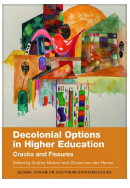
Book Title: Decolonial Options in Higher Education: Cracks and Fissures
Editors: Sinfree Makoni and Chanel van der Merwe
ISBN: 9781836680871 (paperback, 202 pp)
Publisher: Multilingual Matters, Bristol; GBP35
Published: 2025
As Jansen points out, when the students called for the decolonisation of higher education in the protests of 2015 and 2016, the concept of decolonisation "landed with a thud in the academy"1(p.141) because, although South Africans had written extensively about 'the struggle' against apartheid, the language of decolonisation hardly featured in national discourse. Since 2015, this gap has been addressed with the result that Makoni and van der Merwe's edited collection, Decolonial Options in Higher Education, adds to a body of literature that is substantial.
A difference between this fourth volume in the Global Forum on Southern Epistemologies series published by Multilingual Matters and other work focused on decolonial thought lies in its 'collaborative writing'. The volume is a product of the African Studies Global Virtual Forum (ASGVF), defined as an "epistemological community that enhances understanding by being in dialogue with itself and with other non-ASGVF epistemological communities" (p. 1-15). 'Collaborative writing' sees writing not as a product of an autonomous, independent thinker (or 'Enlightenment Man') but as part of a struggle which aims to create "sociopolitical moments of engagement, alliance and co-labouring as part of praxis".
In practical terms, this means that the chapters of the book take a number of forms - the most common of which is that of a transcribed talk followed by questions and comments from members of an audience who may be online. For example, one chapter, termed "an interlude", consists of an interview with an academic who was a student activist in the protests (p. 81-91), and another2
Although the introduction to the book provides a robust rationale for the concept of 'collaborative writing', as a reader I found it difficult to settle into what sometimes came across as a conversational style as a result of what, I admit, is my own subjugation to academic genres. That said, the book provides a fascinating opportunity to engage with authors about their work as a good many of the talks reflect on what has previously been published or said. Jansen's chapter 'How institutions defang colonial ideas' reflects on ideas in his 2022 book co-written with Cyrill Walters, The Decolonization of Knowledge: Radical Ideas and the Shaping of Institutions in South Africa and Beyond3
The idea of my own discomfort in reading a text that cuts across the grain of dominant academic genres leads me to a use for the book that emerges from my background in the field of academic development with a particular interest in the development of academic writing. James Paul Gee's4(p.154) construct of Discourse (always deliberately capitalised to distinguish from other uses of the term) is defined as a kind of social role involving "distinctive ways of speaking/listening and, often, too, writing/reading coupled with distinctive ways of interacting valuing feeling, dressing, thinking [and] believing" and has informed much of my thinking about student development in South African universities5
For Gee, literacy is mastery of a Discourse which can only be developed as a result of immersion in contexts where the Discourse is practised rather than through teaching. My own command of academic Discourses results from years of engagement with academic work and my ability to critique academic writing from my work with students. Teaching, according to Gee, does, however, have a place in the acquisition of a Discourse as it allows for the development of criticality.
Using Makoni and van der Merwe's volume as a basis for discussion about the alternative forms of writing characterised by the different chapters' initiatives intended to enhance student learning, especially at postgraduate level, would allow for the development of criticality of academic genres themselves, what they achieve, how they achieve it and, more importantly, what they fail to achieve. This is all the more possible given that some chapters refer to work already published in more conventional formats. In addition, as the discussion sections presented at the end of each chapter model practice in academic seminars, they could be used as a means of introducing students to dominant academic practices as well as to critiques of them. The focus of the book on decoloniality potentially means that the volume holds interest for students from a range of backgrounds, given the fervour with which calls for decolonisation were taken up more than ten years ago.
Conventionally, book reviews engage with the content of a book. The fact that this volume allows for a review focusing on form speaks to the intent of the ASGVF to develop praxis in the form of the application or realisation of decolonial theory, and to the achievement of one of the forum's aims.
References
-
1. Jansen J. The problem with decolonization: Entanglements in the politics of knowledge. J Mod Afr Stud. 2025;61(1):139-156. https://doi.org/10.1017/S0022278X23000162
» https://doi.org/10.1017/S0022278X23000162 - 2. Connell R. The good university. In: Makoni S, van der Merwe C, editors. Decolonial options in higher education. Bristol & Jackson: Multilingual Matters; 2025. p. 107-121.
-
3. Jansen JD, Walters CA. The decolonization of knowledge: Radical ideas and the shaping of institutions in South Africa and beyond. Cambridge: Cambridge University Press; 2022. https://doi.org/10.1017/9781009082723
» https://doi.org/10.1017/9781009082723 -
4. Gee JP. Social linguistics and literacies: Ideology in discourse. Basingstoke: Falmer Press; 2008. https://doi.org/10.4324/9780203944806
» https://doi.org/10.4324/9780203944806 -
5. Boughey C. What are we thinking of?: A critical overview of approaches to developing academic literacy in South African higher education. J Lang Teach. 2013;47(2):25-42. http://dx.doi.org/10.4314/jlt.v47i2.2
» http://dx.doi.org/10.4314/jlt.v47i2.2