Computer history as humanistic method: Labour and technology in Mark Sanders's 'A Will for the Machine'
Aidan Erasmus
Department of Historical Studies, University of the Western Cape, Cape Town, South Africa. Email:
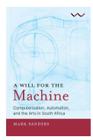
Book Title: A Will for the Machine: Computerization, Automation, and the Arts in South Africa
Author: Mark Sanders
ISBN: 9781997461203 (paperback, 256pp)
Publisher: Wits University Press, Johannesburg; ZAR420
Published: 2026
What do machines mean when they are not simply tools for work? This is where Mark Sanders sets to work in A Will for the Machine: Computerization, Automation, and the Arts in South Africa, a book tracking South Africa's history of computerisation in the 1960s and 1970s alongside apartheid's thinking on the division of labour, race and technology through various artistic works and practices. Sanders asks us to think anew about the configuration that is human-machine interaction, opening the possibility of computer history as a methodological intervention around the question of labour and technology.
While Sanders does not name his intervention as such, I would contend that computer history is not simply a history of computerisation, but a mode of apprehending the conditions of emergence and possibilities for human-machine interaction. Sanders states from the outset that "no history of computerization in South Africa exist[s] in the form of a single ready reference", and that there is "no basic chronicle for...computer history". Sanders turns to how the mine and the mineworker become constitutive of a general industrial and economic historiography as a starting place for a history of computerisation, noting how mining administration itself births the turn to automation in the 1960s in South Africa. This interaction between the worker and the machine pre-automation is also a history of the apartheid state economically and ideologically: it is mining capital that sets in motion the forces of state building and entrenches notions of skilled and unskilled labour as the grounds for apartheid's economic engineering. Therefore, when the black blue-collar worker, also facing mechanisation at the coalface, is simultaneously mirrored by the introduction of computerisation as a threat to the white-collar worker, a different configuration of the division of labour becomes available to the apartheid state. From this insight, Sanders suggests that the problem of computerisation strikes at the very heart of how we might imagine apartheid as a project of social and technological engineering. Automation, or the shifting relation between the human and machine, is therefore crucial to how apartheid reifies race, class and gender in the subjects it sought to produce. A picture of this can be gleaned for Sanders from artistic practice, through works by William Kentridge, J.M. Coetzee and Miriam Tlali. It is the aesthetic as a mode through which to chart the complexity of these shifts and is perhaps the definitive contribution to an otherwise dispersed field of industrial history, or a yet-to-emerge history of technology in South Africa. It is Sanders's contention that "certain texts, artworks, and instances of performance place workers at the centre of questions of automation and the racial division of labour". By asking whether it is possible for a history of computerisation to be thought through the literary, Sanders simultaneously asks what the stakes are of thinking the erstwhile scientific or technical through the aesthetic. Through interrogating how the human and machine are co-constitutive but are represented as not, Sanders unwittingly connects the problem of computerisation in the 1950s and 1960s particularly salient in the current moment of generative artificial intelligence and large language models, where the problem of the language calculator brings the technical and the aesthetic ever closer.
The stakes of Sanders's core premise - that the question of labour and technology shifts dramatically with mechanisation - are that the centrality of the worker to regimes of labour and technology is disrupted, or, as Sanders writes, the figure of the operator becomes a slippery concept, which is especially profound for the smartphone users or the data workers of our present. The concept of anamorphosis that appears repeatedly throughout the book is meant to capture the representational excess of the interaction between human and machine in the wake of this shift and gives Sanders some methodological grounding in his invocation of literature as the mode for a computer history. Anamorphosis, borrowed from visual art, is defined in various ways across the book. Perhaps the most striking definition is where Sanders names it "the regulated transformation of one order of marks into another", and where computerisation is described as a "system of regulated conversion of representationally inert marks into meaningful syntagms and recognizable images". Anamorphosis captures, as Sanders proclaims in the conclusion, the conditions under which human and machine may merge and what that merging engenders.
What allows the book to aim beyond the horizon of simply a history of computerisation, is Sanders's provocative claim in the final chapter about the humanities and the technical. In elucidating how Miriam Tlali's world is marked by a desire for the machine, Sanders asks what it means when the humanist looks for the machine and can only find "dehumanization", thus "reliev[ing the humanist] of the task of thinking the machine". This response, Sanders suggests, is caught up in the binaries determined by a specific historiographic tradition, where "the agon of oppressed and oppressor, colonizer and colonized, black and white, and so forth" is raised "to a mythic level'. While such a claim is provocative and lays the ground for the work to extend beyond the terms of its argument, it rings somewhat hollow outside the southerly context that Sanders examines, where much richer and complex examinations of media agency and subject formation may be found. The desire to work - or acting for the machine as Sanders phrases the positive agency of workers in relation to automation in the book - is fortunately not of the same character as work itself. Nonetheless, this does bolster a search for a positive desire for work amid apartheid's reduction of the black subject to labour. This would orientate the notion of a computer history as a writing against the negation of the machine in humanist discourse, and as one that might then offer a productive framework with which to think earlier engagements with the technological over the course of South African history. In this sense, a will for the machine is worth pursuing.
Published: 29 September 2026