Mapping underutilised and emerging food sources and technologies as solutions to food insecurity in South Africa
Abstract
There are clear signs that the South African food system is failing as we experience increasing trends in hunger, rising food costs, lack of dietary diversity, child stunting, foodborne illnesses, food waste and an obesity epidemic coupled with malnutrition. A literature review was conducted to identify underutilised or emerging new food sources and technologies (UEFST). They were identified as indigenous African crops (IACs), insects, fermentation, cultured meat and seafood, food waste recovery and algae. Criteria were developed to assess these UEFST to evaluate their ability to provide affordable, nutritious, safe and relevant food for South Africans (ANSSA). A survey was conducted with food professionals from industry, academia and government to evaluate these UEFST against the ANSSA criteria. Findings indicate that the two most promising UEFSTs - lACs and food waste recovery - could be available to South Africans within three to five years. These sources were rated highest in their ability to meet the ANSSA criteria identified. The two underutilised or emerging food sources with the longest time frame to commercialisation were cultured meat and seafood and algae (5 to 10 years), with cultured meat and seafood scoring the lowest of all six UEFST against the ANSSA criteria. SIGNIFICANCE: • Underutilised and emerging food sources offer South Africa new solutions to address food security. • Indigenous African crops and recovery and valorisation of food waste are the most promising short-term options to address food security. • South African stakeholders from academia, government and industry will need to invest in research, product development, capability-building, scale-up and an agile regulatory environment for these underutilised and emerging food sources to reach commercialisation.
South Africa; underutilised and emerging foods; affordable food; nutritious food
Introduction
South Africa emerged from an oppressive apartheid system in 1994, and more than 30 years of democracy later, over half of the population still lives in poverty.112
One in five South African households (21%) in 2021 was affected by moderate to severe food insecurity.34 5
Food consumption patterns have changed and will continue to change dramatically over the coming decades in South Africa.67778910114
South Africa's food system contributes 15-20% of greenhouse gas emissions.121313 14
It is evident that the South African food system is failing as we experience increasing trends in hunger and malnutrition, rising food costs, a lack of dietary diversity, child stunting, foodborne illnesses, an obesity epidemic coupled with negative climate impacts and environmental degradation. There is a need to develop renewable and sustainable sources of food.21
The objective of this study was to identify which UEFSTs have the potential to be able to address food security and environmental issues in South Africa and to provide recommendations to enable this transition. The findings of this study could help key stakeholders in government and academia and those along the food value chain to prepare for or enable acceleration in research, advance scale-up infrastructure, and enable regulatory and/or policy frameworks to support the commercialisation of these potential future food solutions for South Africa.
Materials and methods
Literature review
A literature review was conducted to identify UEFSTs that could potentially provide solutions to delivering safe, affordable and nutritious foods for vulnerable South Africans. These food sources and technologies were then evaluated based on their positive and negative inherent properties (such as nutritional value, food safety and organoleptic properties) as well as the drivers and barriers to reaching commercialisation related to achieving scale, consumer adoption, regulatory considerations and food system impact.
Quantitative expert survey
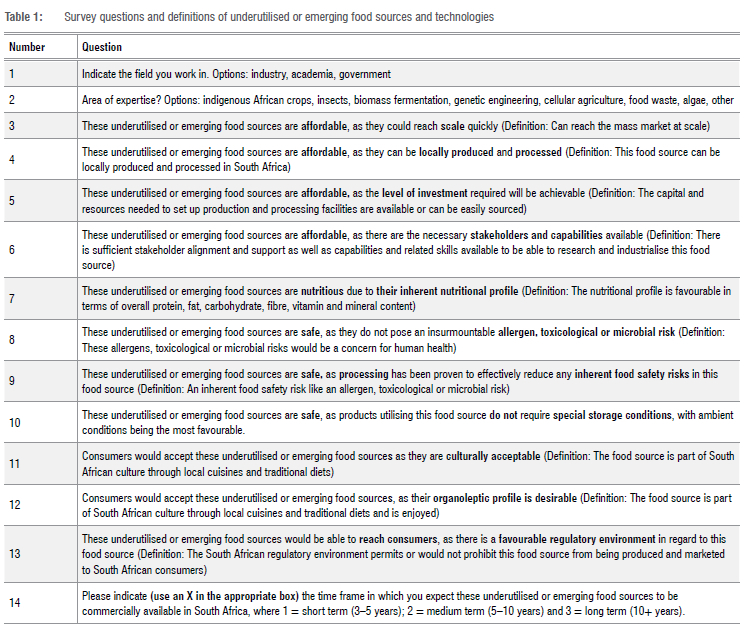
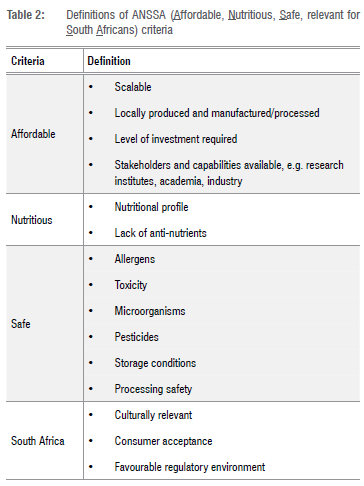
A quantitative study was conducted to gain insight from South African food science and technology professionals on the potential of these UEFSTs to provide affordable, nutritious, safe food products. The question was defined so that respondents could familiarise themselves with the six underutilised or emerging food sources. The survey (Table 1) was designed around criteria related to affordability, nutrition, safety, consumer acceptance and regulatory environment (referred to as ANSSA criteria - Affordable, Nutritious, Safe, relevant for South Africans). The ANSSA criteria (Table 2) were designed to evaluate those UEFSTs most likely to be produced locally at scale, to be accepted by South Africans, and to enable a sustainable and affordable diet while improving the population's health. A question was also included to understand the time horizon for commercialisation in South Africa. The survey consisted of 14 questions. The criteria were rated on a 4-point Likert scale, where 4 = strongly agree, 3 = agree, 2 = disagree and 1 = strongly disagree.
Recruitment of experts
We identified experts from government, industry and academia through our professional networks (Figure 1). They were selected for their experience and skills related to the South African food and beverage industry and food science and technology.
Ethical approval was obtained from Stellenbosch University's Ethics Council on 15 July 2021 with project number 22423 before the commencement of the research process. We extended an invitation via email to 53 experts identified to participate in the survey. of the 53 experts invited to participate, 40 agreed and signed the informed consent letter. They were told that they could withdraw their participation at any point during the survey.
Statistical analysis
The questionnaire (in Microsoft Word) was sent to all willing participants electronically via email to complete the survey (Figure 1). MS Excel was used to capture the response data and STATISTICA 14 (TIBCO Software Inc. Data Science Workbench, version 14, 2020) was used to analyse the data.
Constructs in the study were measured with items on a Likert scale, and the reliability of the items was investigated with Cronbach alpha analyses to indicate how well the set of items in the survey results related to each other. The mean of the reliable items was used to measure these constructs.
The relationships between two continuous variables were investigated using regression analysis, and the relationship's strength was measured with the Spearman correlation to determine whether there was a correlation between the variables. The agreement between repeated measures of the same variable was investigated through Bland-Altman plots. The relationships between continuous response variables and nominal input variables were analysed to determine if there were statistically significant differences using appropriate analyses of variance (ANOVA). A p-value of less than 0.05 represents statistical significance in hypothesis testing, and 95% confidence intervals were used to describe the estimation of unknown parameters.
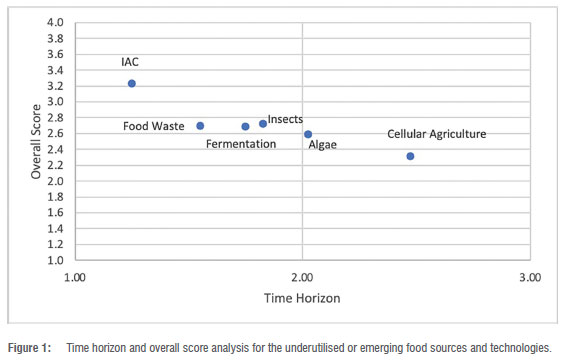
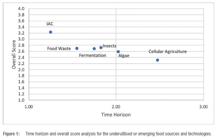
The total scores of each underutilised or emerging new food source from this survey were plotted against the estimated time horizon indicated to determine the most promising future food sources.
Results and discussion
Summarised results of the literature review on UEFST
Indigenous African crops
Modern agricultural systems promote the cultivation of a limited number of crop species, such as wheat and maize, and have neglected the utilisation of indigenous African crops (IACs).2222-2423-2728,29
Insects
The consumption of insects, also called entomophagy, is practised by more than two billion people worldwide and is steadily increasing.30-32 3330,31,343430,31
Fermentation
Dating back 6000 years, fermentation is the oldest and most economical biotechnology process.35,3636
Fungal mycoproteins are already widely consumed as meat alternatives through the brand Quorn, which is made from Fusarium venenatum.16,17,36 36
Precision fermentation can also use microbial cells to produce specific functional ingredients or recombinant proteins such as dairy, egg or heme proteins that can enhance plant proteins, cultivated animal cells or other microbial biomass.16,3636,3736,37
Cultured meat or seafood
Cultured meat or seafood is an emerging branch of biotechnology that encompasses culturing techniques to manufacture products typically obtained from animal production.38,3939,40 394138,39,4138,39,42
Food waste
It is estimated that 30% of all food produced on the planet is lost before reaching a human stomach.4343,44
A staggering 10 million tonnes (about one-third) of food is wasted in South Africa.44,4545
The edible portion of currently wasted foods is an emerging source of new ingredients for the food-processing industry.2116
Algae
Algae have been exploited for centuries as food and feed.4647 Chlorella microalgae for human consumption. Algae are abundant primary producers with multiple species having a high protein content, oils rich in polyunsaturated fatty acids (PUFAs), a high fibre content, vitamins, minerals, antioxidants and natural colourants.46,48
Algae use less land, are fast growing, can grow in areas unsuitable for plants, and more efficiently utilise energy from sunlight.48,494850 46
Results of the quantitative expert survey
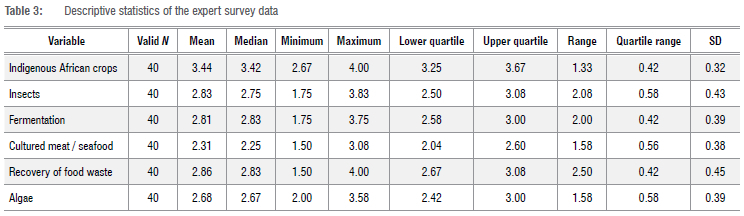
Descriptive statistics were used to describe the variables (Table 3). Of the 40 expert respondents, 50% were from industry and 50% were from academia or government (called academia for statistical analysis purposes). The power analysis result for the total group of 40 respondents was a 90% power with a small/medium effect size of δ = 0.53. When comparing the two groups of 20 each, industry compared to academia, there was a 90% power and medium effect size of δ = 0.75. The power analysis measures the likelihood that a researcher will find statistical significance in a sample if the effect exists.
Overall results
Indigenous African crops
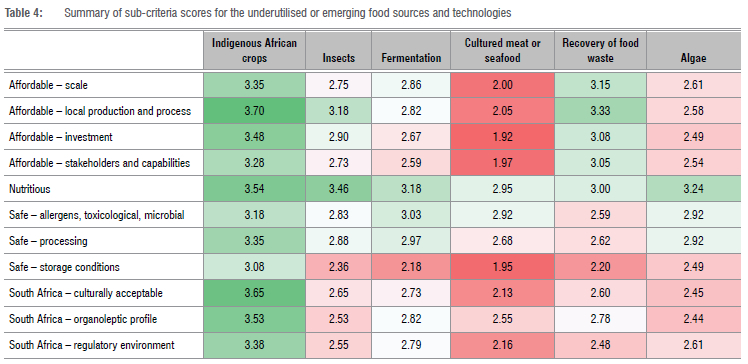
lACs recorded the highest mean and highest scores out of the six UEFST for each criterion (Tables 3 and 4). This was consistent across both the industry and academic expert groups. IACs received the highest score for the 'Affordable' criteria due to their ability to be locally produced and processed. IACs are inherently suitable to the South African climate, especially given their drought tolerance, and are currently grown by subsistence farmers. The potential integration of subsistence farming with the formal market would create economic opportunities, employment and improved food security. The criterion of 'Safe' was the lowest score related to inherent allergens, toxicological and microbial risks. With such positive results across all criteria, the question remains: why are lACs not being utilised more to address food insecurity in South Africa? Some respondents (3 of 40) highlighted that the perception of these crops being linked to poverty requires a real public shift to enable the adoption of this underutilised food source.
Insects
Insects scored the second highest of the six UEFSTs for the criterion of 'Nutritious', which was the highest of all the criteria for insects (Table 4). The lowest overall result for insects was related to the 'South Africa' criterion. Challenges were related to cultural acceptability, organoleptic profile and favourable regulatory environment. These are significant barriers to insect protein gaining momentum globally, not only in South Africa. In many parts of rural South Africa, however, catching, cooking and eating insects whole is a common practice.5131
Fermentation
The criterion of 'Nutritious' was the highest score for this UEFST (Table 4). The lowest scores for fermentation were for the criteria of 'Safe', related to contamination of reactors and the requirement of chilled storage conditions and 'Affordable' associated with the lack of stakeholders and capabilities (respondents highlighted the need for specialised scientific support and research), as well as investment available for this technology. Furthermore, the 'South Africa' criterion scored lower for cultural acceptability, organoleptic profile and regulatory environment. Fermentation has been a culturally acceptable processing practice for dairy (e.g. amasi) and grains (e.g. mageu) for generations, and hence, an extension of this into meat/dairy alternatives or nutritional ingredients is a leap consumers could make if transparency and trust are maintained between industry, regulators and consumers.
Cultured meat or seafood
Cultured meat or seafood scored the lowest of the UEFSTs for the 'Affordability' criterion. This was related to the investment required, the availability of stakeholders and capabilities (respondents highlighted the need for specialised scientific support and research), and the ability to reach scale with local production and processes (Table 4). All these challenges identified by the respondents are aligned with an emerging and novel technology. Further barriers to meeting the criteria are related to cultured meat or seafood being culturally acceptable in a country where animal meat is extremely desirable from a cultural, heritage and status perspective. In addition, the regulatory environment is a barrier as no regulations exist for cultured meat and seafood from the Department of Agriculture, Land Reform and Rural Development. Furthermore, there were safety hurdles related to storage conditions, namely requiring a chilled/cold chain.
The Mann-Whitney test indicated a significant difference (p = 0.04) between industry and academia in their assessment of cultured meat or seafood. Academia scored higher at 2.43 than the 2.18 for industry, indicating that industry is challenged to engage with this new technology as multiple hurdles remain to be solved at the research and scale-up stage and, hence, is not yet ready for commercialisation. There are two cultured meat start-ups, Mzansi Meats Co. (now Newform Foods) and WildBio, and a cultured seafood start-up, Sea-Stematic, headquartered in South Africa.
Recovery of food waste
A few respondents (3 of 40) highlighted food waste avoidance as a critical first step to feeding hungry South Africans. They indicated that food manufacturers are working hard to integrate post-industrial food waste into their processes but suggested there is more value to be captured. In line with the United Nation's Sustainable Development Goals, food manufacturers and retail members of the Consumer Goods Council of South Africa launched the South African Food Loss and Waste Voluntary Agreement, committing to halving food waste by 2030.52
Food waste recovery scored highest in the 'Affordable' sub-criteria and the 'Nutritious' criterion (Table 4). However, it scored the lowest for safety of all the UEFSTs, with respondents highlighting storage as the primary concern (most likely after recovery and before processing), then inherent food safety risks (examples given by respondents were cross-contamination, pathogen growth, mycotoxins and microbial spoilage) and then safe processing. Furthermore, respondents highlighted the lack of a favourable regulatory environment for companies to redistribute food waste as a key barrier. Consumer acceptance was also highlighted as a challenge, with respondents suggesting the term 'food surplus' rather than 'food waste'.
Algae
The major hurdle for algae indicated by respondents was acceptance by the South African consumer, with cultural acceptance and organoleptic profile scoring the lowest (Table 4). Unlike in Asia, eating algae is not part of the South African diet. Furthermore, respondents indicated affordability with a lack of investment, stakeholder and capability (respondents highlighted the need for specialised scientific support and research) and local production and processes as challenges. The 'Nutritious' criterion was the highest score for algae, suggesting that using nutrients and bioactive extracts from algae to enhance products is an opportunity.
Time frames
Respondents indicated that the two most promising UEFSTs - IACs and food waste recovery - could be available to South Africans in the shortest time frame (within 3-5 years), with a score of > 2.8 for their ability to meet the criteria identified (Figure 1). According to the Spearman correlation, acceptance by South Africans of recovered food waste as a food source is the reason for the longer time frame (p = 0.04) for this UEFST. Fermentation and insects are next in terms of time frames to commercialisation (< 5-10 years) and they scored > 2.8. The Spearman correlation indicated that the criterion of 'affordability' was the main reason for the longer time estimates provided for fermentation by the respondents (p = 0.02).
The two underutilised or emerging food sources and technologies with the most extended time frames to availability are algae and cultured meat or seafood (> 5-10 years). 'Affordability', 'safety' and 'acceptance' by South African consumers were all reasons for the longer time estimates provided by respondents for algae when analysing the Spearman correlation.
Conclusion
UEFSTs could be an essential solution in providing South Africans with affordable, nutritious, safe foods. These could be in the form of a nutritious ingredient enhancing the overall nutritional profile of a product with added macro- or micronutrients derived from insects, algae or food waste. Replacement of whole animal/fish proteins could be through biomass fermentation, cultured meat, seafood, or hybrids utilising plant proteins and precision fermentation. Enhancing dietary diversity could be achieved by incorporating lACs into our diets through innovative new products like baked goods, snacks or meat alternatives. Through product formulation and flavour science, food products utilising these new ingredients/food sources can be designed to be tasty, ensuring that consumers purchase them again.
Marketing these products to ensure consumers understand what they are, as well as their benefits, is essential to any new product adoption, especially to overcome food neophobia. Respondents in the survey highlighted that, as South Africa is so diverse, products made from UEFSTs will not necessarily appeal to all South Africans. However, they may be targeted to a niche-conscious consumer group and grow in mass adoption and acceptance over time.
Respondents indicated that, for any of these UEFSTs to reach the market, there needs to be investment from industry, governments, and academia into research, technical capability building and scale-up infrastructure through to commercialisation. According to the report conducted by Mouton et al.535353
It is also evident from the research that for many of these UEFSTs to become available to South Africans, a progressive and agile regulatory environment needs to be in place, which is not the case today. For example, Singapore's Food Agency approved the sale of cultured meat in 2020, enabling start-ups like Eat Just to test and scale this technology in that country.5455
Industry, too, needs to shift R&D investment and focus on supporting research and capability building. Food and beverage multinationals traditionally spend far less on R&D than other sectors like the healthcare, automotive and technology sectors.5656
Recommendations
Future diets of South Africans could be far more diverse and nutritious and have less impact on the climate and environment if we invest in UEFST research and commercialisation. This requires a collaborative stakeholder effort from academia, government and industry to ensure UEFSTs reach everyday South Africans. Some recommendations from the research are for:
• government funding and incentives for research, development, infrastructure and commercialisation;
• an agile regulatory framework to assess safety and enable novel technologies to be commercialised; and
• industry venture capital appetite to assess and invest in start-ups and research looking to develop and commercialise UESFT.
Limitations
The experts identified for the survey to map underutilised and emerging food sources to provide safe, affordable, and nutritious foods for South Africans, were from the researchers' professional network. To reduce bias, a statistically significant sample size of respondents was recruited that represents the various role players of academia, government, and industry.
Data availability
The data supporting the results of this study are available upon request to the corresponding author.
Declarations
We have no AI or LLM use to declare. L-C.R-R. worked in the South African food and beverage industry while conducting this research as part of her PhD. Ethical approval was obtained from Stellenbosch University's Ethics Council (project number 22423).
Authors' contributions
L-C.R-R.: Conceptualisation, methodology, project leadership, investigation, formal analysis, validation, data curation, writing - the original draft. G.O.S.: Conceptualisation, methodology, supervision, writing -review and editing. Both authors read and approved the final manuscript.
Acknowledgements
Dr Scott Drimie, Maricel Krügel and Dr Melvi Todd from Stellenbosch University are acknowledged for providing guidance during the study. Dr Leah Bessa and Dr Vusi Mshayisa are acknowledged for their review and contribution to this research. We thank all the food science professionals who participated in the survey and L-C.R-R.'s employers during the study for providing time and financial assistance.
References
-
1. The World Bank. Poverty & equity brief South Africa [document on the Internet]. 2025 [cited 2025 Apr 25]. Available from: https://documents.worldbank.org/en/publication/documents-reports/documentdetail/099542004222542658
» https://documents.worldbank.org/en/publication/documents-reports/documentdetail/099542004222542658 -
2. Statistics South Africa. Quarterly Labour Force Survey P0211 [document on the Internet]. c2024 [cited 2025 Apr 25]. Available from: https://www.statssa.gov.za/publications/P0211/P02114thQuarter2024.pdf
» https://www.statssa.gov.za/publications/P0211/P02114thQuarter2024.pdf -
3. Statistics South Africa . Assessing food inadequacy and hunger in South Africa 2021 using the General Household Survey (GHS) [document on the Internet]. c2021 [cited 2025 Apr 25]. Available from: https://www.statssa.gov.za/publications/03-00-20/03-00-202021.pdf
» https://www.statssa.gov.za/publications/03-00-20/03-00-202021.pdf -
4. Statistics South Africa . Living conditions of households in South Africa: An analysis of household expenditure and income data using the LCS 2014/2015 [document on the Internet]. c2017 [cited 2020 Sep 21]. Available from: http://www.statssa.gov.za/publications/P0310/P03102014.pdf
» http://www.statssa.gov.za/publications/P0310/P03102014.pdf -
5. Pietermaritzburg Economic Justice & Dignity Group. Household affordability index April 2024 [document on the Internet]. c2024 [cited 2025 Apr 25]. Available from: https://pmbejd.org.za/wp-content/uploads/2024/04/PMBEJD_Key-Data_April-2024_24042024.pdf
» https://pmbejd.org.za/wp-content/uploads/2024/04/PMBEJD_Key-Data_April-2024_24042024.pdf - 6. Claasen N, van der Hoeven M, Covic N. Food environments, health and nutrition in South Africa. Working Paper 34. Cape Town: PLAAS, UWC and Centre of Excellence on Food Security; 2016.
-
7. Ronquest-Ross LC, Vink N, Sigge GO. Food consumption changes in South Africa since 1994. S Afr J Sci. 2015;111(9/10), Art. #2014-0354. https://doi.org/10.17159/sajs.2015/20140354
» https://doi.org/10.17159/sajs.2015/20140354 -
8. Institute for Health Metrics and Evaluation. Health data [webpage on the Internet]. No date [cited 2025 Apr 25]. Available from: https://www.healthdata.org/research-analysis/health-by-location/profiles/south-africa
» https://www.healthdata.org/research-analysis/health-by-location/profiles/south-africa -
9. Simelane T. Almost 50% of adult South Africans are overweight or obese. Poverty and poor nutrition are largely to blame. The Conversation. 2024 March 17 [cited 2025 Apr 25]. Available from: https://theconversation.com/almost-50-of-adult-south-africans-are-overweight-or-obese-poverty-and-poor-nutrition-are-largely-to-blame-224286
» https://theconversation.com/almost-50-of-adult-south-africans-are-overweight-or-obese-poverty-and-poor-nutrition-are-largely-to-blame-224286 -
10. International Diabetes Federation. Key information: South Africa [webpage on the Internet]. No date [cited 2025 Apr 25]. Available from: https://idf.org/our-network/regions-and-members/africa/members/south-africa/
» https://idf.org/our-network/regions-and-members/africa/members/south-africa/ -
11. Micha R, editor. Global nutrition report: Stronger commitments for greater action. Bristol: Development Initiatives; 2022. Available from: https://media.globalnutritionreport.org/documents/2022_Global_Nutrition_Report_updated.pdf
» https://media.globalnutritionreport.org/documents/2022_Global_Nutrition_Report_updated.pdf -
12. Global Alliance for the Future of Food. Untapped opportunities for climate action: An assessment of food systems in nationally determined contributions [document on the Internet]. c2022 [cited 2023 Mar 23]. Available from: https://futureoffood.org/wp-content/uploads/2022/03/assessment-of-food-systems-in-ndcs.pdf
» https://futureoffood.org/wp-content/uploads/2022/03/assessment-of-food-systems-in-ndcs.pdf -
13. Von Bormann T. Agri-food systems: Facts and futures. How South Africa can produce 50% more by 2050. Cape Town: World Wide Fund for Nature; 2019. Available from: www.wwf.org.za/report/agrifood_systems
» www.wwf.org.za/report/agrifood_systems -
14. World Wide Fund for Nature. Water [webpgage on the Internet]. No date [cited 2021 Apr 16]. Available from: https://www.wwf.org.za/our_work/water/
» https://www.wwf.org.za/our_work/water/ -
15. Tub C, Seba T. RethinkX disruption, implications and choices. Rethinking food and agriculture 2020-2030. RethinkX; 2019. https://doi.org/10.61322/IJIP9096
» https://doi.org/10.61322/IJIP9096 -
16. Pyett S, de Vet E, Trindade LM, van Zanten HHE, Fresco L. Chickpeas, crickets and Chlorella: Our future proteins [document on the Internet]. Wageningen: Wageningen University & Research; 2019. Available from: http://edepot.wur.nl/496402
» http://edepot.wur.nl/496402 -
17. Vanhercke T, Colgrave M. What's brewing? Precision food proteins from fermentation [webpage on the Internet]. c2022 [cited 2022 Apr 18]. Available from: https://research.csiro.au/synthetic-biology-fsp/food-australia-precision-fermentation/
» https://research.csiro.au/synthetic-biology-fsp/food-australia-precision-fermentation/ -
18. Ronquest-Ross LC, Vink N, Sigge GO. Application of science and technology by the South African food and beverage industry. S Afr J Sci. 2018;114(9/10), Art. #4757. https://doi.org/10.17159/sajs.2018/4757
» https://doi.org/10.17159/sajs.2018/4757 -
19. Ngige L. Meet the founder: Mzansi Meat's co-founders on building a global foodtech company with African roots [webpage on the Internet]. c2022 [cited 2025 Apr 25]. Available from: https://agfundernews.com/mzansi-meat-co-founders-on-building-a-global-foodtech-company-with-african-roots
» https://agfundernews.com/mzansi-meat-co-founders-on-building-a-global-foodtech-company-with-african-roots -
20. Ministry of Food, Agriculture and Fisheries of Denmark. Danish action plan for plant-based foods [document on the Internet]. c2023 [cited 2025 Apr 25]. Available from: https://en.fvm.dk/Media/638484294982868221/Danish-Action-Plan-for-Plant-based-Foods.pdf
» https://en.fvm.dk/Media/638484294982868221/Danish-Action-Plan-for-Plant-based-Foods.pdf -
21. Knorr D, Augustin MA, Tiwari B. Advancing the role of food processing for improved integration in sustainable food chains. Front Nutr. 2020;7, Art. #34. https://doi.org/10.3389/fnut.2020.00034
» https://doi.org/10.3389/fnut.2020.00034 -
22. Chivenge P, Mabhaudhi T, Modi AT, Mafongoya P. The potential role of neglected and underutilised crop species as future crops under water scarce conditions in sub-Saharan Africa. Int J Environ Res Public Health. 2015;12:5685-5711. https://doi.org/10.3390/ijerph120605685
» https://doi.org/10.3390/ijerph120605685 -
23. Raheem D. The need for agro-allied industries to promote food security by value addition to indigenous African food crops. Outlook Agric. 2011;40:343-349. https://doi.org/10.5367/oa.2011.0063
» https://doi.org/10.5367/oa.2011.0063 -
24. Taylor JRN, Belton PS, Beta T, Duodu KG. Increasing the utilisation of sorghum, millets and pseudocereals: Developments in the science of their phenolic phytochemicals, biofortification and protein functionality. J Cereal Sci. 2014;59:257-275. https://doi.org/10.1016/j.jcs.2013.10.009
» https://doi.org/10.1016/j.jcs.2013.10.009 -
25. Adebiyi JA, Obadina A, Adebo OA, Kayitesi E. Fermented and malted millet products in Africa: Expedition from traditional/ethnic foods to industrial value-added products. Crit Rev Food Sci. 2016;58:463-474. https://doi.org/10.1080/10408398.2016.1188056
» https://doi.org/10.1080/10408398.2016.1188056 -
26. Onyeoziri IO, Kinnear M, de Kock HL. Relating sensory profiles of canned amaranth (Amaranthus cruentus), cleome (Cleome gynandra), cowpea (Vigna unguiculata) and Swiss chard (Beta vulgaris) leaves to consumer acceptance. J Sci Food Agric. 2017;98:2231-2242. https://doi.org/10.1002/jsfa.8710
» https://doi.org/10.1002/jsfa.8710 -
27. Akinola R, Pereira LM, Mabhaudhi T, de Bruin FM, Rusch L. A review of indigenous food crops in Africa and the implications for more sustainable and healthy food systems. Sustainability. 2020;12, Art. #3493. https://doi.org/10.3390/su12083493
» https://doi.org/10.3390/su12083493 -
28. South African Department of Agriculture, Land Reform & Rural Development. Most common indigenous crops of South Africa [document on the Internet]. c2013 [cited 2020 Jun 20]. Available from: https://www.nda.agric.za/docs/Brochures/Indigfoodcrps.pdf
» https://www.nda.agric.za/docs/Brochures/Indigfoodcrps.pdf -
29. Shaver D. Future 50 foods [document on the Internet]. c2019 [cited 2021 Apr 16]. Available from: https://www.wwf.org.uk/sites/default/files/2019-02/Knorr_Future_50_Report_FINAL_Online.pdf
» https://www.wwf.org.uk/sites/default/files/2019-02/Knorr_Future_50_Report_FINAL_Online.pdf - 30. Rumpold BA, Schlüter O. Insect-based protein sources and their potential for human consumption: Nutritional composition and processing. Anim Front. 2015;5:20-24.
-
31. Bessa LW, Pieterse E, Sigge G, Hoffman LC. Insects as human food; from farm to fork. J Sci Food Agric. 2017;100(14):5017-5022. https://doi.org/10.1002/jsfa.8860
» https://doi.org/10.1002/jsfa.8860 -
32. Kim TK, Yong HI, Kim YB, Kim HW, Choi YS. Edible insects as a protein source: A review of public perception, processing technology, and research trends. Food Sci Anim Resour. 2019;39:521-540. https://doi.org/10.5851/kosfa.2019.e53
» https://doi.org/10.5851/kosfa.2019.e53 -
33. Iwuoha JP. The top 4 most eaten insects in Africa; and why insect farming has become a big business opportunity [webpage on the Internet]. c2016 [cited 2021 Apr 16]. Available from: https://www.linkedin.com/pulse/top-4-most-eaten-insects-africa-why-insect-farming-has-iwuoha/
» https://www.linkedin.com/pulse/top-4-most-eaten-insects-africa-why-insect-farming-has-iwuoha/ -
34. Van Huis A. Potential of insects as food and feed in assuring food security. Annu Rev Entomol. 2013;58:563-583. https://doi.org/10.1146/annurev-ento-120811-153704
» https://doi.org/10.1146/annurev-ento-120811-153704 -
35. Mishra SS, Ray RM, Panda SK, Montet D. Technological innovations in processing of fermented foods - An overview. In: Ray RC, Montet D, editors. Fermented foods part II: Technological Intervention. Boca Raton, FL: CRC Press; 2017. https://doi.org/10.1201/9781315205359
» https://doi.org/10.1201/9781315205359 -
36. Specht L, Crosser N. 2020 State of the industry report. Fermentation: Meat, eggs, and dairy. Washington DC: The Good Food Institute; 2020. Available from: https://gfi.org/wp-content/uploads/2021/04/COR-SOTIR-Fermentation-2021-10-01-1.pdf
» https://gfi.org/wp-content/uploads/2021/04/COR-SOTIR-Fermentation-2021-10-01-1.pdf -
37. Floros JD, Newsome R, Fisher W, Barbosa-Cánovas GV Chen H, Dunne CP, et al. Feeding the world today and tomorrow: The importance of food science and technology: An IFT scientific review. Compr Rev Food Sci Food Saf. 2010;9:572-599. https://doi.org/10.1111/j.1541-4337.2010.00127.x
» https://doi.org/10.1111/j.1541-4337.2010.00127.x -
38. Stephens N, Di Silvioc L, Dunsford I, Ellis M, Glencross A, Sexton A. Bringing cultured meat to market: Technical, socio-political, and regulatory challenges in cellular agriculture. Trends Food Sci. 2018;78:155-166. https://doi.org/10.1016/j.tifs.2018.04.010
» https://doi.org/10.1016/j.tifs.2018.04.010 -
39. Swartz E. SBE Special Section: Industrial Biotechnology: Meeting the needs of the cell-based meat industry. CEP. 2019;Oct:41-45. Available from: https://gfi.org/images/uploads/2020/02/Cell-Based_Meat_CEP_Oct2019.pdf
» https://gfi.org/images/uploads/2020/02/Cell-Based_Meat_CEP_Oct2019.pdf -
40. Buss D. How radical innovation will shape the future of food. Food Technology Magazine. 2020 August 01. Available from: https://www.ift.org/news-and-publications/food-technology-magazine/issues/2020/august/features/how-radical-innovation-will-shape-the-future-of-food?token=b8b01179-5807-4849-8818-bffb21cc4102
» https://www.ift.org/news-and-publications/food-technology-magazine/issues/2020/august/features/how-radical-innovation-will-shape-the-future-of-food?token=b8b01179-5807-4849-8818-bffb21cc4102 -
41. Post M, Levenberg S, Kaplan D, Genovese N, Fu J, Bryant CJ, et al. Scientific, sustainability and regulatory challenges of cultured meat. Nat Food. 2020;1(7):403-415. https://doi.org/10.1038/s43016-020-0112-z
» https://doi.org/10.1038/s43016-020-0112-z -
42. Minchin J. Cultivated meat can cause up to 93 percent less global warming says study. New Food Magazine. 2021 March 09. Available from: https://www-newfoodmagazine-com.cdn.ampproject.org/c/s/www.newfoodmagazine.com/news/140769/cultivated-meat-global-warming/amp/
» https://www-newfoodmagazine-com.cdn.ampproject.org/c/s/www.newfoodmagazine.com/news/140769/cultivated-meat-global-warming/amp/ -
43. Food and Agriculture Organization of the United Nations (FAO). Global food losses and food waste - Extent, causes and prevention. Rome: FAO; 2011. Available from: https://www.fao.org/3/i2697e/i2697e.pdf
» https://www.fao.org/3/i2697e/i2697e.pdf -
44. Nahman A, de Lange W. Costs of food waste along the value chain: Evidence from South Africa [document on the Internet]. c2013 [cited 2021 Apr 16]. Available from: https://researchspace.csir.co.za/dspace/bitstream/handle/10204/7115/Nahman2_2013.pdf?sequence=3&isAllowed=y
» https://researchspace.csir.co.za/dspace/bitstream/handle/10204/7115/Nahman2_2013.pdf?sequence=3&isAllowed=y -
45. Oelofse SHH, Polasi T, Haywood L , Musvoto C. Increasing reliable, scientific data and information on food losses and waste in South Africa. Waste Research Development and Innovation Roadmap Research Report, CSIR External Report CSIR/SPLA/SECO/ER/2021/0019/A. Pretoria: CSIR Smart Places Cluster; 2021. Available from: https://wasteroadmap.co.za/wp-content/uploads/2021/06/17-CSIR-Final_Technical-report_Food-waste.pdf
» https://wasteroadmap.co.za/wp-content/uploads/2021/06/17-CSIR-Final_Technical-report_Food-waste.pdf -
46. Vigani M, Parisi C, Rodríguez-Cerezo E, Barbosa MJ, Sijtsma L, Ploeg M, et al. Food and feed products from micro-algae: Market opportunities and challenges for the EU. Trends Food Sci. 2015;42: 81-92. https://doi.org/10.1016/j.tifs.2014.12.004
» https://doi.org/10.1016/j.tifs.2014.12.004 -
47. Deepthi Hebbale MD, Subash Chandran NVJ, Ramachandra TV. Energy and food security from macroalgae. J Biodivers. 2017;8(1):1-11. https://doi.org/10.31901/24566543.2017/08.01.01
» https://doi.org/10.31901/24566543.2017/08.01.01 -
48. Kovac DJ, Simeunovic JB, Babic OB, Misan AC, Milovanovic IL. Algae in food and feed. Food Feed Res. 2013;40:21-31. Available from: https://foodandfeed.fins.uns.ac.rs/uploads/Magazines/magazine_123/Algae-in-food-and-feed.pdf
» https://foodandfeed.fins.uns.ac.rs/uploads/Magazines/magazine_123/Algae-in-food-and-feed.pdf -
49. Poinski M. How algae's potential could make other ingredients green with envy [webpage on the Internet]. c2021 [cited 2021 Apr 16]. Available from: https://www.fooddive.com/news/algae-ingredient-trends/593095/
» https://www.fooddive.com/news/algae-ingredient-trends/593095/ -
50. Becker EW. Micro-algae as a source of protein. Biotechnol Adv. 2007;25: 207-210. https://doi.org/10.1016/j.biotechadv.2006.11.002
» https://doi.org/10.1016/j.biotechadv.2006.11.002 -
51. Schutz E. Termites on the menu: Protecting South Africa's edible insects [webpage on the Internet]. c2020 [cited 2021 Apr 16]. Available from: https://www.dw.com/en/termites-on-the-menu-protecting-south-africas-edible-insects/a-55949049
» https://www.dw.com/en/termites-on-the-menu-protecting-south-africas-edible-insects/a-55949049 -
52. Consumer Goods Council of South Africa. Consumer Goods Council of South Africa (CGCSA) launches the South African food loss and waste voluntary agreement [webpage on the Internet]. c2020 [cited 2021 Apr 16]. Available from: https://www.dffe.gov.za/consumer-goods-council-south-africa-cgcsa-launches-south-african-food-loss-and-waste-voluntary#:~:text=Johannesburg%20%E2%80%93%20The%20Consumer%20Goods%20Council%20of%20South,%28SDG%29%20to%20halve%20global%20food%20waste%20by%202030
» https://www.dffe.gov.za/consumer-goods-council-south-africa-cgcsa-launches-south-african-food-loss-and-waste-voluntary#:~:text=Johannesburg%20%E2%80%93%20The%20Consumer%20Goods%20Council%20of%20South,%28SDG%29%20to%20halve%20global%20food%20waste%20by%202030 -
53. Mouton J, Basson I, Blanckenberg J, Boshoff J, Prozesky H, Redelinghuys H, et al. The state of the South African research enterprise [document on the Internet]. c2020 [cited 2022 May 12]. Available from: http://www0.sun.ac.za/crest/wp-content/uploads/2019/08/state-of-the-South-African-research-enterprise.pdf
» http://www0.sun.ac.za/crest/wp-content/uploads/2019/08/state-of-the-South-African-research-enterprise.pdf -
54. Ives M. Singapore approves a lab-grown meat product, a global first. NY Times. 2020 December 02 [cited 2022 May 28]. Available from: https://www.nytimes.com/2020/12/02/business/singapore-lab-meat.html
» https://www.nytimes.com/2020/12/02/business/singapore-lab-meat.html -
55. Selby G. Dutch government invests record €60 M to boost cellular meat & agriculture [webpage on the Internet]. c2022 [cited 2022 May 28]. Available from: https://www.foodingredientsfirst.com/news/dutch-government-invests-record-%E2%82%AC60m-to-boost-cellular-meat-agriculture.html
» https://www.foodingredientsfirst.com/news/dutch-government-invests-record-%E2%82%AC60m-to-boost-cellular-meat-agriculture.html -
56. Geller M. Food revolution: Megatrends turn to small start-ups for big ideas. Reuters. 2017 May 24 [cited 2022 May 28]. Available from: https://www.reuters.com/article/us-food-investment-insight-idUSKBN18K18O
» https://www.reuters.com/article/us-food-investment-insight-idUSKBN18K18O

Revised: 28 Apr. 2025
Accepted: 30 Apr. 2025
Published: 11 Aug. 2025
Funding: None