The efficiency of stone and bone tools for opening termite mounds: implications for hominid tool use at Swartkrans
Abstract
STONE AND BONE TOOL ARTEFACTS HAVE been recovered from Swartkrans cave deposits in the Cradle of Humankind World Heritage Site, dated to the early and middle Pleistocene. It has been suggested that bone tools were used for digging up tubers of edible plants, excavating termite mounds, or as multi-purpose tools. Here we present results of experiments on the efficiency of both bone and stone tools for the excavation of modern termite mounds. Efficiency of penetrating a termite mound crust is defined by the total excavated mass of the mound, when controlling for the number of strokes used. We demonstrate that stones of considerable mass are most effective in opening up termite mounds, whereas bone tools are relatively more efficient than stone tools when controlling for mass. The light weight, efficiency, and the nature of polish and wear on some Swartkrans artefacts makes it probable that selected bone tools were being carried by hominids and used for more than one purpose.
Introduction
Swartkrans cave, situated one kilometre west of Sterkfontein in Gauteng province, South Africa, has yielded fossilized remains of Paranthropus robustus and Homo ergaster, together with stone artefacts, bone and horn tools, as well as evidence for the controlled use of fire in Pleistocene contexts.1 1 2–4 and van Ryneveld.5
Materials and methods
We examined the following question: to what effect, if at all, are bone tools more efficient than stone tools for breaking through the hard crust of termite mounds associated with the genus Trinervitermes, which has a widespread distribution in southern African savanna habitats?6
Backwell and d'Errico's (2001) analysis of Swartkrans bone tools suggests that they were manufactured from weathered long bones. Here, bone tools were made from both weathered and fresh bone. The weathered bone tools were made from the remains of modern Equus asinus. The spine of a scapula as well as a partial rib made sturdy tools. Two more tools were made from an Equus mandible, simulating possible use of a Hipparion lybicum mandible from Swartkrans (Member 3) that displays wear and polish.1
Horn core artefacts are also found in the Swartkrans sample.1 Connochaetes) was used as a tool in our experiments. In addition, fresh Bos femora were obtained from a local butcher. A large, 3.5-kg quartzite stone from this study was used first to break the shafts of each femur and then employed further to strike off bone flakes. In total, four bone tools were created from shaft fragments, one with the distal end of the bone still intact.
Our experiments were conducted outside the Cradle of Humankind, near Krugersdorp, on land recently disturbed by fire. The first author used each tool to strike an intact area of termite mound crust 25 times, after which the freshly loosened material of the termite mound was collected and weighed.
Results
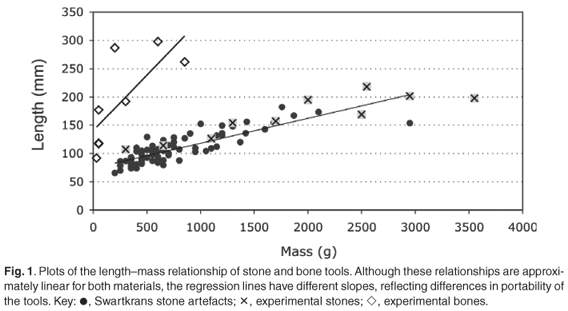
There is a linear relationship between the length and mass of both stone and bone tools (Fig. 1). The two materials show different trajectories (slope of graph), however, due to their different densities. Bone manifested slightly more variation than stone. The difference is not of major concern, however, given the small sample size, the variation in the cortical and trabecular structure within each bone, and the inclusion of both weathered and fresh bone in the figure. The length and mass of the bone tools from Swartkrans are not included here because of their fragmentary nature and the use of plaster in some of their reconstructions.
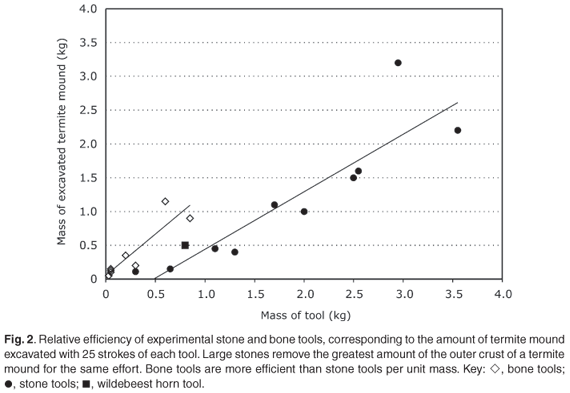
There is an approximately linear relationship between the amount of termite mound removed with 25 strikes of a modern experimental tool and its mass (Fig. 2). Using this relationship to define efficiency, bone and stone tools can again be distinguished, as expressed by differences in slope of the corresponding regression lines.
Discussion
Bone tools are more efficient than stones of the same mass, and remove approximately twice as much termite mound per unit mass for the same effort. As with the Swartkrans bone tools, they may have been used to excavate termites, but they would not have been the most effective means available for the removal of the outer crust. Once the outer crust is broken, the mass of the tool no longer relates to its efficiency in removing the soft interior. The surface area of a tool, among other attributes, may then play a preferred role for excavating the easily removed inside of the mound.
The light weight and relative efficiency of bone tools makes them portable yet highly useful for a variety of tasks. Brain and Shipman1 2–4 propose the excavation of termite mounds, whereas van Ryneveld5 different tasks, but it does suggest that tools were used several times, and were probably saved and carried to more than one locality.
The most efficient bone tools were shaft fragments with an articular surface still intact. Our results show that this efficiency was a result of the extra mass provided by the articular surface, but can also be related to being easier to grip, as noted by van Ryneveld.5 8, 9 Size selection is also seen in the Swartkrans bone tools. Backwell and d'Errico2
Only one horn tool was analysed in our experiment, and its efficiency was intermediate between that of bone and stone tools of the same mass. Its greater efficiency than bone was likely due to the sharply tapered edge of a tool with mass at the upper limit of values obtained for bone. The greater mass came from using the entire horn, however, making it unwieldy.
Termites contribute to the diet of all the great apes. Gorillas,10 11 12,13 Some people (including the Venda in South Africa) consume termites, and the high protein resource may have also contributed to the palaeodiet of australopithecines. Scott et al.14 Australopithecus africanus and A. robustus from Sterkfontein and Swartkrans, respectively. They observe 'some differences' between microwear in the two species and aver that A. robustus may have had a diet that included 'hard and brittle foods', whereas A. africanus consumed 'tough' foods. Stable carbon isotope analyses of hominid tooth hydroxyapatite imply the consumption of insects, including termites.15,16 Scott et al.14
Conclusion
We postulate that termites supplemented hominid diets at Swartkrans, and grit associated with these insects contributed to the 'hard and tough' signals apparent from dental microwear studies. Some of the bone tools from this site show evidence of termite foraging, but we have observed that bone would have been of limited efficiency for breaking open the outer crusts of termite mounds. Although only a tool's wear pattern can provide direct evidence of the tasks it performed, understanding the tool's efficiency can provide insight into why it was chosen for use. Stones with a mass of over 2 kg are more efficient than bone tools for penetrating the crust of a termite mound; however, bone tools are more efficient than stones of equal mass for excavating the exposed mound interior. Bone tools may have been selected by the Swartkrans hominids because of their lightness and efficiency, making them easily portable for a range of tasks.
Support from the Helen McKaig Spuhler Graduate Fellowship Fund at the Department of Anthropology, College of Literature, Science and the Arts, University of Michigan, is gratefully acknowledged. This work was also supported by the National Research Foundation and the French Embassy in South Africa.
References
- 1. Brain C.K. and Shipman P. (2004). The Swartkrans bone tools. In Swartkrans: A cave's chronicle of early man, 2nd edn, ed. C.K. Brain, pp. 195–215. Transvaal Museum Monograph, Pretoria.
- 2. Backwell L.R. and d'Errico F. (2001). Evidence of termite foraging by Swartkrans early hominids. Proc. Natl Acad. Sci. USA 98(4), 1358–1363.
- 3. Backwell L.R. and d'Errico F. (2003). Additional evidence on the early hominid bone tools from Swartkrans with reference to spatial distribution of lithic and organic artefacts. S. Afr. J. Sci. 99, 259–267.
- 4. Backwell L. and d'Errico F. (2005). The origin of bone tool technology and the identification of early hominid cultural traditions. In From Tools to Symbols: From early hominids to modern humans, eds F. d'Errico and L.R. Backwell, pp. 238–275. Witwatersrand University Press, Johannesburg.
- 5. Van Ryneveld K. (2003). Bone tools from the early hominid sites, Gauteng: an experimental approach. M.Sc. thesis, University of the Witwatersrand, Johannesburg.
- 6. Uys V. (2002). A Guide to the Termite Genera of Southern Africa. Plant Protection Research Institute, Agricultural Research Council, Pretoria.
- 7. Clark J.D. (2004). Stone artefact assemblages from Members 1–3, Swartkrans Cave. In Swartkrans: A cave's chronicle of early man, 2nd edn, ed. C.K. Brain, pp. 167–194. Transvaal Museum Monograph, Pretoria.
- 8. Brain C.K. (1981). The Hunters or the Hunted? An introduction to African cave taphonomy. University of Chicago Press, Chicago.
- 9. Haynes G. (1983). A guide for differentiating mammalian carnivore taxa responsible for gnaw damage to herbivore limb bones. Paleobiology 9(2), 164–172.
- 10. Tutin C.E. and Fernandez M. (1983). Gorillas feeding on termites in Gabon, West Africa. J. Mammal. 64(3), 530–531.
- 11. Galdikas B.M.F. (1988). Orangutan diet, range and activity at Tanjung Putting, Central Borneo. Int. J. Primatol. 9, 1–35.
- 12. Goodall J. (1971). In the Shadow of Man. Collins, London.
- 13. McGrew W.C., Tutin C.E.G. and Baldwin P.J. (1979). Chimpanzees, tools, and termites: Cross-cultural comparisons of Senegal, Tanzania, and Rio-Muni. Man 14, 185–214.
- 14. Scott R.S., Ungar P.S., Bergstrom T.S., Brown C.A., Grine F.E., Teaford M.F. and Walker A. (2005). Dental microwear texture analysis shows within-species diet variability in fossil hominins. Nature 436, 693–695.
- 15. Van der Merwe N.J., Thackeray J.F., Lee-Thorp J.A. and Luyt J. (2003). The carbon isotope ecology and diet of Australopithecus africanus at Sterkfontein, South Africa. J. Hum. Evol. 44, 581–597.
- 16. Sponheimer M., Lee-Thorp J., de Ruiter D., Codron D., Codron J., Baugh A.T. and Thackeray J.F. (2005). Hominins, sedges, and termites: new carbon isotope data from the Sterkfontein valley and Kruger National Park. J. Hum. Evol. 48, 301–312.