Modelling the dynamics of animal groups in motion
Abstract
Animal groups in motion, examples being fish schools, bird flocks, insect swarms and mammal herds, can exhibit spectacular collective behaviour. Attempts at formalizing the basic individual behaviour that accounts for the complex dynamics of an animal group began over 50 years ago. Numerous models of these dynamics have since been published. We review this information, starting with an overview of various approaches that have arisen from mathematical, physical, and computer-modelling methods. Our focus is on individual-based models of animal groups. Individuals are assumed to exert three types of local interactions with their neighbours in these models, namely attraction, alignment, and repulsion. We review these models according to their main objectives: to compare modelled results with observational data; to analyse the influence of model parameters on simulated group properties; and to investigate group response to any change in environment, or to divergent behaviour of some of the group members.
Introduction
Animal groups, such as fish schools, bird flocks, insect swarms and mammal herds, can exhibit spectacular collective behaviour.1,2 Being part of a group induces multiple changes in individual links with the environment and to siblings.34,5 namely collective benefits (many eyes, and hence a reduced risk of predation) and collective deficits (many mouths, creating increased competition for food). Complex group behaviour may emerge from simple local interactions between individuals. A fish school is not regarded as having a social leader, and individuals do not perceive the school as an entity of which they are a part, yet fish schools display complex coordinated collective behaviour.67
Models of animal groups in motion have been published in ecological8,9 and fish dynamic modelling reviews,101,2 or theoretical notes11–13 on collective animal behaviour. Several examples of these models have also been reported in books on individual-based models1415
Different modelling approaches
Mathematics
A simple mathematical model used to describe aggregative movements is the 'aggregation–diffusion equation'16:

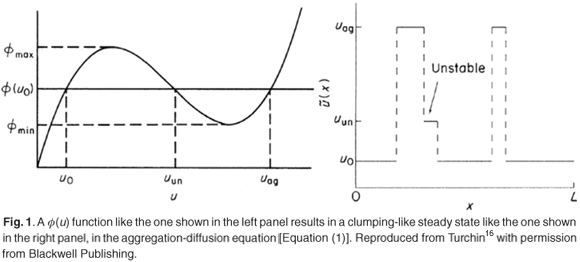
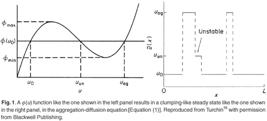
in which u is the density of individuals at time t and space location x along a line. Different shapes of the ø(u) function correspond to different types of interactions between individuals: a linear function ø(u) = Du corresponds to the absence of interaction, resulting in diffusion dynamics, the continuous-time equivalent of a discrete-time random walk; a convex (conversely concave) function results in over-dispersion (conversely under-dispersion), and corresponds to a repulsive (conversely aggregative) interaction. But these dynamics are all 'diffusion-like', in the sense that a steady state of the system has a uniform density u = u0 along the line, where u0 is specified by the boundary conditions u(0,t) = u(L,t) = u0, L being the length of the line. But when ø(u) functions are such that the equation ø(u) = ø(u0) has three roots (Fig. 1, left panel), then the aggregation–diffusion equation gives rise to 'clumping-like' dynamics, where the steady state of the system consists of a succession of both low density and high density zones along the line (Fig. 1, right panel).
Other terms can be added to the aggregation–diffusion equation, in particular, advection and 'reaction' terms, to take into account any environmental (such as sea currents) and demographic (such as growth and mortality) factors, respectively.17–19 For example, see the advection–diffusion–reaction models that have been developed as representing the dynamics of tuna.20–22
Physics
Vicsek et al.23r, with some random perturbation'. The position of each particle i is given by

Its velocity is given a constant value and a direction determined by the angle

In Equation (3), 〈ν(t)〉 denotes the average direction of the velocities of particles located in radius r around particle i, and ξ is a random number chosen from a uniform distribution.
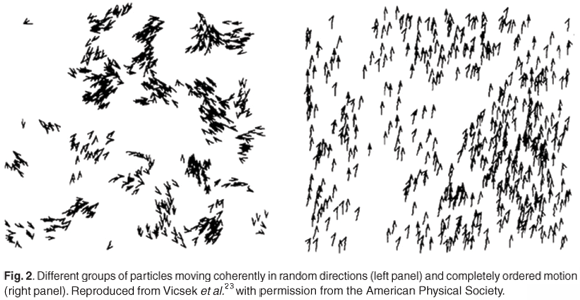
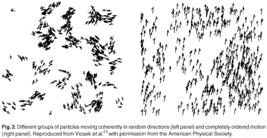
Transitions from disordered motion in this model to discrete groups moving coherently in random directions (Fig. 2, left panel), and thereafter, completely ordered motion (Fig. 2, right panel), occur as particle density increases.232425
Originally developed in two dimensions, the model23262728
Computer science
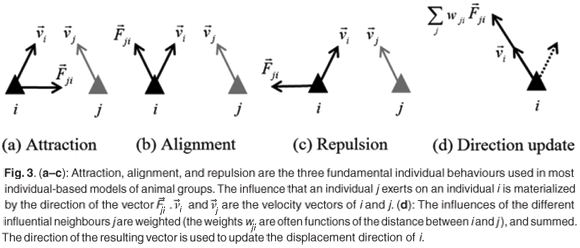
Reynolds2930j may exert on an individual i. This is illustrated in Fig. 3 by the directions of the vector  . This vector is orientated towards (conversely away from) j in the case of an attraction (conversely repulsion) behaviour, and is aligned on the velocity vector,
 , of j, for the alignment behaviour. Generally, each individual i has several influential individuals j in its neighbourhood (termed influential neighbours). In most IBMs the (potentially conflicting) influences of these are weighted by functions of the distance between i and j, and are summed. The resulting vector is used to determine the displacement direction of the individual i at the next time-step (Fig. 3d), and its position is updated using Equation (2). Different types of weighting functions have been used with different IBMs. These functions share some common properties, particularly reflecting the tendency for attraction, alignment and repulsion behaviour to be predominant at large, medium and small distances, respectively. But they also differ in a number of aspects, and the consequences on simulated group characteristics of favouring one type of function over another have been reported in a number of papers.6,31–34
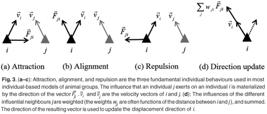
Most IBMs rely on the fundamental principles discussed above, and are therefore conceptually similar to the reported model of self-propelled particles.28
Individual-based models of animal groups
Overview
Of 31 papers on individual-based models of animal groups examined in this review, 20 deal with the dynamics of fish schools.6,35–53 The tendency to select fish in these models has already received attention.5436,40,43,44,46,49–53 varying fields of perception related to different sensory systems (vision and lateral line)36,44 or a fairly sophisticated spring-mass sub-model for locomotion.4931,33,34,55–58 leaving one paper on animal herds,59602924
The objective of early work was to demonstrate that use of IBMs, with simple individual behaviour, allows for simulation of various types of group behaviour40,45,46 and can create realistic animations.29,49 The publications that we examine can be assigned to four categories in terms of their main objectives: a comparison of model results with experimental data, an analysis of the effects of model parameters on the simulated group properties, and an investigation of the simulated group response to a change in its environment, or to divergent behaviour of some of its members.
Comparison of model results with data
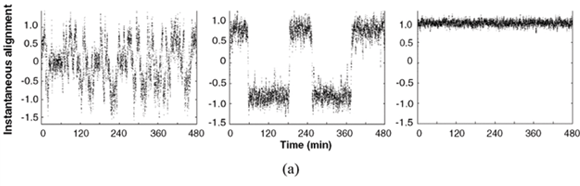
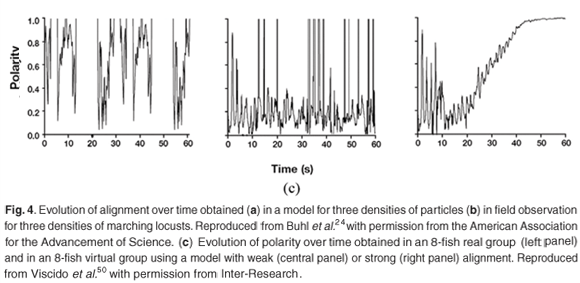
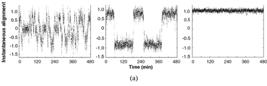
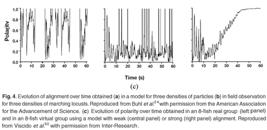
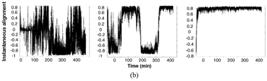
The evolution with time of variables that characterize the alignment of particles in a model, and the alignment of locusts in field observation, have been compared for three different densities.24Fig. 4a and b), are obtained. Moreover, the transitions between the different states occur at approximately the same critical densities. Similarly, the evolution of polarity, another variable characterizing the coherence of the displacement of individuals, has been measured over time, in 8-fish real groups and virtual groups.50Fig. 4c). Several characteristics of simulated fish schools (the distances to nearest neighbours, the degree of polarity, the frequency of the time spent by a fish at the front of a school) are in general good agreement with observed data.42374861
Effects of model parameters on group properties
Analyses of the effects of different types of attraction–alignment–repulsion weighting functions on the simulated group properties31,33 reveal that functions resulting in a smooth transition from one type of behaviour to another (for example, from attraction to repulsion) lead to more cohesive333155455240j individuals that influence the behaviour of individual i, Fig. 3) results in smaller and more-polarized groups.6,40 A larger variability in individual spacing within the group is obtained63151
Group response to environment
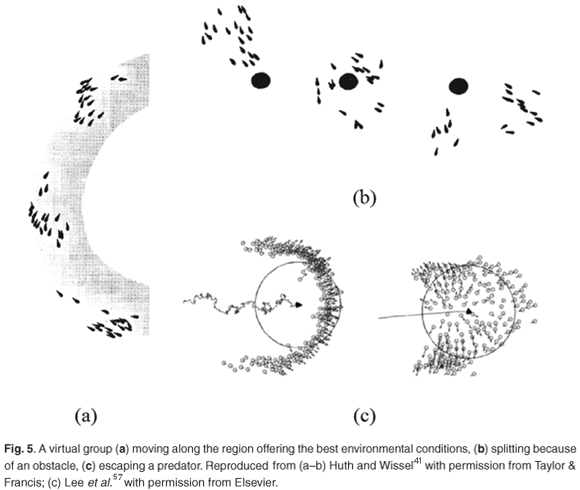
Simple additions to the basic rules used in IBMs allows for the simulation of fish schools when feeding,35,41 swimming along environmental gradients,38,41 avoiding obstacles,38,41,48 and escaping predators.43,53,57,58 A decrease in speed and an increase in the random movement of individuals located in the vicinity of food patches allows one to simulate schools shifting from straight polarized dynamics, while cruising, to loose swarm-like dynamics, while feeding.413541Fig. 5a). A similar approach has been used to simulate the migration of fish schools between spawning and feeding grounds.3841Fig. 5b).
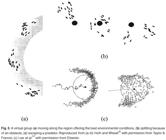
Obstacles can also be represented by unfavourable and avoidable environmental conditions for fish schools.38486043,53,57,58 Typical patterns of fish school responses to predators described in the literature have been identified through simulations.4357Fig. 5c, right); a herd-type response arises when the predator has a more erratic movement (Fig. 5c, left). The interplay between collective escape and 'selfish escape' (when a fish ceases to interact with its neighbours, due to the proximity of the predator) has also been examined.5358
Group response to individual differences
IBMs have also been used largely to study the effects on the group dynamics of some members with different properties, or different behaviour from the others. Various speeds, maximum turning rates, sizes of alignment and repulsion areas, have influence on the positions of individuals relative to the front and/or centre of a group.554736594739,47,56,59 In a modelling experiment where only a small proportion of the fish is attracted towards the source of a stimulus, a critical transition occurs at ~5% of stimulated individuals.3956N1 and N2 individuals have a biased direction towards 0° and x° (x є [0º, 180º]) respectively in a group of 100 individuals moving in a two-dimensional area. With N1 = N2 = 5, and under a critical value of x, the group as a whole is most likely to follow an in-between direction x/2°, whereas above this critical value, it is equally likely to move collectively towards 0° (the preferred direction of the N1 individuals) or x° (the preferred direction of the N2 individuals). In contrast, with N1 = 6 and N2 = 5 there is minimal chance for the group as a whole to move towards x°, and no chance with N1 = 6 and N2 = 4.
Discussion
We have considered models of the dynamics of animal groups using mathematical, physical, or computational methods. Because we focus on individual-based models, our review is biased towards the computational approach (most IBMs considered here have been developed and used in a context of numerical ecology). Spatially explicit IBMs typically employ continuous variables for space. For this reason, we have excluded models that use discrete space, most of them being cellular automata networks developed from physical62–65 or computational66–70 methods.
The effects of changing parameter values in most IBMs on simulated group properties have been assessed. This review devotes a particular section to research in which this assessment was the main objective. Sensitivity analysis is crucial, but time-consuming, as it is based on series of simulations that use various sets of parameter values. There is a lack of theoretical background with respect to IBMs, compared with mathematical and physical modelling. Research that aims to establish links between mathematical or physical models and IBMs32,71–74 is thus of importance.
Individuals are assumed to move at constant speed with most IBMs that we have reviewed, or at a speed randomly chosen from a constant statistical distribution. A Newtonian description of movement has been used for a few IBMs, where the acceleration of each individual has been calculated as the sum of forces applied to it, divided by its mass.6,32,48–52,57 Forces have included social forces (attraction, alignment and repulsion), a drag force that impedes individuals when moving too quickly, and other potential attraction–repulsion forces for individuals that interact with their physical environment4857
It is often claimed that parameters and variables used in IBMs are more biologically meaningful, and easier to estimate than those used for mathematical models. A reason is that IBMs deal with individuals, which are entities that are generally easier to identify than populations, the level at which most mathematical models operate. This said, some parameters and functions used in IBMs of animal groups are notably difficult to estimate. Finding evidence for the existence of attraction–alignment–repulsion zones has already been a challenge.6124,25,37,48,50,61 is expected to play a major role in this regard. The number of influential neighbours has been identified as a crucial parameter in many projects. Estimating such a parameter from data remains an open question. The number of individuals in a group is also an important parameter. Laboratory research thus far confines its work to small groups of individuals. Comparison of these results with larger groups in the field is complex.372443,57 is also a valuable qualitative validation of the models.
We have detailed investigations of a group's response to a change in its environment, and to the different behaviour of some of its members. Individuals with potentially different properties or behaviour exert local interactions with one another, and with their environment. Accounting for local interactions and the diversity of individuals have been two main reasons that have been advanced for the need of IBMs.7539,56 reinforce the view that IBMs are an appropriate method. IBMs of animal groups can also be used to explore other group phenomena. One is a fish school's reaction to shipping. This behaviour has been well documented, and compares the reported responses: avoidance,76–78 attraction,7980African Journal of Marine Science). The step from the current models that simulate groups of hundreds of individuals to modelling a school of hundreds of millions of sardines is a massive challenge.
References
- 1. Parrish J.K. and Edelstein-Keshet L. (1999). Complexity, pattern, and evolutionary trade-offs in animal aggregation. Science 284, 99–101.
- 2. Sumpter D.J.T. (2006). The principles of collective animal behaviour. Phil. Trans. R. Soc. B 361, 5–22.
- 3. Lett C., Auger P. and Gaillard J.M. (2004). Continuous cycling of grouped vs. solitary strategy frequencies in a predator-prey model. Theor. Popul. Biol. 65, 263–270.
- 4. Giraldeau L-A. (1988). The stable group and the determinants of foraging group size. In The Ecology of Social Behaviour, ed. C.N. Slobodchikoff, pp. 33–53. Academic Press, New York.
- 5. Ritz D.A. (1997). Costs and benefits as a function of group size: experiments on a swarming mysid, Paramesopodopsis rufa Fenton. In Animal Groups in Three Dimensions, eds J.K. Parrish and W.M. Hamner, pp. 194–206. Cambridge University Press, Cambridge.
- 6. Parrish J.K., Viscido S.V. and Grünbaum D. (2002). Self-organized fish schools: an examination of emergent properties. Biol. Bull. 202, 296–305.
- 7. Breder C.M. (1954). Equations descriptive of fish schools and other animal aggregations. Ecology 35, 361–370.
- 8. DeAngelis D.L. and Mooij W.M. (2005). Individual-based modeling of ecological and evolutionary processes. Annu. Rev. Ecol. Evol. Syst. 36, 147–168.
- 9. Grimm V., Revilla E., Berger U., Jeltsch F., Mooij W.M., Railsback S.F., Thulke H.H., Weiner J., Wiegand T. and DeAngelis D.L. (2005). Pattern-oriented modeling of agent-based complex systems: lessons from ecology. Science 310, 987–991.
- 10. Giske J., Huse G. and Fiksen O. (1998). Modelling spatial dynamics of fish. Rev. Fish Biol. Fish. 8, 57–91.
- 11. Vicsek T. (2001). A question of scale. Nature 411, 421–421.
- 12. Grünbaum D. (2006). Align in the sand. Science 312, 1320–1322.
- 13. Couzin I. (2007). Collective minds. Nature 445, 715–715.
- 14. Grimm V. and Railsback S.F. (2005). Individual-based Modeling and Ecology. Princeton University Press, Princeton, NJ.
- 15. Camazine S., Deneubourg J-L., Franks N.R., Sneyd J., Theraulaz G. and Bonabeau E. (2001). Self-organization in Biological Systems. Princeton University Press, Princeton, NJ.
- 16. Turchin P. (1989). Population consequences of aggregative movement. J. Anim. Ecol. 58, 75–100.
- 17. Okubo A. (1980). Diffusion and Ecological Problems: Mathematical models. Springer-Verlag.
- 18. Okubo A. (1986). Dynamical aspects of animal grouping: swarms, schools, flocks, and herds. Adv. Biophys. 22, 1–94.
- 19. Grünbaum D. and Okubo A. (1994). Modelling social animal aggregations. In Frontiers in Mathematical Biology. Lecture Notes in Biomathematics Vol. 100, ed. S.A. Levin, pp. 296–325. Springer-Verlag.
- 20. Sibert J.R., Hampton J., Fournier D.A. and Bills P.J. (1999). An advection-diffusion-reaction model for the estimation of fish movement parameters from tagging data, with application to skipjack tuna (Katsuwonus pelamis). Can. J. Fish. Aquat. Sci. 56, 925–938.
- 21. Maury O. and Gascuel D. (2001). 'Local overfishing' and fishing tactics: theoretical considerations and applied consequences in stock assessment studied with a numerical simulator of fisheries. Aquat. Living Resour. 14, 203–210.
- 22. Adam M.S. and Sibert J.R. (2002). Population dynamics and movements of skipjack tuna (Katsuwonus pelamis) in the Maldivian fishery: analysis of tagging data from an advection-diffusion-reaction model. Aquat. Living Resour. 15, 13–23.
- 23. Vicsek T., Czirók A., Ben-Jacob E., Cohen I. and Shochet O. (1995). Novel type of phase transition in a system of self-driven particles. Phys. Rev. Lett. 75, 1226–1229.
- 24. Buhl J., Sumpter D.J.T., Couzin I.D., Hale J.J., Despland E., Miller E.R. and Simpson S.J. (2006). From disorder to order in marching locusts. Science 312, 1402–1406.
- 25. Becco C., Vandewalle N., Delcourt J. and Poncin P. (2006). Experimental evidences of a structural and dynamical transition in fish school. Physica A 367, 487–493.
- 26. Czirók A., Vicsek M. and Vicsek T. (1999). Collective motion of organisms in three dimensions. Physica A 264, 299–304.
- 27. Czirók A. and Vicsek T. (2000). Collective behavior of interacting self-propelled particles. Physica A 281, 17–29.
- 28. Grégoire G., Chaté H. and Tu Y. (2003). Moving and staying together without a leader. Physica D 181, 157–170.
- 29. Reynolds C.W. (1987). Flocks, herds and schools: a distributed behavioral model. In Proc. 14th Annual Conference on Computer Graphics and Interactive Techniques, Anaheim, California, pp. 25–34. ACM Press, New York.
- 30. Reynolds C.W. (1999). Steering behaviors for autonomous characters. In Proc. 1999 Game Developers Conference, San Jose, California, pp. 763–782.
- 31. Mirabet V., Auger P. and Lett C. (2007). Spatial structures in simulations of animal grouping. Ecol. Model. 201, 468–476.
- 32. Mogilner A., Edelstein-Keshet L., Bent L. and Spiros A. (2003). Mutual interactions, potentials, and individual distance in a social aggregation. J. Math. Biol. 47, 353–389.
- 33. Warburton K. and Lazarus J. (1991). Tendency-distance models of social cohesion in animal groups. J. Theor. Biol. 150, 473–488.
- 34. Warburton K. (1997). Social forces in animal congregations: interactive, motivational, and sensory aspects. In Animal Groups in Three Dimensions, eds J.K. Parrish and W.M. Hamner, pp. 313–336. Cambridge University Press, Cambridge.
- 35. Breckling B., Reuter H. and Middelhoff U. (1997). An object oriented modelling strategy to depict activity pattern of organisms in heterogeneous environments. Environ. Model. Assess. 2, 95–104.
- 36. Hemelrijk C.K. and Kunz H. (2005). Density distribution and size sorting in fish schools: an individual-based model. Behav. Ecol. 16, 178–187.
- 37. Hensor E., Couzin I.D., James R. and Krause J. (2005). Modelling density-dependent fish shoal distributions in the laboratory and field. Oikos 110, 344–352.
- 38. Hubbard S., Babak P., Sigurdsson S.T. and Magnusson K.G. (2004). A model of the formation of fish schools and migrations of fish. Ecol. Model. 174, 359–374.
- 39. Huse G., Railsback S. and Ferno A. (2002). Modelling changes in migration pattern of herring: collective behaviour and numerical domination. J. Fish Biol. 60, 571–582.
- 40. Huth A. and Wissel C. (1992). The simulation of the movement of fish schools. J. Theor. Biol. 156, 365–385.
- 41. Huth A. and Wissel C. (1993). Analysis of the behavior and the structure of fish schools by means of computer simulations. Comments Theor. Biol. 3, 169–201.
- 42. Huth A. and Wissel C. (1994). The simulation of fish schools in comparison with experimental data. Ecol. Model. 75/76, 135–145.
- 43. Inada Y. and Kawachi K. (2002). Order and flexibility in the motion of fish schools. J. Theor. Biol. 214, 371–387.
- 44. Kunz H. and Hemelrijk C.K. (2003). Artificial fish schools: collective effects of school size, body size, and body form. Artif. Life 9, 237–253.
- 45. Niwa H.S. (1994). Self-organizing dynamic model of fish schooling. J. Theor. Biol. 171, 123–136.
- 46. Reuter H. and Breckling B. (1994). Self-organization of fish schools: an object-oriented model. Ecol. Model. 75/76, 147–159.
- 47. Romey W.L. (1996). Individual differences make a difference in the trajectories of simulated schools of fish. Ecol. Model. 92, 65–77.
- 48. Suzuki K., Takagi T. and Hiraishi T. (2003). Video analysis of fish schooling behavior in finite space using a mathematical model. Fish. Res. 60, 3–10.
- 49. Tu X. and Terzopoulos D. (1994). Artificial fishes: physics, locomotion, perception, behavior. In Proc. 21st Annual Conference on Computer Graphics and Interactive Techniques, Orlando, Florida, pp. 43–50. ACM Press, New York.
- 50. Viscido S.V., Parrish J.K. and Grünbaum D. (2004). Individual behavior and emergent properties of fish schools: a comparison of observation and theory. Mar. Ecol.–Prog. Ser. 273, 239–249.
- 51. Viscido S.V., Parrish J.K. and Grunbaum D. (2005). The effect of population size and number of influential neighbors on the emergent properties of fish schools. Ecol. Model. 183, 347–363.
- 52. Viscido S.V., Parrish J.K. and Grünbaum D. (2007). Factors influencing the structure and maintenance of fish schools. Ecol. Model. 206, 153–165.
- 53. Zheng M., Kashimori Y., Hoshino O., Fujita K. and Kambara T. (2005). Behavior pattern (innate action) of individuals in fish schools generating efficient collective evasion from predation. J. Theor. Biol. 235, 153–167.
- 54. Grimm V. (1999). Ten years of individual-based modelling in ecology: what have we learned and what could we learn in the future? Ecol. Model. 115, 129–148.
- 55. Couzin I.D., Krause J., James R., Ruxton G.D. and Franks N.R. (2002). Collective memory and spatial sorting in animal groups. J. Theor. Biol. 218, 1–11.
- 56. Couzin I.D., Krause J., Franks N.R. and Levin S.A. (2005). Effective leadership and decision-making in animal groups on the move. Nature 433, 513–516.
- 57. Lee S-H., Pak H.K. and Chon T-S. (2006). Dynamics of prey-flock escaping behavior in response to predator's attack. J. Theor. Biol. 240, 250–259.
- 58. Nishimura S.I. and Ikegami T. (1997). Emergence of collective strategies in a prey-predator game model. Artif. Life 3, 243–260.
- 59. Gueron S., Levin S.A. and Rubenstein D.I. (1996). The dynamics of herds: from individuals to aggregations. J. Theor. Biol. 182, 85–98.
- 60. Helbing D., Farkas I. and Vicsek T. (2000). Simulating dynamical features of escape panic. Nature 407, 487–490.
- 61. Tien J.H., Levin S.A. and Rubenstein D.I. (2004). Dynamics of fish shoals: identifying key decision rules. Evol. Ecol. Res. 6, 555–565.
- 62. Csahók Z. and Vicsek T. (1995). Lattice-gas model for collective biological motion. Phys. Rev. E 52, 5297–5303.
- 63. Bussemaker H.J. (1996). Analysis of a pattern-forming lattice-gas automaton: mean-field theory and beyond. Phys. Rev. E 53, 1644–1661.
- 64. Bussemaker H.J., Deutsch A. and Geigant E. (1997). Mean-field analysis of a dynamical phase transition in a cellular automaton model for collective motion. Phys. Rev. Lett. 78, 5018–5021.
- 65. Deutsch A. (2000). A new mechanism of aggregation in a lattice-gas cellular automaton model. Math. Comput. Model. 31, 35–40.
- 66. Vabø R. and Nøttestad L. (1997). An individual based model of fish school reactions: predicting antipredator behaviour as observed in nature. Fish. Oceanogr. 6, 155–171.
- 67. Stöcker S. (1999). Models for tuna school formation. Math. Biosci. 156, 167–190.
- 68. Morale D. (2001). Modeling and simulating animal grouping – Individual-based models. Futur. Gener. Comp. Syst. 17, 883–891.
- 69. Schönfisch B. (2001). Simple individual based models of movement, alignment and schooling behaviour. Futur. Gener. Comp. Syst. 17, 873–882.
- 70. Hancock P.A., Milner-Gulland E.J. and Keeling M.J. (2006). Modelling the many-wrongs principle: the navigational advantages of aggregation in nomadic foragers. J. Theor. Biol. 240, 302–310.
- 71. Grünbaum D. (1994). Translating stochastic density-dependent individual behavior with sensory constraints to an Eulerian model of animal swarming. J. Math. Biol. 33, 139–161.
- 72. Flierl G., Grünbaum D., Levin S. and Olson D. (1999). From individuals to aggregations: the interplay between behavior and physics. J. Theor. Biol. 196, 397–454.
- 73. Adioui M., Treuil J.P. and Arino O. (2003). Alignment in a fish school: a mixed Lagrangian-Eulerian approach. Ecol. Model. 167, 19–32.
- 74. Moon S.J., Nabet B., Leonard N.E., Levin S.A. and Kevrekidis I.G. (2007). Heterogeneous animal group models and their group-level alignment dynamics: an equation-free approach. J. Theor. Biol. 246, 100–112.
- 75. Huston M., DeAngelis D. and Post W. (1988). New computer models unify theoretical ecology. BioScience 38, 682–690.
- 76. Gerltto F., Castillo J., Saavedra A., Barbieri M.A., Espejo M. and Cotel P. (2004). Three-dimensional structure and avoidance behaviour of anchovy and common sardine schools in central southern Chile. ICES J. Mar. Sci. 61, 1120–1126.
- 77. Handegard N.O. and Tjøstheim D. (2005). When fish meet a trawling vessel: examining the behaviour of gadoids using a free-floating buoy and acoustic split-beam tracking. Can. J. Fish. Aquat. Sci. 62, 2409–2422.
- 78. Skaret G., Slotte A., Handegard N.O., Axelsen B.E. and Jorgensen R. (2006). Pre-spawning herring in a protected area showed only moderate reaction to a surveying vessel. Fish. Res. 78, 359–367.
- 79. Røstad A., Kaartvedt S., Klevjer T.A. and Melle W. (2006). Fish are attracted to vessels. ICES J. Mar. Sci. 63, 1431–1437.
- 80. Skaret G., Axelsen B.E., Nøttestad L., Fernö A. and Johannessen A. (2005). The behaviour of spawning herring in relation to a survey vessel. ICES J. Mar. Sci. 62, 1061–1064.