The evolution of fire management practices in savanna protected areas in South Africa
Abstract
The history and development of ecologically-based fire management policies in savanna protected areas during the 20th century are reviewed. Research on fire in savannas began in the 1950s, and from the 1980s onwards, managers of savanna protected areas experimented on large scales with different management approaches. New ecological paradigms that embraced variability in space and time, and management goals that broadened from single-species to biodiversity conservation, precipitated significant changes to management approaches in the 1990s. Many lessons have been learnt in the process, allowing for the derivation of general principles regarding both the effects of fire and managerial ability to influence fire regimes on a large scale. Significant challenges remain; these include dealing with increasing CO2 concentrations in the atmosphere, and with interactions between fire and increasing elephant numbers in protected areas. The ability of savanna managers to deal with these challenges in the context of an imperfect understanding will be determined by how well, and how fast, they can learn from experience.
adaptive management; CO2 enrichment; elephants; heterogeneity
Introduction
Savannas constitute one of the largest biomes of the world, covering about 20% of the land surface. Most of the world's savannas occur in Africa, with smaller areas in South America, India and Australia.1 2
Dry and warm winters, experienced over most of South Africa, combined with abundant grass fuels and ready sources of ignition (both lightning and humans) ensure that fires are a regular feature of savanna landscapes. Approaches to the management of protected areas evolved as ecological understanding grew in the 20th century. Management was initially influenced by research carried out for agricultural purposes, but in the second half of the 20th century, research carried out in protected areas became more important. Changes in ecological thinking also had a significant influence. These included a move from management promoting a desired stable state to one that embraced flux over time and heterogeneity in space, and an expansion of the goals of conservation to include all elements of biodiversity. This paper traces the evolution of fire management policies in savanna vegetation during the 20th century. This paper does not provide a detailed account of savanna fire ecology, as good reviews exist elsewhere.2,3 Rather, I have attempted to explore the development of ecologically-based management approaches, with a focus on savanna protected areas in southern Africa.
Fire and savanna ecology
Savannas are characterised by the coexistence of two major life forms: grasses and trees. The mechanisms that allow grasses and trees to coexist are central to the understanding of savanna ecology. This coexistence is traditionally explained by either equilibrium or disequilibrium models.4 5 6 7
The relevance of disequilibrium models is greater in areas of higher mean annual rainfall. The maximum woody cover in savannas receiving a mean annual rainfall of less than 650 mm is constrained by the amount of rainfall.8 8
Fire research in savannas
Although fire is a vital ecosystem process in savannas, there was practically no research on its effects until the 1950s.9 10,11 This was followed in 1974 with the establishment of the Nylsvley research site as part of the Savanna Biome Project.12,13 In the early 1970s, Winston Trollope established an experiment to examine the effects of fire and herbivory in the Eastern Cape Province.12 12
Only 24 accounts of South African savanna fire ecology were published between 1950 and 1978, and most addressed the issue of bush encroachment.9 14 15,16 in 1992. This work addressed questions relating to the role of fire in affecting the chemistry of the atmosphere.
Although SAFARI had macroscale aims from which savanna managers were not expected to benefit directly, it brought home the realities of potential deposition of industrial and motor vehicle emissions and possible nitrogen leaks from upstream areas.11
Fire management in savannas
Early views on the role and use of fire in savanna vegetation were divergent.17 18 19,20 recognised that deliberate burning of grasslands had several beneficial features. In his 1930 review,17 South African Journal of Science in 1930'.21 22 22
From the 1980s onwards, managers of savanna protected areas, armed with understanding generated by the SCOPE (and later SAFARI) research initiatives, experimented on large scales with different approaches. All of these approaches were based on the belief that fires were both inevitable and necessary, and that they could be used to achieve ecological goals (Table 1). Several examples merit consideration here.
In the Kruger National Park, regular prescribed burning every three years was introduced in 1957, following the recognition27 11,28,29
In the then Hluhluwe and Umfolozi Game Reserves, burning frequency was determined to a large extent by the available fuel load from the mid-1960s, with some consideration for maintaining reserve grazing for herbivores.30 30
In the Etosha National Park, the use of fire was forbidden in the 1970s, but the policy allowed for backfires to contain and limit any wildfires that did occur.31 32 32,33
In the Pilanesberg National Park, a patch-mosaic burning system was developed to create a diverse fire regime.34
Arguably the largest changes in fire management approaches in savanna ecosystems came about as a result of changing paradigms in both conservation and ecology.25,35 For over a century, the primary conservation goal in savanna ecosystems was the protection of large mammals. The commonly-used name 'game reserve' betrays the intention to conserve animals (game) for hunting (and later tourism) purposes. A global trend towards the conservation of biodiversity (rather than particular, often charismatic, species) led to these goals being challenged, and in many places they were replaced by goals that required the conservation of all facets of biodiversity. Changes in ecological thinking also came about with the growing realisation that ecosystems were far from stable, and management aimed at the maintenance of a particular state was doomed to failure. The adoption of a heterogeneity paradigm in savanna ecology, with variability as a central concept,24,25,36 has required thinking about the use of fire in ways quite different to the fixed-area, fixed-return interval approach that characterised the 1950s to 1980s, which aimed at maintaining a stable vegetation structure. Currently, most burning programmes in savanna protected areas encourage variability in space and time, and seek to mimic 'natural' conditions.
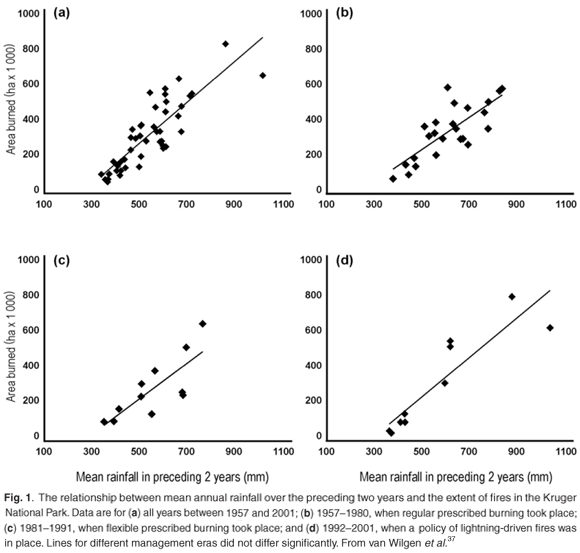
The difficulties facing mid-and late-20th century ecosystem managers who sought to impose a fire regime of their choice on savanna ecosystems are reflected by the experience in the Kruger National Park. Despite adopting different approaches to the use of fire (described above), the total area burnt was found to be predominantly determined by grass fuel loads, in turn determined by rainfall over the previous two years, and was unaffected by the management approach (Fig. 1).37 Fig. 2). Given that it was not possible to impose a fire regime consistently on small plots, even with large budgets to support attempts to do so, it follows that imposition of fire regimes onto very large areas would be much less likely to succeed.

In the Kruger National Park, the concept of adaptive management using 'thresholds of potential concern' was introduced in the mid-1990s.38 39 11 11 29
Lessons from research and implementation
Many lessons have been learned about fire management in savannas, arising both from research as well as the application of fire in different ways and in different areas. As a result, a number of principles can be recognised.
Fire is a vital ecological process in maintaining the structure of savannas in relatively moist areas. In moist savannas (where mean annual rainfall >650 mm), the tree layer is not constrained by a lack of moisture, but is prevented from reaching closure because of repeated fires and pressure from herbivores. In such areas, the elimination of fire will result in dominance by woody vegetation. The incidence of fires in these ecosystems is also more regular, as less variable rainfall results in the more regular accumulation of sufficient fuel to support a spreading fire.
Fire is a less dominant ecological process in relatively arid areas. In arid savannas (where mean annual rainfall <650 mm), the tree layer is effectively prevented from reaching closure, as it is constrained by a lack of moisture. In these systems, the elimination of fire will not lead to total dominance by woody vegetation. The incidence of fires in these ecosystems is also more erratic, as variable rainfall and herbivory often prevent the accumulation of sufficient fuel to support regular spreading fires.
Fires do not act alone in shaping the vegetation. The regular removal of grass by a variety of grazing species affects fuel loads,35 40 29
Savannas are resilient to a wide range of fire regimes. Long-term fire experiments in the Kruger National Park have shown that the effects of fire on the vegetation were most marked in extreme treatments (burning every year, burning in the summer wet season, or long periods of fire exclusion), and that these effects were greater in areas of higher rainfall.11 11
The ability of managers to control fire regimes over large areas is often limited, especially in more arid areas. Fuel loads respond to variations in rainfall more than to post-fire age, and many uncontrollable sources of ignition combine with the regular occurrence of weather suitable for fires to ignite grass fuels.
The belief that diverse fire regimes are necessary for conservation remains unproven. In a recent critique of the 'patch burning' approach,41 39
The management of fire in savannas will become more complex in future. Changes in global climate will have both direct and indirect impacts on fires and their effects; increases in CO2 concentrations in the atmosphere will affect the balance between grasses and trees; invasion by alien plants may also have significant impacts; and growing human populations will result in ever-increasing sources of ignition. Some of these issues are addressed in the next section.
Future challenges to fire management in savannas
The key to a better understanding of fire ecology and the development of effective management interventions appears to lie in the adoption of a system of adaptive management.42 41
Managers of protected areas are also faced with issues of scale when attempting to implement burning programmes. Increased human populations can fragment the landscape and can significantly alter fire regimes.43 34 29 41
Two other concerns that will affect the management of fire in savanna ecosystems are currently being vigorously debated. The first relates to CO2 enrichment, and its effects on the balance between grass and trees in savannas. The phenomenon of 'bush encroachment' (increases in woody vegetation at the expense of grasses) has long been recognised as a major problem in South Africa.44 2 would have been a significant factor in the reduction of trees during glacial times, both because they would have experienced slower growth (and thus been more susceptible to fires), and because, under these conditions, fire would have promoted the spread of competing grasses.45 2 levels (from 270 ppm in pre-industrial times to 370 ppm, and increasing, in modern times) could possibly explain the recent bush encroachment in savanna protected areas, despite the presence of large mammalian browsers. Attempts to recreate 'natural' fire regimes that simulate pre-colonisation fire regimes may be inappropriate under scenarios of global change and higher CO2 levels.35
The second issue relates to the interactions between elephants and fire. Concern is often expressed about declining numbers of large trees in the Kruger National Park, which are at least in part due to fire, and interactions between fire and damage by elephants.46,47 The exclusion of one of either fire or elephants, and the presence of the other, both result in the dominance of large trees; the co-occurrence of both apparently erodes the number of large trees.27 Fig. 3). It is therefore tempting to consider either the manipulation of fire regimes, or reductions in elephant numbers, as possible means of slowing or preventing declines in large trees in the presence of elephants. However, there are a number of underlying principles that need to be considered before such interventions can be proposed.48 49 48 36 48

Conclusions
The evolution of fire management in southern Africa over the past century has reflected increasing levels of ecological understanding. Attitudes towards fire and its management have changed dramatically from the views of the 1920s, when fire was regarded, in an ecological sense, as a detrimental force that needed to be controlled. These views were slow to change, but over the next few decades fire came to be viewed by many as something that was not always bad, and had to be tolerated and understood. As a result, many critically important long-term burning experiments were initiated in the 1950s and 1960s. As ecological understanding advanced further, fire was finally recognised as a key ecosystem process that was both inevitable and necessary.
The evolution of fire management approaches and philosophies reflected this advance in understanding. During the early 20th century, fire prevention and suppression was the order of the day. With the later acceptance of prescribed burning as a management practice, policies were developed with a view to imposing a desired fire regime onto the landscape. Under these policies, managers focussed on the implementation of particular prescriptions, without critically assessing whether or not strategic ecological objectives were met. More recently, in South Africa and elsewhere, there has been much progress towards attempts to influence fire regimes, rather than to maintain a 'command-and-control' approach.50
Our ability to deal with dynamic ecosystem management challenges within the context of imperfect understanding will be determined by how well, and how fast, we can learn from experience. The recent adoption of adaptive management approaches is certainly a step in the right direction, but it needs to be expanded and strengthened. Adaptive management will require managers to set measurable (and meaningful) goals, collect and curate considerable volumes of data, and to continually assess new evidence, and change approaches, as understanding increases. In South Africa, we are fortunate to have a strong tradition of ecological research, and consequently understanding, on which to build. This tradition must be passed on to young South Africans if science is to maintain its important role in informing management and conservation.
I thank Harry Biggs for stimulating discussions on adaptive management. Figures 1 and 2 are reproduced, with permission, from the journals Conservation Biology and International Journal of Wildland Fire, respectively.
References
- 1. Shorrocks B. (2007). The Biology of African Savannahs. Oxford University Press, Oxford.
- 2. Scholes R.J. and Walker B.H. (1993). An African Savanna: Synthesis of the Nylsvley Study. Cambridge University Press, Cambridge.
- 3. Bond W.J. (1997). Fire. In Vegetation of Southern Africa, eds R.M. Cowling, D.M. Richardson and S.M. Pierce, pp. 421–446. Cambridge University Press, Cambridge.
- 4. Scholes R.J. and Archer S.R. (1997). Tree–grass interactions in savannas. Ann. Rev. Ecol. Syst. 28, 517–544.
- 5. Walter H. (1971). Ecology of Tropical and Subtropical Vegetation. Oliver and Boyd, Edinburgh.
- 6. Walker B.H. and Noy-Meir I. (1982). Aspects of the stability and resilience of savanna ecosystems. In Ecology of Tropical Savannas, eds B.J. Huntley and B.H. Walker, pp. 556–590. Springer-Verlag, Berlin.
- 7. Higgins S.I., Bond W.J. and Trollope W. S.W. (2000). Fire, resprouting and variability: a recipe for grass–tree coexistence in savanna. J. Ecol. 88, 213–229.
- 8. Sankaran M., Hannan N.P., Scholes R.J., Ratnam J., Augustine D.J., Cade B.S., Gignoux J., Higgins S.I., le Roux X., Ludwig F., Ardo J., Banyikwa F., Bronn A., Bucini G., Caylor K.K., Coughenour M.B., Diouf A., Ekaya W., Feral C.J., February E.C., Frost P.G.H., Hiernaux P., Hrabar H., Metzger K.L., Prins H.H.T., Ringrose S., Sea W., Tews J., Worden J. and Zambatis N. (2005). Determinants of woody cover in African savannas. Nature 438, 846–849.
- 9. Schirge G.U. and Penderis A.H. (1978). Fire in South African Ecosystems: an Annotated Bibliography. South African National Scientific Programmes Report no. 33. CSIR, Pretoria.
- 10. Van der Schijff H.P. (1958). Inleidende verslag oor veldbrandnavorsing in die Nationale Krugerwildtuin. Koedoe 1, 60–93.
- 11. Van Wilgen B.W., Govender N. and Biggs H.C. (2007). The contribution of fire research to fire management: a critical review of a long-term experiment in the Kruger National Park, South Africa. Int. J. Wildl. Fire 16, 519–530.
- 12. Anonymous (1978). South African Programme for the SCOPE Mid-Term Project on the Ecological Effects of Fire. South African National Scientific Programmes Report no. 32. CSIR, Pretoria.
- 13. Gandar M.V. (1982). Description of a Fire and its Effects in the Nylsvley Nature Reserve: a Synthesis Report. South African National Scientific Programmes Report no. 63. CSIR, Pretoria.
- 14. Booysen P. de V. and Tainton N.M. (eds) (1984). Ecological Effects of Fire in South African Ecosystems. Springer, Berlin.
- 15. Lindesay J.A., Andreae M.O., Goldammer J.G., Harris G., Annegarn H.J., Garstang M., Scholes R.J. and van Wilgen B.W. (1996). International Geosphere-Biosphere Programme/International Global Atmospheric Chemistry SAFARI-92 field experiment: background and overview. J. Geoph. Res. 101(D19), 23521–23530.
- 16. Van Wilgen B.W., Andreae M.O., Goldammer G.J. and Lindesay J.A. (1997). Fire in Southern African Savannas: Ecological and Atmospheric Perspectives. Witwatersrand University Press, Johannesburg.
- 17. Phillips J.F.V. (1930). Fire: its influence on biotic communities and physical factors in South and East Africa. S. Afr. J. Sci. 27, 352–367.
- 18. Drought Investigation Commission (1926). The great drought problem of South Africa. Journal of the Department of Agriculture, Reprint no. 16.
- 19. Busse W. (1908). Die periodischen Grasbrände im tropischen Afrika, ihr Einfluss auf die vegetation und ihre Bedeuting für die Landeskultur. Mitt. A.D. Deutschen Schutzgeb. 21, Heft 2.
- 20. Staples R.R. (1926). Experiments in Veld Management. First Report of the South African Department of Agriculture, Scientific Bulletin 49.
- 21. Phillips J.F.V. (1984). Foreword. In Ecological Effects of Fire in South African Ecosystems, eds P. de V. Booysen and N.M. Tainton, pp. v–vi. Springer Verlag, Berlin.
- 22. Trollope W.S.W. (1984). Fire in savanna. In Ecological Effects of Fire in South African Ecosystems, eds P. de V. Booysen and N.M. Tainton, pp. 149–176. Springer Verlag, Berlin.
- 23. Komarek E.V. (1972). Fire in Africa. In Proceedings of the Annual Tall Timbers Fire Ecology Conference 11,Tall Timbers Research Station, Tallahassee, Florida.
- 24. Frost P., Menaut J-C., Walker B., Medina E., Solbrig O. and Swift M. (1986). Responses of Savannas to Stress and Disturbance. Biology International Special Issue 10, International Union of Biological Sciences, Paris.
- 25. Mentis M.T. and Bailey A.W. (1990). Changing perceptions of fire management in savanna parks. J. Grassl. Soc. Sthn. Afr. 7, 81–85.
- 26. Freitag S. (1998). The Kruger National Park and the analysis of historic data sets: where are we going? S. Afr. J. Sci. 94, 146.
- 27. Van Wilgen B.W., Trollope W.S.W., Biggs H.C., Potgieter A.L.F. and Brockett B.H. (2003). Fire as a driver of ecosystem variability. In The Kruger Experience: Ecology and Management of Savanna Heterogeneity, eds J. du Toit, K.H. Rogers and H.C. Biggs, pp. 149–170. Island Press, New York.
- 28. Biggs H.C. and Potgieter A.L.F. (1999). Overview of the fire management policy of the Kruger National Park. Koedoe 42, 101–110.
- 29. Van Wilgen B.W., Govender N. and MacFadyen S. (2008). An assessment of the implementation and outcomes of recent changes to fire management in the Kruger National Park. Koedoe 50, 22–31.
- 30. Balfour D.A. and Howison O.E. (2001). Spatial and temporal variation in a mesic savanna fire regime: responses to variation in annual rainfall. Afr. J. Range Forage Sci. 19, 43–51.
- 31. Siegfried W.R. (1981). The incidence of veld-fire in the Etosha National Park 1970–1979. Madoqua 12, 225–230.
- 32. Du Plessis W.P. (1997). Refinements to the burning strategy in the Etosha National Park, Namibia. Koedoe 40, 63–76.
- 33. Stander P.E., Nott T.B. and Mentis M.T. (1993). Proposed burning strategy for a semi-arid African savanna. Afr. J. Ecol. 31, 282–289.
- 34. Brockett B.H., Biggs H.C. and van Wilgen B.W. (2001). A patch mosaic burning system for conservation areas in southern Africa. Int. J. Wildl. Fire 10, 169–183.
- 35. Bond W.J. and Archibald S. (2003). Confronting complexity: fire policy choices in South African savanna parks. Int. J. Wildl. Fire 12, 381–389.
- 36. Rogers K.H. (2003). Adopting a heterogeneity paradigm: implications for management of protected savannas. In The Kruger Experience: Ecology and Management of Savanna Heterogeneity, eds J. du Toit, K.H. Rogers and H.C. Biggs, pp. 41–58. Island Press, New York.
- 37. Van Wilgen B.W., Govender N., Biggs H.C., Ntsala D. and Funda X.N. (2004). Response of savanna fire regimes to changing fire management policies in a large African national park. Cons. Biol. 18, 1533–1540.
- 38. Biggs H.C. and Rogers K.H. (2003). An adaptive system to link science, monitoring, and management in practice. In The Kruger Experience: Ecology and Management of Savanna Heterogeneity, eds J. du Toit, K.H. Rogers and H.C. Biggs, pp. 59–80. Island Press, New York.
- 39. Van Wilgen B.W., Biggs H.C. and Potgieter A.L.F. (1998). Fire management and research in the Kruger National Park, with suggestions on the detection of thresholds of potential concern. Koedoe 41, 69–87.
- 40. Yeaton R.I. (1988). Porcupines, fire and the dynamics of the tree layer in Burkea africana savanna. J. Ecol. 76, 482–486.
- 41. Parr C.L. and Andersen A.N. (2006). Patch mosaic burning for biodiversity conservation: a critique of the pyrodiversity paradigm. Cons. Biol. 20, 1610–1619.
- 42. Stankey G.H., Clark R.N. and Bormann B.T. (2005). Adaptive Management of Natural Resources: Theory, Concepts and Institutions. USDA Forest Service, General Technical Report PNW-GTR-654, Pacific Northwest Research Station, Portland Oregon.
- 43. Archibald S.A., Roy D.P., van Wilgen B.W. and Scholes R.J. (2009). What limits fire? An examination of drivers of burnt area in sub-equatorial Africa. Glob. Chang. Biol. 15, 613–630.
- 44. Hoffman M.T. (1997). Human impacts on vegetation. In Vegetation of Southern Africa, eds R.M. Cowling, D.M. Richardson and S.M. Pierce, pp. 507–534. Cambridge University Press, Cambridge.
- 45. Bond W.J., Woodward F.I. and Midgley G.F. (2003). The importance of low atmospheric CO2 and fire in promoting the spread of grasslands and savannas. Glob. Chang. Biol. 9, 973–982.
- 46. Eckhardt H.C., van Wilgen B.W. and Biggs H.C. (2000). Trends in woody vegetation cover in the Kruger National Park, South Africa, between 1940 and 1998. Afr. J. Ecol. 38, 108–115.
- 47. Edkins M.T., Kruger L.M., Harris K. and Midgley J.J. (2007). Baobabs and elephants in Kruger National Park: nowhere to hide. Afr. J. Ecol. 38, 108–115.
- 48. Owen-Smith N., Kerley G.I.H., Page B., Slotow R. and van Aarde R.J. (2006). A scientific perspective on the management of elephants in the Kruger National Park and elsewhere. S. Afr. J. Sci. 102, 389–394.
- 49. Dublin H.T., Sinclair A.R.E. and Mcglade J. (1990). Elephants and fire as causes of multiple states in the Serengeti–Mara Woodlands. J. Anim. Ecol. 59, 1147–1164.
- 50. Andersen A.N. (1999). Fire management in northern Australia: beyond command-and-control. Aust. Biologist 12, 63–70.