
 Coping with drought: do science and policy agree?
NEWS & VIEWS
Coping with drought – do science and policy agree?
Colleen SeymourI; Philip DesmetII
IApplied Biodiversity Research Division, South African National Biodiversity Institute, Kirstenbosch Research Centre, Cape Town, South Africa E-mail:
II84 Clearwater Road, Lynnwood Glen, 0081, South Africa E-mail:
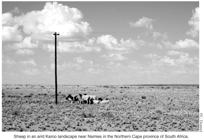
Arid regions—which occupy about half the surface area of South Africa—experience highly variable rainfall and frequent droughts.123
Drought has been researched in South Africa since early last century, and drought losses have long been attributed to poor vegetation, soil and water management.44
Six papers in this issue, emanating from the Arid Zone Ecology Forum of 2007, discuss drought in arid areas, and particularly how its social and ecological effects are interlinked. Finding ways to reduce the impacts of drought on both ecosystems and society should be a major research focus. The ability of land users to deal with drought is becoming progressively dictated by the resilience of their agro-ecosystems; the diversity of livelihood options; and whether or not they have access to resources and good institutional support.55
It also appears as if it is not just the Department of Agriculture for which drought management is not a policy priority. Despite South Africa's water-stressed status, half of the 12 proposed projects for the Accelerated and Shared Growth Initiative for South Africa are water-intensive and unlikely to be sustainable (J. Blignaut pers. comm.). These include a biofuels initiative that will include cultivation of crops in the Northern Cape and Free State, both provinces that have suffered severe droughts in recent years. By 2000, we had allocated almost 99% of that year's surface water yield and 41% of the annual usable potential groundwater to human use, primarily for irrigation.666
A search of the literature reveals that relatively few studies have been conducted on the ecological effects of drought. Hoffman et al.,7et al.88
Ecosystem responses are usually revealed only over time, and nowhere is this truer than in arid areas. Long-term research is therefore essential, and it is imperative that the South African research community and government agree to a suite of coordinated long-term field observations, experiments and models to inform agricultural policy and conservation planning. This may be an opportunity for the recently-established arid zone node of the South African Environmental Observation Network to develop and drive research and monitoring programmes that integrate ecological, social and economic impacts, ensuring that research contributes to our understanding of long-term variability and habitat change.
But research will have no impact on livelihoods unless there are mechanisms in place for translating findings into policies which address the needs of society in response to drought. The challenge here for institutions such as the South African National Biodiversity Institute and the Agricultural Research Council, is to convey information from researchers to government, as well as convince government that continued support for research will yield long-term dividends. The challenge to government—translating research recommendations into policy—is even more difficult, but no less crucial.
The 2007 special drought session of the Arid Zone Ecology Forum, and the papers emerging from it, were funded by the Critical Ecosystem Partnership Fund, through the Succulent Karoo Ecosystem Programme.
References
- 1. Le Houérou H.N. (1996). Climate change, drought and desertification. J. Arid Environ. 34(2), 133–185.
- 2. O'Farrell P.J., Anderson P.M.L., Milton S.J. and Dean W.R.J. (2009). Human response and adaptation to drought in the arid zone: lessons from southern Africa. S. Afr. J. Sci. 105, 34–39.
- 3. Joubert A.M. Mason S.J. and Galpin J.S. (1996). Droughts over southern Africa in a doubled-CO2 climate. Int. J. Climat. 16(10), 1149–1156.
- 4. Vogel C. (1994). (Mis)management of drought in South Africa: past, present and future. S. Afr. J. Sci. 90, 4–5.
- 5. Vetter S. (2009). Drought, change and resilience in South Africa's arid and semi-arid rangelands. S. Afr. J. Sci. 105, 29–33.
- 6. Blignaut J., Ueckermann L. and Aronson J. (2009). Agriculture production's sensitivity to changes in climate in South Africa. S. Afr. J. Sci. 105, 61–68.
- 7. Hoffman M.T., Carrick P.J., Gillson L. and West A.G. (2009). Drought, climate change and vegetation response in the succulent karoo biome, South Africa. S. Afr. J. Sci. 105, 54–60.
- 8. Dean W.R.J., Barnard P. and Anderson M.D. (2009). When to stay, when to go: trade-offs for arid-zone birds in times of drought. S. Afr. J. Sci. 105, 24–28.