Anti-viral effects of aqueous extracts of Aloe ferox and Withania somnifera on herpes simplex virus type 1 in cell culture
Abstract
ALOE FEROX AND WITHANIA SOMNIFERA are among southern African plants commonly used for the treatment of sexually transmitted infections (STIs). Aqueous extracts from both species, together with aloin, isolated from A. ferox, were evaluated for antiviral activity against herpes simplex virus type 1 (HSV-1) in vitro. The aqueous extracts showed detectable activity at a concentration of 1000 µg/ml against the virus in monolayers of the Vero African green monkey cell cultures, whereas aloin showed significant activity at 62 µg/ml. HSV-1 is usually associated with mucocutaneous infections of the oropharynx but can also cause genital herpes. Herpes simplex virus type 2 (HSV-2) is the classical genital herpes pathogen, but with current sexual habits, can give rise to both oral and genito-anal infections. Our results indicate that the use of these two plant species for the treatment of STIs could have a scientific rationale.
Introduction
The indigenous people of the Eastern Cape province of South Africa have a long history of traditional plant usage for the treatment of various diseases and ailments.1,2 This includes the use of plants for the treatment of sexually transmitted infections (STIs). STIs are common among young adults in the rural communities of the province. Herbalists take advantage of the biodiversity of plant species to treat these infections.3
In our previous survey of plants used for the treatment of STIs,3Aloe ferox and Withania somnifera as two of the commonest species used for the treatment of genital herpes, a disease commonly caused by herpes simplex virus type 2 (HSV-2). Herpes simplex virus type 1 (HSV-1) has also been implicated in genital infections. Aloe ferox (Asphodelaceae) is widely used in traditional healing. According to several authors, the species is used for the treatment of leukaemia, as an anti-inflammation and anticancer agent and against neuroectodermal tumours.1,4,5 Withania somnifera (Solanaceae) grows in the Eastern Cape. It is used for the treatment of arthritis, tuberculosis, cancer and STIs.1,6,7
The antimicrobial properties of these two plant species have been widely reported in the literature.8–10 However, the reports have focused mainly on their antifungal and antibacterial properties, whereas information on their antiviral activity is scanty.11A. ferox and W. somnifera on HSV-1 in vitro in this study.
Materials and methods
See Appendix.
Results and discussion
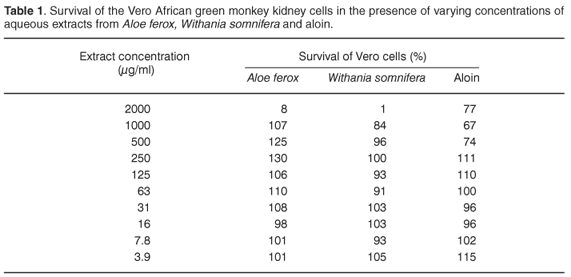
Vero cell monolayers treated with water extracts from A. ferox or W. somnifera, including the stock solution of aloin, exhibited altered morphology after one week. Their integrity, treated with concentrations from 3.9 µg/ml to 2000 µg/ml of these extracts, was maintained, although morphological changes and/or cell death, indicative of cytotoxic effects (CPE), were observed at a concentration of 2000 µg/ml. These observations were confirmed by the MTT assay (Table 1).
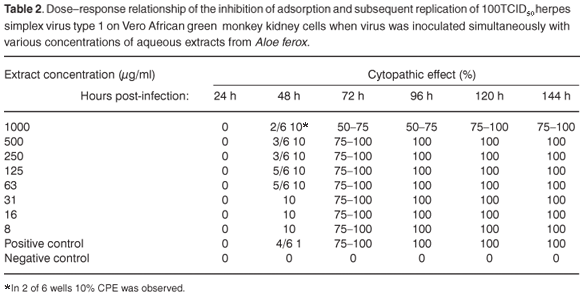
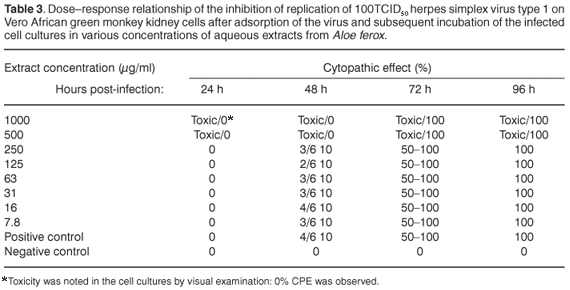
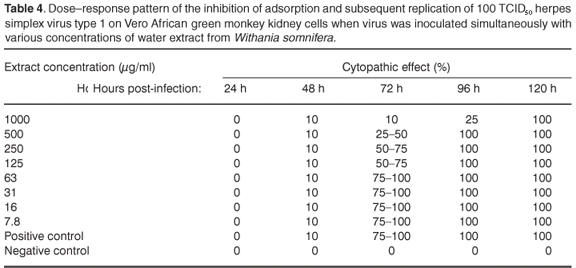
In the assay to assess the possible antiviral properties of the plants, aqueous extract from A. ferox exhibited partial activity against HSV-1 at a concentration of 1000 µg/ml when the virus was inoculated onto the cell cultures simultaneously with the plant extract. The infected cells showed 50–75% CPE 96 h after infection at 1000 µg/ml (see Table 2 in supplementary material online at www.sajs.co.za). Exposure to an aqueous extract from W. somnifera, on the other hand, delayed the appearance of CPE at 1000 µg/ml. The infected cells showed 25% CPE 96 h after infection (see Table 3 online). However, 100% CPE 96 h post-infection was noted at concentrations ranging from 7.8 µg/ml to 500 µg/ml. Water extract from A. ferox exhibited no activity against the replication of HSV-1 after viral adsorption had taken place at concentrations ranging from 7.8 µg/ml to 1000 µg/ml (see Table 4 online).
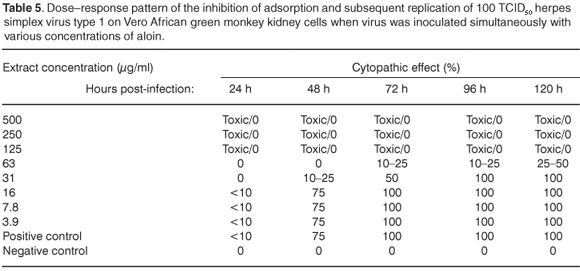
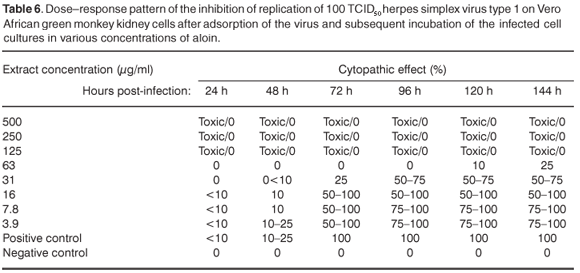
The extracts showed some activity, with no CPE, at a concentration of 1000 µg/ml. At this concentration, the extracts may contain compounds that are either true antivirals, but are present in quantities that are insufficient to inactivate all infectious viral particles, or they may be compounds that retard the replication and spread of the virus. 17,18 Aloin exhibited activity against HSV-1 at a concentration of 63 µg/ml, and the infected cells showed 25–50% CPE 120 h after infection (see Table 5 online). It is important to note that at a concentration of 63 µg/ml, aloin delayed the appearance of CPE, possibly due to interference in the replication cycle of the virus (see Table 6 online).
The activity of aloin and the partial activity of the aqueous extracts of the experimental plants could validate the use of A. ferox and W. somnifera by traditional healers, as these practitioners use water for extraction, and prescribe the extracts to their patients with no maximum concentration limit.
This research was supported by the National Research Foundation.
References
- 1. Van Wyk B.E., Van Oudtshoorn B. and Gericke N. (1997). In Medicinal Plants of South Africa, Briza, Pretoria.
- 2. Grierson D.S. and Afolayan A.J. (1999). Antibacterial activity of some indigenous plants used for the treatment of wounds in the Eastern Cape, South Africa. J. Ethnopharmacol. 66, 103–106.
- 3. Kambizi L. and Afolayan A.J. (2003). Phytomedicinal studies of four selected medicinal plants used for the treatment of STIs in the Eastern Cape. Fort Hare Papers 12,10–24.
- 4. Capasso F., Borrelli F. and Capasso R. (1998). Aloe and its therapeutic use. Phytotherapy Res. 12, 124–127.
- 5. Pecere T., Gazzola M.V., Mucignat C., Parolin C., Vecchia F.D., Cavaggion A., Baso G., Diaspro A., Salvato B., Carli M. and Palù G. (2000). Aloe emodin is a new type of anticancer agent with selective activity against neuroectodermal tumors. Cancer Res. 60, 2800–2804.
- 6. Devi P.U. (1996). Withania somnifera Dunal (Ashwagandha): Potential plant source of a promising drug for cancer chemotherapy and radiosensitization. Indian J. Exp. Biol. 34, 927–932.
- 7. Singh S. and Kumar S. (1998). In Withania somnifera. The Indian ginseng ashwagandha. Central Institute of Medicinal and Aromatic Plants: 293. Lucknow.
- 8. Sarath N., Arseculeratne A.A., Gunatilaka L. and Panabokke R.G. (1985). Studies on medicinal plants of Sri Lanka. Part 14: Toxicity of some traditional medicinal herbs. J. Ethnopharmacol. 13, 323–335.
- 9. Afolayan A.J., Grierson D.S., Kambizi L., Madamombe I. and Masika P.J. (2002). In vitro antifungal activity of some South African medicinal plants. S. Afr. J. Bot. 68, 72–76.
- 10. Arora S., Dhillon S., Rani G. and Nagpal A. (2004). The in vitro antibacterial/synergistic activities of Withania somnifera extracts. Fitoterapia 75, 385–388.
- 11. Scartezzini P. and Speroni E. (2000). Review on some plants of Indian traditional medicine with antioxidant activity. J. Ethnopharmacol. 71, 23–43.
- 12. Grist N.R., Bell E.J., Follette E.A.C. and Urquhart G.E.D. (1979). In Diagnostic Methods in Clinical Virology, 3rd edn, pp. 60–79. Blackwell Scientific Publications, Oxford.
- 13. Van Rensburg C.E.J., Anderson R., Myer M.S., Jooné G.K. and O'Sullivan J.F. 1994). The riminophenazine agents clofazimine and B669 reverse acquired multidrug resistance in a human lung cancer cell line. Cancer Lett. 85, 59–63.
- 14. Hussain R.F., Nouri A.M.E. and Oliver R.T.D. (1993). A new approach for measurement of cytotoxicity using colorimetric assay. J. Immunol. Methods 160, 89–96.
- 15. Kambizi L. Sultana N. and Afolayan A.J. (in press). Bioactive compounds isolated from Aloe ferox: A plant traditionally used for the treatment of sexually transmitted infections in the Eastern Cape, South Africa. J. Pharmaceut. Biol.
- 16. Taylor R.S.L., Manandhar N.P., Hudson J.B. and Towers G.H.N. (1996). Antiviral activities of Nepalese medicinal plants. J. Ethnopharmacol. 52,157–163.
- 17. Kupin V.I. and Polevaia E.B. (1986). Stimulation of the immunological reactivity of cancer patients by Eleutherococcus extract. Vopr. Onkol. 7, 21–26.
- 18. Kudi A.C. and Myint S.H. (1999). Antiviral activity of some Nigerian medicinal plant extracts. J. Ethnopharmacol. 68, 289–294
* Author for correspondence. E-mail:
Supplementary material to:
Kambizi L., Goosen B.M., Taylor M.B. and Afolayan A.J. (2007). Anti-viral effects of aqueous extracts of Aloe ferox and Withania somnifera on herpes simplex virus type 1 in cell culture. S. Afr. J. Sci. 103, 359–360.