Response to Booysen (2026) 'The National Research Foundation researcher rating system: An expensive bureaucracy whose time has passed'
SIGNIFICANCE: Booysen's recent critique (S Afr J Sci. 2026;122(9/10), Art. #27295) of the National Research Foundation (NRF) researcher rating system should not be dismissed as it identifies questions that the NRF and the wider research system ought to answer with evidence. It does not, however, establish a sufficient empirical basis for abolition. The more defensible conclusion is therefore one of reform: retain expert judgement where it adds information that indicators cannot supply, use quantitative evidence where it genuinely improves efficiency and consistency, and require the system itself to demonstrate its public value.
NRF rating; research evaluation; bibliometrics; research policy; South Africa; academic incentives
Response to Booysen (2026) 'The National Research Foundation researcher rating system: An expensive bureaucracy whose time has passed'
Gugu Moche
Deputy CEO: Research, Innovation, Impact Support and Advancement (RIISA) and Acting Group Executive: Digital Transformation, National Research Foundation, Pretoria, South Africa
ABSTRACTSIGNIFICANCE:
Booysen's recent critique (S Afr J Sci. 2026;122(9/10), Art. #27295) of the National Research Foundation (NRF) researcher rating system should not be dismissed as it identifies questions that the NRF and the wider research system ought to answer with evidence. It does not, however, establish a sufficient empirical basis for abolition. The more defensible conclusion is therefore one of reform: retain expert judgement where it adds information that indicators cannot supply, use quantitative evidence where it genuinely improves efficiency and consistency, and require the system itself to demonstrate its public value.
Keywords: NRF rating, research evaluation, bibliometrics, research policy, South Africa, academic incentives
The National Research Foundation (NRF) researcher rating system is unusual in the South African research landscape because it assigns national recognition to individual researchers through discipline-based peer judgement. In its current form, the system considers the quality and influence of a researcher's recent work and the standing that work has earned among disciplinary peers. The NRF describes rating as a voluntary mechanism for benchmarking South African researchers nationally and internationally and for strengthening the competitiveness of the research system. Assessment is centred on the preceding 8 years of research, interpreted through national and international peer review, with ratings awarded in the A, B, C, P and Y categories.1
The endurance of the system is not accidental. A rating provides recognition that travels with the researcher rather than with the employing institution, and peer review can engage aspects of scholarly quality that are poorly represented by citation counts alone. The developmental purpose of the P and Y categories is also significant: they recognise research trajectory and potential, not simply accumulated reputation. Nor is the process a single reputational vote. Specialist committees, assessors, the Executive Evaluation Committee and an Appeals Committee create successive points at which a judgement can be examined.1
Booysen2
His critique should not be dismissed. It identifies questions that the NRF and the wider research system ought to answer with evidence. It does not, however, establish a sufficient empirical basis for abolition. The headline estimate of ZAR 7-20 million in annual academic labour, for example, is modelled rather than audited, and the behavioural effects attributed specifically to rating have not been isolated from the many other incentives that shape academic practice. The proposed bibliometric alternative also carries its own structural biases across fields, languages and publishing systems. The more defensible conclusion is therefore one of reform: retain expert judgement where it adds information that indicators cannot supply, use quantitative evidence where it genuinely improves efficiency and consistency, and require the system itself to demonstrate its public value. That position is consistent with the direction taken by the Leiden Manifesto345
Purpose, evolution and current design
The rating system dates to 1984, when it was introduced by the Foundation for Research Development (FRD). Research funding was scarce, and information that is now routinely available through digital bibliographic systems was far harder to obtain. In that setting, rating served a practical purpose: it helped identify researchers with strong records, concentrate support around research excellence and create a national benchmark. The NRF retained the function after its establishment in 1999 through the merger of the FRD and the Human Sciences Research Council's Centre for Science Development. Although the scheme was initially associated more strongly with the natural and engineering sciences, it was later extended to the social sciences and humanities.6,7 Booysen is right to emphasise that the system emerged from a funding-and-recognition logic that belongs to a different research environment from the one that exists today.
The financial relationship has changed markedly. In 2008, rating again carried explicit incentive funding: A-rated researchers received ZAR 100 000 a year, B-rated researchers ZAR 80 000 and C-rated researchers ZAR 40 000. With 1684 rated researchers at the time, the annual cost was reported to be about ZAR 72 million. Growth in the rated population made this model increasingly difficult to sustain, and the later Incentive Funding for Rated Researchers framework moved away from recurring allocations towards more limited once-off support. The critique is therefore correct that the direct financial meaning of a rating is weaker than it once was. That change, however, does not make the contemporary system purposeless. Rating now operates more clearly as a national mechanism for recognition, benchmarking and researcher development than as a route to recurrent funding. It also remains connected to the wider development architecture. NRF funding includes support directed at Y-rated researchers, while programmes such as Thuthuka and the Black Academics Advancement Programme support researchers at earlier stages of the pathway to established standing. The present question is consequently not whether the system still resembles its 1980s form; it plainly does not. The question is whether its current functions justify the costs and consequences of maintaining a national individual-rating mechanism.
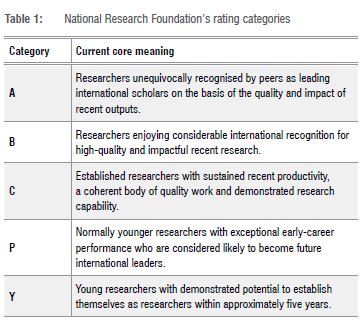
The categories are discipline-relative; they are not intended to constitute a single numerical ranking across fields (Table 1).
These category descriptions are drawn from the NRF's current 'Reviews and Evaluations' material.88
It is therefore misleading to describe rating as if it were simply a league table of researchers. The categories express different forms and levels of standing within disciplinary norms. An A-rated mathematician is not being declared intrinsically superior to a B-rated historian. Yet the distinction becomes less tidy once ratings are used beyond their technical purpose. Where universities take them into account in appointments, promotion, prestige or resource allocation, a categorical judgement acquires material consequences. At that point, questions of validity, consistency and fairness are not peripheral concerns - they go to the legitimacy of the instrument itself.9
Peer review, quality assurance and administrative burden
Under the NRF's current guidance, an Assessment Panel considers several reviewer reports on the applicant's 8-year research record. Cases in which a panel cannot reach consensus, potential A and P ratings, and possible loss of A status are referred to the Executive Evaluation Committee. Researchers may appeal decisions. The NRF also publishes panel membership, category definitions, reviewer guidance, response templates, guidance on assessing reports and its feedback policy.1,10 These features matter because any criticism of peer review should address the process that actually exists, not a simplified version thereof.
Peer review nevertheless remains an exercise in judgement. It cannot deliver mechanical objectivity, and it should not be defended as if it could. Callaghan's9
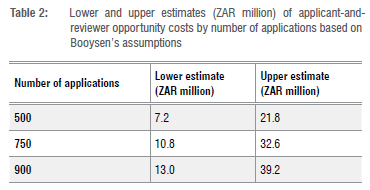
Administrative burden is a more concrete challenge. Booysen assumes that applicants spend 20-40 hours preparing an application, reviewers spend 3-6 hours on each review, and senior academic time costs roughly ZAR 450-680 an hour. On a conservative scenario of 500 applications a year, those assumptions generate an applicant-and-reviewer opportunity cost of about ZAR 7-20 million. This figure is useful as a warning about scale, not as an audited cost of the rating system. It excludes panel time, NRF staff effort and the work carried by university research offices. The sensitivity range using Booysen's assumptions is given in Table 2.
The 500-application scenario broadly reproduces Booysen's conservative estimate. The 750- and 900-application scenarios are included only to show how sensitive the result is to application volume; they are not estimates of current volumes. A second uncertainty concerns the renewal cycle. Booysen refers to approximately 4500 rated researchers and works from a 5-year cycle, whereas current university guidance indicates that ratings are valid for 6 years. An authoritative cost assessment needs to settle those assumptions before the figure is used as evidence for policy.
The burden is also partly mitigated by the design of the application system. The NRF indicates that approximately 90% of a rating application is populated from the researcher's existing NRF online CV. Applicants are therefore not reconstructing the full 8-year record from the beginning each time. This does not eliminate the work: researchers must still verify and frame their records, and institutions still screen and validate submissions. It does mean that any time-and-cost study should measure the actual workflow rather than infer it from the apparent length of the dossier.
The absence of such a study is, in my view, the clearest weakness in the current debate. There is no recent public activity-based audit that brings together application volumes, NRF staff effort, reviewer solicitation and completion rates, reviewer and panel hours, institutional research-office effort and system costs. Without that baseline, both defenders and critics are arguing about value for money with incomplete evidence. Booysen's call for an audit should therefore be accepted.
Assessment of critiques raised
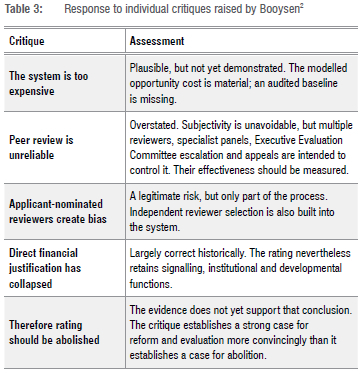
Table 3 presents an assessment of the main critiques raised by Booysen.2
Equity, careers, collaboration and societal impact
Equity cannot be an optional lens through which to assess the rating system. Breetzke and Hedding's1212
The 2025 NRF Awards offer a limited but telling contemporary illustration of concentration. Of 32 researchers recognised for new or repeat A ratings, 11 were associated with the University of Cape Town, 6 with the University of Pretoria, 4 each with Stellenbosch University and the University of the Witwatersrand, 2 each with the University of the Western Cape and University of Johannesburg, and 1 each with University of KwaZulu-Natal, Nelson Mandela University and Rhodes University. Of the 32 awardees, 25 (about 78%) were therefore located at four historically research-intensive universities. The award cohort is not the same as the full population of active A-rated researchers, so it cannot sustain a system-wide conclusion on its own. It does, however, make the distributional question difficult to ignore.
The NRF's own efforts to expand research chairs into historically disadvantaged institutions reflect a wider recognition that research capacity has been unevenly distributed. Rating outcomes must be read in that context. A national rating may simply mirror structural inequality; in some settings it may amplify it, while in others it may help researchers overcome institutional location by providing portable recognition. We do not yet know which effect dominates. That is precisely why longitudinal analysis linking rating outcomes to institutional resources, career stage, demographic profile and funding history is needed.
Epistemic equity raises a different problem. International recognition and publication in high-impact outlets remain part of the vocabulary through which research standing is commonly described. Beigel1314
The treatment of early-career researchers is one feature of the present system that should be protected in any redesign. P and Y ratings recognise potential and trajectory rather than only accumulated standing, and development support for Y-rated researchers connects assessment to capacity building. The weakness lies in rigid chronological-age thresholds. They can penalise researchers whose careers include caregiving, delayed doctoral entry, interrupted employment or other non-linear pathways. Years of active research and documented opportunity would provide a fairer basis for judging career stage, and would be more consistent with CoARA's5
Booysen is also right to ask whether an individual rating sits comfortably with team science and interdisciplinary work. We know from the international literature that assessment systems can alter behaviour and encourage strategic responses.1516
Societal impact has become more visible in the NRF's broader approach to research, even though it remains less explicit in the core rating categories. The NRF has adopted a framework for societal and knowledge impact17
Alternatives and international lessons
Booysen proposes three broad substitutes for the present system: bibliometric profiles, grant peer review and institutional assessment. None is a simple detour from research assessment. Each changes where judgement takes place, what evidence is privileged, and who carries the cost.
A metrics-led model would undoubtedly be easier to reproduce and could reduce administrative effort. Its limitations are equally concrete. Field-normalised citations can compensate for different citation intensities between disciplines, but they cannot adequately address database exclusion, language bias, books and creative outputs, locally oriented policy influence, Indigenous knowledge or the problem of attributing individual contribution in large collaborations. A credible bibliometric system also requires researcher disambiguation, database access, metadata cleaning, field classification and governance of the indicators themselves. International guidance is clear on this point. DORA45
Institutional assessment offers more room for local context and could remove much of the national application burden. Its weakness is that South African universities differ sharply in research capacity, resources and internal evaluation practice. A fully decentralised system would make recognition more dependent on institutional location. That would sacrifice one of the current system's most defensible features: a national judgement that is portable across institutions.
Grant success is valuable evidence, but it answers a narrower question. A successful grant shows that a proposal survived peer scrutiny in a particular competition. It does not necessarily provide a rounded assessment of a researcher's recent scholarly contribution, and it does not remove the cost of peer review. It shifts that cost into funding competitions and makes recognition dependent on the aims, eligibility rules and budgets of specific calls.
International reform is useful less because it provides a model to copy than because it shows how research assessment is being reconsidered. Australia discontinued Excellence in Research for Australia in 2023 and is developing a lower-burden, data-informed Research Insights Capability centred on dashboards and targeted analysis. New Zealand is replacing the Performance-Based Research Fund with the Tertiary Research Excellence Fund from 2029. The Tertiary Research Excellence Fund assesses providers rather than individual researchers and draws on several indicators, including research-degree completions, external research income, field-weighted citations, commercialisation and policy impact. These examples support experimentation, mixed evidence and lower transaction costs. They do not answer the specifically South African question of whether national individual recognition still adds sufficient value.
For South Africa, I would not frame the policy choice as peer review versus metrics. The better question is what work each should do. Quantitative evidence should be used wherever it can reduce repetitive data capture, improve calibration or flag anomalies. Expert judgement should remain where disciplinary context, scholarly quality and forms of contribution cannot be reduced validly to indicators. National assessment should then be reserved for purposes for which a portable national benchmark adds demonstrable value. This approach would preserve what remains distinctive and useful in the rating system while directly addressing the concerns that now threaten its legitimacy: cost, equity, transparency and relevance.
Declarations
I have no AI or LLM use to declare.
References
-
1. South African National Research Foundation (NRF). NRF rating [webpage on the Internet]. No date [cited 2026 Aug 11]. Available from: https://www.nrf.ac.za/rating/
» https://www.nrf.ac.za/rating/ -
2. Booysen MJ. The National Research Foundation researcher rating system: An expensive bureaucracy whose time has passed. S Afr J Sci. 2026;122(9/10), Art. #27295. https://doi.org/10.17159/sajs.2026/27295
» https://doi.org/10.17159/sajs.2026/27295 -
3. Hicks D, Wouters P, Waltman L, de Rijcke S, Rafols I. Bibliometrics: The Leiden Manifesto for research metrics. Nature. 2015;520:429-431. https://doi.org/10.1038/520429a
» https://doi.org/10.1038/520429a -
4. Declaration on Research Assessment (DORA). San Francisco Declaration on Research Assessment [webpage on the Internet]. c2012 [cited 2026 Aug 11]. Available from: https://sfdora.org/read/
» https://sfdora.org/read/ -
5. Coalition for Advancing Research Assessment (CoARA). The Agreement [webpage on the Internet]. c2022 [cited 2026 Aug 11]. Available from: https://www.coara.org/agreement/the-agreement-full-text/
» https://www.coara.org/agreement/the-agreement-full-text/ - 6. South African National Research Foundation (NRF). The National Research Foundation celebrates 25 years of research, innovation, impact and partnerships. Pretoria: NRF; 2024.
- 7. Pouris A. The National Research Foundation's rating system: Why scientists let their ratings lapse. S Afr J Sci. 2007;103(11/12):439-441.
-
8. South African National Research Foundation (NRF). Reviews and evaluations (RE) [webpage on the Internet]. No date [cited 2026 Aug 11]. Available from: https://www.nrf.ac.za/core-mandate-business-divisions/riisa-directorates/reviews-and-evaluations-re/
» https://www.nrf.ac.za/core-mandate-business-divisions/riisa-directorates/reviews-and-evaluations-re/ -
9. Callaghan C. A review of South Africa's National Research Foundation's ratings methodology from a social science perspective. S Afr J Sci. 2018;114(3/4), Art. #2017-0344. https://doi.org/10.17159/sajs.2018/20170344
» https://doi.org/10.17159/sajs.2018/20170344 -
10. South African National Research Foundation (NRF). Call for applications for evaluation and rating 2026 [webpage on the Internet]. c2026 [cited 2026 Aug 11]. Available from: https://www.nrf.ac.za/call-for-applications-for-evaluation-and-rating-2026/
» https://www.nrf.ac.za/call-for-applications-for-evaluation-and-rating-2026/ -
11. Boshoff C. Chris Callaghan's criticism of the National Research Foundation's rating methodology: A rebuttal. S Afr J Sci. 2018;114(7/8), Art. #a0278. https://doi.org/10.17159/sajs.2018/a0278
» https://doi.org/10.17159/sajs.2018/a0278 -
12. Breetzke GD, Hedding DW. The changing and challenging research landscape in South Africa. Stud High Educ. 2020;45(11):2245-2259. https://doi.org/10.1080/03075079.2019.1602758
» https://doi.org/10.1080/03075079.2019.1602758 -
13. Beigel F. Publishing from the periphery: Structural heterogeneity and segmented circuits: The evaluation of scientific publications for tenure in Argentina's CONICET. Curr Sociol. 2014;62(5):743-765. https://doi.org/10.1177/0011392114533977
» https://doi.org/10.1177/0011392114533977 -
14. McKenna S, Swartz L. The university of global excellence. S Afr J Sci. 2024;120(1/2), Art. #17469. https://doi.org/10.17159/sajs.2024/17469
» https://doi.org/10.17159/sajs.2024/17469 -
15. De Rijcke S, Wouters PF, Rushforth AD, Franssen TP, Hammarfelt B. Evaluation practices and effects of indicator use: A literature review. Res Eval. 2016;25(2):161-169. https://doi.org/10.1093/reseval/rvv038
» https://doi.org/10.1093/reseval/rvv038 -
16. South African Department of Higher Education and Training (DHET). Research outputs policy. Pretoria: DHET; 2015. Available from: https://www.dhet.gov.za/Policy%20and%20Development%20Support/Research%20Outputs%20policy%20gazette%202015.pdf
» https://www.dhet.gov.za/Policy%20and%20Development%20Support/Research%20Outputs%20policy%20gazette%202015.pdf -
17. South African National Research Foundation (NRF). NRF framework to advance the societal and knowledge impact of research. Pretoria: NRF; 2021. Available from: https://www.nrf.ac.za/wp-content/uploads/2021/12/NRF-Framework-to-Advance-the-Societal-and-Knowledge-Impact-of-Research.pdf
» https://www.nrf.ac.za/wp-content/uploads/2021/12/NRF-Framework-to-Advance-the-Societal-and-Knowledge-Impact-of-Research.pdf