
 Charles Darwin and John Herschel
The influence of John Herschel on the philosophical thoughts of Charles Darwin, both through the former's book, Natural Philosophy, and through their meeting in 1836 at the Cape of Good Hope, is discussed. With Herschel having himself speculated on evolution just a few months before he met Darwin, it is probable that he stimulated at least the beginnings of the latter's lifelong work on the subject.
evolution; Cape of Good Hope; Charles Darwin; John Herschel
Charles Darwin and John Herschel*
B. Warner
Department of Astronomy, University of Cape Town, Rondebosch 7700, South Africa. E-mail:
ABSTRACTThe influence of John Herschel on the philosophical thoughts of Charles Darwin, both through the former's book, Natural Philosophy, and through their meeting in 1836 at the Cape of Good Hope, is discussed. With Herschel having himself speculated on evolution just a few months before he met Darwin, it is probable that he stimulated at least the beginnings of the latter's lifelong work on the subject.
Key words: evolution, Cape of Good Hope, Charles Darwin, John Herschel
He never talked much, but every word which he uttered was worth listening to.
Charles Darwin, about Sir John Herschel
His Majesty's Ship Beagle, commanded by Captain Robert Fitz-Roy and carrying Charles Robert Darwin as the naturalist on board, arrived in Simon's Bay on 31 May 1836 on the final stage of a voyage around the world that had taken four and a half years and had still another six months to go. One of FitzRoy's duties was to check the accuracy of 22 marine chronometers, destined for use by the Royal Navy; the presence of the Royal Observatory in Cape Town gave him the finest opportunity to carry this out, with the result that the Beagle stayed in port for 18 days—longer than at any other port during the circumnavigation (they stayed for five weeks in the Galapagos, but islandhopped).
Darwin used much of his time studying the geology of the region, around Cape Town and beyond the mountains to Paarl and Franschhoek, returning via Sir Lowry's Pass. He took very little interest in the local flora and fauna, presumably because they had been well studied and collected by such previous visitors as the botanists Carl Peter Thunberg and Anders Sparrmann some sixty years before. But his geological interests were assisted by Dr Andrew Smith, who had recently returned from a two-year collecting expedition into the interior and had founded the South African Museum in 1825. Smith gave him a conducted tour of the geology around Cape Town and described the fauna of the interior.1,2 In later correspondence, over many years, he gave Darwin further assistance.
However, it was Herschel who interested Darwin most at the Cape. Sir John Frederick William Herschel, already had had, and would continue to have, a fundamental influence on Darwin's philosophy and attitude to research. John Herschel influenced Darwin's approach to scientific investigation in two ways: through his book A Preliminary Discourse on the Study of Natural Philosophy,3
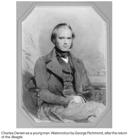
Of his formative undergraduate years Darwin later wrote 'During my last year at Cambridge, I read with care and profound interest Humboldt's Personal Narrative. This work, and Sir J. Herschel's Introduction to the Study of Natural Philosophy, stirred up in me a burning zeal to add even the most humble contribution to the noble structure of Natural Science. No one or a dozen other books influenced me nearly so much as these two'.4
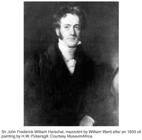
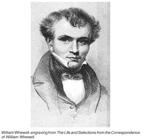
The book by Alexander von Humboldt,5 6 Preliminary Discourse, hot off the press, was more compact and of sufficient interest and import to remain in print to this day.7 Origin of Species.
Modern assessments of the Preliminary Discourse emphasise that, although a portrait of Francis Bacon is used on its title page, its recommendations are far from 'Baconian – which recommended the simple amassing of observations until new general properties or laws become self evident. To quote the historian of science Walter Cannon, Herschel's 'view of scientific method was that perhaps the best results come when the mind 'leaps forward', 'by forming at once a bold hypothesis'.8 History of the Inductive Sciences9 inter alia embraces the modern spirit that observations or measurements alone are pointless if there is no theory to interpret them. (Herschel's almost book-length review of this is a masterly summary and points out that 'the true idea … often presents itself almost spontaneously'.10
Astronomy is the earliest science in which theory (in the form of mathematical orbits of planets and double stars) demonstrated its predictive power. John Herschel was a pioneer in this—his work on binary stars showed the universality of Newton's laws; but he was also a polymath, and recognised by his eminent contemporary researchers as their superior—see the comments collected by Walter Cannon,11
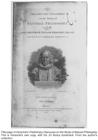
The importance of the Preliminary Discourse is acknowledged by many of the 19th century's greatest thinkers—notably John Stuart Mill, James Clerk Maxwell, William Thomson and Charles Darwin himself. (For a general discussion of the philosophy of science and the influence of the Preliminary Discourse, see chapter 13 of Victorian Science,12
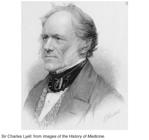
There was another book strongly influencing Darwin at this time: Charles Lyell's Principles of Geology13Beagle, which departed on its circumnavigation in November 1831. The second volume, which contained extensive discussion of the geographical distribution of species, ancient and modern, including speculations on their transmutation, caught up with him in Montevideo in October 1832, and the third volume was waiting for him on his return in 1836. Like Herschel's Preliminary Discourse, Lyell's book contained a large collection of examples with a purpose in mind—the title could have been expanded to become Principles of Geological Reasoning, as is made evident by its subtitle: An attempt to explain the former changes of the Earth's surface, by reference to causes now in operation. Lyell espoused the principle of uniformitarianism (a word invented by Whewell), appealing to currently observable physical processes to explain the past as recorded in the rocks. These volumes amplified the geological tour that Darwin had made with Adam Sedgwick, Professor of Geology at Cambridge, shortly before the departure of the Beagle. As a result, during the voyage Darwin largely considered himself a geologist, specialising in rocks and fossils, collecting botanical and faunal specimens as a supplementary interest. The powerful influence of Lyell is seen in Darwin's later admission to Leonard Horner, Charles Lyell's father-in-law; 'I always feel as if my books came half out of Lyell's brains & that I never acknowledge this sufficiently, nor do I know how I can, without saying so in so many words—for I have always thought that the great merit of the Principles, was that it altered the whole tone of one's mind & therefore that when seeing a thing never seen by Lyell, one yet saw it partially through his eyes.'14
Before describing the meeting with John Herschel at the Cape we jump ahead a little. Darwin arrived back in England on 4 October 1836, after 55 months at sea. He lodged in London and was soon immersed in scientific society, attending a meeting of the Zoological Society on 23 October with a rich store of knowledge to share, but evidently retained the memory of his meeting with Herschel as a highlight of his journey: the next day Elizabeth Ann, wife of George Robert Waterhouse (curator of the Zoological Society's museum and later to describe Darwin's South American insects and mammals) wrote to John Herschel's wife, Margaret: 'We heard of you yesterday evening from Mr Darwin, whom I dare say you remember – he was at the evening meeting of this Society & mentioned you & Sir John to Mr Waterhouse.... He expressed in terms which I must not repeat the pleasure he had had in your own and Sir John's Society'.15
Six days after the Zoological Society meeting, Darwin finally met, and dined with, Charles Lyell. That Darwin still considered himself largely a geologist is clear: he had written from Falmouth, ahead of arrival in London, asking the Cambridge mineralogist and botanist John Stevens Henslow to propose him for Fellowship of the Geological Society, the procedure for which was started immediately, and Darwin read his first paper to that Society on 4 January 1837. Despite his friendship with Waterhouse he did not join the Zoological Society until two years later; and he only joined the Linnean Society, the official authority on species, in 1854.
As a preamble to Darwin's meeting with Herschel, we may note that the latter was one of 14 men who had met at the Freemason's Tavern, Lincoln's Inn Fields, London on 12 January 1820, to found a 'Society for the encouragement and promotion of Astronomy',16 17 18 heaven-born genius it was John Herschel!'19
The Beagle arrived on 31 May 1836 and the next day Darwin rode to Cape Town, passing through Wynberg, where the Herschels lived, arriving in the evening. On 3 June Darwin wrote to his sister Catherine: 'Tomorrow morning I am going to call with Capt. F[itz] R[oy] on Sir J. Herschel. I have already seen the house which he has purchased; it is six miles from the town & in a most retired charming situation. I have heard so much about his eccentric but very amiable manners, that I have a high curiosity to see the great Man'.20 21
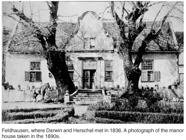
'At the Cape, Capt Fitz Roy, & myself enjoyed a memorable piece of good fortune in meeting Sir J. Herschel. We dined at his house & saw him a few times besides. He was exceedingly good natured, but his manners, at first, appeared to me, rather awful. He is living in a very comfortable country house, surrounded by fir and oak trees, which alone, in so open a country, give a most charming air of seclusion & comfort. He appears to find time for every thing; he sh[o]wed us a pretty garden full of Cape Bulbs of his own collecting; & afterwards I understood, that every thing was the work of his own hands. What a very nice person Lady Herschel appears to be, – in short we were charmed with every thing in & about the house'.22
He noted in his diary that the meeting 'was the most memorable event which, for a long period, I have had the good fortune to enjoy'—praise indeed from someone who had spent the previous four and a half years fulfilling his early ambition of exploring a largely unknown world!
It is frustrating that neither Darwin nor Herschel recorded many details of their meetings. In his autobiography Darwin simply remarks 'I felt a high reverence for Sir J. Herschel, and was delighted to dine with him at his charming house at the C. of Good Hope and afterwards at his London house. I saw him, also, on a few other occasions. He never talked much, but every word which he uttered was worth listening to. He was very shy and he often had a distressed expression'.23 24 25
Margaret Herschel appears not to have noticed Darwin at all, having eyes only for FitzRoy, writing to her brother in England: 'You may soon expect to see a Capt. Fitzroy who has run off with all our hearts, & sundry husbands are very glad he has gone – he has been like an epidemic among us, but the erring wives are safe in the numbers affected'.26
Herschel's apparent serious demeanour belied a light-hearted interior: Maria Edgeworth in 1827 wrote that he 'is not only a man of the first scientific genius, but his conversation is full of information on all subjects, and he has a taste for humour and playful nonsense, though with a melancholy exterior'.27 28,29
Herschel must have remained fresh in Darwin's mind for the rest of the Beagle's voyage—in his diary for 26 September 1836, three months after leaving the Cape, he makes 'a short retrospective of the advantages and disadvantages the pain and pleasure of our five years' wandering', concluding 'it appears to me that nothing can be more improving to a young naturalist, than a journey in distant countries. It both sharpens and partly also allays that want and craving, which as Sir J. Herschel remarks, a man experiences, although every corporeal sense is fully satisfied.' That sentiment, as Darwin notes in the margin, comes from page 3 of Herschel's Preliminary Discourse. It later was carried out to good effect by, for example, the naturalists Joseph Dalton Hooker on James Clark Ross's Antarctic expedition in the Erebus and Thomas Henry Huxley in his circumnavigation in the Rattlesnake.
Although Herschel 'never talked much' it is probable that at the Cape he put a number of ideas into Darwin's mind. By a remarkable coincidence, in the months before Darwin's arrival, Herschel had been thinking about evolution of animals and plants. Thoughts on evolution ran in the family—his father, William Herschel, had tried to determine from his own observations whether stars possibly evolved from gaseous nebulae, or vice versa, and had suggested that if rates of change could be measured then the dates of origin could be found. John Herschel had continued to work towards this, and early on expressed his justifiably cautious attitude towards evolution in general:
'…however completely a scale of gradation between a multitude of individuals existing simultaneously may be made out, this affords no ground whatsoever for supposing any one among them to have passed, or be capable of passing, through all the other states, or for concluding them to be in a course of progress from one state in the series to another. There are infinite varieties in the modes and forms of animal life, from man down to the lowest orders; and some naturalists would willingly establish a progression among them, beginning with the simpler, and going on to more complicated forms; but so long as no progress can be seen to go on – so long as for generation after generation every animal succeeds to all the imperfections of its parent, the utmost that we can admit is, that such a formative nisus may have once existed, and acted in the progressive manner supposed, but that all such progression has long since ceased in the present state of nature.'30
This statement was made in the introductory section of a catalogue of binary stars, and may not have reached far beyond the eyes of astronomers. Herschel later reviewed knowledge of celestial evolution in his Treatise on Astronomy,31 Cabinet Cyclopaedia series (the Preliminary Discourse had been the first), published just before his trip to the Cape and the best-selling popular book on astronomy throughout the 19th century. It was Herschel's observations at the Cape of the Large Magellanic Cloud, in which all stages of evolution of stars, nebulae and star clusters exist simultaneously, that later advanced the subject further. His careful drawings of nebulae were clearly intended as 'first epoch' delineations that could be used by posterity to discover changes and their rates; and it is probable that his almost photographic depiction of the eastern buttresses of Table Mountain was similarly destined.32
His later thoughts on evolution among living organisms were partly initiated by the richness of the Cape flora, which had stimulated him and his wife to collect and paint them, especially the bulbous varieties. The 'pretty garden full of Cape Bulbs', mentioned by Darwin, contained in excess of 200 species, over 100 of which were illustrated by the Herschels.33 34 merely fill it, but does so with the superaddition of some new characters – or some analogy with a 3rd species which the others do not offer'.
John Rourke has commented:35 36,37
Herschel's letter to Lyell contained largely geological matters, in which he advances an hypothesis on the rise and fall of continents and concomitant sea level which embodies the principle of isostasy—a word only introduced much later in the 19th century. This is an item that we know he did discuss with Darwin, for in Darwin's notebook, written onboard the Beagle and used to record immediate reactions, there is the comment 'Sir J. Herschel's idea of escape of Heat prevented by sedimentary rocks, & hence Volcanic action, contradicted by Cordillera, where that action commenced before any great accumulation of such matter'.38
But here we are more concerned with what Herschel had written to Lyell about evolution. It is worth noting, in any case, whether or not he shared these ideas with Darwin verbally, the latter certainly saw them in detail soon after his return to England because Charles Babbage (who had been an exact contemporary and friend of Herschel at Cambridge) read the letter sent to Lyell and published a major extract from it in an Appendix to his Ninth Bridgewater Treatise.39 Treatise was written largely as a cheeky rebuttal to the previous eight multi-authored volumes, which took as their commissioned theme the wonders of Nature as evidence for the (in the case of appearance of new species, the continued) work of a Creator, essentially as a 'tinkering miracle-monger'.40
What Herschel thought about the Treatises is not clear, but may be connected with a diary entry on board ship some ten days before arriving at the Cape in January 1834, where he was raised to such a fury that he poured scorn into his private diary: 'In Evening skimmed Sharon Turner's Sacred History from Creation to Deluge41 in toto would re-drown the world whereas it would not raise the Ocean a foot &c &c'.42 43
What Lyell had argued in the first edition of his Principles was that geological processes required at least millions of years to accomplish what was evident to any careful observer; Lyell was thus one of the founders of modern geology. On its publication, his book was treated very much in the same way as Darwin's Origin some 30 years later—only John Herschel and the geologist G. Poulett Scrope immediately came out in support of it. Others of his fellow geologists, astonished at Lyell's adoption of uniformitarianism rather than the in-vogue catastrophism, complained of his 'absurdities' and members of the church condemned its 'impiety'.
Near the beginning of his letter to Lyell, Herschel comments on an aspect of the third edition of Principles of Geology that he had just received from the author (that he had read the first edition is evident from his ship-board diary entry quoted above): '…by unveiling a dim glimpse of a region of speculation … where it seems impossible to venture without experiencing some degree of that mysterious awe…. Of course I allude to that mystery of mysteries the replacement of extinct species by others. Many will doubtless think your speculation too bold – but it is as well to face the difficulty at once. For my own part I cannot think it an inadequate conception of the Creator, to assume it as granted that his combinations are exhausted upon any one of the theatres of their former exercise – though in this, as in all his other works we are led by all analogy to suppose that he operates through a series of intermediate causes & that in consequence, the origins of fresh species, could it ever come under our cognisance would be found to be a natural in contradistinction to a miraculous process – though we perceive no indications of any process actually in progress which is likely to issue in such a result'.
Darwin pounced on one aspect of this paragraph, written on page 226 of the Bridgewater Treatise, and wrote in his notebook 'Herschel calls the appearance of new species the mystery of mysteries, & has a grand passage upon the problem! Hurrah – 'intermediate causes''.44 Beagle notebook. But another indication that Herschel did discuss aspects of evolution with Darwin is that the first mention of an evolutionary solution to the question of disappearance and creation of species is written in Darwin's ornithological notebook shortly after he sailed from Cape Town.45
Continuing with Herschel's letter:
'Speaking of the destruction of species there is here a very lovely species of plant which seems verging rapidly to extinction – the Disa Grandiflora.46
Herschel's philosophy was thus that species are dynamic entities, not static ones. This was not a new concept, but Herschel's emphasis undoubtedly stayed with Darwin, and he eventually struck on the mechanism that accounts for the dynamic nature of species. Twenty years later Darwin's opening paragraph of the Origin of Species47 Beagle as naturalist, I was much struck with certain facts on the distribution of organic beings inhabiting South America. These facts seemed to throw some light on the origin of species – that mystery of mysteries, as it has been called by one of our greatest philosophers'.
In his reply to Herschel's letter, Lyell admits his reluctance to carry speculation on transmutation further than he already had:
'In regard to the origination of new species, I am very glad to find that you think it probable that it may be carried on through the intervention of intermediate causes. I left this rather to be inferred, not thinking it worth while to offend a certain class of persons by embodying in words what would only be a speculation'48 49 Origin did Lyell have the courage to support transmutation of species publicly—in the tenth edition of his Principles, which appeared in 1867.
Herschel's letter to Lyell contains a passage of relevance to what Herschel and Darwin discussed at the Cape: 'I hope your example will be followed in other sciences, in trying what can be done with existing causes, in place of giving way to the indolent weakness of a priori dogmatism…. In one subject (I mean Philology) it strikes me this would be very desirable. An enquiry into the laws of verbal corruption & into the processes and rate by which words do actually change their meanings….' This passage illustrates Herschel generalising his thoughts on evolution to an apparently unrelated discipline, but it is of importance here because many years later Darwin wrote to Lyell: 'Your metaphor of the pebbles of pre-existing languages reminds me that I heard Sir J. Herschel at the Cape say how he wished some one would treat language as you had Geology, and study the existing causes of change, and apply the deduction to old languages',50
In his letter to Lyell, Herschel went on to say 'Words are to the Anthropologist what rolled pebbles are to the Geologist – battered relics of past ages often containing within them indelible records capable of intelligible interpretation, and when we see what amount of change 2 000 years has been able to produce in the languages of Greece & Italy … we naturally begin to ask how long a period must have lapsed since the Chinese, the Hebrew, the Delaware & the Malessas had a point in common with the German & Italian & each other. Time! Time! Time! We must not impugn the Scripture Chronology, but we must interpret it in accordance with whatever shall appear on fair enquiry to be the truth for there cannot be two truths. And really here is scope enough: for the lives of the Patriachs may as reasonably be extended to 5 000 or 50 000 years apiece as the days of Creation to as many thousands of millions of years'. Herschel here is suggesting the use of the rate of departure from an ur-language as a means of estimating the age of man—similar to modern use of DNA mutation rates to find the most recent common ancestor.
Darwin's letter written to Henslow from St Helena reported 'There are many pleasant people at the Cape. Mr Maclear, the astronomer, was most kind & hospitable'. Maclear himself was not keeping a diary at this time, but his wife, Mary, recorded several visits to the observatory by FitzRoy, for most of which Darwin was elsewhere, but 'Friday 10th [June] Disappointed to find the H[erschel]s were previously engaged – also of Dr Smith's company – disappointed only Mr Darwin & Capt. F. here'.51
The third component of influence on Darwin's thought, beyond those of Herschel and Lyell, was his discovery in October 1838 of the reasoning in Thomas Malthus's book.52 Preliminary Discourse Herschel quotes admiringly from another of Malthus's books, the Principles of Political Economy.53
Darwin and Herschel had only one later joint involvement. In 1848, the Navy persuaded Herschel to produce a handbook, a Manual of Scientific Enquiry, for seafarers, which would help them to record observations of use to science. Herschel distributed the task among experts, selecting Meteorology for himself (he expanded this in the 8th edition of the Encyclopedia Brittanica in 1857, later published separately54Geology, probably reasoning that, unlike Lyell, Darwin had himself been a seafarer. Darwin's magisterial essay contained much advice, based on his Beagle experiences, and right at the outset states that although a traveller may not witness geological changes 'he is admirably situated for studying the still active causes of those changes, which, accumulated during long-continued ages, is the object of geology to record and explain'.55
'You may possibly be surprised at my having expressed myself rather strongly, that the mere collecting rock-specimens is hardly of any use to Geology. I have for some years come deliberately to this opinion, in which some other geologists, with whom I have discussed the point, concur with me. I could specify several large collections lately brought home, which no one person would take the trouble even of looking at. This is very mortifying to the collector & prevents him afterwards turning his attention to some other branch of Nat[ural] Hist[ory], in which mere collecting would be of service.'56
That Darwin really had taken such matters to heart is seen in a letter he wrote to Asa Gray in America in 1857: 'It ought never to be forgotten that the observer can generalise his own observations incomparably better than any one else. How many astronomers have laboured their whole lives on observations, and have not drawn a single conclusion; I think it is Herschel who has remarked how much better it would be if they had paused in their devoted work and seen what they could have deduced from their work.57
In a letter to J.D. Hooker, Darwin saw the value of the Manual to current and future scientists like themselves: 'This work, which is edited by Sir J. Herschel, is a very good job, in as much as, the Captains of Men of War, will now see the Admiralty care for science & so will favour naturalists on board.'58
By the time of the Manual Darwin had established himself by publishing his first few books, two reporting his discoveries on the voyage of the Beagle, but one conforming more completely to Herschel's expectations of a scientist—his work on coral reefs.59 60 machine for grinding general laws out of large collections of facts', which is closer to the Baconian concept of research.
When Darwin produced the Origin, his opus magnum, in 1859, he naturally was anxious to hear his hero's opinion and so sent Herschel an advance copy:61 62
To some extent, Darwin's Origin follows Herschel's Preliminary Discourse in that both assembled an enormous number of examples that a theory, or theories, could connect together in explanation. That had become the emphasis—science is not a mere accumulation of facts, it provides understanding, from which prediction and verification should be possible. Furthermore, Darwin's process of arriving at the principle underlying transmutation had incidentally satisfied Herschel's wish that 'the true idea … present itself almost spontaneously': Darwin says in his autobiography that 'I can remember the very spot in the road, whilst in my carriage, when to my joy the solution occurred to me'.63
The influence of Herschel and Whewell on Darwin's philosophy of science has been examined in depth by Ruse.64 Origin, but rumours of his attitude towards it spread: 'I have heard by round about channel that Herschel says my Book 'is the law of higgledy-pigglety'. What this exactly means I do not know, but it is evidently very contemptuous. If true this is a great blow & discouragement.'65
In fact, Herschel had failed to accept the essence of Darwin's proposed mechanism—that genetic variations produce changes that may be advantageous or disadvantageous, and, in a competitive world, the former can lead to steady departure from the original type. Thomas Huxley's reaction when he read this in his own advance copy of Origin was 'How extremely stupid not to have thought of that!'66 directed variations were necessary: 'Favourable variations must 'occur' if anything is to be 'effected'' is what he noted in his copy of the Origin. But we may respect that he was also still influenced by his earlier stated principle that 'so long as no progress can be seen to go on … the utmost that we can admit is, that such a formative nisus may have once existed', which is correct in intention but ultra-conservative and effectively denies the possibility of arriving at a solution by inductive reasoning.
Herschel's rejection of straightforward natural selection might be thought to be the result of his advancing years but probably was also partly due to the influence of his wife, who was the daughter of a Presbyterian minister. He also resisted acceptance of the law of conservation of energy a few years later,67 68 Homo sapiens is at the top of the tree of life, so even if evolved from lower animals there had to be a built-in bias to natural selection in order to ensure the 'right' outcome. He, and those with vested interests, ignored the reality that in 1543, when Nicholas Copernicus moved the Earth from the centre of the universe, Homo sapiens went with it.
Just prior to publication of the Origin, Herschel had contributed a major article on geography to the eighth edition of the Encylopaedia Brittanica in which he is explicit in his belief that 'in each of those successive submersions and reconstructions of the continents, fresh corresponding races of animals, and a new and different clothing of vegetation have been introduced … which, however, has not operated, either by a gradual progressive variation of species, nor by a sudden and total abolition of one race, and introduction of another entirely new, but by a series of overlappings, leaving the last portion of each in coexistence with the earlier members of the new series.'
When Herschel republished this article as a book, Physical Geography,69 disproved the view taken in the text'. He goes on to affirm that random variations will only produce slow departure in a literally random direction from the average, and uses the analogy of constructing Newton's Principia or the works of Shakespeare by 'Laputan' means (see Swift's Gulliver's Travels)! Nevertheless, he softens the blow by ending his comment '…with some demur as to the genesis of man [author's emphasis], we are far from disposed to repudiate the view taken of this mysterious subject in Mr. Darwin's work'.
This gave Darwin the opportunity in a letter to Herschel, to be, initially, grateful:
'You must permit me to have the pleasure to thank you for your kind present of your Physical Geography. I feel honoured by your gift, & shall prize this Book with your autograph. I am pleased with your note on my book on species, though apparently you go but a little way with me. The point which you raise on intelligent Design has perplexed me beyond measure; & has been ably discussed by Prof. Asa Gray, with whom I have had much correspondence on the subject. I am in a complete jumble on the point. One cannot look at this Universe with all living productions & man without believing that all has been intelligently designed; yet when I look to each individual organism, I can see no evidence of this. For, I am not prepared to admit that God designed the feathers in the tail of the rock-pigeon to vary in a highly peculiar manner in order that man might select such variations & make a Fan-tail; & if this be not admitted (I know it would be admitted by many persons), then I cannot see design in the variations of structure in animals in a state of nature, – those variations which were useful to the animal being preserved & those useless or injurious being destroyed. But I ought to apologise for thus troubling you'.
Finally, losing patience, and out of character, Darwin the mature and successful scientist, insults his revered senior:
'You will think me very conceited when I say I feel quite easy about the ultimate success of my views, (with much error, as yet unseen by me, to be no doubt eliminated); & I feel this confidence, because I find so many young & middle-aged truly good workers in different branches, either partially or wholly accepting my views, because they find that they can thus group & understand many scattered facts. This has occurred with those who have chiefly or almost exclusively studied morphology, geographical Distribution, systematic Botany, simple geology & palaeontology. Forgive me boasting, if you can; I do so because I should value your partial acquiescence in my views, more than that of almost any other human being.'70
And that is how it was left. One of Darwin's contemporary young supporters was Alfred Russell Wallace, who had independently arrived at identical conclusions; and later discoveries in genetics and molecular biology revealed the mechanisms by which natural selection works, variously at molecular and species level. A modern assessment of Darwin's contribution can be found in Stamar's book.71
In his autobiography,26
Darwin and Herschel did not converge in their views, but ultimately they did in their corporeal remains—they are buried in neighbouring graves at the northeast corner of the nave in Westminster Abbey, next to the tomb of Isaac Newton.
References
- 1. Armstrong P.H. (1991). Three weeks at the Cape of Good Hope 1836: Charles Darwin's African Interlude. The Indian Ocean Review 4, 8–13.
- 2. Barnard W.S. (2004). Darwin at the Cape. S. Afr. J. Sci. 100, 243–248.
- 3. Herschel J.F.W. (1831). A Preliminary Discourse on the Study of Natural Philosophy, the first volume of The Cabinet Cyclopaedia. Conducted by Dionysius Lardner, Longmans, London.
- 4. Barlow N. (ed.) (1958). The Autobiography of Charles Darwin. Collins, London.
- 5. Personal Narrative of Travels to the Equinoctial Regions of the New Continent during the years 1799–1804. London, 1814–1829.
- 6. Burkhardt F. (ed.) (1996). Darwin to John Stevens Henslow, 11 July 1831.In Charles Darwin's Letters: A Selection. Cambridge University Press, Cambridge.
- 7. Herschel J.F.W. (1987). A Preliminary Discourse on the Study of Natural Philosophy. University of Chicago Press, Chicago & London.
- 8. Cannon W.F. (1964). History in depth: the Early Victorian Period. In History of Science, vol. 3, eds A.C. Crombie and M.A. Hoskin, pp. 20–38. Heffers, Cambridge.
- 9. Whewell W. (1837). History of the Inductive Sciences. J.W. Parker, London.
- 10. Herschel J.F.W. (1841). Whewell on the inductive sciences. Q. Rev. 68, 177–238.
- 11. Cannon W.F. (1961). John Herschel and the idea of science. J. Hist. Ideas 22, 215–239.
- 12. Basalla G., Coleman W. and Kargon R.H. (eds) (1970). Victorian Science. Anchor Books, Doubleday, New York.
- 13. Lyell C. (1830–1833). Principles of Geology, vols 1–3. John Murray, London.
- 14. Darwin to L. Horner, 29 August 1844 (1988). Correspondence of Charles Darwin vol. 3, p. 771. Cambridge University Press, Cambridge.
- 15. Letter, Elizabeth A. Waterhouse to M. B. Herschel, 24 October 1836. Herschel-Shorland Collection.
- 16. Dreyer J.J.E. and H.J. Turner (eds) (1923). History of the Royal Astronomical Society, 1820–1920, p. 2. Royal Astronomical Society, London.
- 17. Warner B. (1995). Royal Observatory, Cape of Good Hope, 1820–1831. Kluwer, Dordrecht.
- 18. De Morgan S.E. (1882). Memoir of Augustus de Morgan, p. 41. Longmans, London.
- 19. Judd J.W. (1909). Darwin & Geology. In Darwin and Modern Science. Essays in Commemoration of the Centenary of the Birth of Charles Darwin and of the Fiftieth Anniversary of the Publication of The origin of Species, ed. A.C. Seward,. p. 357. Cambridge University Press, Cambridge.
- 20. Darwin to C. Darwin (1986). Correspondence of Charles Darwin, vol. 1, p. 497. Cambridge University Press, Cambridge.
- 21. Barlow N. (1933). Charles Darwin's Diary of the Voyage of H. M. S. Beagle. Cambridge University Press, Cambridge.
- 22. Darwin to J. Henslow (1986). Correspondence of Charles Darwin, vol. 1, p. 500. Cambridge University Press, Cambridge.
- 23. Darwin F. (ed.) (1887). The Life and Letters of Charles Darwin, Including an Autobiographical Chapter, p. 74. John Murray, London.
- 24. Evans D.S., Deeming T.J., Evans B.H. and Goldfarb S. (1969). Herschel at the Cape. Balkema, Cape Town.
- 25. Letter, J.F.W. Herschel to J. McGrigor, 26 June 1836. Herschel Letters. Royal Society, 12.17
- 26. Letter, Margaret Herschel to Peter Stewart, 4 July 1836 (1991). Lady Herschel: Letters from the Cape 1834–1838, p. 118. B. Warner, Friends of the South African Library, Cape Town.
- 27. Hare A.J.C. (1895). The Life and Letters of Maria Edgeworth, vol. 2, p. 503. Houghton Mifflin, Boston and New York.
- 28. Schweber S.S. (1989). John Herschel and Charles Darwin: a study of parallel lives. J. Hist. Biol. 22, 1.
- 29. Gruber H.E. (1974). Darwin on Man: A Psychological Study of Scientific Creativity. Dutton, New York.
- 30. Herschel J.F.W. (1826). Account of some observations made with a 20-feet reflecting telescope. Mem. Roy. Astr. Soc. 2, 459–497.
- 31. Herschel J.F.W. (1833). A Treatise on Astronomy. Longmans, London.
- 32. Warner B. (2006). Cape Landscapes: Sir John Herschel's sketches 1834–1838. University of Cape Town Press, Cape Town.
- 33. Warner B. and Rourke J. (1996). Flora Herscheliana. The Brenthurst Press, Houghton.
- 34. Letter, J.F.W. Herschel to C. Lyell, 20 February 1836 (1961). Quoted in W. H. Cannon, The Impact of Uniformitarianism. Two letters from John Herschel to Charles Lyell, 1836–1839. Proc. Amer. Philos. Soc. 105, 301–314.
- 35. Rourke J.P. (1994). John Herschel and the Cape Flora. Trans. Roy. Soc. S. Afr. 49, 71–86.
- 36. Hennig W. (1950). Grundzüge einer Theorie der Phylogenetishen Systematik. Deutscher Zentralverlag, Berlin.
- 37. Hennig W. (1966). Phylogenetic Systematics. University of Illinois Press, Urbana.
- 38. Herbert S. (1980). The Red Notebook of Charles Darwin. Bull. Br. Mus. Nat. Hist. 7, 1–164.
- 39. Babbage C. (1837). Ninth Bridgewater Treatise: A Fragment. John Murray, London.
- 40. Desmond A. and Moore J. (1992). Darwin, pp. 212–214. Penguin, London.
- 41. Turner S. (1832–1837). The Sacred History of the World, as Displayed in the Creation and subsequent Events to the Deluge, vols 1–3. Longmans, London.
- 42. Herschel at the Cape, loc cit, p. 32.
- 43. Letter, Herschel to Whewell, written from Feldhausen, 9 May 1835: Trinity College, Cambridge, Add. Ms.a.207.
- 44. De Beer G. (ed.) (1960). Darwin's notebooks on transmutation of species. Part II. Second notebook [C] (February to July 1838). Bull. Br. Mus. 2 (3), 59.
-
45. Lennox J. Darwinism. In Stanford Encyclopedia of Philosophy, ed. E.N. Zalta. Online at: http://plato.stanford.edu/
» http://plato.stanford.edu/ - 46. Now known as Disa uniflora.
- 47. Darwin C. (1859). On the Origin of Species by means of Natural Selection, or the Preservation of Favoured Races in the Struggle for Life. Murray, London.
- 48. C. Lyell to Darwin, 1 June 1836 (1881). The Life, Letters, and Journals of Sir Charles Lyell, vol. 1, ed. K.M. Lyell, p. 464. John Murray, London.
- 49. Ibid, Vol. II, p. 36.
- 50. Darwin to C. Lyell, 9 March 1850 (1903). More Letters of Charles Darwin, vol. 2, eds F. Darwin and A.C. Seward, p. 229. John Murray, London.
- 51. Maclear-Mann Papers, National Archives of South Africa.
- 52. Malthus T.R. (1826). An Essay on the Principle of Population; or a View on its Past and Present Effects on Human Happiness, with an Inquiry into our Prospects Respecting the Future Removal or Mitigation of the Evils which it Occasions, 6 edn. John Murray, London.
- 53. Malthus T. R. (1820). Principles of Political Economy. John Murray, London.
- 54. Herschel J.F.W. (1861). Meteorology. A. & C. Black, Edinburgh.
- 55. Herschel J.F.W. (ed.) (1849). A Manual of Scientific Enquiry; Prepared for the Use of Her Majesty's Navy: and Adapted for Travelers in General, pp. 166–204. John Murray, London.
- 56. Darwin to Herschel, 21 March 1848 (1989). Correspondence of Charles Darwin, vol. 4, p. 120. Cambridge University Press, Cambridge.
- 57. Darwin to Asa Gray, 1857 (1991). Correspondence of Charles Darwin, vol. 6, p. 2060. Cambridge University Press, Cambridge.
- 58. Darwin to J.D. Hooker, 10 May 1848 (1986). Correspondence of Charles Darwin, vol. 4, p. 133. Cambridge University Press, Cambridge.
- 59. Darwin C. (1842). The Structure and Distribution of Coral Reefs. Smith, Elder, London.
- 60. Darwin F. (ed.) (1887). The Life and Letters of Charles Darwin, Including an Autobiographical Chapter, p. 70. John Murray, London.
- 61. Preserved, with marginal notes by Herschel, in the Harry Ransome Humanities Research Center, University of Texas at Austin, USA.
- 62. Darwin to J. Herschel, 11 November 1859 (1992). Correspondence of Charles Darwin, vol. 7, p. 368. Cambridge University Press, Cambridge.
- 63. Darwin F. (ed.) (1887). The Life and Letters of Charles Darwin, Including an Autobiographical Chapter, p. 43. John Murray, London.
- 64. Ruse M. (1975). Darwin's debt to philosophy: an examination of the influence of the philosophical ideas of John. F.W. Herschel and William Whewell on the development of Charles Darwin's theory of evolution. Stud. Hist. Philos. Sci. 6, 159.
- 65. Darwin to C. Lyell, 10 December 1859 (1992). Correspondence of Charles Darwin, vol. 7, p. 423. Cambridge University Press, Cambridge.
- 66. Huxley L. (1900). Life and Letters of Thomas Henry Huxley, p. 170. Macmillan, London.
- 67. James F.A.J.L.(1985). Between two scientific generations: John Herschel's rejection of the conservation of energy in his 1864 correspondence with William Thomson. Notes & Records, Roy. Soc. 40, 53–62.
- 68. For example, Gray, Lyell, Richard Owen – see Darwin, loc cit, p. 534.
- 69. Herschel J.F.W. (1861). Physical Geography, p. 12. Adam & Charles Black, Edinburgh.
- 70. Darwin to J. Herschel, 23 May 1861 (1994). Correspondence of Charles Darwin, vol. 9, p. 3154. Cambridge University Press, Cambridge.
- 71. D.N. Stamar. (2007). Darwin and the Nature of Species. State University of New York Press, New York.
Accepted 28 August 2009.