Peer review vs Publish all - Navigating the changing landscape of scientific publication
SIGNIFICANCE: This article delves into the critical juncture at which scientific publishing finds itself, examining traditional pre-publication peer review, the emerging 'publish all' model, and the role of preprints. As the scientific community grapples with the need for rapid dissemination of research alongside maintaining rigorous quality controls, the article offers a comprehensive analysis of the pros and cons of each model. It serves as an essential read for researchers, academics, and policymakers, providing insights into how these evolving models impact the quality, credibility, and accessibility of scientific research. It aims to guide informed choices in the ever-changing landscape of scientific publishing.
open science; peer review; preprints; publish all; scientific publishing
Peer review vs Publish all - Navigating the changing landscape of scientific publication
Mariette Pretorius
Science Communication Officer. GENUS: DSI-NRF Centre of Excellence in Palaeosciences, University of the Witwatersrand, Johannesburg. South Africa
ABSTRACTSIGNIFICANCE:
This article delves into the critical juncture at which scientific publishing finds itself, examining traditional pre-publication peer review, the emerging 'publish all' model, and the role of preprints. As the scientific community grapples with the need for rapid dissemination of research alongside maintaining rigorous quality controls, the article offers a comprehensive analysis of the pros and cons of each model. It serves as an essential read for researchers, academics, and policymakers, providing insights into how these evolving models impact the quality, credibility, and accessibility of scientific research. It aims to guide informed choices in the ever-changing landscape of scientific publishing.
Keywords: open science, peer review, preprints, publish all, scientific publishing
Being a scientist means conducting research and publishing that research in an accredited journal. At the heart of this practice is the scientific method - a rigorous process designed to produce research that is both repeatable and credible. When your work is published, it is essential that other researchers can replicate your study based on the methodology that you have described. This ensures that both the scientific community and the public can trust your findings, which have undergone a stringent peer-review process in which seasoned experts have evaluated the merits of your research.
Although it is time-consuming and sometimes frustrating, the peer-review process is a crucial gatekeeper. It ensures that your research is not published until it has reached its highest possible quality, making it both reliable and worthy of citation. However, a recent controversial paper about the deliberate burial of the dead by Homo naledi1 eLife, an open-access, post-publication peer-review journal, sparked widespread scientific debate2
Traditional peer review: Review, then publish
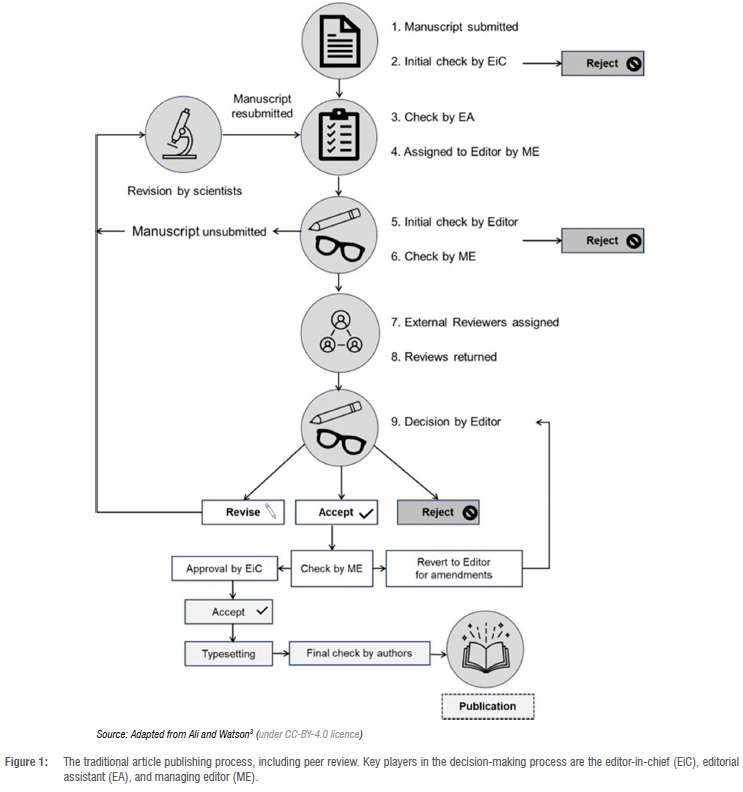
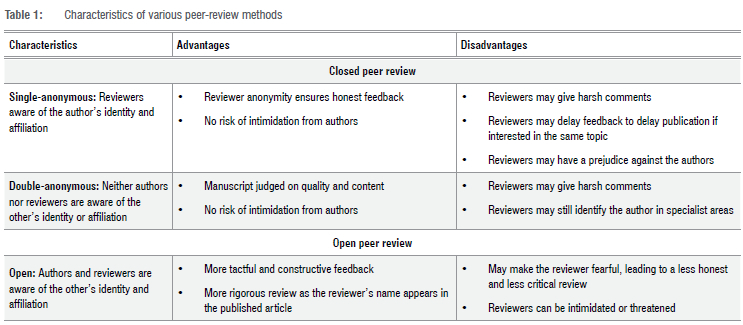
The traditional scientific publication process is a rigorously structured pathway3Figure 1). Researchers submit their completed studies in the form of a written manuscript to a scientific journal of their choice. Here, an editor initially assesses if it fits into the scope of the journal and meets format and language standards. If it passes this first stage, it goes through several more rounds of internal review. It is then finally forwarded to independent experts (usually two or three) in the field for peer review. This framework is known as pre-publication peer review455Table 1).
The reviewers scrutinise the research for its validity, significance, quality, and ease of reading and understanding, offering (mostly) constructive feedback and recommendations for acceptance, revision, or rejection. Authors may then revise their work based on this feedback and resubmit the manuscript, after which the editor makes the final decision on its suitability for publication. This framework is known as pre-publication peer review.663
While the peer review process is a cornerstone of academic integrity, it comes with its own set of challenges7 568
Post-publication peer review: Publish first, ask questions later
In contrast to the traditional model, a novel form of scientific publication arrived on the scene in October 20229eLife changed its editorial practice1011
This openness comes with several advantages9
Additionally, authors retain more agency in the publication process, as they can choose whether to implement reviewers' suggestions.11
Meanwhile, preprints have been around for at least 30 years and probably paved the way for the rise of the 'publish all' model. In this approach, researchers upload their manuscripts to preprint servers (like ResearchGate or ScienceOpen) before they undergo traditional peer review. These platforms make the research publicly available almost immediately, allowing other scientists to comment, critique, and even build upon the work. This gives the authors time to incorporate feedback before the paper is submitted to a journal for official peer review. Think of a preprint as a draft version of the research that is publicly shared before it has been officially reviewed.
One of the key advantages of preprints is their speed.121314
However, the 'publish all' model is not without its drawbacks, the most glaring of which is the potential compromise on research quality.1115
The future of citations?
In academic and scientific writing, citations serve a purpose: they give credit where it is due and offer readers a pathway to find the original source for further reading or verification. Crucially, they form the basis of tried and trusted evidence to support new research. Considering the emerging 'publish all' method, how can researchers cite studies presented in this way? Citing papers that have not undergone traditional peer review presents a unique set of challenges and considerations.
In the traditional peer-review model, citing is straightforward because the research has undergone rigorous scrutiny and has been published in a reputable journal. Researchers can cite these papers with confidence, knowing that the work has been vetted by experts in the field. In the publish-all model, like the one adopted by eLife, papers are published alongside reviewer comments, but they may not necessarily have been revised based on those comments. Researchers who cite such articles may inadvertently propagate unverified or flawed findings, thereby affecting the quality of their work and potentially leading to the spread of misinformation. Researchers should exercise caution and critically evaluate the paper's quality and relevance to their work. The citation should ideally include a note indicating that the paper has not undergone traditional peer review, like is done for preprints. Various influential journals (Nature, Science, The Lancet, and the BMJ) now explicitly state that although they allow the citation of preprints, there are specific guidelines about how these materials should be cited.16
Conclusion
As the academic publishing environment evolves, there is room to revamp and restructure peer-review systems and frameworks. The rise of preprints, particularly during the COVID-19 crisis, demonstrates the advantages of disseminating scientific findings quickly before undergoing conventional peer review. Additionally, the era of open science demands innovative platforms that can facilitate dynamic and thorough debates, contributing to scientific advancement while also promoting fairness and transparency. However, the publication of flawed science using the publish-all model raises serious and valid concerns within the scientific community.
The long-term sustainability of the current peer-review system is increasingly coming into question, even though it is unclear what will take its place, how it will transform or even who will manage this transformation. The era of open science is pushing us toward more transparent, inclusive, and rapid forms of communication. However, this should not come at the expense of quality and rigour. As we move forward, it is crucial to develop frameworks that facilitate quicker publication whilst still being able to uphold the integrity and credibility of scientific research.
Competing interests
I have no competing interests to declare.
Acknowledgements
The support of the GENUS DSI-NRF Centre of Excellence in Palaeosciences at the University of the Witwatersrand is gratefully acknowledged. I thank Dr Christine Steininger for sharing her insights and useful suggestions regarding the article.
References
-
1. Berger LR, Makhubela T, Molopyane K, Kruger A, Randolph-Quinney P Elliott M, et al. Evidence for deliberate burial of the dead by Homo naledi [reviewed preprint]. eLife. 2023;12, RP89106. https://doi.org/10.7554/eLife.89106.1
» https://doi.org/10.7554/eLife.89106.1 -
2. Callaway E. Criticism of controversial ancient-human claims tests eLife's peer-review model. Nature. 2023;620:13-14. https://doi.org/10.1038/d41586-023-02415-w
» https://doi.org/10.1038/d41586-023-02415-w -
3. Ali PA, Watson R. Peer review and the publication process. Nurs Open. 2016;3(4):193-202. https://doi.org/10.1002/nop2.51
» https://doi.org/10.1002/nop2.51 -
4. Elsevier. Publishing guidelines: Peer review [webpage on the Internet]. c2014 [cited 2023 Oct 04]. Available from: http://www.elsevier.com/about/publishing-guidelines/peer-review
» http://www.elsevier.com/about/publishing-guidelines/peer-review -
5. Santos A, Morris DS, Rattan R, Zakrison T. Double-blinded manuscript review: Avoiding peer review bias. J Trauma Acute Care Surg. 2021;91(1):e39-e42. https://doi.org/10.1097/TA.0000000000003260
» https://doi.org/10.1097/TA.0000000000003260 -
6. Teixeira da Silva JA, Dobránszki J. Problems with traditional science publishing and finding a wider niche for post-publication peer review. Account Res. 2015;22(1):22-40. https://doi.org/10.1080/08989621.2014.899909
» https://doi.org/10.1080/08989621.2014.899909 -
7. Tennant JP Ross-Hellauer T. The limitations to our understanding of peer review. Res Integr Peer Rev. 2020;5(1):6. https://doi.org/10.1186/s41073-020-00092-1
» https://doi.org/10.1186/s41073-020-00092-1 -
8. Pretorius M. Breaking barriers or breaking the bank? The academic publishing system is extorting emerging researchers. Daily Maverick. 2023 September 04 [cited 2023 Oct 04]. Available from: https://www.dailymaverick.co.za/opinionista/2023-09-04-breaking-barriers-or-breaking-the-bank-the-academic-publishing-system-is-extorting-emerging-researchers/
» https://www.dailymaverick.co.za/opinionista/2023-09-04-breaking-barriers-or-breaking-the-bank-the-academic-publishing-system-is-extorting-emerging-researchers/ - 9. Kelly J, Sadeghieh T, Adeli K. Peer review in scientific publications: Benefits, critiques, & a survival guide. Ejifcc. 2014;25(3):227.
-
10. Abbott A. Strife at eLife: Inside a journal's quest to upend science publishing. Nature. 2023;615:780-781. https://doi.org/10.1038/d41586-023-00831-6
» https://doi.org/10.1038/d41586-023-00831-6 -
11. O'Sullivan L, Ma L, Doran P An overview of post-publication peer review. Sch Assess Rep. 2021;3(1):1-11. https://doi.org/10.29024/sar.26
» https://doi.org/10.29024/sar.26 -
12. Fraser N, Brierley L, Dey G, Polka JK, Pálfy M, Nanni F, et al. The evolving role of preprints in the dissemination of COVID-19 research and their impact on the science communication landscape. PLoS Biol. 2021;19(4), e3000959. https://doi.org/10.1371/journal.pbio.3000959
» https://doi.org/10.1371/journal.pbio.3000959 -
13. Guterman EL, Braunstein LZ. Preprints during the COVID-19 pandemic: Public health emergencies and medical literature. J Hosp Med. 2020;15(10):634. https://doi.org/10.12788/jhm.3491
» https://doi.org/10.12788/jhm.3491 -
14. Sarabipour S, Debat HJ, Emmott E, Burgess SJ, Schwessinger B, Hensel Z. On the value of preprints: An early career researcher perspective. PLoS Biol. 2019;17(2), e3000151. https://doi.org/10.1371/journal.pbio.3000151
» https://doi.org/10.1371/journal.pbio.3000151 -
15. Callaway E. Sharp criticism of controversial ancient-human claims tests eLife's revamped peer-review model. Nature. 2023;620:13-14. https://doi.org/10.1038/d41586-023-02415-w
» https://doi.org/10.1038/d41586-023-02415-w -
16. Berg JM, Bhalla N, Bourne PE, Chalfie M, Drubin DG, Fraser JS, et al. Preprints for the life sciences. Science. 2016;352(6288):899-901. https://doi.org/10.1126/science.aaf9133
» https://doi.org/10.1126/science.aaf9133

Published: 28 May 2024