A review of the environments, biota, and methods used in microplastics research in South Africa
Abstract
Microplastics are small plastic materials often defined as those between 5 mm and 0.05 mm in size. Microplastics can have toxicological impacts on various biota, from gut blockages to the transport or leaching of toxicants used in their production or absorbed from the surrounding environment. Although microplastic research has increased significantly, microplastic research in Africa lags behind that of developed countries. South Africa is the African nation with the highest number of microplastic publications. We aimed to determine the current state of microplastic research in South Africa. A total of 46 publications on microplastics in South Africa have been produced. However, many of these publications use methods that might not be accurate in determining holistic descriptions of microplastics in the aquatic environment. Similarly, many ecologically relevant environments and species have not been investigated for microplastics in the country, including any atmospheric or terrestrial environment. We conclude that, although the research being produced in South Africa can be considered adequate, a singular standard method for sampling and assessing microplastics in South African environments is required. The production of such a standard method would be critical to use as a monitoring tool to determine and compare microplastic abundances across the country and globally. SIGNIFICANCE: • More than 40 publications on microplastics have been produced in South Africa. • Microplastics have been discovered in multiple aquatic environments in South Africa, but have not been investigated in atmospheric or terrestrial environments. • Polymer analysis was limited in published research. • A standard method is required for comparing between studies. • Terrestrial and atmospheric microplastic studies are required.
fresh water; marine; biota; Africa; plastics pollution
Introduction
Plastics are polymers that consist of monomers chained together to produce products with unique characteristics.1 232,34456
Microplastics have since been collected, described, and characterised globally in marine and freshwater environments, soil, biota, and the atmosphere.7232
After discovering microplastics, their toxicity and potential impact on biota were investigated. Microplastics can have toxicological impacts on biota through three separate pathways. First, the physical nature of microplastics can lead to gut obstructions or reduce the ability of organisms to move or reproduce.22,333891011
In this review, we aimed to determine the state of microplastic research in South Africa. The review focuses on the environments and biota investigated, the concentrations of microplastics found, the overall methods used within the country, the current trends, and shortfalls of the research in South Africa, and where more research is required.
Method
Data collection
Data were collected using the primary academic search engines ScienceDirect, SpringerLink, Google Scholar and the research network ResearchGate. The primary keywords used for the search of papers were "South Africa" and "Microplastics". The papers were then screened by relevance (whether conducted in South Africa) and ordered chronologically from 2023 to 1990. The information recorded from the papers included the authors, title, year of publication, where in South Africa the study was conducted, whether it was conducted in freshwater, marine or terrestrial environments, whether biota were included in the study, which matrices were investigated (water, sediment, biota), the extraction methods used, the identification method, mean concentrations and whether quality control was performed in the study. Modelling and review papers were also included; no published studies that were conducted in South Africa were omitted. Documents that did not undergo peer review, such as dissertations, theses, preprints and reports, were not included. Microsoft Excel was used to produce graphs and tables. A map of the research conducted within South Africa was created on QGIS v3.26.2 to visualise and highlight areas where more research might be required.
Microplastic research in Africa
Microplastic research within Africa has primarily focused more on the marine environment than freshwater environments - a global trend also found in developed nations.5,1212,131212,141414141412141312-14
Microplastics in South African environments
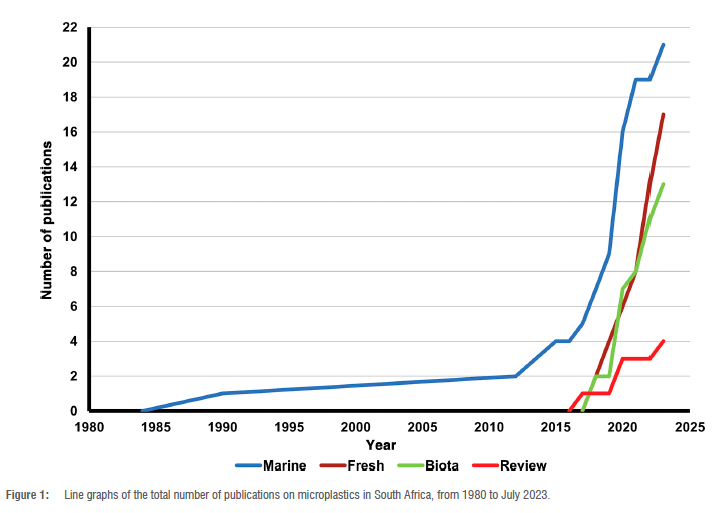
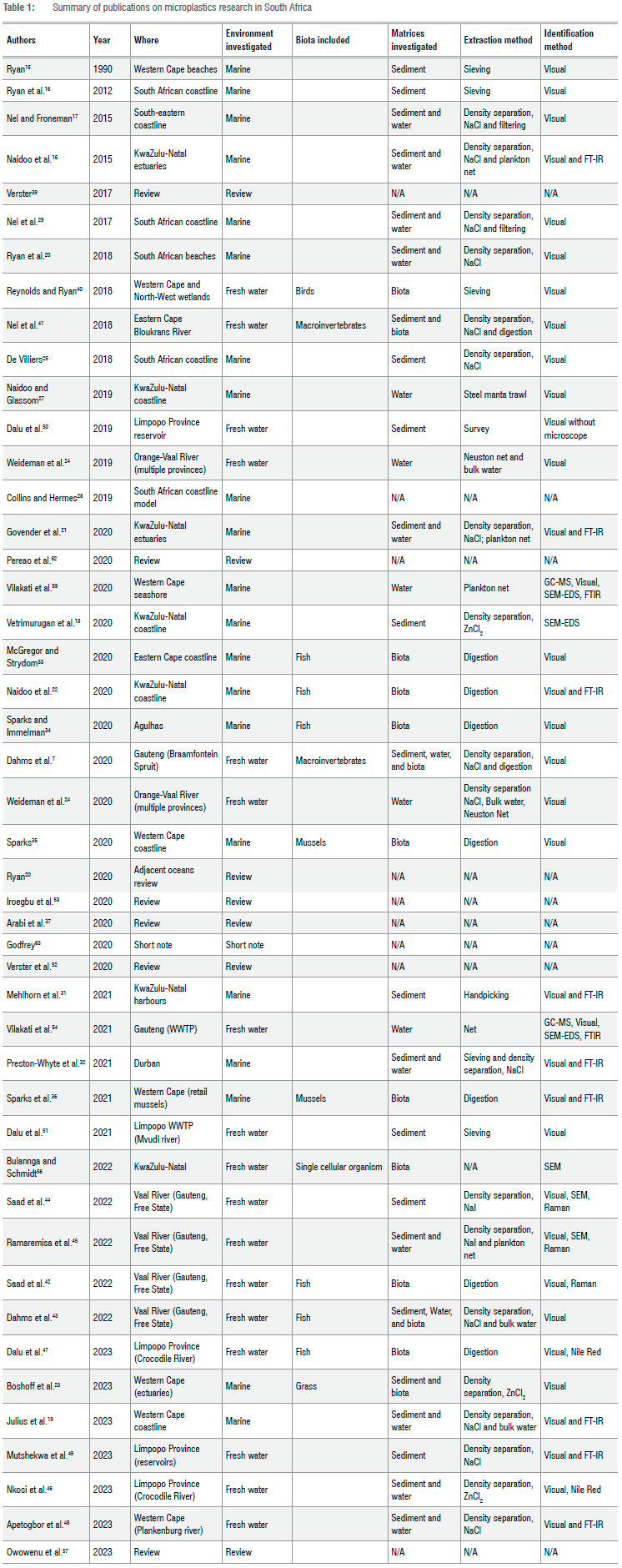
Alimi et al.14Table 1). Microplastic research in South Africa began in 1990 when Ryan15Figure 1). It is important to acknowledge that of all 46 publications, only 12 have investigated microplastics' presence or impacts on biota. No studies have investigated the presence or deposition of microplastics from the atmosphere. Similarly, no research has been done on microplastics in the terrestrial environment, including on any terrestrial organisms. This indicates a large gap in microplastic research within South Africa.
Microplastics in the marine environment
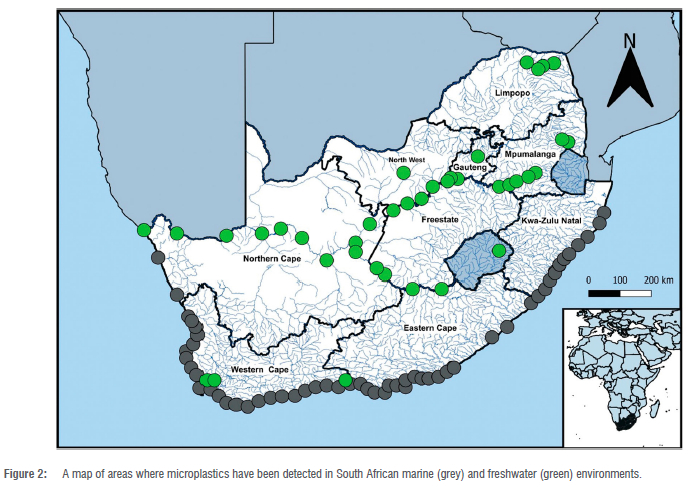
In 1990, Ryan1516,17151819,20Figure 2).
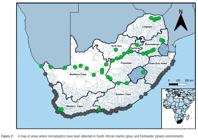
From 1990 to August 2023, a total of 20 publications were produced on microplastics in marine environments, excluding reviews and coastal modelling studies. The primary matrices investigated in South African marine environments were sediment, water, and biota, although no studies had investigated all three matrices within a single study. Estuaries can be regarded as the most under-researched marine environment, with only four publications quantifying their microplastic pollution. These studies have determined the microplastic concentrations in water and sediment21222316,22,2324
The other studies were primarily focused on quantifying microplastics on beaches and coastlines to determine the type of pollutant and how the microplastics may be distributed. Ryan et al.2025 20,2526
When the concentration and distribution of microplastics in water along the coastline were investigated, researchers found two opposing trends in the distribution. Naidoo and Glassom2728282827
However, harbours around the coastline of South Africa were found to be areas where microplastics could increase in abundance and then be released. The first study to investigate South African harbours was conducted by Nel et al.29292928,29
In a multinational study, Matsuguma et al.3030
Further studies by Mehlhorn et al.3132 31,32
Research on the impact or presence of microplastics on marine biota is limited in South Africa. Only five publications have determined the presence of microplastics in marine animals. Fish have been the predominant focus, with three of the studies determining the presence of microplastics in marine and estuarine fish.33,34353636
It is recommended that microplastic research in the marine environment must accurately determine the distribution of specific polymers along coastlines, beaches, and biota.372,3
Microplastics in the freshwater environment
In parallel with the global trend in microplastic research, freshwater environments in South Africa were investigated for microplastics only decades after the first publication on microplastics from marine environments.53839 Figure 2). The first research was published when Reynolds and Ryan4041404140 41 4141
This research was followed by the first evidence of microplastics in the Orange-Vaal River system.2424244243Clarias gariepinus for microplastics, detecting them in all three matrices. Similarly, Saad et al.44Cyprinus carpio and detected microplastics in the fish. Clarias gariepinus and Cyprinus carpio are important fish species economically and are a food source for subsistence fishers in the country, indicating that the microplastics ingested by these fishes might be ingested by humans.43,44454445244542,44417,43 23
The only other major rivers in South Africa that have been investigated for microplastic pollution are the Crocodile River and Plankenberg River. The Crocodile River was investigated when Nkosi et al.4647 47484848
Only one urban stream has been investigated. Dahms et al.777777
Aquatic environments that have rarely been investigated are pans, reservoirs, or isolated water bodies, with the only publications being those of Mutshekwa et al.4950
With microplastics in rivers being attributed to WWTPs, multiple studies have investigated their contribution to microplastics in South Africa. It was previously highlighted that Dalu et al.47 51512,52,53 5454 55
Of the microplastics studies in freshwater environments, seven included a biological component as either a bioindicator or to assess whether microplastics were entering aquatic food chains. Fish have primarily been the most popular organisms studied and were investigated in three of the studies, followed by benthic macroinvertebrates in two studies, with birds and ciliates being the only other organisms investigated.56
Although there has been a significant increase in microplastic research in freshwater systems, many publications have primarily determined and reported the microplastic abundance in only one or two ecosystem components. Only 13 studies have attempted to determine the microplastic abundance in two or more components of the environment, with only 2 studies investigating all components of the ecosystem to determine how the distribution is impacted. A review paper by Owowenu et al.57
From the review of all the literature presented here, it is recommended that microplastic studies in freshwater environments must incorporate all aspects of the system to determine accurately how microplastics are distributed.27,40Figure 2).13,39,40 2
Methods used in South Africa
Field sampling methods
Water and sediment have been the primary components of the environment that have been investigated in South Africa. Sampling methods have been similar to those used in other countries.23Table 1). The other studies used slightly denser solutions, such as Nal or ZnCl2, which can have densities of over 1.5 g.cm3585858
Collection of water samples varied across studies; however, the most common method was sampling bulk water, filtered at the site, or using nets such as manta trawls, neuston, and plankton nets of various mesh sizes that might not collect all the sizes of microplastics present. Care must be taken when nets or containers made from plastic are used, which could potentially contaminate the sample with microplastics. Contamination also needs to be considered when biota are sampled to ensure that nets used to catch and keep biota do not contaminate the samples. Finally, the most important aspect of sampling from environments is to contextualise the site from where the sample was collected. The season, flow, depth, sediment grain size, and discharge could all impact the distribution of the microplastics. If the site data cannot be contextualised, the results could provide a false indication of the total plastics sampled, regardless of the method used.7,57
Microplastic identification
Identifying microplastic polymers in South Africa seems limited compared to that in developed countries. Only a limited number of publications had some form of polymer identification. Of those that had determined the polymer of plastic, the most available method seemed to be Fourier transform infrared (FT-IR) analysis conducted in 9 of the publications produced, with 21 papers not conducting any form of polymer analysis. This was followed by Raman spectroscopy, used in three publications, and pyrolysis-GC-MS59606160,61
Recommendations for future research
Microplastics research should be conducted in more environments and biota in South Africa. Aquatic environments are crucial in a water-scarce country such as South Africa, and the impact of microplastics on freshwater environments has scarcely been investigated. There is also the need for a prescribed method for the sampling and analysis of microplastics in South African environments. For a standard monitoring tool, a standard method that is both cost- and time-effective but accessible and accurate in its analysis could be easily adopted by the various research institutes in the country.62,636060,6112-14
Competing interests
We have no competing interests to declare.
Authors' contributions
H.T.J.D.: Conceptualisation; data collection; methodology; data collection; data analysis; writing - the initial draft. R.G.: Conceptualisation; methodology; validation; writing - revision; student supervision; funding acquisition.
Acknowledgements
We acknowledge the South African National Research Foundation for funding this research [grant number: 612 MND200505519919; grant number: 137999]. We also thank the anonymous reviewers for their contribution to the review.
References
-
1. Jansen JA. Plastics - It's all about molecular structure. Plastics Engineering. 2016 September. Available from: https://read.nxtbook.com/wiley/plasticsengineering/september2016/consultantscorner_plastics.html
» https://read.nxtbook.com/wiley/plasticsengineering/september2016/consultantscorner_plastics.html -
2. Li J, Liu H, Paul Chen J. Microplastics in freshwater systems: A review on occurrence, environmental effects, and methods for microplastics detection. Water Res. 2018;137:362-374. https://doi.org/10.1016/j.watres.2017.12.056
» https://doi.org/10.1016/j.watres.2017.12.056 -
3. Guo X, Wang J. The chemical behaviors of microplastics in marine environment: A review. Mar Pollut Bull. 2019;142:1-14. https://doi.org/10.1016/j.marpolbul.2019.03.019
» https://doi.org/10.1016/j.marpolbul.2019.03.019 -
4. Gregory MR. Plastic pellets on New Zealand beaches. Mar Pollut Bull. 1977;8:82-84. https://doi.org/10.1016/0025-326X(77)90193-X
» https://doi.org/10.1016/0025-326X(77)90193-X -
5. Eerkes-Medrano D, Thompson R. Occurrence, fate, and effect of microplastics in freshwater systems. In: Zeng EX editor. Microplastic contamination in aquatic environments. Amsterdam: Elsevier; 2018. p. 95-132. https://doi.org/10.1016/B978-0-12-813747-5.00004-7
» https://doi.org/10.1016/B978-0-12-813747-5.00004-7 - 6. Arthur C, Baker J, Bamford H. International research workshop on the occurrence, effects, and fate of microplastic marine debris. In: Conference Proceedings of the International Research Workshop on the Occurrence, Effects, and Fate of Microplastic Marine Debris; 2008 September 9-11; Tacoma, WA, USA. NOAA Technical Memorandum NOS-OR&R-30. Silver Spring, MD: NOAA Marine Debris Division; 2009.
-
7. Dahms HTJ, van Rensburg GJ, Greenfield R. The microplastic profile of an urban African stream. Sci Total Environ. 2020;731, Art. #138893. https://doi.org/10.1016/j.scitotenv.2020.138893
» https://doi.org/10.1016/j.scitotenv.2020.138893 -
8. Barboza LGA, Vieira LR, Branco V Carvalho C, Guilhermino L. Microplastics increase mercury bioconcentration in gills and bioaccumulation in the liver, and cause oxidative stress and damage in Dicentrarchus labrax juveniles. Sci Rep. 2018;8:1-9. https://doi.org/10.1038/s41598-018-34125-z
» https://doi.org/10.1038/s41598-018-34125-z -
9. Syakti AD, Jaya JV, Rahman A, Hidayati NV, Raza'i TS, Idris F, et al. Bleaching and necrosis of staghorn coral (Acropora formosa) in laboratory assays: Immediate impact of LDPE microplastics. Chemosphere. 2019;228:528-535. https://doi.org/10.1016/j.chemosphere.2019.04.156
» https://doi.org/10.1016/j.chemosphere.2019.04.156 -
10. Wang W, Gao H, Jin S, Li R, Na G. The ecotoxicological effects of microplastics on aquatic food web, from primary producer to human: A review. Ecotoxicol Environ Saf. 2019;173:110-117. https://doi.org/10.1016/j.ecoenv.2019.01.113
» https://doi.org/10.1016/j.ecoenv.2019.01.113 -
11. Walker TR. (Micro)plastics and the UN Sustainable Development Goals. Curr Opin Green Sustain Chem. 2021;30, Art. #100497. https://doi.org/10.1016/j.cogsc.2021.100497
» https://doi.org/10.1016/j.cogsc.2021.100497 -
12. Okeke ES, Olagbaju OA, Okoye CO, Addey CI, Chukwudozie KI, Okoro JO, et al. Microplastic burden in Africa: A review of occurrence, impacts, and sustainability potential of bioplastics. Chem Eng J Adv. 2022;12, Art. #100402. https://doi.org/10.1016/j.ceja.2022.100402
» https://doi.org/10.1016/j.ceja.2022.100402 -
13. Aragawa TA. Microplastic pollution in African countries' water systems: A review on findings, applied methods, characteristics, impacts, and managements. SN Appl Sci. 2021;3:629. https://doi.org/10.1007/s42452-021-04619-z
» https://doi.org/10.1007/s42452-021-04619-z -
14. Alimi OS, Fadare OO, Okoffo ED. Microplastics in African ecosystems: Current knowledge, abundance, associated contaminants, techniques, and research needs. Sci Total Environ. 2021;755, Art. #142422. https://doi.org/10.1016/j.scitotenv.2020.142422
» https://doi.org/10.1016/j.scitotenv.2020.142422 - 15. Ryan PG. Plastic and other artefacts on South African beaches: Temporal trends in abundance and composition. S Afr J Sci. 1990;86:450-452.
-
16. Naidoo T, Glassom D, Smit AJ. Plastic pollution in five urban estuaries of KwaZulu-Natal, South Africa. Mar Pollut Bull. 2015;101(1):473-480. https://doi.org/10.1016/j.marpolbul.2015.09.044
» https://doi.org/10.1016/j.marpolbul.2015.09.044 -
17. Nel HA, Froneman PW. A quantitative analysis of microplastic pollution along the south-eastern coastline of South Africa. Mar Pollut Bull. 2015;101(1):274-279. https://doi.org/10.1016/j.marpolbul.2015.09.043
» https://doi.org/10.1016/j.marpolbul.2015.09.043 -
18. Vetrimurugan E, Jonathan MP Sarkar SK, Rodríguez-González F, Roy PD, Velumani S, et al. Occurrence, distribution and provenance of micro plastics: A large scale quantitative analysis of beach sediments from southeastern coast of South Africa. Sci Total Environ. 2020;746, Art. #141103. https://doi.org/10.1016/j.scitotenv.2020.141103
» https://doi.org/10.1016/j.scitotenv.2020.141103 -
19. Julius D, Awe A, Sparks C. Environmental concentrations, characteristics and risk assessment of microplastics in water and sediment along the Western Cape coastline, South Africa. Heliyon. 2023;9(8), E18559. https://doi.org/10.1016/j.heliyon.2023.e18559
» https://doi.org/10.1016/j.heliyon.2023.e18559 -
20. Ryan PG, Perold V, Osborne A, Moloney CL. Consistent patterns of debris on South African beaches indicate that industrial pellets and other mesoplastic items mostly derive from local sources. Environ Pollut. 2018;238:1008-1016. https://doi.org/10.1016/j.envpol.2018.02.017
» https://doi.org/10.1016/j.envpol.2018.02.017 -
21. Govender J, Naidoo T, Rajkaran A, Cebekhulu S, Bhugeloo A, Sershen. Towards characterising microplastic abundance, typology and retention in mangrove-dominated estuaries. Water. 2020;12(10), Art. #2802. https://doi.org/10.3390/w12102802
» https://doi.org/10.3390/w12102802 -
22. Naidoo T, Sershen, Thompson RC, Rajkaran A. Quantification and characterisation of microplastics ingested by selected juvenile fish species associated with mangroves in KwaZulu-Natal, South Africa. Environ Pollut. 2020;257, Art. #113635. https://doi.org/10.1016/j.envpol.2019.113635
» https://doi.org/10.1016/j.envpol.2019.113635 -
23. Boshoff BJ, Robinson TB, von der Heyden S. The role of seagrass meadows in the accumulation of microplastics: Insights from a South African estuary. Mar Pollut Bull. 2023;186, Art. #114403. https://doi.org/10.1016/j.marpolbul.2022.114403
» https://doi.org/10.1016/j.marpolbul.2022.114403 -
24. Weideman EA, Perold V, Ryan PG. Little evidence that dams in the Orange-Vaal River system trap floating microplastics or microfibres. Mar Pollut Bull. 2019;149, Art. #110664. https://doi.org/10.1016/j.marpolbul.2019.110664
» https://doi.org/10.1016/j.marpolbul.2019.110664 -
25. de Villiers S. Quantification of microfibre levels in South Africa's beach sediments, and evaluation of spatial and temporal variability from 2016 to 2017. Mar Pollut Bull. 2018;135:481-489. https://doi.org/10.1016/j.marpolbul.2018.07.058
» https://doi.org/10.1016/j.marpolbul.2018.07.058 -
26. Ryan PG, Bouwman H, Moloney CL, Yuyama M, Takada H. Long-term decreases in persistent organic pollutants in South African coastal waters detected from beached polyethylene pellets. Mar Pollut Bull. 2012;64 (12):2756-2760. https://doi.org/10.1016/j.marpolbul.2012.09.013
» https://doi.org/10.1016/j.marpolbul.2012.09.013 -
27. Naidoo T, Glassom D. Sea-surface microplastic concentrations along the coastal shelf of KwaZulu-Natal, South Africa. Mar Pollut Bull. 2019;149, Art. #110514. https://doi.org/10.1016/j.marpolbul.2019.110514
» https://doi.org/10.1016/j.marpolbul.2019.110514 -
28. Collins C, Hermes JC. Modelling the accumulation and transport of floating marine micro-plastics around South Africa. Mar Pollut Bull. 2019;139:46-58. https://doi.org/10.1016/j.marpolbul.2018.12.028
» https://doi.org/10.1016/j.marpolbul.2018.12.028 -
29. Nel HA, Hean JW, Noundou XS, Froneman PW. Do microplastic loads reflect the population demographics along the southern African coastline? Mar Pollut Bull. 2017;115(1-2):115-119. https://doi.org/10.1016/j.marpolbul.2016.11.056
» https://doi.org/10.1016/j.marpolbul.2016.11.056 -
30. Matsuguma Y, Takada H, Kumata H, Kanke H, Sakurai S, Suzuki T, et al. Microplastics in sediment cores from Asia and Africa as indicators of temporal trends in plastic pollution. Env Cont Toxicol. 2017;73:230-239. https://doi.org/10.1007/s00244-017-0414-9
» https://doi.org/10.1007/s00244-017-0414-9 -
31. Mehlhorn P, Viehberg F, Kirsten K, Newman B, Frenzel P, Gildeeva O, et al. Spatial distribution and consequences of contaminants in harbour sediments - A case study from Richards Bay Harbour, South Africa. Mar Pollut Bull. 2021;172, Art. #112764. https://doi.org/10.1016/j.marpolbul.2021.112764
» https://doi.org/10.1016/j.marpolbul.2021.112764 -
32. Preston-Whyte F, Silburn B, Meakins B, Bakir A, Pillay K, Worship M, et al. Meso- and microplastics monitoring in harbour environments: A case study for the Port of Durban, South Africa. Mar Pollut Bull. 2021;163, Art. #111948. https://doi.org/10.1016/j.marpolbul.2020.111948
» https://doi.org/10.1016/j.marpolbul.2020.111948 -
33. McGregor S, Strydom NA. Feeding ecology and microplastic ingestion in Chelon richardsonii (Mugilidae) associated with surf diatom Anaulus australis accumulations in a warm temperate South African surf zone. Mar Pollut Bull. 2020;158, Art. #111430. https://doi.org/10.1016/j.marpolbul.2020.111430
» https://doi.org/10.1016/j.marpolbul.2020.111430 -
34. Sparks C, Immelman S. Microplastics in offshore fish from the Agulhas Bank, South Africa. Mar Pollut Bull. 2020;156, Art. #111216. https://doi.org/10.1016/j.marpolbul.2020.111216
» https://doi.org/10.1016/j.marpolbul.2020.111216 -
35. Sparks C. Microplastics in mussels along the coast of Cape Town, South Africa. Bull Environ Contam Toxicol. 2020;104(4):423-431. https://doi.org/10.1007/s00128-020-02809-w
» https://doi.org/10.1007/s00128-020-02809-w -
36. Sparks C, Awe A, Maneveld J. Abundance and characteristics of microplastics in retail mussels from Cape Town, South Africa. Mar Pollut Bull. 2021;166, Art. #112186. https://doi.org/10.1016/j.marpolbul.2021.112186
» https://doi.org/10.1016/j.marpolbul.2021.112186 -
37. Arabi S, Nahman A. Impacts of marine plastic on ecosystem services and economy: State of South African research. S Afr J Sci. 2020;116(5/6), Art. #7695. https://doi.org/10.17159/sajs.2020/7695
» https://doi.org/10.17159/sajs.2020/7695 -
38. Blettler MCM, Abrial E, Khan FR, Sivri N, Espinola LA. Freshwater plastic pollution: Recognizing research biases and identifying knowledge gaps. Water Res. 2018;143:416-124. https://doi.org/10.1016/j.watres.2018.06.015
» https://doi.org/10.1016/j.watres.2018.06.015 -
39. Verster C, Minnaar K, Bouwman H. Marine and freshwater microplastic research in South Africa. IEAM. 2017;13:533-535. https://doi.org/10.1002/ieam.1900
» https://doi.org/10.1002/ieam.1900 -
40. Reynolds C, Ryan PG. Micro-plastic ingestion by waterbirds from contaminated wetlands in South Africa. Mar Pollut Bull. 2018;126:330-333. https://doi.org/10.1016/j.marpolbul.2017.11.021
» https://doi.org/10.1016/j.marpolbul.2017.11.021 -
41. Nel HA, Dalu T, Wasserman RJ. Sinks and sources: Assessing microplastic abundance in river sediment and deposit feeders in an Austral temperate urban river system. Sci Total Environ. 2018;612:950-956. https://doi.org/10.1016/j.scitotenv.2017.08.298
» https://doi.org/10.1016/j.scitotenv.2017.08.298 -
42. Saad D, Ndlovu M, Ramaremisa G, Tutu H. Microplastics in freshwater environment: The first evaluation in sediment of the Vaal River, South Africa. Heliyon. 2022;8(10), e11118. https://doi.org/10.1016/j.heliyon.2022.e11118
» https://doi.org/10.1016/j.heliyon.2022.e11118 -
43. Dahms HTJ, Tweddle GP, Greenfield R. Gastric microplastics in Clarias gariepinus of the Upper Vaal River, South Africa. Front Environ Sci. 2022;10, Art. #931073. https://doi.org/10.3389/fenvs.2022.931073
» https://doi.org/10.3389/fenvs.2022.931073 -
44. Saad D, Chauke P, Cukrowska E, Richards H, Nikiema J, Chimuka L, et al. First biomonitoring of microplastic pollution in the Vaal River using Carp fish (Cyprinus carpio) "as a bio-indicator." Sci Total Environ. 2022;836, Art. #155623. https://doi.org/10.1016/j.scitotenv.2022.155623
» https://doi.org/10.1016/j.scitotenv.2022.155623 -
45. Ramaremisa G, Ndlovu M, Saad D. Comparative assessment of microplastics in surface waters and sediments of the Vaal River, South Africa: Abundance, composition, and sources. Environ Toxicol Chem. 2022;41(12):3029-3040. https://doi.org/10.1002/etc.5482
» https://doi.org/10.1002/etc.5482 -
46. Nkosi MS, Cuthbert RN, Wu N, Shikwambana P, Dalu T. Microplastic abundance, distribution, and diversity in water and sediments along a subtropical river system. Environ Sci Pollut Res. 2023;30:91440-91452. https://doi.org/10.1007/s11356-023-28842-w
» https://doi.org/10.1007/s11356-023-28842-w -
47. Dalu T, Themba NN, Dondofema F, Cuthbert RN. Nowhere to go! Microplastic abundances in freshwater fishes living near wastewater plants. Environ Toxicol Pharmacol. 2023;101, Art. #104210. https://doi.org/10.1016/j.etap.2023.104210
» https://doi.org/10.1016/j.etap.2023.104210 -
48. Apetogbor K, Pereao O, Sparks C, Opeolu B. Spatio-temporal distribution of microplastics in water and sediment samples of the Plankenburg River, Western Cape, South Africa. Environ Pollut. 2023;15:323. https://doi.org/10.1016/j.envpol.2023.121303
» https://doi.org/10.1016/j.envpol.2023.121303 -
49. Mutshekwa T, Munyai LF, Mugwedi L, Cuthbert RN, Dondofema F, Dalu T. Seasonal occurrence of microplastics in sediment of two South African recreational reservoirs. Water Biol Secur. 2023;2(3), Art. #100185. https://doi.org/10.1016/j.watbs.2023.100185
» https://doi.org/10.1016/j.watbs.2023.100185 -
50. Dalu T, Malesa B, Cuthbert RN. Assessing factors driving the distribution and characteristics of shoreline macroplastics in a subtropical reservoir. Sci Total Environ. 2019;696, Art. #133992. https://doi.org/10.1016/j.scitotenv.2019.133992
» https://doi.org/10.1016/j.scitotenv.2019.133992 -
51. Dalu T, Banda T, Mutshekwa T, Munyai LF, Cuthbert RN. Effects of urbanisation and a wastewater treatment plant on microplastic densities along a subtropical river system. Environ Sci Pollut Res. 2021;28:36102-36111. https://doi.org/10.1007/s11356-021-13185-1
» https://doi.org/10.1007/s11356-021-13185-1 -
52. Verster C, Bouwman H. Landbased sources and pathways of marine plastics in a South African context. S Afr J Sci. 2020;116(5/6), Art. #7700. https://doi.org/10.17159/sajs.2020/7700
» https://doi.org/10.17159/sajs.2020/7700 -
53. Iroegbu AOC, Sadiku RE, Ray SS, Hamam Y Plastics in municipal drinking water and wastewater treatment plant effluents: Challenges and opportunities for South Africa-a review. Environ Sci Pollut Res Int. 2020;27(12):12953-12966. https://doi.org/10.1007/s11356-020-08194-5
» https://doi.org/10.1007/s11356-020-08194-5 -
54. Vilakati B, Sivasankar V,Nyoni H, Mamba BB, Omine K, Msagati TAM. The Py-GC-TOF-MS analysis and characterization of microplastics (MPs) in a wastewater treatment plant in Gauteng Province, South Africa. Ecotoxicol Environ Saf. 2021;222, Art. #112478. https://doi.org/10.1016/j.ecoenv.2021.112478
» https://doi.org/10.1016/j.ecoenv.2021.112478 -
55. Weis JA. Aquatic microplastic research - a critique and suggestions for the future. Water. 2020;12, Art. #1475. https://doi.org/10.3390/w12051475
» https://doi.org/10.3390/w12051475 -
56. Bulannga RB, Schmidt S. Uptake and accumulation of microplastic particles by two freshwater ciliates isolated from a local river in South Africa. Environ Res. 2022;204, Art. #112123. https://doi.org/10.1016/j.envres.2021.112123
» https://doi.org/10.1016/j.envres.2021.112123 -
57. Owowenu E, Nnadozie C, Akamagwuna FC, Noundou XS, Uku JE, Odume ON. A critical review of environmental factors influencing the transport dynamics of microplastics in riverine systems: Implications for ecological studies. Aquat Ecol. 2023;57:557-570. https://doi.org/10.1007/s10452-023-10029-7
» https://doi.org/10.1007/s10452-023-10029-7 -
58. Coppock RL, Cole M, Lindeque PK, Queirós AM, Galloway TS. A small-scale, portable method for extracting microplastics from marine sediments. Environ Pollut. 2017;230:829-837. https://doi.org/10.1016/j.envpol.2017.07.017
» https://doi.org/10.1016/j.envpol.2017.07.017 -
59. Vilakati B, Sivasankar V Mamba BB, Omine K, Msagati TAM. Characterization of plastic micro particles in the Atlantic Ocean seashore of Cape Town, South Africa and mass spectrometry analysis of pyrolyzate products. Environ Pollut. 2020;265, Art. #114859. https://doi.org/10.1016/j.envpol.2020.114859
» https://doi.org/10.1016/j.envpol.2020.114859 -
60. De Frond H, Hampton LT, Kotar S, Gesulga K, Matuch C, Lao W, et al. Monitoring microplastics in drinking water: An interlaboratory study to inform effective methods for quantifying and characterizing microplastics. Chemosphere. 2022;298, Art. #134282. https://doi.org/10.1016/j.chemosphere.2022.134282
» https://doi.org/10.1016/j.chemosphere.2022.134282 -
61. Kotar S, McNeish R, Murphy-Hagan C, Renick V,Lee CT, Steele C, et al. Quantitative assessment of visual microscopy as a tool for microplastic research: Recommendations for improving methods and reporting. Chemosphere. 2022;308, Art. #136449. https://doi.org/10.1016/j.chemosphere.2022.136449
» https://doi.org/10.1016/j.chemosphere.2022.136449 -
62. Pereao O, Opeolu B, Fatoki O. Microplastics in aquatic environment: Characterization, ecotoxicological effect, implications for ecosystems and developments in South Africa. Environ Sci Pollut Res. 2020;27:22271-22291. https://doi.org/10.1007/s11356-020-08688-2
» https://doi.org/10.1007/s11356-020-08688-2 -
63. Godfrey L. Are there gaps in our understanding of marine plastic pollution? S Afr J Sci. 2020;116(5/6), Art. #8170. https://doi.org/10.17159/sajs.2020/8170
» https://doi.org/10.17159/sajs.2020/8170

Revised: 04 Mar. 2024
Accepted: 05 Mar. 2024
Published: 28 May 2024
Funding: South African National Research Foundation (MND200505519919, 37999)