Land use and soil organic matter in South Africa 1: a review on spatial variability and the influence of rangeland stock production
Abstract
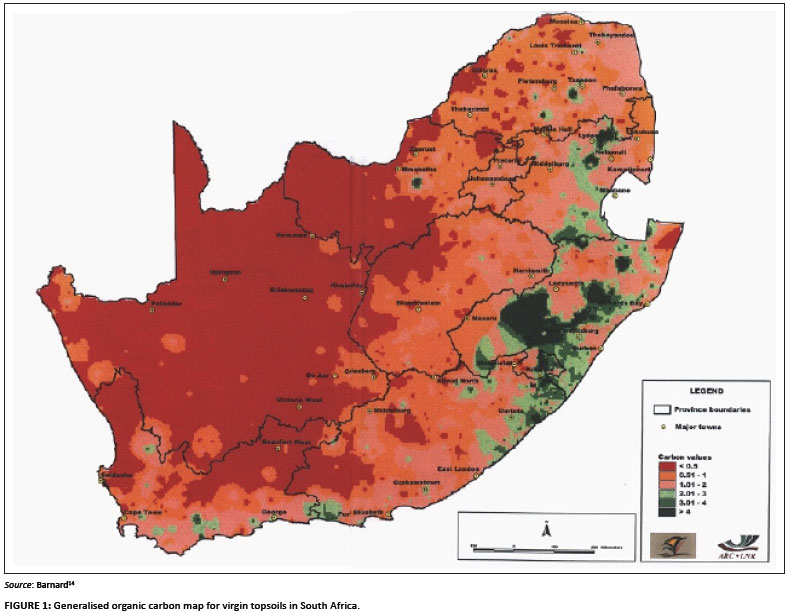
Degradation of soil as a consequence of land use poses a threat to sustainable agriculture in South Africa, resulting in the need for a soil protection strategy and policy. Development of such a strategy and policy require cognisance of the extent and impact of soil degradation processes. One of the identified processes is the decline of soil organic matter, which also plays a central role in soil health or quality. The spatial variability of organic matter and the impact of grazing and burning under rangeland stock production are addressed in this first part of the review. Data from uncoordinated studies showed that South African soils have low organic matter levels. About 58% of soils contain less than 0.5% organic carbon and only 4% contain more than 2% organic carbon. Furthermore, there are large differences in organic matter content within and between soil forms, depending on climatic conditions, vegetative cover, topographical position and soil texture. A countrywide baseline study to quantify organic matter contents within and between soil forms is suggested for future reference. Degradation of rangeland because of overgrazing has resulted in significant losses of soil organic matter, mainly as a result of lower biomass production. The use of fire in rangeland management decreases soil organic matter because litter is destroyed by burning. Maintaining or increasing organic matter levels in degraded rangeland soils by preventing overgrazing and restricting burning could contribute to the restoration of degraded rangelands. This restoration is of the utmost importance because stock farming uses the majority of land in South Africa.
Introduction
The degradation of South Africa's soil resource base poses a serious threat to sustainable agriculture. Soil is essentially a non-renewable resource and protection of this precious resource is of the utmost importance. The country is therefore in need of a soil protection strategy and policy. In the development of such a strategy and policy, cognisance should be taken of the extent and impact of soil degradation processes. The decline of soil organic matter that coincides with some land uses was one of the processes identified for review.
In the broadest context, organic matter can be referred to as the total complement of organic substances present in the soil, including living organisms of various sizes, organic residues in various stages of decomposition and dark-coloured humus consisting of non-humic and humic substances. Humus is relatively stable and has a major effect on various soil properties and processes that play a role in the functioning of soils.1
Organic matter, especially the humus fraction, influences the properties of mineral soils disproportionately to the quantity of organic matter present. Organic matter is a major source of nutrients and microbial energy, holds water and nutrients in available form, usually promotes soil aggregation and root development, and improves water infiltration and water-use efficiency.2
The organic matter content of soils is therefore a key attribute to both soil health and soil quality. The latter was defined by Doran and Parkin34
'the continued capacity of soil to function as a vital living system, within ecosystem and land use boundaries, to sustain biological productivity, promote the quality of air and water environments, and maintain plant, animal and human health'.
Hence it is not surprising that these two concepts are often used synonymously without a clear distinction between them.56
The organic matter content of soils varies widely because the organic matter content of a soil increases over time until an equilibrium is reached. The magnitude of this equilibrium depends on interactions between the factors of soil formation. Variations in the factors responsible for soil formation experienced on a landscape scale and the interdependence of these factors, contribute to the large variability in the contents of soil organic matter, even within localised areas. The relative importance of these factors on soil organic matter follows the order: climate > biota > topography = parent material > time.1
Soil organic matter also is important because the soil is both a source and sink for atmospheric CO2. It is a source because there is more than three times more carbon in the soil than in the atmosphere.7
The organic matter equilibrium in soils is disturbed by human activities such as crop and stock farming. Agricultural activities of this nature may either increase or decrease soil organic matter content in the long term, but in the majority of cases it has led to a decrease. The ultimate organic matter content in agricultural soils is governed by land use and the resulting land cover.8
Part 1 of this review addresses the spatial variability of organic matter and the impact of grazing and burning under veld stock production in South African soils. The second part of this review9
Spatial variability
No systematic countrywide study has thus far been carried out to determine the status and spatial distribution of organic matter in South Africa. However, the land type survey10111213
Barnard14Figure 1). The organic carbon content of topsoils ranged from less than 0.5% to more than 4%. Only 4% of the topsoils contained more than 2% organic carbon, whilst 58% of the topsoils contained less than 0.5% organic carbon. The remainder of the topsoils contained between 0.5% and 2% organic carbon.1514
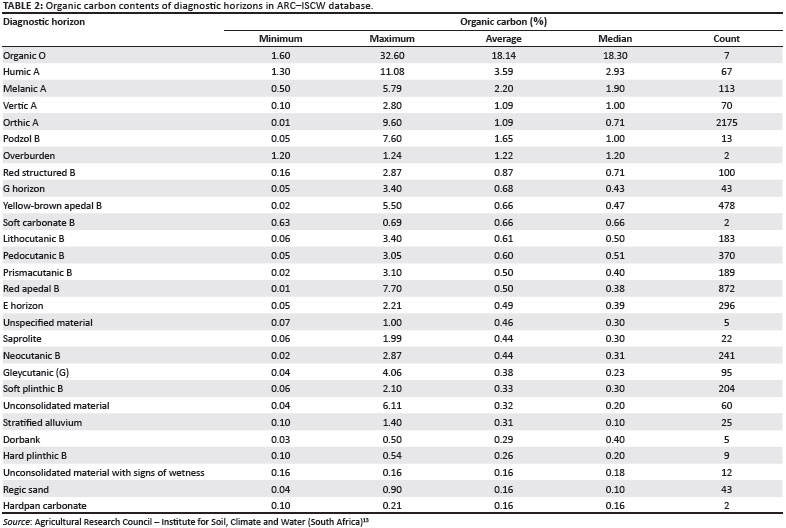
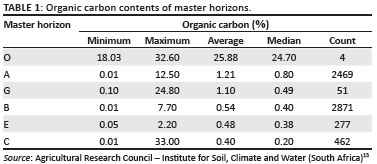
The land type survey data10Table 1) and per diagnostic horizon (Table 2). Counts between the master and diagnostic horizon classification do not necessarily agree because certain classifications were not done per horizon. No attempt was made by the authors to validate or correct the land type survey data.
As expected, organic O horizons had the highest organic carbon - an average of 25.88% - but only four of these horizons were analysed. Of the mineral horizons, the A horizons had the highest organic carbon at 1.21%, decreasing to 0.54% in the B and 0.40% in the C horizons. Organic carbon in the E horizons (0.48%) was lower than in the B (0.54%) or G horizons (1.10%), but higher than in the C horizons (0.40%). The distribution of organic carbon in the master horizons can be related to the various soil forming processes active in these horizons.
In the diagnostic topsoil horizons, organic carbon decreased in order of magnitude from organic O (18.14%) to humic A (3.59%), melanic A (2.20%), orthic A (1.09%) and vertic A (1.09%). Patterns in organic carbon distribution were less clear in the diagnostic B horizons, probably because of a lower organic carbon content compared to the A horizons. In general, organic carbon contents were lower in the B horizons (0.29% in dorbank and 0.16% in hardpan carbonate), which is typical of drier regions. The subsoil horizons typical of wetter regions (gleycutanic = 0.38%, E = 0.49%, soft plinthic = 0.33% and hard plinthic = 0.26%), also had lower organic carbon contents than the B horizons average (0.54%), whilst structured B horizons (pedocutanic = 0.60%, prismacutanic = 0.50% and red structured = 0.87%) had higher organic carbon contents than the average.
In the Mpumalanga province, the organic carbon content of 252 topsoils under grassland was higher than that of 290 topsoils under savannah. Organic carbon under savannah ranged from 0.18% to 4.86% (with a median of 1.28%), whilst under grassland it varied from 0.09% to 12.53% (with a median of 2.51%).14
The amount, distribution, origin and stability of soil organic matter in Acacia and Burkea savannahs were investigated by McKean16Acacia savannah it decreased, whilst it remained constant in the Burkea savannah. Trees and grass contributed to soil organic matter in the two savannahs in approximate proportion to their primary production, with grasses contributing 76% and trees 24%. The turnover in organic carbon associated with clay amounted to 51% over a period of 26 years. This suggests that the organic carbon associated with clay in sandy savannah soils has a much faster turnover time than the hundreds of years quoted for temperate ecosystems. In both savannahs, soil organic matter and microbial biomass were strongly correlated.16
Some insight into the distribution of soil organic matter in granite landscapes can be obtained from three study areas: north-east of Nelspruit,171819
Du Toit and Du Preez20p < 0.01) between the organic matter contents of 41 virgin orthic A topsoils and their fine silt-plus-clay contents (organic carbon: r = 0.91 and total nitrogen: r = 0.91), the aridity indices of the localities where they were sampled (organic carbon: r = 0.90 and nitrogen: r = 0.89) and the products of aridity indices of the localities and the fine silt-plus-clay contents of the soils (organic carbon: r = 0.94 and total nitrogen: r = 0.95). These orthic A horizons from the Free State, Limpopo, Mpumalanga and North West provinces are underlain by red apedal, yellow-brown apedal and soft plinthic B horizons. The organic matter content of these virgin orthic A topsoils increased linearly with increasing fine silt-plus-clay contents and exponentially with increasing aridity index values. Organic matter content was found to be lower in the warmer, drier areas than in the wetter, cooler areas. In an area with a given aridity index the organic matter content increased with an increase in fine silt-plus-clay content. Inclusion of orthic A horizons underlain by either red structured or pedocutanic B horizons resulted in poorer relationships.
A baseline study on soil organic matter and vegetation was done in the Weatherley catchment near Maclear before this Moist Upland Grassland was converted to commercial forest.21
A prominent feature is an almost similar and linear decrease in organic carbon from the surface to a depth of 650 mm, irrespective of the kind of B horizon present. For the different soil groups mentioned in the previous paragraph, the decrease was from about 0.015 Mg/m3333
With regard to total nitrogen two observations are significant. Firstly, the decrease in total nitrogen with increasing depth was less pronounced than that of organic carbon, resulting in considerably lower carbon to nitrogen ratios towards the bottom of the profiles. Across all the soils, the average decrease in total nitrogen from the surface to a depth of 1150 mm was from 0.0011 Mg/m33
The average oven-dry biomass yield from the grassland cover was 3400 kg/ha per year. Carbon sequestration efficiency by the grassland in the catchment was estimated to be 2.1 kg/ha/mm rainfall per year. It was possible, after making some assumptions, to estimate that the equivalent value for Pinus patula would be approximately 2.8 kg/ha/mm rainfall per year.
In a study on the nutrient status of virgin soils in the Lusikisiki area, Bühmann et al.22
Rangeland stock production
Grazing
A comprehensive doctoral study on the reciprocal relationships between vegetation structure and soil properties in selected biomes of South Africa was done by Mills2324,25 and research articles26,27,28 are discussed here.
Stocks of carbon and nitrogen at selected sites in five contrasting biomes exposed to different land uses were examined by Mills and Fey2626
In a subsequent paper, Mills et al.27
Heavy browsing of xeric succulent thicket by goats resulted in the loss of Portulacaria afra and transformed this habitat to an open savannah dominated by annual grasses.28
The effect of vegetation canopy on soil organic matter was also evident within thicket and savannah. In thicket, the organic carbon of soil sampled to a depth of 100 mm under canopies of Portulacaria afra and in the open averaged 5.6% and 3.7%, respectively.28Pappea capensis and in the open, respectively contained 4.1% and 3.0% organic carbon and 0.30% and 0.24% total nitrogen. These differences of ~30% in organic carbon and ~20% in total nitrogen illustrate the importance of good vegetative cover in thicket and savannah to ensure high organic matter contents in the upper 100 mm soil layer. The surprising high soil organic matter in thicket suggests that the dense Portulacaria afra bush in this semi-arid region strongly regulates its content through microclimate, erosion control, litter quantity, and perhaps chemistry, which, according to Mills and Fey28
A change in the condition of veld from good veld to either poor veld or bare soil was induced and maintained for 5 years on a Bloemdal form soil, near Bloemfontein.292930inter alia, less phytomass production, which is the major source of soil organic matter, and high soil temperatures, which accelerate decomposition of organic matter.29,30
Bond et al.31
In the Kalahari, soil organic carbon was significantly lower where either reduced rainfall or grazing lowered litter inputs to soil. Site-averaged concentrations of soil organic carbon showed no significant differences beneath plant canopies, but woody plant canopies alone showed elevated soil organic carbon at some sites.32
Results reported by Hansen-Quartey et al.33Artemisia afra near Alice had no significant effect on organic matter in the upper 100 mm soil. The organic carbon content of soil under this shrub was 1.06% whilst that of the control soil was 0.91%. However, soil aggregates under the aromatic shrub had a higher stability than those of the control soil.
Burning
The long-term effects of annual burning and fire exclusion on soil organic matter were examined by Mills and Fey3434
The effect of fire frequency on the organic matter content of a basaltic soil in the Kruger National Park was investigated by Jones et al.35
The effects of burning of native grassland on soil organic matter status were investigated by Fynn et al.3636
Fire is an important tool for the management of rangeland in the False Thornveld, which consists of grassland thickly interspersed with dwarf Acacia karoo. Hence the effect of long-term burning frequencies on the organic carbon content of a Glenrosa soil near Alice was examined by Materechera et al.37
Conclusions
The limited available data on soil organic matter in South Africa is based on a few uncoordinated studies done by a few researchers acting on their own. There is no data available that is based on systematic and georeferenced sampling programmes. The limited data available shows that South African soils are characterised by very low organic matter levels. About 58% of the soils contain less than 0.5% organic carbon, 38% of the soils contain 0.5% - 2% organic carbon and only 4% contain more than 2% organic carbon. There are large differences in organic matter content within and between soil forms, depending on climatic conditions, vegetation cover, topographical position and soil texture. Degradation of rangeland on account of overgrazing results in significant losses of soil organic matter, which is mainly attributed to a lower biomass production. The use of fire in rangeland management decreases soil organic matter because the primary source of organic matter, the plant litter, is destroyed with burning.
A countrywide baseline study to quantify organic matter contents within and between soil forms is essential for future reference. Such a study should make use of a systematic sampling programme covering important agro-ecological regions in the country and using georeferenced sites to permit future monitoring of changes in soil organic matter levels. Clearer relationships between soil properties and functions are needed to establish whether it is possible to determine threshold values for soil organic matter. Management of soil organic matter must be optimised on an ecotope basis because of the great variability of this soil quality indicator as a result of climate, slope and soil. Maintaining, and, if possible, increasing organic matter content in degraded rangeland soils by preventing overgrazing and restricted burning is of the utmost importance because stock farming claims most of the land in South Africa.
Acknowledgement
We are grateful to everyone who assisted us in one way or another in compiling this review.
References
- 1. Stevenson FJ, Cole MA. Cycles of soil: Carbon, nitrogen, phosphorus, sulphur and micronutrients. 2nd ed. New York: Wiley; 1999.
- 2. Allison FE. Soil organic matter and its role in crop production. Amsterdam: Elsevier; 1973.
- 3. Doran JW, Parkin TB. Defining and assessing soil quality. In: Doran JW, Coleman DC, Bezdicek DF, Stewart BA, editors. Defining soil quality for a sustainable environment. Madison: Soil Science Society of America; 1994.
- 4. Doran JW, Safley M. Defining and assessing soil health and sustainable productivity. In: Pankhurst CE, Double BM, Gupta VVSR, editors. Biological indicators of soil health. New York: CAB International; 1997.
- 5. Doran JW, Sarrantonio M, Liebig MA. Soil health and sustainability. Adv Agron. 1996;56:2-55.
- 6. Van Antwerpen R. A review of soil health indicators for laboratory use in the South African sugar industry. Proc S Afr Sug Technol Ass. 2005;79:179-191.
- 7. Weil RR, Magdoff F. Significance of soil organic matter to soil quality and health. In: Magdoff F, Weil RR, editors. Soil organic matter in sustainable agriculture. London: CRC Press, 2004; p. 1-43. doi:10.1201/9780203496374.ch1
- 8. Arrouays D, Deslais W, Badeau V. The carbon content of top soils and its geographical distribution in France. Soil Use Manage. 2001;17:7-11. doi:10.1111/j.1475-2743.2001.tb00002.x
- 9. Du Preez CC, Van Huyssteen CW, Mnkeni PNS. Land use and soil organic matter in South Africa 2: A review on the influence of arable crop production. S Afr J Sci. 2011;107(5/6), Art. #358, 8 pages. doi:10.4102/sajs.v107i5/6.358
- 10. Agricultural Research Council - Institute for Soil, Climate and Water (ARC-ISCW). Land types of South Africa. Pretoria: ARC-ISCW; 2003.
- 11. Macvicar CN, De Villiers JM, Loxton RF, et al. Soil classification: A binomial system for South Africa. Pretoria: Department of Agriculture Technical Services; 1977.
- 12. Soil Classification Working Group. Soil classification: A taxonomic system for South Africa. Memoirs on the Agricultural Resources of South Africa No 15. Pretoria: Department of Agricultural Development; 1991.
- 13. Agricultural Research Council - Institute for Soil, Climate and Water (ARC-ISCW). Land types and soil inventory databases of South Africa. Pretoria: ARC - ISCW; 2006.
- 14. Barnard RO. Carbon sequestration in South African soils. ARC-ISCW Report No. GW/A/2000/48. Pretoria: Agricultural Research Council -Institute for Soil, Climate and Water; 2000.
- 15. Scotney DM, Dijkhuis FJ. Changes in the fertility status of South African soils. S Afr J Sci. 1990;86:395-402.
- 16. McKean SG. Soil organic matter patterns, processes and effects in two contrasting savannas. MSc dissertation, Johannesburg, University of the Witwatersrand, 1993.
- 17. Verster E. Spatial pattern and variability of soils in a granite landscape, north-east of Nelspruit. S Afr J Plant Soil. 1989;6:14-23.
- 18. Munnik MC, Verster E, Van Rooyen TH. Spatial pattern and variability of soil and hillslope properties in a granitic landscape. 1. Pretoriuskop area. S Afr J Plant Soil. 1990;7:121-130.
- 19. Munnik MC, Verster E, Van Rooyen TH. Spatial pattern and variability of soil and hillslope properties in a granitic landscape. 2. Pretoria-Johannesburg area. S Afr J Plant Soil. 1992;9:43-51.
- 20. Du Toit ME, Du Preez CC. [Relationship between organic matter content of certain virgin orthic topsoils, soil properties and climatic data in South Africa]. S Afr J Plant Soil. 1993;10:168-173. Afrikaans.
- 21. Le Roux PAL, Hensley M, Du Preez CC, et al. The Weatherley catchment: Soil organic matter and vegetation baseline study. WRC Report No. KV170/50. Pretoria: Water Research Commission; 2005.
- 22. Bühmann C, Beukes DJ, Turner DP. Plant nutrient status of soils in the Lusikisiki area, Eastern Cape Province. S Afr J Plant Soil. 2006;23:93-98.
- 23. Mills AJ. Reciprocal relationships between vegetation structure and soil properties in selected biomes of South Africa. PhD thesis, Stellenbosch, Stellenbosch University, 2003.
- 24. Mills AJ, Fey MV. Declining soil quality in South Africa: Effects of land use on soil organic matter and surface crusting. S Afr J Sci. 2003;99:429-436.
- 25. Mills AJ, Fey MV. Declining soil quality in South Africa: Effects of land use on soil organic matter and surface crusting. S Afr J Plant Soil. 2004;21:388-398.
- 26. Mills AJ, Fey MV. Soil carbon and nitrogen in five contrasting biomes of South Africa exposed to different land uses. S Afr J Plant Soil. 2004;21:94-102.
- 27. Mills AJ, O'Connor TG, Donaldson JS, et al. Ecosystem carbon storage under different land uses in three semi-arid shrublands and a mesic grassland in South Africa. S Afr J Plant Soil. 2005;22:183-190.
- 28. Mills AJ, Fey MV. Transformation of thicket to savanna reduces soil quality in the Eastern Cape, South Africa. Plant and Soil. 2004;265:153-163. doi:10.1007/s11104-005-0534-2
- 29. Snyman HA, Du Preez CC. Rangeland degradation in semi-arid South Africa. 2. Influence on soil quality. J Arid Environ. 2005;60:483-507. doi:10.1016/j.jaridenv.2004.06.005
- 30. Du Preez CC, Snyman HA. Organic matter content of a soil in a semi-arid climate with three long-standing veld conditions. Afr J Range For Sci. 1993;10:108-110. doi:10.1080/10220119.1993.9638333
- 31. Bond WJ, Stock WD, Hoffmann MT. Has the Karoo spread - a test for desertification using carbon isotopes from soils. S Afr J Sci. 1994;90:391-397.
- 32. Feral CJW, Epstein HE, Otter L, et al. Carbon and nitrogen in the soil-plant system along rainfall and land-use gradients in southern Africa. J Arid Environ. 2003;54:327-343. doi:10.1006/jare.2002.1091
- 33. Hansen-Quartey JH, Materechera SA, Nyamaphene K. Soil properties as influenced by cultivation of the aromatic shrub Artemisia afra. S Afr J Plant Soil. 1998;15:14-18.
- 34. Mills AJ, Fey MV. Frequent fires intensify soil crusting: Physico-chemical feed back in the pedoderm of long-term burn experiments in South Africa. Geoderma. 2004;121:45-64. doi:10.1016/j.geoderma.2003.10.004
- 35. Jones CL, Smithers NL, Scholes MC, Scholes RJ. The effect of fire frequency on the organic components of a basaltic soil in the Kruger National Park. S Afr J Plant Soil. 1990;7:236-237.
- 36. Fynn RWS, Haynes RJ, O'Connor TG. Burning causes long-term changes in soil organic matter content of a South African grassland. Soil Biol Biochem. 2003;35:677-687. doi:10.1016/S0038-0717(03)00054-3
- 37. Materechera SA, Mandiringana OT, Mbokodi PM, Nyamamphene K. Organic matter, pH and nutrient distribution in soil layers of a savanna Thornveld subjected to different burning frequencies at Alice in the Eastern Cape. S Afr J Plant Soil. 1998;15:109-115.
Chris du Preez
Postal address: PO Box 339
Bloemfontein 9300, South Africa
Email: dpreezcc@ufs.ac.za

Accepted: 01 Mar. 2011
Published: 16 May 2011