The multilingual brain: A critical review of cognitive advantages
Abstract
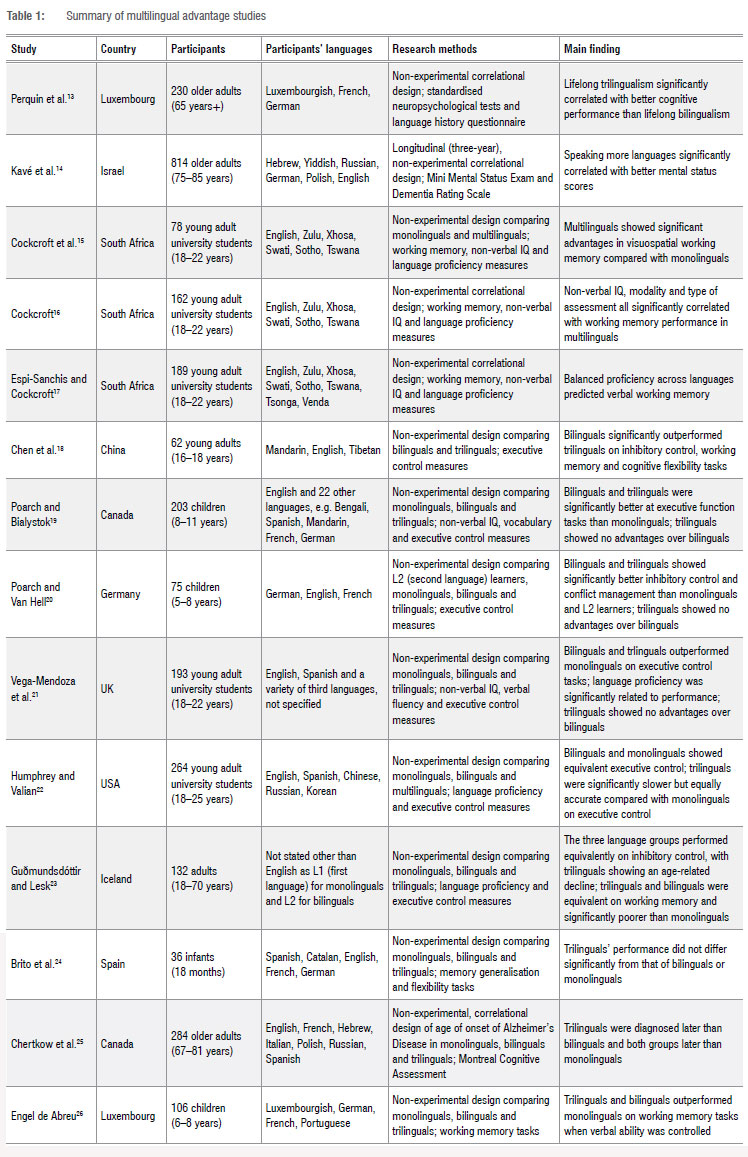
Being bilingual, or speaking two languages, has several well-documented cognitive advantages referred to as the 'bilingual advantage'. These advantages have been carefully scrutinised over the past 30 years, with debates about their existence ongoing. The cognitive benefits of multilingualism (speaking three or more languages) are less well known, and it is uncertain whether adding more languages to one's repertoire advantages our cognition or hinders it. The available evidence is complicated by the fact that many studies use the terms 'bilingual' and 'multilingual' interchangeably, thereby blurring the findings. In this review, 14 studies published between 2008 and 2025 that focused on cognitive benefits related to multilingualism were critically reviewed, and the findings were compared to those reported for bilingualism. Available evidence tentatively supports the emergence of multilingual advantages in older age in the form of delays in cognitive decline. These appear concomitant with an early age of acquisition, and regular use, of additional languages (leading to automatisation). In samples of other ages, multilinguals appear not to possess any advantages beyond bilinguals, although they often outperform monolinguals. It is possible that lifelong use of multiple languages is necessary before benefits manifest. The review presents a systematic consideration of the vast array of interrelated individual, task- and language-related factors which shape when, how and whether these advantages may develop. SIGNIFICANCE: Understanding whether multilingualism advantages cognition contributes to investigations into experiences that engender neuroplasticity. Following from the popularity of the bilingual advantage is an assumption that more languages lead to more cognitive benefits. A critical review of the evidence reveals that the only clear advantage for multilinguals appears to be in the delay of cognitive decline in older age, while other benefits to cognition for multilinguals do not appear to exceed those present for bilinguals. This has implications for cognitive development and healthy ageing.
bilingual advantage; bilingualism; cognition; executive functioning; multilingualism