The multilingual brain: A critical review of cognitive advantages
Abstract
Being bilingual, or speaking two languages, has several well-documented cognitive advantages referred to as the 'bilingual advantage'. These advantages have been carefully scrutinised over the past 30 years, with debates about their existence ongoing. The cognitive benefits of multilingualism (speaking three or more languages) are less well known, and it is uncertain whether adding more languages to one's repertoire advantages our cognition or hinders it. The available evidence is complicated by the fact that many studies use the terms 'bilingual' and 'multilingual' interchangeably, thereby blurring the findings. In this review, 14 studies published between 2008 and 2025 that focused on cognitive benefits related to multilingualism were critically reviewed, and the findings were compared to those reported for bilingualism. Available evidence tentatively supports the emergence of multilingual advantages in older age in the form of delays in cognitive decline. These appear concomitant with an early age of acquisition, and regular use, of additional languages (leading to automatisation). In samples of other ages, multilinguals appear not to possess any advantages beyond bilinguals, although they often outperform monolinguals. It is possible that lifelong use of multiple languages is necessary before benefits manifest. The review presents a systematic consideration of the vast array of interrelated individual, task- and language-related factors which shape when, how and whether these advantages may develop. SIGNIFICANCE: Understanding whether multilingualism advantages cognition contributes to investigations into experiences that engender neuroplasticity. Following from the popularity of the bilingual advantage is an assumption that more languages lead to more cognitive benefits. A critical review of the evidence reveals that the only clear advantage for multilinguals appears to be in the delay of cognitive decline in older age, while other benefits to cognition for multilinguals do not appear to exceed those present for bilinguals. This has implications for cognitive development and healthy ageing.
bilingual advantage; bilingualism; cognition; executive functioning; multilingualism
Introduction
Exploring the effects of multilingualism (proficiency in two or more languages) on the brain is valuable due to the centrality of language in shaping human experience.121
While the relationship between the brain and bilingualism has received considerable research interest, not much is known about how the use of three or more languages impacts cognition.3,4 The available evidence is muddied by definitional obscurity; while some scholars use the term 'multilingualism' to refer to the ability to understand and speak more than two languages, others define multilingualism as the use of more than one language, thereby confounding bilingual and multilingual findings.1
Most of what is known about multilingual effects on cognition are inferences from bilingual studies.52-4 Executive functions are high-level skills that enable us to control, regulate and manage our thoughts and behaviour to achieve goals. Bilingualism is associated with advantages in several key executive function components, namely inhibitory control, working memory and cognitive flexibility. Inhibitory control is the ability to consciously suppress automated or well-learned responses when they are inappropriate for a particular situation. Bilinguals develop this skill by frequently inhibiting one language while actively using another, preventing interference between languages. The executive function of working memory entails the temporary storage and manipulation of information, which supports tasks such as following instructions, problem solving and reasoning. Managing two linguistic systems places ongoing demands on working memory, possibly strengthening it over time. The third aspect of executive function in which bilingual advantages have been reported is cognitive flexibility or the ability to switch efficiently between different rules, tasks and mental perspectives. The regular switching between languages in which bilinguals engage may develop - depending on context, speaker and/or setting - the capacity to adapt quickly to changing cognitive demands. Reviews and meta-analyses reach varying conclusions about the existence of bilingual advantages in these executive functions6-10 and debates are ongoing about the size of these effects and whether they are legitimate or a product of publication bias favouring positive research outcomes11,12.
The aim of this narrative literature review is to critically consider the current state of knowledge about multilingual effects on cognition and to address the following questions: Are the effects of three or more languages on cognition the same as for two languages? If they are different, in what way? What factors modulate any cognitive changes in multilinguals?
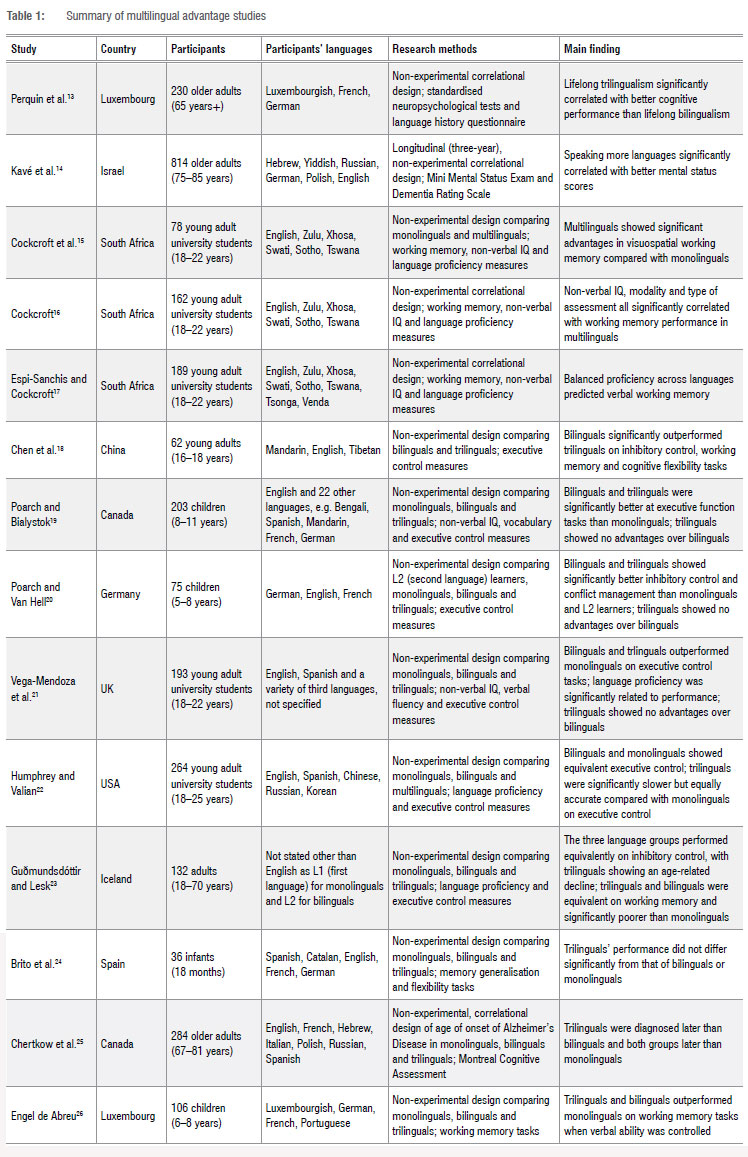
A search of PsycINFO, Scopus, Web of Science and LLBA (Linguistics and Language Behaviour Abstracts) databases for articles with multilingual or trilingual in the title, abstract or keywords yielded 14 publications (published between 2008 and 2025) that investigated potential cognitive advantages in multilinguals of any age (Table 1). Studies that combined bilinguals and multilinguals into a single group were excluded. Sources included primary research studies and peer-reviewed conference proceedings using any research designs. Systematic or scoping reviews and meta-analyses were not included.
From bilingual to multilingual advantages
The bilingual advantage refers to the frequent use of two languages resulting in neural changes that benefit cognition. Advantages include improved higher-order cognitive (or executive) functions, such as enhanced inhibitory control, working memory and cognitive flexibility, which form the foundation for other higher functions like problem solving, decision-making, goal setting and creativity.2,7 Interest in the topic originated with the discovery that bilinguals outperformed monolinguals on inhibitory control tasks in which cognitive effort must be applied to prevent an automatic response.227282
For these advantages to manifest, bilinguals should be proficient in their languages to the extent that they are automatised, so that the changes occur not only in the language representations and brain structures that underlie language processing but are also generalised to other areas of cognition, particularly executive functions. These advantages are manifest in how flexibly a person can control their attention, shift between rules and focus on relevant, and ignore irrelevant, content.2,7 In support of this, infant, toddler and preschooler bilinguals consistently outperform monolinguals in tasks related to selective attention and cognitive flexibility.77,11,28,29 However, separate meta-analyses of bilingual effects on inhibitory control9,30, working memory1031p = 0.528). Recent evidence suggests that the bilingual advantage may not manifest in any of the aforementioned executive functions, but rather in selective attention and disengagement of attention (switch costs when moving attention between tasks) which underlies these executive functions.22
Bialystok's22932,33 Relative to monolinguals, bilinguals seem to be behaviourally protected from neural changes resulting from Alzheimer's dementia. Despite similar levels of Alzheimer's dementia in brain scans, those who were proficient in two languages from childhood appeared functionally much better off, often behaving like a person without dementia. These findings have been replicated and suggest a delay of 5 years in the manifestation of cognitive decline in bilinguals relative to monolinguals.343536
The evidence for similar cognitive advantages when more than two languages are spoken is limited. Adding more languages creates greater cross-linguistic interference, which could either strengthen executive control or create greater confusion and difficulty in language processing.2837,38 The interaction between these factors is likely responsible for the varied findings concerning cognitive advantages in bilinguals and multilinguals, and each is discussed below by comparing what is known for bilinguals and multilinguals.
Factors that influence multilingual advantages
Language-related factors
These range from relatively simple factors such as the number of languages spoken, to more complex aspects, such as the linguistic environment and extent of proficiency in each language. Although each is discussed separately, this is an artificial separation as they are closely related.
Number of languages spoken
Speaking at least two languages appears to offer some protection against cognitive decline related to Alzheimer's dementia by strengthening executive function networks and/or by developing alternative networks that compensate for those lost due to ageing and/or pathology.32-35 Trilingualism reportedly offers seven times more protection against cognitive decline relative to bilingualism, and if two of the trilinguals' languages were acquired simultaneously and early in life, the protection almost doubles.1313,14
In younger multilingual samples, the number of languages spoken is not consistently related to enhanced cognitive control skills.15,16,30 This may be because multilingualism as a categorical variable does not capture the complexity and variability of the phenomenon (e.g. balanced or sequential, frequency of use, and proficiency in, each language etc), and these aspects appear more strongly related to cognitive advantages in younger bilinguals. Variations in these factors undoubtedly contribute to inconsistencies in findings.10,16,39 It is also possible that prolonged use of multiple languages is needed for advantages to manifest, resulting in effects only becoming evident in older age.
Age of acquisition
Earlier age of acquisition of an L2 is associated with better executive function outcomes (inhibitory control and working memory) in bilinguals.40-42 Multilinguals also show this advantage relative to monolinguals, but do not appear to possess an added advantage to bilinguals.17,40,43 The supply-and-demand mismatch hypothesis434318
Proficiency
Earlier age of acquisition is typically correlated with higher proficiency, making it difficult to separate their effects, but many studies measure only one or the other. Some propose that, to accrue benefits from bilingualism, there should be balance, or equivalent proficiency, among languages, because, at lower levels of proficiency, words from both languages compete for activation, while greater proficiency results in greater automatisation of cognitive processes.314445
The impact of balanced proficiency among multilinguals' languages has been explored in terms of its impact on working memory.1717
Exposure and language environment
The attentional, switching and inhibitory control exerted when bilinguals and multilinguals use one of their languages appears dependent on the context.4,28,37,46-48 Linguistic contexts vary between single-language, dual-language and dense code-switching. In the former, language use is separated by contextual cues (e.g. one language at school and another at home) and there is minimal to no switching between languages. In dual-language contexts, language choice is determined by the speaker, rather than the context, whereas in dense code-switching contexts, all speakers are at least bilingual and can use those words and grammatical structures that are most available to express themselves, i.e. code-switching often occurs within sentences resulting in language integration rather than inhibitory control. South Africa features the latter two linguistic contexts, which is typical of highly multilingual contexts.
These varying linguistic contexts determine the type of cognitive control required, with each hypothesised to strengthen different neural substrates through frequent use.4,49 The adaptive control hypothesis447,48,50
Similarity between languages
The linguistic relatedness between a multilingual's languages can affect language organisation and processing. Greater similarity between languages may improve speed of processing between languages due to the stronger inhibitory control required515253,54 This aspect has yet to be systematically explored in multilinguals.
Task-related factors
A range of task-related qualities likely impacts whether, and how, cognitive advantages manifest in multilinguals. These include the particular cognitive functions investigated, the type of task used to tap those functions and the task modality.
Cognitive functions assessed
The cognitive functions most evaluated for bilingual advantages are the executive functions of inhibitory control, cognitive flexibility and working memory. The biggest effects seem to be for inhibitory control in bilinguals, with mixed evidence of effects on working memory and cognitive flexibility.4319-21 For example, when monolinguals, bilinguals and trilinguals between 5 and 8 years old were assessed on inhibitory control, trilinguals and bilinguals fared significantly better than the monolinguals, but trilinguals showed no advantages over bilinguals.201921,22,54, and in a larger study comparing bilingual and trilingual adults (18-70 years)2323
Of the available studies exploring multilingual advantages in working memory, none found significant advantages for multilinguals over bilinguals, while evidence for an advantage of multilinguals over monolinguals is mixed. Trilingual infants (18 m) showed no memory advantages relative to monolinguals or bilinguals.241523
As for bilingual advantages in executive functions, the evidence for multilingual advantages is equivocal, with differences in findings likely resulting from the divergent methods and conceptualisations of bilingualism and multilingualism, as well as a tendency to use categorical definitions of these constructs that do not capture the diverse continuum of ways in which language is used.10
Modality and task type
Bilingual advantage studies use a range of executive function measures with considerable differences between them in terms of stimuli and procedures (even within the same type of task, e.g. inhibitory control (Flanker, Simon task) and working memory (n-back, digit span, symbol span). The issue is complicated by the task impurity problem, i.e. executive function tasks never measure a single executive function process as they are so intertwined, and also involve non-executive processes (e.g. processing speed).455556155710,16
Individual differences
A primary reason for the mixed results in multilingual and bilingual advantage studies is that various individual differences (verbal ability, intelligence, age, gender, socio-economic status) may influence whether, and to what extent, advantages in executive function and related domains are observed.
Verbal ability and intelligence
Few bilingual or multilingual advantage studies measure verbal ability, which is concerning given that bilinguals and multilinguals are at a disadvantage relative to monolinguals on verbal tasks, particularly those assessing vocabulary size, verbal fluency, naming and speed of access to lexical items.2,15,58,59 This is because additional languages interfere with, and slow down, the production of an appropriate verbal response, in addition to which, weaker links may be formed between lexical items the more languages that are spoken.60,61 The verbal disadvantage has been challenged, however, as it tends to disappear when vocabulary is statistically accounted for32,62, and may be more evident in childhood, at points when verbal skills are developing, or a feature of the timing of L2 acquisition58
The role of intelligence in bilingual and multilingual advantages is similarly under-researched. In multilingual young adults, it was the strongest and most consistent predictor of working memory - even stronger than language-related variables - highlighting the importance of including pre-existing cognitive abilities as covariates.16
Gender
There is no consistent evidence for gender differences in bilingual or multilingual advantages (a demographic that is seldom explored), although language may be represented differently in male and female individuals, and female individuals tend to acquire vocabulary faster than male individuals.16,37 However, these differences disappear in late childhood and/or are related to task-specific strategies.63
Age
In contrast to infants, children and young adults, for whom the evidence is mixed, older bilingual and multilingual adults show superior performance in executive function tasks more consistently.64,65 Multiple language experience may offer protection against the gradual decline in brain volume associated with ageing by contributing to cognitive reserve, or the ability to effectively use existing cognitive processes and brain networks to adapt to, and compensate for, brain damage, disease or ageing.662513
Socio-economic status
The benefits of bilingualism and multilingualism on executive functions may stem from correlated socio-economic status effects. For example, in bilinguals, both socio-economic status and bilingualism independently predict executive function and language skills, with those from backgrounds of higher socio-economic status performing best.67,68 This suggests that some 'bilingual advantages' may be due to differences in socio-economic status, and that, if not included as a covariate, socio-economic status could amplify or mask cognitive benefits. In contrast, there is evidence of bilingual and trilingual children from backgrounds of low socio-economic status outperforming monolingual peers on working memory tasks, even when verbal abilities were matched. This suggests that bilingualism may develop cognitive resilience in socio-economically disadvantaged groups.26
Studies of multilinguals often include immigrant or minority groups, who sometimes have lower socio-economic status, without attempting to control for these effects.16943
Conclusion
In response to the questions posed at the outset of the review, there is no ubiquitous multilingual advantage, as it is dependent on an array of interrelated individual, task- and language-related factors, the combination of which shapes whether, and which, cognitive advantages develop. Multilinguals show some advantages beyond those for bilinguals, which appear most consistently in older adults in terms of added protection against cognitive decline.25,66 In terms of executive function benefits, multilinguals have an advantage relative to monolinguals, but this advantage does not appear to differ from that for bilinguals.19-21 It is possible that extended use of multiple languages across the lifespan is required before advantages manifest, which is why they are most evident in older adults.
The vastly varying methodologies employed by studies in the field made synthesising these findings difficult. Methodologically, research on this topic is limited by a reliance on correlational research designs in which pre-existing neural and cognitive differences may determine multilingual outcomes.2,14 These hidden moderators (verbal ability, intelligence) of performance on executive function tasks are seldom measured in studies of multilingual advantages. Longitudinal studies are essential to track the complex relationship between cognition, its development and decline, and language usage to fully investigate the issue. Further, studies using behavioural (psychometric and/or experimental tasks) and physiological (neuroimaging and/or electrophysiological methods) assessments yield differing results due to the varying sensitivity of these measures, and the inclusion of both in the same study would provide more comprehensive data on the topic.4,31 Finally, most multilingual studies sample trilinguals and very little is known about cognitive effects for speakers of four or more languages, or how the linguistic context influences cognition for multilinguals.
This review demonstrates that there is no simple linear relationship between knowing more languages and accruing more cognitive advantages. Instead, how often languages are used, how balanced/proficient speakers are, the ages at which languages are acquired, as well as the qualities of the languages and linguistic contexts shape which cognitive processes are exercised and whether measurable advantages are likely to emerge.
Data availability
There are no data pertaining to this article.
Declarations
I have no competing interests to declare. I have no AI or LLM use to declare.
References
-
1. Grohmann KK. Multifaceted multilingualism. Amsterdam: John Benjamins; 2024. https://doi.org/10.1075/sibil.66
» https://doi.org/10.1075/sibil.66 -
2. Bialystok E. Where language meets thought. London: Routledge, Taylor & Francis; 2024. https://doi.org/10.4324/9781003412427
» https://doi.org/10.4324/9781003412427 -
3. Wang X, Kim J-Y, Kim J-H, Choi Y, Ha E-G, Kim D-H, et al. Brain structure correlates of foreign language learning experiences. Front Hum Neurosci. 2025;19, Art. #1663218. https://doi.org/10.3389/fnhum.2025.1663218
» https://doi.org/10.3389/fnhum.2025.1663218 -
4. Pliatsikatis C. Multilingualism and brain plasticity. In: Schwieter JW, editor. The handbook of the neuroscience of multilingualism. Hoboken, NJ: John Wiley and Sons; 2019. p. 230-251. https://doi.org/10.1002/9781119387725.ch11
» https://doi.org/10.1002/9781119387725.ch11 -
5. Banik G. The cognitive advantages of multilingualism: Enhancing learning and academic performance in educational paradigms. Int J Appl Res. 2025;11(6):311-316. https://doi.org/10.22271/allresearch.2025.v11.i6d.12688
» https://doi.org/10.22271/allresearch.2025.v11.i6d.12688 -
6. Leivada E, Dentella V, Masullo C. Bilingual disadvantages are systematically compensated by bilingual advantages across tasks and populations. Sci Rep. 2024;14, Art. #2107. https://doi.org/10.1038/s41598-024-52417-5
» https://doi.org/10.1038/s41598-024-52417-5 -
7. Bialystok E. The bilingual adaptation: How minds accommodate experience. Psychol Bull. 2017;143(3):233-262. https://doi.org/10.1037/bul0000099
» https://doi.org/10.1037/bul0000099 -
8. Hilchey MD, Klein RM. Are there bilingual advantages on nonlinguistic interference tasks? Implications for the plasticity of executive control processes. Psychon Bull Rev. 2011;18(4):625-658. https://doi.org/10.3758/s13423-011-0116-7
» https://doi.org/10.3758/s13423-011-0116-7 -
9. Lehtonen M, Soveri A, Laine A, Järvenpää J, de Bruin A, Antfolk J. Is bilingualism associated with enhanced executive functioning in adults? A meta-analytic review. Psychol Bull. 2018;144(4):394-425. https://doi.org/10.1037/bul0000142
» https://doi.org/10.1037/bul0000142 -
10. Von Bastian CC, Souza AS, Gade M. No evidence for bilingual cognitive advantages: A test of four hypotheses. J Exp Psychol Gen. 2016;145(2):246-258. https://doi.org/10.1037/xge0000120
» https://doi.org/10.1037/xge0000120 -
11. De Bruin A, Treccani B, Della Sala S. Cognitive advantage in bilingualism: An example of publication bias? Psychol Sci. 2014;26(1):99-107. https://doi.org/10.1177/0956797614557866
» https://doi.org/10.1177/0956797614557866 -
12. Paap KR, Greenberg ZI. There is no coherent evidence for a bilingual advantage in executive processing. Cogn Psychol. 2013;66(2):232-258. https://doi.org/10.1016/j.cogpsych.2012.12.002
» https://doi.org/10.1016/j.cogpsych.2012.12.002 -
13. Perquin M, Vaillant M, Schuller AM, Pastore J, Dartigues JF, Lair ML, et al. Lifelong exposure to multilingualism: New evidence to support cognitive reserve hypothesis. PLoS One. 2013;8(4), e62030. https://doi.org/10.1371/journal.pone.0062030
» https://doi.org/10.1371/journal.pone.0062030 -
14. Kavé G, Eyal N, Shorek A, Cohen-Mansfield J. Multilingualism and cognitive state in the oldest old. Psychol Aging. 2008;23(1):70-78. https://doi.org/10.1037/0882-7974.23.1.70
» https://doi.org/10.1037/0882-7974.23.1.70 -
15. Cockcroft K, Wigdorowitz M, Liversage L. A multilingual advantage in the components of working memory. Biling Lang Cogn. 2019;22(1):15-29. https://doi.org/10.1017/S1366728917000475
» https://doi.org/10.1017/S1366728917000475 -
16. Cockcroft K. Working memory in multilinguals: Factors that assist and impede. Int J Multiling. 2024;21(2):997-1013. https://doi.org/10.1080/14790718.2022.2085710
» https://doi.org/10.1080/14790718.2022.2085710 -
17. Espi-Sanchis G, Cockcroft K. Working memory and multilingualism: Balanced language proficiency predicts verbal working memory. Int J Biling Educ Biling. 2021;25(8):2976-2990. https://doi.org/10.1080/13670050.2021.1997901
» https://doi.org/10.1080/13670050.2021.1997901 -
18. Chen J, Jiang C, Liu F. Do trilingual individuals exhibit an advantage over bilinguals in executive function tasks? Acta Psychol (Amst). 2025;259, Art. #105354. https://doi.org/10.1016/j.actpsy.2025.105354
» https://doi.org/10.1016/j.actpsy.2025.105354 -
19. Poarch GJ, Bialystok E. Bilingualism as a model for multitasking. Dev Rev. 2015;35:113-124. https://doi.org/10.1016/j.dr.2014.12.003
» https://doi.org/10.1016/j.dr.2014.12.003 -
20. Poarch GJ, Van Hell JG. Executive functions and inhibitory control in multilingual children: Evidence from second-language learners, bilinguals, and trilinguals. J Exp Child Psychol. 2012;113(4):535-551. https://doi.org/10.1016/j.jecp.2012.06.013
» https://doi.org/10.1016/j.jecp.2012.06.013 -
21. Vega-Mendoza M, West H, Sorace A, Bak TH. The impact of late, non-balanced bilingualism on cognitive performance. Cognition. 2015;137:40-46. https://doi.org/10.1016/j.cognition.2014.12.008
» https://doi.org/10.1016/j.cognition.2014.12.008 - 22. Humphrey AD, Valian VV. Multilingualism and cognitive control: Simon and flanker task performance in monolingual and multilingual young adults. Paper presented at: 53rd Annual Meeting of the Psychonomic Society; 2012 November 15-18;. Minneapolis, MN, USA.
-
23. Guðmundsdóttir MD, Lesk VE. Does the bilingual advantage extend to trilingualism? Int J Multiling. 2019;16(4):549-562. https://doi.org/10.1080/14790718.2019.1617717
» https://doi.org/10.1080/14790718.2019.1617717 -
24. Brito NH, Sebastián-Gallés N, Barr R. Differences in language exposure and its effects on memory flexibility in monolingual, bilingual, and trilingual infants. Biling Lang Cogn. 2015;18(4):670-682. https://doi.org/10.1017/S1366728914000789
» https://doi.org/10.1017/S1366728914000789 -
25. Chertkow H, Whitehead V, Phillips N, Wolfson C, Atherton J, Bergman H. Multilingualism (but not always bilingualism) delays the onset of Alzheimer disease: Evidence from a bilingual community. Alzheimer Dis Assoc Disord. 2010;24(2):118-125. https://doi.org/10.1097/WAD.0b013e3181ca1221
» https://doi.org/10.1097/WAD.0b013e3181ca1221 -
26. Engel de Abreu PMJ. Working memory in multilingual children: Is there a bilingual effect? Memory. 2011;19(5):529-537. https://doi.org/10.1080/09658211.2011.590504
» https://doi.org/10.1080/09658211.2011.590504 - 27. Dijkstra T, Van Heuven WJ. The BIA model and bilingual word recognition. In: Grainger J, Jacobs AM, editors. Localist connectionist approaches to human cognition. Mahwah, NJ: Lawrence Erlbaum Associates; 1998. p. 189-225.
-
28. Green DW, Abutalebi J. Language control in bilinguals: The adaptive control hypothesis. J Cogn Psychol. 2013;25(5):515-530. https://doi.org/10.1080/20445911.2013.796377
» https://doi.org/10.1080/20445911.2013.796377 -
29. Luk G, Bialystok E, Craik FI, Grady CL. Lifelong bilingualism maintains white matter integrity in older adults. J Neurosci. 2011;31(46):16808-16813. https://doi.org/10.1523/JNEUROSCI.4563-11.2011
» https://doi.org/10.1523/JNEUROSCI.4563-11.2011 -
30. Paap KR, Anders-Jefferson R, Mason L, Alvarado K, Zimiga B. Bilingual advantages in inhibition or selective attention: More challenges. Front Psychol. 2018;9, Art. #1409. https://doi.org/10.3389/fpsyg.2018.01409
» https://doi.org/10.3389/fpsyg.2018.01409 -
31. Paap K. The bilingual advantage debate: Quantity and quality of the evidence. In: Schwieter JW, editor. The handbook of the neuroscience of multilingualism. Hoboken, NJ: John Wiley and Sons; 2019. p. 701-735. https://doi.org/10.1002/9781119387725.ch34
» https://doi.org/10.1002/9781119387725.ch34 -
32. Bialystok E. Bilingualism: The good, the bad, and the indifferent. Biling Lang Cogn. 2009;12(1):3-11. https://doi.org/10.1017/S1366728908003477
» https://doi.org/10.1017/S1366728908003477 -
33. Abutalebi J, Canini M, Della Rosa PA, Sheung LP, Green DW, Weekes BS. Bilingualism protects anterior temporal lobe integrity in aging. Neurobiol Aging. 2014;35(9):2126-2133. https://doi.org/10.1016/j.neurobiolaging.2014.03.010
» https://doi.org/10.1016/j.neurobiolaging.2014.03.010 -
34. Craik FI, Bialystok E, Freedman M. Delaying the onset of Alzheimer disease: Bilingualism as a form of cognitive reserve. Neurology. 2010;75(19):1726-1729. https://doi.org/10.1212/WNL.0b013e3181fc2a1c
» https://doi.org/10.1212/WNL.0b013e3181fc2a1c -
35. Abutalebi J, Guidi L, Borsa V, Canini M, Della Rosa PA, Parris BA, et al. Bilingualism provides a neural reserve for aging populations. Neuropsychologia. 2015;69:201-210. https://doi.org/10.1016/j.neuropsychologia.2015.01.040
» https://doi.org/10.1016/j.neuropsychologia.2015.01.040 -
36. Poarch GJ, Krott A. A bilingual advantage? An appeal for a change in perspective and recommendations for future research. Behav Sci (Basel). 2019;9(9), Art. #95. https://doi.org/10.3390/bs9090095
» https://doi.org/10.3390/bs9090095 -
37. Blackburn A. Neuroimaging studies of multilingual speech. In: Schwieter JW, editor. The handbook of the neuroscience of multilingualism. Hoboken, NJ: John Wiley and Sons; 2019. p. 121-146. https://doi.org/10.1002/9781119387725.ch6
» https://doi.org/10.1002/9781119387725.ch6 -
38. Legault J, Grant A, Fang SY, Li P. A longitudinal investigation of structural brain changes during second language learning. Brain Lang. 2019;197, Art. #104661. https://doi.org/10.1016/j.bandl.2019.104661
» https://doi.org/10.1016/j.bandl.2019.104661 -
39. DeLuca V, Segaert K, Mazaheri A, Krott A. Understanding bilingual brain function and structure changes? U bet! A unified bilingual experience trajectory model. J Neurolinguistics. 2020;56, Art. #100930. https://doi.org/10.1016/j.jneuroling.2020.100930
» https://doi.org/10.1016/j.jneuroling.2020.100930 -
40. Yow WQ, Li X. Balanced bilingualism and early age of second language acquisition as the underlying mechanisms of a bilingual executive control advantage: Why variations in bilingual experiences matter. Front Psychol. 2015;6, Art. #164. https://doi.org/10.3389/fpsyg.2015.00164
» https://doi.org/10.3389/fpsyg.2015.00164 -
41. Ware AT, Kirkovski M, Lum JAG. Meta-analysis reveals a bilingual advantage that is dependent on task and age. Front Psychol. 2020;11, Art. #1458. https://doi.org/10.3389/fpsyg.2020.01458
» https://doi.org/10.3389/fpsyg.2020.01458 -
42. Tsimpli I. Early, late or very late? Timing acquisition and bilingualism. Linguist Approaches Biling. 2014;4(3):283-310. https://doi.org/10.1075/lab.4.3.01tsi
» https://doi.org/10.1075/lab.4.3.01tsi -
43. Schroeder SR, Marian V. Cognitive consequences of trilingualism. Int J Biling. 2017;21(6):754-773. https://doi.org/10.1177/1367006916637288
» https://doi.org/10.1177/1367006916637288 -
44. Linck J, Michael EB, Golonka E, Twist A, Schwieter JW. Moving between two languages: The effects of multilingualism on language processing and language learning. In: Schwieter JW, editor. The Cambridge handbook of bilingual processing. Cambridge: Cambridge University Press; 2015. p. 665-694. https://doi.org/10.1017/CBO9781107447257.030
» https://doi.org/10.1017/CBO9781107447257.030 -
45. Paap KR, Johnson HA, Sawi O. Are bilingual advantages dependent upon specific tasks or specific bilingual experiences? J Cogn Psychol. 2014;26(6):615-639. https://doi.org/10.1080/20445911.2014.944914
» https://doi.org/10.1080/20445911.2014.944914 -
46. Guo T, Liu X, Chen M, Fu Y, Guo T. An fMRI dataset for investigating language control and cognitive control in bilinguals. Sci Data. 2025;12, Art. #889. https://doi.org/10.1038/s41597-025-05245-9
» https://doi.org/10.1038/s41597-025-05245-9 -
47. Wigdorowitz M, Pérez AI, Tsimpli IM. A holistic measure of contextual and individual linguistic diversity. Int J Multiling. 2020;20(2):469-487. https://doi.org/10.1080/14790718.2020.1835921
» https://doi.org/10.1080/14790718.2020.1835921 -
48. Wigdorowitz M, Pérez AI, Tsimpli IM. Sociolinguistic context matters: Exploring differences in contextual linguistic diversity in South Africa and England. Int Multiling Res J. 2022;16(4):345-364. https://doi.org/10.1080/19313152.2022.2069416
» https://doi.org/10.1080/19313152.2022.2069416 -
49. Grant A, Legault J, Li P. What do bilingual models tell us about the neurocognition of multiple languages? In: Schwieter JW, editor. The handbook of the neuroscience of multilingualism. Hoboken, NJ: John Wiley and Sons; 2019. p. 48-74. https://doi.org/10.1002/9781119387725.ch3
» https://doi.org/10.1002/9781119387725.ch3 -
50. Kuzyk O, Friend M, Severdija V, Zesiger P, Poulin-Dubois D. Are there cognitive benefits of code-switching in bilingual children? A longitudinal study. Biling (Camb Engl). 2020;23(3):542-553. https://doi.org/10.1017/S1366728918001207
» https://doi.org/10.1017/S1366728918001207 -
51. Szubko-Sitarek W. Multilingual lexical recognition in the mental lexicon of third language users. New York: Springer; 2015. https://doi.org/10.1007/978-3-642-32194-8
» https://doi.org/10.1007/978-3-642-32194-8 -
52. González Alonso J, Puig-Mayenco E, Fábregas A, Chaouch-Orozco A, Rothman J. On the status of transfer in adult third language acquisition of early bilinguals. PLoS One. 2021;16(3), e0247976. https://doi.org/10.1371/journal.pone.0247976
» https://doi.org/10.1371/journal.pone.0247976 -
53. Coderre EL, Van Heuven WJB. The effect of script similarity on executive control in bilinguals. Front Psychol. 2014;5, Art. #1070. https://doi.org/10.3389/fpsyg.2014.01070
» https://doi.org/10.3389/fpsyg.2014.01070 -
54. Paap KR, Johnson HA, Sawi O. Bilingual advantage in executive functioning either do not exist or are restricted to very specific and undetermined circumstance. Cortex. 2015;69:265-278. https://doi.org/10.1016/j.cortex.2015.04.014
» https://doi.org/10.1016/j.cortex.2015.04.014 -
55. Grundy JG, Timmer K. Bilingualism and working memory capacity: A comprehensive meta-analysis. Second Lang Res. 2017;33(3):325-340. https://doi.org/10.1177/0267658316678286
» https://doi.org/10.1177/0267658316678286 -
56. Monnier C, Boiché J, Armandon P, Baudoin S, Bellocchi S. Is bilingualism associated with better working memory capacity? A meta-analysis. Int J Biling Educ Biling. 2021;25(6):2229-2255. https://doi.org/10.1080/13670050.2021.1908220
» https://doi.org/10.1080/13670050.2021.1908220 -
57. Cockcroft K. Are working memory models WEIRD? Testing models of working memory in a non-WEIRD sample. Neuropsychology. 2022;36(5):456-467. https://doi.org/10.1037/neu0000811
» https://doi.org/10.1037/neu0000811 -
58. Bylund E, Antfolk J, Abrahamsson N, Olstad AMH, Norrman G, Lehtonen M. Does bilingualism come with linguistic costs? A meta-analytic review of the bilingual lexical deficit. Psychon Bull Rev. 2023;30(3):897-913. https://doi.org/10.3758/s13423-022-02136-7
» https://doi.org/10.3758/s13423-022-02136-7 -
59. Olson DJ. A systematic review of proficiency assessment methods in bilingualism research. Int J Biling. 2024;28(2):163-187. https://doi.org/10.1177/13670069231153720
» https://doi.org/10.1177/13670069231153720 -
60. Costa A, Sebastian-Galles N. How does the bilingual experience sculpt the brain? Nat Rev Neurosci. 2014;15(5):336-345. https://doi.org/10.1038/nrn3709
» https://doi.org/10.1038/nrn3709 -
61. Shook A, Goldrick M, Engstler C, Marian V. Bilinguals show weaker lexical access during spoken sentence comprehension. J Psycholinguist Res. 2015;44:789-802. https://doi.org/10.1007/s10936-014-9322-6
» https://doi.org/10.1007/s10936-014-9322-6 -
62. Luo L, Craik FI, Moreno S, Bialystok E. Bilingualism interacts with domain in a working memory task: Evidence from aging. Psychol Aging. 2013;28(1):28-34. https://doi.org/10.1037/a0030875
» https://doi.org/10.1037/a0030875 -
63. Paap K. The bilingual advantage in executive functioning hypothesis: How the debate provides insight into psychology's replication crisis. Abingdon: Routledge; 2022. https://doi.org/10.4324/9781003308027
» https://doi.org/10.4324/9781003308027 -
64. Valian V. Bilingualism and cognition. Biling Lang Cogn. 2015;18(1):3-24. https://doi.org/10.1017/S1366728914000522
» https://doi.org/10.1017/S1366728914000522 -
65. Pérez AI, Fotiadou G, Tsimpli I. Preserved executive control in ageing: The role of literacy experience. Brain Sci. 2022;12(10), Art. #1392. https://doi.org/10.3390/brainsci12101392
» https://doi.org/10.3390/brainsci12101392 -
66. Stern Y. Cognitive reserve in ageing and Alzheimer's disease. Lancet Neurol. 2012;11(11):1006-1012. https://doi.org/10.1016/S1474-4422(12)70191-6
» https://doi.org/10.1016/S1474-4422(12)70191-6 -
67. Calvo A, Bialystok E. Independent effects of bilingualism and socioeconomic status on language ability and executive functioning. Cognition. 2014;130(3):278-288. https://doi.org/10.1016/j.cognition.2013.11.015
» https://doi.org/10.1016/j.cognition.2013.11.015 -
68. Naeem K, Filippi R, Periche-Tomas E, Papageorgiou A, Bright P. The importance of socioeconomic status as a modulator of the bilingual advantage in cognitive ability. Front Psychol. 2018;9, Art. #1818. https://doi.org/10.3389/fpsyg.2018.01818
» https://doi.org/10.3389/fpsyg.2018.01818 -
69. Antoniou M. The advantages of bilingualism debate. Annu Rev Linguist. 2019;5:395-415. https://doi.org/10.1146/annurev-linguistics-011718-011820
» https://doi.org/10.1146/annurev-linguistics-011718-011820

Revised: 07 Apr. 2026
Accepted: 02 July 2026
Published: 29 Sep. 2026
Funding: None