The search for Pleistocene lion tracks with Indigenous San trackers on South Africa's coast
Abstract
The African record of fossil large felid tracks is sparse. Three Pleistocene sites (one previously reported and two described here for the first time) add to this record, and provide the only reported fossilised probable lion tracksites in southern Africa. All three sites are preserved on aeolianite surfaces on South Africa's Cape south coast. Trackmaker and trackway identification and interpretation were made as a collaboration between Western-trained scientists and Ju/'hoansi San Master Trackers from Namibia. The value of the integration of Western science and Indigenous knowledge and expertise has thus been demonstrated, and has led to a deeper understanding of the trackmakers and their behaviours. SIGNIFICANCE: • Three African large felid (probable lion) fossil tracksites have been identified on South Africa's Cape south coast. • All three sites date to the Pleistocene epoch. • These tracksites add to a sparse African record of fossilised large felid footprints. • Trackmaker identifications and interpretations were made as a collaboration between Western scientists and Ju/'hoansi San Master Trackers from northeastern Namibia, which led to refined identifications and behavioural interpretations.
lion tracks; aeolianites; Cape south coast; Pleistocene; Indigenous San trackers
Introduction
Since the inception of the Cape South Coast Ichnology Project in 2008, almost 400 Pleistocene vertebrate tracksites have been identified along a 350-km stretch of coastline on South Africa's Cape coast12,3
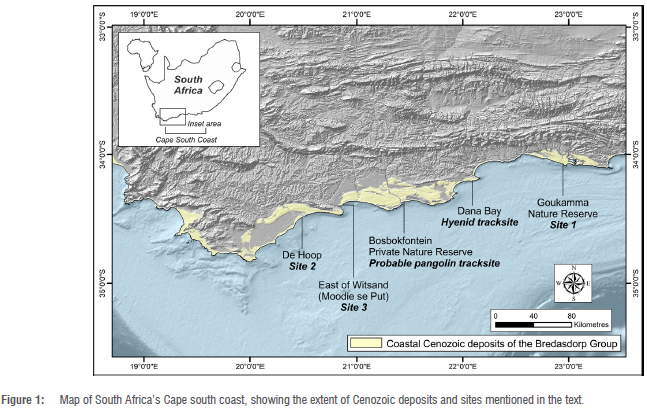
The purpose of this article is to describe three Cape south coast tracksites attributed to the African lion, Panthera leo (Figure 1). While the three sites may have a common Pleistocene trackmaker species, their interpretation differed in salient aspects, leading to different types of collaborative approaches between the Western-trained scientists and the Ju/'hoansi Indigenous Master Trackers in our research team. The findings described here build on the foundation established through previous publications on hyena footprints and a probable pangolin trackway.4,5 The compelling benefits that have accrued through the fusion of two perspectives, whereby traditional scientific knowledge is blended with modern scientific approaches, have been extolled. Moreover, the remarkable skills of Indigenous Master Trackers, inculcated from an early age, have been summarised.6
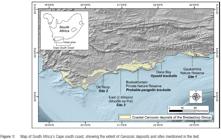
All three sites are located on aeolianite (cemented dune) surfaces of the Waenhuiskrans Formation78910
The African record of fossilised lion (or large felid) footprints is relatively sparse. Other than the sites described here, the only African record is from the Pliocene at Laetoli, Tanzania.1112,13 A trackway attributed to the extinct European cave lion (Panthera leo spelaea), dated to 42-35 ka, was also recovered from Bottrop.14,15 In Western Australia, thousands of Pleistocene claw scratch marks on the walls of Tight Entrance Cave have been attributed to the marsupial lion (Thylacoleo carnifex), the largest-known marsupial carnivore (which, despite its name, belongs to the order Diprotodontia, rather than Carnivora).16
Multiple reports exist of medium-sized or large felid footprints from the Americas, North America in particular. For example, footprints of the extinct Panthera atrox were reported from Cat Track Cave in Missouri, from the North American Pleistocene.17Panthera atrox.1817Panthera onca) or Smilodon, both of which were present in the regional fossil record19Panthera onca) have been reported from several sites, for example, Jaguar Cave in Tennessee.20
From South America, medium-sized footprints have been reported from the Late Pleistocene Pehuen Co site in Argentina.2122
Methods
Tracksites were assessed and documented through measuring footprint length, footprint width, footprint depth, pace length, stride length and trackway width, following the methods of Leonardi23
Photographs were taken, including for photogrammetric analysis.24,25 3D models were generated with Agisoft MetaShape Professional (v. 1.0.4) using an Olympus TG-5 camera (focal length 4.5 mm; resolution 4000 x 3000; pixel size 1.56 x 1.56 um). The final images were rendered using CloudCompare (v.2.10-beta).
At each of the three tracksites, independent assessments were undertaken by the Ju/'hoansi trackers and the team members trained in the application of the Western scientific method, ahead of discussion regarding interpretation, so as to avoid cognitive bias in either direction. The Ju/'hoansi team members would examine, confer at length in Ju/'hoan, and reach a conclusion. Interpretations would then be shared, along with 3D photogrammetry data where applicable. We would aim to reach consensus through our respective but complementary perspectives.
Results and interpretation
Site 1 - Goukamma
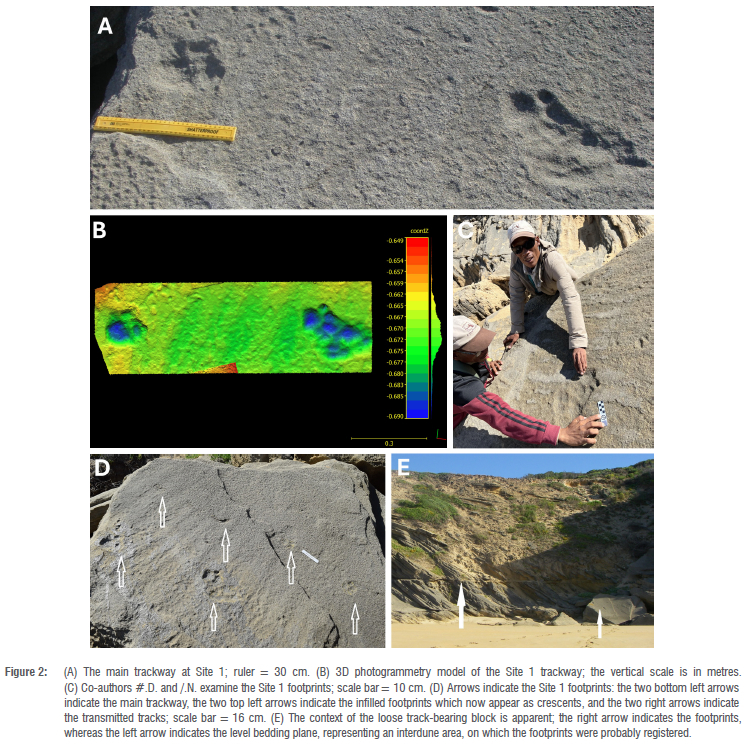
The Goukamma tracksite (Figure 2), located on the coast in the Goukamma Nature Reserve, was reported by Helm et al. in 20182610Figure 2A-D). The footprints occur on a fallen aeolianite block, and are preserved in concave epirelief (Figure 2E). Claw impressions are absent. The highest level of anatomical fidelity is present in the second footprint.
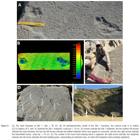
The first footprint measured 15 cm in maximum length, 13 cm in maximum width and 3.0 cm in maximum depth. The second footprint measured 17 cm in maximum length, 14 cm in maximum width and 4.0 cm in maximum depth. Ahead of it were fainter impressions which probably represented an indirect register. A pace length of 76 cm was measured. Indistinct indentations anterior to each footprint were present.
On the same surface, exhibiting less relief but nonetheless clearly evident when angled early-morning lighting was present, another short trackway segment was evident, aligned in the same direction as the first. In this case, the two footprints took the form of crescentic depressions, interpreted as large footprints that had been almost completely filled in by sand, presumably deposited by wind. These features were situated 65 cm from the main trackway (to the left of the main trackway when viewed from the direction of travel of the main trackmaker). The trackmaker responsible for the infilled footprints could not be identified from the appearance of these two crescents alone, but in the same axis the footprint-bearing surface ended, and an underlying layer situated 1.5 cm below it was exposed. Distal to these two crescentic shapes, and on this underlying layer, two footprints were present, each with maximum length and width of 12 cm. Overall morphology was similar to that of the two main footprints described above, other than the smaller size. The likelihood of this being a four-footprint trackway, with the proximal two footprints largely infilled and the distal two footprints being transmitted tracks (undertracks), was supported by the consistent pace lengths of 60 cm, 61 cm and 61 cm. No displacement rims were evident around the footprints on the main layer, suggesting that the footprints were registered on a fairly level dune surface.
As the best-preserved main footprint was of a high degree of preservation and anatomical fidelity2728,29 Further discussion then involved the subtleties of the female lion trackway, with its footprints infilled by windblown sand on the main layer, and transmitted tracks on an underlying layer. The footprints of the (heavier) male lion were better preserved than those of the female, exhibiting deeper indents and sharper margins. The presence of a nearby in situ level surface in the nearby cliffs was noted, and it was agreed that the footprints had probably been registered on this interdune surface.
Site 2 - De Hoop
In the coastal portion of the De Hoop Nature Reserve, an in situ aeolianite surface surrounded by loose aeolianite blocks contained two adjacent footprints (Figure 3A), preserved in concave epirelief. As viewed in the photogrammetry image in Figure 3B, the left footprint was better defined and contained at least three distinct large digit pad traces. The main pad impression was partially infilled and therefore could not be described further, but the footprint length was 14 cm. The right footprint was less well defined, and mostly comprised two large digit pad impressions. A fainter impression was evident between these two footprints, suggesting that the trackmaker had shifted its foot ~4 cm to the left (the middle impression thus being older than the left impressions).
Based on the footprint size and prominent digit pad impressions and morphology, the tentative interpretation by our Western-trained scientists was of probable large felid (most likely lion) footprints, but the confidence to reach a definite conclusion was lacking. The discussion on this occasion took longer, but the conclusion reached by the Ju/'hoansi team members was expressed with confidence: these were lion footprints. Furthermore, a crouching position of a lion that was ready to pounce was suggested - an interpretation that explained the set of two footprints adjacent to one another, pointing in the same direction. Thus, the Ju/'hoansi team members assertively contended that the footprints were from a lion, and they provided additional behavioural interpretations.
Site 3 - East of Witsand
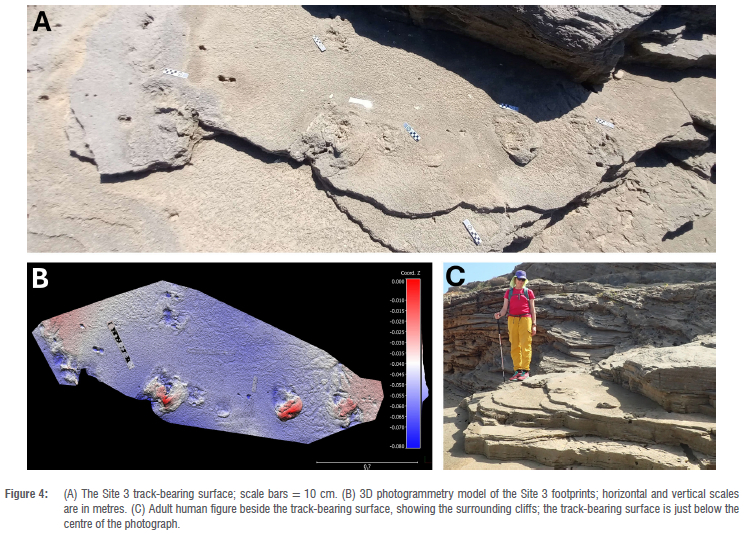
This site was located at the foot of aeolianite cliffs on the coast east of the community of Witsand, close to the old well dug in aeolianites that is known as Moodie se Put. An in situ aeolianite surface dipped at an angle of 30° to the south, and contained an assemblage of footprints preserved in epirelief (Figure 4). The most obvious features were the substantial displacement mounds at the downslope ends of three of the footprints, along with the large size of the generally roundish footprints (Figure 4A,B). Approximate footprint size was 14 cm for the larger footprint and 11 cm for the smaller footprints. Footprint depth is approximately 1.5 cm (not including displacement mounds) and 5 cm (including displacement mounds).
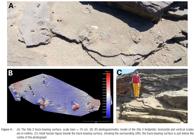
The interpretation of our Western-trained team members was simply of large, unidentifiable trackmakers that had registered footprints on a steep dune slope. In this case, however, animated discussion ensued among our Ju/'hoansi team members, after which an interpretation of a lion tracksite was made, including trackways of male (larger footprints) and female (smaller footprints) lions that crossed each other (the subtle morphological differences between the footprints of male and female lions have been alluded to above). Claw impressions were discussed and attributed to the dune slope the lions were climbing, while the large main pad impression of the male lion and its distinctive posterior margin were noted.
Discussion
Extant African lion footprint morphology
Five comprehensive guides are available for southern African trackers.28-32 The closeness in time (from a geological perspective) of the Pleistocene to the present implies that they can be used with reasonable confidence when interpreting Pleistocene footprints. Furthermore, vertebrate trackmaker species which are extinct have been well documented through the body fossil record.33,34
Liebenberg noted that the male lion's footprints are larger and proportionately broader than those of the female, that the female's toes are more slender than the male's, and that a young male lion's footprint can thus be distinguished from that of the female by the general shape.2828
Walker described lion footprints as "unmistakable", and as being made by a "large pug".303131
Gutteridge and Liebenberg noted the large size of the footprints (length of as much as 14 cm for the forefoot footprint), three lobes at the back of the main (metatarsal) pad, and the generally broader footprint of the male.3232
Van den Heever et al. provided the most detailed description of lion footprints and traces, with eight pages of information, including sage advice on modern lion-tracking.29Panthera pardus).29
Collaborative interpretation
Lion-tracking has developed a mystique, and is often viewed as the peak experience of modern tracking.35
Other than Panthera leo, there is no extant carnivoran in southern Africa that would have been capable of making footprints of the dimensions noted. Among extinct felids, the only known contender would have been a dirk-toothed (sabre-toothed) cat species, but, from the body fossil record, this subfamily (Smilodontini) of the Felidae appears to have become extinct in southern Africa36Dinofelis in Kenya during the early Pleistocene.37
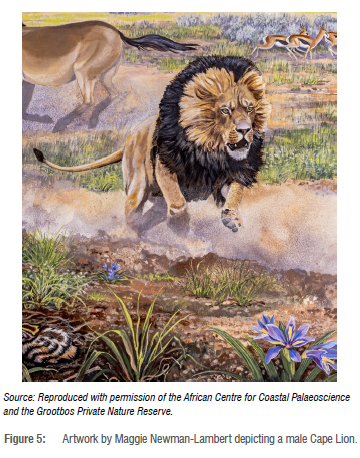
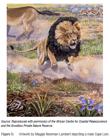
The relatively large size prompted speculation that the footprints at Site 1 may have been registered by Panthera leo melanochaitus, the purported extinct Cape Lion, or "black-maned lion".38,39 Klein reported that carnivoran body size was sometimes larger during the Pleistocene402941Figure 5 depicts an artistic rendition of a male Cape Lion.
The three sites, although all attributed to lion trackmakers, differed substantially in how collaboration ensued between Western-trained and Ju/'hoansi team members. At Site 1, the attribution to Panthera leo was not in doubt by either group, and discussion revolved around the subtler nuances of ichnological phenomena, such as footprints partially infilled by windblown sand and transmitted tracks. Congruence was quickly achieved, and the passage of a female lion, which had not been asserted by the Western-trained scientists, was added to the interpretation.
At Site 2, a tentative identification of a lion trackmaker had been made by our Western-trained scientists, but it was open to doubt and a confident conclusion was lacking. Input from the Ju/'hoansi team members led to this tentative interpretation being upgraded to 'confirmed', and a more detailed explanation for the pattern of noted features was provided.
At Site 3, no identification had been made by our Western-trained scientists, other than that the footprints were registered by large unidentified trackmakers progressing on a steep dune slope, producing substantial displacement rims. Our Ju/'hoansi team members took the interpretation to a higher level, not only identifying trackmaker species but also providing a rationale for their conclusions and providing behavioural interpretation. The footprints at Site 3 are not considered amenable to detailed morphological appraisal or comparison with examples in the palaeo-ichnological record by our Western-trained scientists.
The temporal proximity of the Pleistocene to the present, combined with the extensive amount of archaeological and palaeontological research that has been performed along the Cape south coast, makes it extremely unlikely that a hitherto unrecorded large felid may have inhabited the area during the Pleistocene. While such a possibility can never be totally excluded, the footprints described here can in all probability be attributed to Panthera leo.
Ichnotaxonomy
The morphofamily Felipedidae Remeika, 2001 was proposed to incorporate footprints with the classic felid morphology, similar to that described above, usually with an absence of claw impressions.42Felipeda Panin and Avram, 1962 was proposed to include plantigrade to semi-plantigrade footprints with four digits, each exhibiting a round or oval digit pad. The digit pads have the appearance of a semicircle anterior to the metatarsal pads. The dimensions of the digit pads are typically similar, but may show slight variation. Again, claw impressions may be present, but are typically absent.43
The ichnogenus Pantheraichnus Diedrich, 2011, was proposed to encompass lion footprints from northern Germany13Felipeda44Felipeda.
Conclusions
The three Cape south coast tracksites not only add substantially to the sparse global record of fossilised large felid (almost certainly lion) footprints, but also provide a stark ichnological reminder of the pre-colonial presence of lions in the southern Cape. Whether the Cape Lion deserves to be regarded as a distinct subspecies should not obscure the fact that large lions left their footprints and traces on Pleistocene dune surfaces.
In each case, the San provided more details about the represented footprints, including specific behaviours not originally interpreted by the Western-trained team members. Furthermore, in two cases, the specific taxon (lion) was asserted by the San, although the Western-trained researchers were originally less certain.
While the identification of well-preserved lion and other large felid footprints is relatively straightforward, less obvious cases require considerable expertise. The ability of Ju/'hoansi Indigenous Master Trackers to make the transition from tracking in Kalahari sands to tracking on Cape south coast aeolianite surfaces is both remarkable and welcome. Using their skills and insights, which have been inculcated from an early age, they hold the potential to contribute to further enhancements in the interpretation of the Cape coastal fossil record from the Pleistocene. Through the examination of the three sites described here, the capacity has again been demonstrated for the emergence of results that are richly compelling through the blending of diverse perspectives.
Funding
We thank the Discovery Wilderness Trust for financial assistance.
Data availability
The data supporting the results of this study are available upon request to the corresponding author.
Declarations
We have no competing interests to declare. We have no AI or LLM use to declare. All authors read and approved the final manuscript.
Contributors' contributions
C.W.H.: Lead author, conceptualisation, formal analysis, investigation, writing - original draft, project administration. H.C.C.: Conceptualisation, formal analysis, investigation, writing - review and editing. #.D.: Formal analysis, investigation, writing - review and editing. J.C.D.V.: Conceptualisation, formal analysis, investigation, writing - review and editing. /.N.: Formal analysis, investigation, writing - review and editing. C.R.T.: Conceptualisation, formal analysis, funding acquisition, investigation, writing - review and editing. S.K.: Track identification and interpretation.
Acknowledgements
Our colleague Steve Kunta passed away in October 2025, shortly before we finalised this article for submission. Had he not passed away, he would have been listed as a coauthor. We acknowledge Steve's wonderful contributions to our research team and to ichnology, and we dedicate this paper to his memory. We also acknowledge the helpful support from Dam Debe of the Nyae Nyae Conservancy in helping to finalise the manuscript. We thank Jack Carrigan and CapeNature staff for their support. We thank the anonymous reviewers for their thoroughness and constructive suggestions.
References
-
1. Helm CW. Pleistocene vertebrate trace fossils from the Cape south coast of South Africa: Inferences and implications [PhD thesis]. Gqeberha: Nelson Mandela University; 2023. Available from: http://hdl.handle.net/10948/60589
» http://hdl.handle.net/10948/60589 -
2. Neto de Carvalho C, Helm C, Melchor RN, Feola S, Goldstein D, Camens AB. The Quaternary record of vertebrate tracks and trackways. In: Lucas SG, Hunt AP, Klein H, editors. Vertebrate ichnology: Tracks and trails, consumption, digging and reproduction, geoconservation. Vol. 2. Amsterdam: Elsevier; 2025. p. 3-103. https://doi.org/10.1016/B978-0-443-38351-9.00004-9
» https://doi.org/10.1016/B978-0-443-38351-9.00004-9 -
3. Neto de Carvalho C, Helm C, Goldstein D, Camens AB, Belaústegui Z, Baucon A, et al. Walk the world and beyond: Hominin footprints. In: Lucas SG, Hunt AP, Klein H, editors. Vertebrate ichnology: Tracks and trails, consumption, digging and reproduction, geoconservation. Vol. 2. Amsterdam: Elsevier; 2025. p. 105-206. https://doi.org/10.1016/B978-0-443-38351-9.00007-4
» https://doi.org/10.1016/B978-0-443-38351-9.00007-4 -
4. Helm C, Cawthra H, Daqm #, De Vynck J, Nǂamce /, Thompson C. A Pleistocene hyenid trackway from the Cape south coast of South Africa. Quat Res. 2025;123:59-69. https://doi.org/10.1017/qua.2024.31
» https://doi.org/10.1017/qua.2024.31 -
5. Helm CW, Carr AS, Cawthra HC, Daqm #, De Vynck JC, Gräbe P-J, et al. A probable Pleistocene pangolin (Order: Pholidota) trackway from South Africa's Cape south coast. S Afr J Sci. 2025;121(3/4), Art. #18687. https://doi.org/10.17159/sajs.2025/18687
» https://doi.org/10.17159/sajs.2025/18687 -
6. Helm CW, Cawthra H, De Vynck JC, Thompson CR. San Master Trackers: Deploying ancient skills to enhance palaeo-ichnological interpretation on South Africa's Cape south coast. In: Eller JD, editor. Indigenous people - surviving and reviving in the 21st century. London: IntechOpen; 2026. https://doi.org/10.5772/intechopen.1014695
» https://doi.org/10.5772/intechopen.1014695 - 7. Malan JA. Lithostratigraphy of the Waenhuiskrans Formation (Bredasdorp Group). South African Committee for Stratigraphy Lithostratigraphic Series 8. Pretoria: Department of Mineral and Energy Affairs; 1989.
- 8. Malan JA. The stratigraphy and sedimentology of the Bredasdorp Group, Southern Cape Province, South Africa [MSc thesis]. Cape Town: University of Cape Town; 1990.
-
9. Bateman MD, Carr AS, Dunajko AC, Holmes PJ, Roberts DL, Mclaren SJ, et al. The evolution of coastal barrier systems: A case study of the Middle-Late Pleistocene Wilderness barriers, South Africa. Quat Sci Rev. 2011;30:63-81. https://doi.org/10.1016/j.quascirev.2010.10.003
» https://doi.org/10.1016/j.quascirev.2010.10.003 -
10. Helm CW, Carr AS, Cawthra HC, De Vynck JC, Dixon MG, Lockley MG, et al. Large Pleistocene tortoise tracks on the Cape south coast of South Africa. Quat Res. 2023;112:93-110. https://doi.org/10.1017/qua.2022.50
» https://doi.org/10.1017/qua.2022.50 -
11. Musiba CM, Mabula A, Selvaggio M, Magori CC. Pliocene animal trackways at Laetoli: Research and conservation potential. Ichnos. 2008;15(3-4):166-178. https://doi.org/10.1080/10420940802470383
» https://doi.org/10.1080/10420940802470383 - 12. Koenigswald W, Walders M, Sander M. Jungpleistozane tierfahrten aus der Emscher-Niederterrasse von Bottrop-Welheim [Late Pleistocene animal tracks from the Emscher lower terrace at Bottrop-Welheim]. Munchner Geowiss Abhandl. 1995;27:5-50. German.
- 13. Koenigswald W, Walders M, Sander M. The Upper Pleistocene tracksite Bottrop-Welheim (Germany). Acta Zool Cracov. 1996;39:235-244.
-
14. Diedrich CG. Late Pleistocene steppe lion Panthera leo spelaea (Goldfuss, 1810) footprints and bone records from open air sites in northern Germany - evidence of hyena-lion antagonism and scavenging in Europe. Quat Sci Rev. 2011;30:1883-1906. https://doi.org/10.1016/j.quascirev.2011.03.006
» https://doi.org/10.1016/j.quascirev.2011.03.006 -
15. Antón M, Salasa MJ. Walking with lions: The missed potential of Quaternary palaeoichnology. Quat Sci Rev. 2012;49:106-108. https://doi.org/10.1016/j.quascirev.2012.05.006
» https://doi.org/10.1016/j.quascirev.2012.05.006 -
16. Arman SD, Prideaux GJ. Behaviour of the Pleistocene marsupial lion deduced from claw marks in a southwestern Australian cave. Sci Rep. 2016;6(1), Art. #21372. https://doi.org/10.1038/srep21372
» https://doi.org/10.1038/srep21372 -
17. Graham RW, Farlow JO, Vandike JE. Tracking ice age felids: Identification of tracks of Panthera atrox from a cave in southern Missouri, U.S.A. In: Stewart KM, Seymour KM, editors. Palaeoecology and palaeoenvironments of Late Cenozoic mammals: Tributes to the career of C.S. (Rufus) Churcher. Toronto: University of Toronto Press; 1996. p. 331-345. https://doi.org/10.3138/9781487574154-018
» https://doi.org/10.3138/9781487574154-018 -
18. Bushell MW, Schubert BW. Large felid tracks and bones from Chilly Bowl Cave, Arkansas. J Cave Karst Stud. 2024;86(1/2):1-12. https://doi.org/10.4311/2023PA011
» https://doi.org/10.4311/2023PA011 - 19. Hawksley O. Remains of Quaternary vertebrates from Ozark caves and other miscellaneous sites. Mo Speleol. 1986;26:1-67.
- 20. Lockley M. The eternal trail - a tracker looks at evolution. New York: Perseus Publishing; 1999.
- 21. Aramayo SA, Manera de Bianco T. Hallazgo de una icnofauna continental (Pleistoceno tardío) en la localidad Pehuen-Có (partido de Coronel Rosales), provincia de Buenos Aires, Argentina. Parte I: Edentata, Litopterna, Proboscidea [Discovery of a continental ichnofauna (Late Pleistocene) at the Pehuen-Có locality (Coronel Rosales District), Buenos Aires Province, Argentina. Part I: Edentata, Litopterna, Proboscidea]. In: Proceedings of the 4th Latin American Paleontology Congress; 1987 July 27-30; Santa Cruz de la Sierra, Bolivia. Bolivia: Asociación Boliviana de Paleontología; 1987. p. 516-547. Spanish.
-
22. Agnolín FL, Chimento NR, Campo DH, Magnussen M, Boh D, De Cianni F. Large carnivore footprints from the Late Pleistocene of Argentina. Ichnos. 2019;26(2):119-126. https://doi.org/10.1080/10420940.2018.1479962
» https://doi.org/10.1080/10420940.2018.1479962 - 23. Leonardi G. Glossary and manual of tetrapod footprint palaeoichnology. Brasília: Ministério das Minas e Energia, Departamento Nacional da Produção Mineral; 1987.
- 24. Matthews NA, Noble TA, Breithaupt BH. Close-range photogrammetry for 3-D ichnology: The basics of photogrammetric ichnology. In: Falkingham PL, Marty D, Richter A, editors. Dinosaur tracks: The next steps. Bloomington, IN: Indiana University Press; 2016. p. 28-55.
-
25. Falkingham PL, Bates KT, Avanzini M, Bennett M, Bordy EM, Breithaupt BH, et al. A standard protocol for documenting modern and fossil ichnological data. Palaeontology. 2018;61(4):469-480. https://doi.org/10.1111/pala.12373
» https://doi.org/10.1111/pala.12373 - 26. Helm CW, McCrea RT, Cawthra HC, Thesen GHH, Mwankunda JM. Late Pleistocene trace fossils in the Goukamma Nature Reserve, Cape south coast, South Africa. Palaeontol Afr. 2018;52:89-101.
-
27. Marchetti L, Belvedere M, Voigt S, Klein H, Castanera D, Díaz-Martínez I, et al. Defining the morphological quality of fossil footprints. Problems and principles of preservation in tetrapod ichnology with examples from the Palaeozoic to the present. Earth-Sci Rev. 2019;193:109-145. https://doi.org/10.1016/j.earscirev.2019.04.008
» https://doi.org/10.1016/j.earscirev.2019.04.008 - 28. Liebenberg L. A photographic guide to tracks and tracking in southern Africa. Cape Town: Struik Publishers; 2000.
- 29. Van den Heever A, Mhlongo R, Benadie K, Thomas I. Tracker manual: A practical guide to animal tracking in southern Africa. Cape Town: Struik Nature; 2024.
- 30. Walker C. Signs of the wild: A field guide to the spoor & signs of the mammals of southern Africa. Cape Town: Struik Nature; 2018.
- 31. Stuart C, Stuart M. A field guide to the tracks and signs of southern and East African wildlife. Cape Town: Struik Nature; 2019.
- 32. Gutteridge L, Liebenberg L. Mammals of southern Africa and their tracks and signs. Johannesburg: Jacana Media; 2021.
-
33. Faith JT. Late Pleistocene and Holocene mammal extinctions on continental Africa. Earth-Sci Rev. 2014;128:105-121. https://doi.org/10.1016/j.earscirev.2013.10.009
» https://doi.org/10.1016/j.earscirev.2013.10.009 -
34. Avery DM. A fossil history of southern African land mammals. Cambridge: Cambridge University Press; 2019. https://doi.org/10.1017/9781108647243
» https://doi.org/10.1017/9781108647243 - 35. Varty B. The lion tracker's guide to life. New York: HarperOne; 2019.
-
36. Klein RG, Avery G, Cruz-Uribe K, Steele TE. The mammalian fauna associated with an archaic hominin skullcap and later Acheulean artifacts at Elandsfontein, Western Cape Province, South Africa. J. Hum Evol. 2007;52(2):164-186. https://doi.org/10.1016/j.jhevol.2006.08.006
» https://doi.org/10.1016/j.jhevol.2006.08.006 - 37. Werdelin L, Lewis E. Koobi Fora Research Project, Volume 7: The Carnivora. San Francisco, CA: California Academy of Sciences; 2013.
- 38. Mazák V. Notes on the black-maned lion of the Cape, Panthera leo melanochaita (Ch. H. Smith, 1842) and a revised list of the preserved specimens. Verh K Ned Akad Wetensch. 1975;64:1-44.
-
39. Christiansen P. On the distinctiveness of the Cape lion (Panthera leo melanochaita Smith, 1842), and a possible new specimen from the Zoological Museum, Copenhagen. Mamm Biol. 2008;73(1):58-65. https://doi.org/10.1016/j.mambio.2007.06.003
» https://doi.org/10.1016/j.mambio.2007.06.003 -
40. Klein RG. Carnivore size and Quaternary climatic change in southern Africa. Quat Res. 1986;26:153-170. https://doi.org/10.1016/0033-5894(86)90089-X
» https://doi.org/10.1016/0033-5894(86)90089-X -
41. De Flamingh A, Gnoske TP, Rivera-Colón AG, Simeonovski VA, Kerbis Peterhans JC, Yamaguchi N, et al. Genomic analysis supports Cape lion population connectivity prior to colonial eradication and extinction. J Hered. 2024;115(2):155-165. https://doi.org/10.1093/jhered/esad081
» https://doi.org/10.1093/jhered/esad081 - 42. Remeika P. The Fish Creek Canyon ichnofauna: A Pliocene (Blancan) vertebrate footprint assemblage from Anza-Borrego Desert State Park, California. In: Santucci VL, McClelland L, editors. Proceedings of the 6th Fossil Resource Conference; 2001; Grand Junction, Colorado, USA. Technical report NPS/NRGRD/GRDTR-01/01. Lakewood, CO: Geologic Resources Division, National Park Service, US Department of the Interior; 2001. p. 55-75.
- 43. Panin N, Avram E. Noe urme de vertebrate in Miocenul Subcarpaţilor romineşti [New vertebrate traces in the Miocene of the Romanian Sub-Carpathians]. Stud Cercet Geol. 1962;7:455-484. Romanian.
-
44. Abbassi N, Melchor RN, Díaz-Martínez I. Ichnotaxonomy of Paleogene and Neogene tetrapod tracks. In: Lucas SG, Hunt AP, Klein H, editors. Vertebrate ichnology. Amsterdam: Elsevier; 2025. p. 749-892. https://doi.org/10.1016/B978-0-443-13837-9.00005-6
» https://doi.org/10.1016/B978-0-443-13837-9.00005-6

Revised: 08 June 2026
Accepted: 16 July 2026
Published: 29 Sep. 2026
Funding: Discovery Wilderness Trust