How innovative is South Africa?
NEWS & VIEWS
How innovative is South Africa?
William BlankleyI; Cheryl MosesII
IHuman Sciences Research Council's Centre for Science, Technology and Innovation Indicators, Private Bag X9182, Cape Town 8000, South Africa (e-mail:
IIHuman Sciences Research Council's Centre for Science, Technology and Innovation Indicators, Private Bag X9182, Cape Town 8000, South Africa. (e-mail:
Innovation in widely acknowledged as being vital to economic growth and progress. Innovation is vital to ensuring the future success and competitiveness of business enterprises in an increasingly competitive global economy. In recent years, world markets have become more sophisticated; customers and clients have become far more demanding; and the range and variety of products and services offered in the market has grown dramatically. The European Union's Seventh Framework Programme identifies the 'knowledge triangle' of research, education and innovation as core factors in advancing Europe to become the most competitive and dynamic economy in the world. South Africa's own Department of Science and Technology recently launched a ten-year innovation plan for South Africa for 2008–2018—'Innovation towards a knowledge-based economy'.
Innovations essentially comprise the introduction of new or significantly improved goods or services to the market, or the use of new or significantly improved processes for producing goods and services. Innovative enterprises are thus those that are changing to meet the demands and expectations of customers and clients. Innovative enterprises also include some powerful companies that lead and shape markets through their innovations. It is not only large enterprises such as car manufacturers that have to be innovative, but also small firms that are able to exploit various market niches. Innovations do not always result in economic success, however, as enterprises can easily misread or mistime the market.
Innovation surveys provide interesting and useful data for public policy and are designed to measure the extent of innovation in the business sector of a country and to estimate expenditure on various innovation activities. The surveys also indicate the importance of certain factors that affect innovation activities in enterprises. The Centre for Science, Technology and Innovation Indicators (CeSTII) undertook South Africa's first official Innovation Survey during 2006 and 2007 as commissioned by the Department of Science and Technology, which released the highlights of the results in 2007.12
Here we compare several aspects of innovation in the 27 member states of the European Union (EU-27), as well as Norway and Iceland (where available) and South Africa, in order to better understand the innovative capabilities of South African enterprises compared with other countries. This is the first time that it has been possible to objectively compare such a wide range of innovation survey data for South Africa with the results of similar surveys in developed countries.
In 2001, Eurostat (the central Statistical Office of the European Communities) circulated an open invitation to non-EU member states to use the core Community Innovation Survey (CIS) questionnaire and survey methodology for national innovation surveys in order to improve the comparability of innovation indicators between regions and countries worldwide. The design of the South African innovation survey of 2005 was informed by the Eurostat questionnaire and guidelines for the fourth round of the CIS (CIS4) as well as the structure of the Statistics South Africa business register, from which the survey sample was drawn. Innovation Surveys are based on the results obtained from questionnaires distributed to a sample of the total business population, which are then extrapolated to the total business population. The survey design thus comprised a random stratified sample (by sector and size of enterprise) drawn from the business registry database of Statistics South Africa. An overall response rate of 37.3% from an eventual sample of 2627 enterprises was obtained. The results of the survey were extrapolated to the target business population of 31 456 enterprises based on the weights of 120 strata.
During 2007, Eurostat published various results from CIS4 for EU-27 countries as well as Iceland and Norway. The South African innovation survey of 2005 had been aligned with CIS4, which allowed direct comparison of the South African results with those for the European countries. Innovation survey results are not particularly useful in isolation, and these international comparisons provide a rich source of reference for understanding and interpreting South Africa's innovation survey results. The final results of the South African innovation survey, including international comparisons, have been compiled as a detailed report to the Department of Science and Technology.3
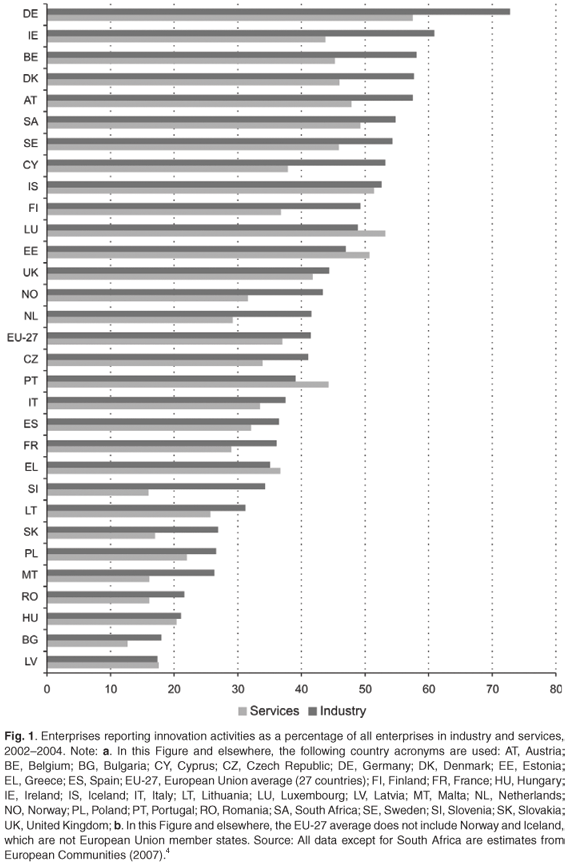
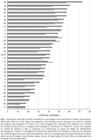
In most European countries, industrial enterprises are more innovative than service enterprises, but in several countries (including Luxembourg, Estonia, Portugal, Greece and Latvia), the rates of innovation in the services sector are higher than in industry (Fig. 1). The proportion of enterprises engaged in innovation activities ranged from 72.8% in German industry to 12.7% in Bulgarian services. In South Africa, 54.8% of industrial enterprises were innovative, compared with 49.3% of service enterprises. The proportion of innovative enterprises in South Africa is considerably higher than the EU-27 averages of 41.5% for industry and 37.0% for services. South Africa had the sixth highest rate of innovation in industrial enterprises and the fifth highest rate of innovation in service enterprises.
It is becoming more important for both industrial and service enterprises to be innovative, as services play an increasingly significant role in the transfer of technology and the facilitation of business in both developed and developing economies. The bulk of the gross domestic product (GDP) of developed countries now originates from service-based industries, and the majority of workers are employed in the services sector.56
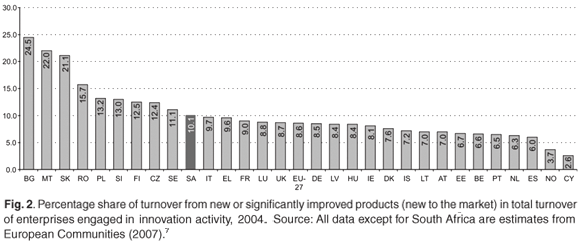
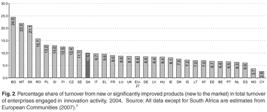
Figure 2 shows that South Africa performed relatively well in terms of the percentage of turnover generated by the sale of new or significantly improved products (new to the market and not just new to the enterprise). It should be noted that the leading countries on this indicator were four new EU members, namely Bulgaria (24.5%), Malta (22.0%), Slovakia (21.1%) and Romania (15.7%).7
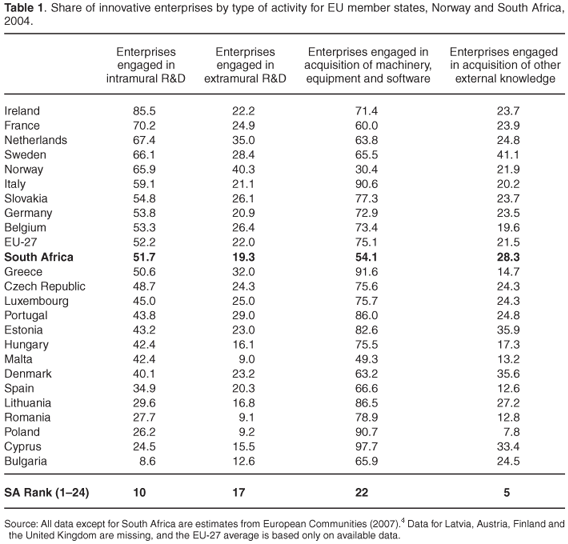
International comparisons of innovation activities in innovative enterprises provide some interesting comparisons. The proportion of innovative South African enterprises undertaking intramural research and experimental development (R&D) was close to the EU-average of 52.2%, and South Africa (51.7%) ranked 10th out of 24 countries on this scale (Table 1). The country ranked 17th in terms of the percentage of innovative enterprises that outsourced or engaged in extramural R&D (19.3%). Despite relatively high expenditure on the acquisition of machinery, equipment and software, South African enterprises were not as active as enterprises in other countries in these acquisitions, and with only 54.1% of enterprises reporting such expenditure, the country ranked only 22nd. South Africa ranked fifth in terms of the percentage of innovative enterprises engaged in acquiring other external knowledge (28.3%).
Among EU countries, Ireland (86%) and France (70%) had the highest proportion of innovative enterprises engaged in in-house R&D. Bulgaria (9%) and Cyprus (24.5%) recorded the least intramural R&D activity.
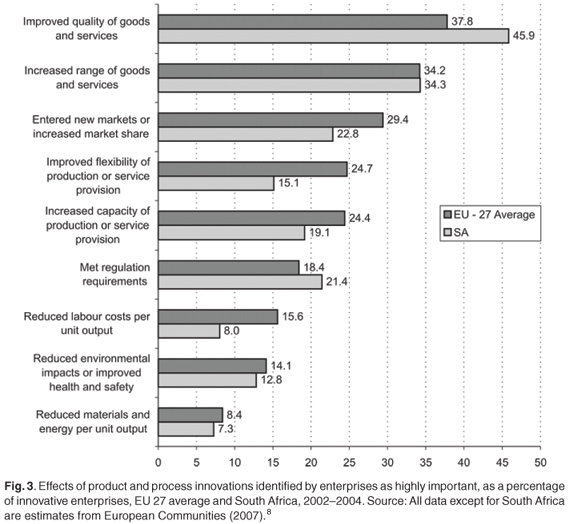
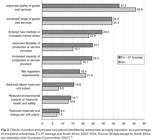
South African innovative enterprises showed a remarkably similar profile to the EU-27 average for most of the effects of innovation identified as highly important for enterprises (Fig. 3). The most important reason for both South African and EU enterprises to be innovative was to improve the quality of the goods and services they provide.8
Successful business managers understand that the shareholder value of an enterprise is determined essentially by its ability to grow future profits.9
Competition provides consumers with a multitude of choices, and to be successful, businesses have to find consistent ways of delivering excellence in these circumstances. In order to increase shareholder value, businesses need to do things better and differently in the eyes of customers or clients. Innovation is increasingly becoming an important metric by which corporate performance is measured, and executives are aware that it is vital for the future success of their companies.
In most European countries, the industrial sector shows a higher rate of innovation than the services sector. The same trend is found in South Africa, where 54.8% of enterprises in the industrial sector are innovative, compared with 49.3% in the services sector. Concerns about the management of innovation have always centred largely on the manufacturing industry. However, the services sector is now of major importance in almost all developed countries, accounting for over 75% of GDP in countries such as the United States, the United Kingdom and France.5101011
Managers in the services sector must identify and understand the processes behind innovation in their companies and provide support and encouragement for such activities. It is essential for top management to foster innovation initiatives if the services sector is to become more competitive.
There are many barriers to innovation in enterprises, including reluctance to venture into the unknown and to experiment with new technology and business models, as well as clinging to conventional planning practices.12
References
-
1. Department of Science and Technology (2007). South African Innovation Survey 2005: Highlights, Pretoria. Online at: http://www.hsrc.ac.za/ Document-2159.phtml
» http://www.hsrc.ac.za/ Document-2159.phtml - 2. Blankley W. (2005). Preliminary results of the South African Innovation Survey, 2005. S. Afr. J. Sci. 103, 190–192.
-
3. Blankley, W. and Moses, C. (2009). Main Results of the South African Innovation Survey 2005. Department of Science and Technology and Human Sciences Research Council. HSRC Press, Pretoria. Online from: www.hsrc.ac.za.
» www.hsrc.ac.za - 4. European Communities (2007). Community innovation. Statistics: more than half of the innovative enterprises in the EU do in-house R&D. Statistics in Focus: Science and Technology, 72/2007. Author: S-V. Parvan, Eurostat.
-
5. CIA (2008). The World Factbook, Field Listing – GDP – Composition by Sector. Central Intelligence Agency. Online at: www.cia.gov.library/publications/the-world-factbook/fields/2012.html
» www.cia.gov.library/publications/the-world-factbook/fields/2012.html - 6. Statistics South Africa (2007). Gross domestic product: annual estimates 1993–2006 and annual estimates per region 1995–2006; Third quarter: 2007, Statistical Release P0441. Statistics South Africa, Pretoria.
- 7. European Communities (2007). Community innovation. Statistics: Is Europe growing more innovative? Statistics in Focus: Science and Technology, 61/2007. Author: S-V. Parvan, Eurostat.
- 8. European Communities (2007). Community innovation. Statistics: Innovation activities and their effects. Statistics in Focus: Science and Technology, 113/2007. Author: S-V. Parvan, Eurostat.
-
9. Nanda A. (2005). Innovate or perish! Rediff News, 26 October. Online at: http://in.rediff.com/ money/2005/oct/26col.htm
» http://in.rediff.com/ money/2005/oct/26col.htm -
10. Oke A. and Goffin K. (2001). Managing innovation in the service sector. Online at: www.som. cranfield.ac.uk/som/groups/opsman/downloads/Managing%20Innovation%20in%20the %20Service%20Sector.pdf
» www.som. cranfield.ac.uk/som/groups/opsman/downloads/Managing%20Innovation%20in%20the %20Service%20Sector.pdf -
11. Haataja M.J. (2005). Development of competitiveness of knowledge intensive services. International Society for Professional Innovation Management. Online at: www.tut.fi/units/tuta/tita/ tip/Haataja_ISPIM2005.pdf
» www.tut.fi/units/tuta/tita/ tip/Haataja_ISPIM2005.pdf - 12. Financial Times (2004). FT mastering innovation: connecting across the divide. Financial Times Mastering Innovation Series, Part Four, 8 October.