Bridging the science-policy interface: a new era for South African research and the role of knowledge brokering
Abstract
Government departments and agencies are faced with issues of increasing socio-ecological complexities around environmental sustainability and global change, which require them to make decisions that have the potential to impact greatly on society and economies. As a result, they are under increasing pressure to develop policies that consider a wide spectrum of scientific and indigenous knowledge. It is acknowledged that in South Africa, as elsewhere, a gap typically exists between the scientific or research community and the policymaking community, due to a number of underlying reasons at both ends. This gap often results in a unidirectional 'push of evidence' by researchers to policymakers, with a hope that policymakers will take up these findings and use them in policy identification, formulation or implementation. To support the uptake of evidence in policy, it is also important to stimulate an environment of 'evidence pull' by the policy community from the research community, as well as increasing the dialogue between these communities. A model of knowledge brokering is proposed in this paper as a means to bridge this gap between science and policy and, thereby, ensure the uptake of evidence in policy development and implementation. This model looks at the need for institutional mechanisms, such as knowledge-brokering offices, both within research organisations and government departments. It also highlights the importance of researchers involving policymakers from the onset of their research process, with a continuous dialogue between the two parties, both during and after the research, as a means of increasing the likelihood of research uptake.
environmental sustainability; evidence-based policy; global change; knowledge brokering; research; South Africa
INTRODUCTION
People are becoming more demanding, whether as consumers of goods and services in the market place, as citizens or as businesses affected by the policies and services which government provides. To meet these demands, government must be willing constantly to re-evaluate what it is doing so as to produce policies that really deal with problems; that are forward-looking and shaped by the evidence rather than a response to short-term pressures; that tackle causes not symptoms; that are measured by results rather than activity ... 1
This growing pressure on governments to adopt evidence in support of policy development and implementation is not unique to the European community. South African government departments are under increasing pressure to provide evidence-based policies that ensure the consideration of a wide spectrum of scientific and indigenous knowledge. This is reflected in the address by the then South African Minister of Science and Technology2
This ... symposium on the 'Nature of Evidence' and 'Science-based Advice for the Nation' has an important contribution to make in exploring the urgency and growing importance of evidence as the basis for making informed policy and practical decisions across the world.2
Governments are faced with issues of increasing complexity that require them to make decisions that have the potential to impact greatly on society and economies.3
In South Africa there exists significant political will at regional, national and provincial levels to address sustainability issues and especially the threats and opportunities posed by climate change. This includes investment in negotiations at many international forums and with strong cross linkages to trade and other economic negotiations and considerations. South Africa's and even SADC negotiating positions will benefit greatly from an improved and more coherent science base to inform policy. National to local scale development planning will also benefit if effective channels of communication can be opened to fast track scientific knowledge to policy-makers and implementers.4
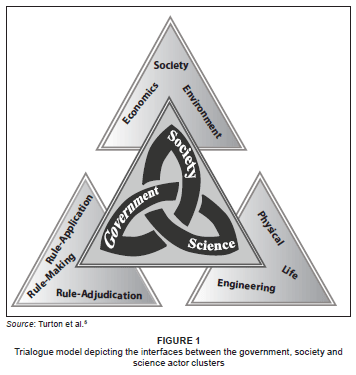
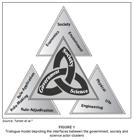
The Trialogue Model5Figure 1) suggests that the increasing complexity and apparently intractable nature of contemporary environmental issues require the establishment of new, closer and co-operative relationships between government, science and society actor clusters.5,6 The argument put forward by the Trialogue also suggests that each of the interfaces between the different clusters requires a different type of communication strategy, which, in the case of the interaction between the science and policy actor clusters, also implies improving and deepening existing relations between the actors involved.
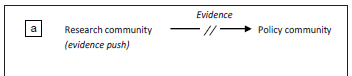
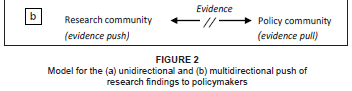
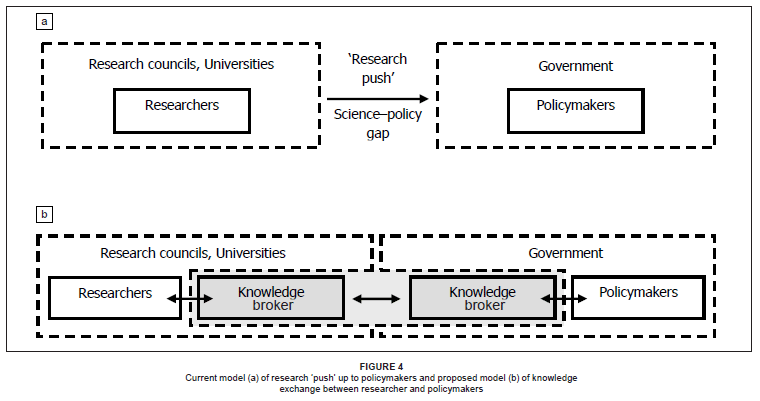
The transfer of research outputs from universities and science councils has, in the past, been linear and unidirectional,7Figure 2a). It is proposed that, to strengthen the science-policy relationship, there must be a stronger 'pull' of research by policymakers to support policy questions, or a push-pull, multidirectional relationship between these communities (Figure 2b).
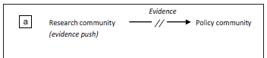
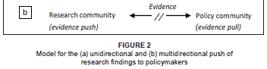
Researchers have questioned why 'some of the ideas that circulate in the research/policy networks [are] picked up on and acted on, while others are ignored and disappear'.89
In terms of the science-government interface of the Trialogue Model,5
To support the uptake of evidence in policy, it is important to stimulate an environment of evidence pull by policymakers from the research community, as well as increasing dialogue between the communities. The following sections focus on, (1) the way in which policy is informed by evidence, (2) barriers to evidence uptake and (3) one key model that can be used to overcome these barriers.
POLICY INFORMED BY EVIDENCEPolicymaking is typically shaped by a number of factors, including the social and political context of the country,107,11,12 There is currently divergence in the literature regarding the definition of 'evidence'. Some authors consider 'evidence' to include only science or research,11138111415 15
systematic work, drawing on knowledge gained from research and practical experience that is directed to producing new materials, products and devices; to installing new processes, systems and services; or to improving substantially those already produced or installed.15
The UK government has, however, adopted a broader definition of evidence. According to their Cabinet Office, evidence can comprise, but is not limited to
expert knowledge; existing domestic and international research; existing statistics; stakeholder consultation; evaluation of previous policies; new research, if appropriate; or secondary sources, including the internet. Evidence can also include analysis of the outcome of consultation, costings of policy options and the results of economic or statistical modelling.13
This paper focuses specifically on the role of research as evidence and, in particular, on the role of applied and experimental research, both of which are directed towards practical outcomes, such as uptake for policy. This is not to say that there is no place for basic (blue skies) research. Blue skies research still needs to be encouraged and supported, because while the impact of such research may not be realised immediately, the potential for future impact does exist.
According to Davies (cited in ODI)111111evidence-based14 evidence-backed, where policymakers use data to justify preconceived policy options to suit their own political agendas.1617
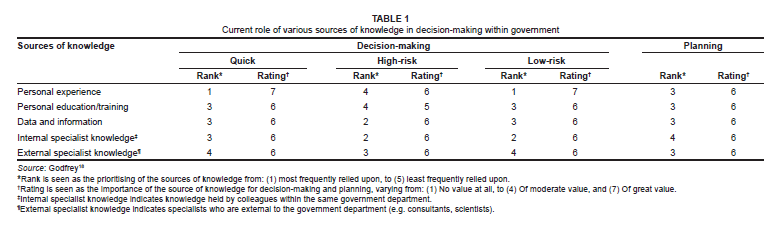
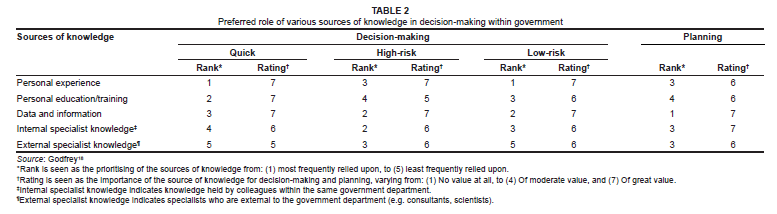
Results presented in Table 1 are the median values obtained from a questionnaire administered to 11 managers within government who are responsible for pollution and waste management in South Africa. The results indicate that, in instances of quick or low-risk decision-making, managers rely less on input from external specialists and more on personal experience. In instances of high-risk decision-making, a shift away from the use of personal knowledge to one of evidence (data, information, specialist knowledge) becomes evident; however, there is still little reliance on external specialist knowledge. What is interesting to note is that this reliance on specialist knowledge does not change from current practice to desired practice (Table 2). Even in the case of desired practice, government officials still place a lower emphasis on the knowledge of specialists in the field and, in particular, specialists external to the organisation. This observation is not unique to South Africa. However, internationally, things appear to be changing, as there is evidence of growing reliance on specialist knowledge by government departments in the decision-making and policymaking processes. Advisory groups made up of specialists in their field are evident, for example, in the Department for Environment, Food and Rural Affairs' (DEFRA) Science Advisory Council and the UK Waste and Resources Research Advisory Group.
BARRIERS TO THE UPTAKE OF RESEARCH
There are a number of possible reasons for the low reliance on specialists by government officials. These include: being unaware of who the information providers are,198,11,20,21 and limited understanding of the value of evidence.111111
It is always important to bear in mind that 'knowledge' is relative and mutable. That which may be considered certain and fixed in science at one point in time, may be overruled by new discoveries at a later stage.2
This changing or shifting knowledge base, or possible contradictions within the same knowledge base, often makes it difficult for policymakers to define a 'fixed knowledge point' on which to base policy or decisions. This is evident, for example, in the fields of climate change or the human health impacts of nanotechnology, where scientists can hold differing views on scientific processes and outcomes.
The UK National Audit Office227
considerable human capital challenges which constitute the primary implementation constraint for enhancing South African effort in global change related science and technology. This national lack of capacity impacts on the ability to both implement the research programme (i.e. funding researchers) and to implement research outputs (in the state departments). Notwithstanding important efforts to build capacity, particularly amongst blacks and women, these efforts remain ad-hoc with the existence of considerable barriers for scale up.4
Watson-Wright23
The UK government notes that
policy-makers' ability to access evidence-based advice is constrained in a number of ways. For example, the demand for quick fixes means policy-makers often do not have time for in-depth research. Where time is not a constraint, the sheer volume of research material available can be daunting. There is a danger of information 'overload', compounded by a shortage of people with the skills needed to act as an 'intelligent customer' for research and to understand or interpret available information. And, of course, in many cases evidence can either be incomplete, contradictory or inconclusive, adding to the difficulty of taking informed decisions rather than reducing it. Finally, the growing emphasis on cross-cutting policies increases the need for cross-cutting information and research if either duplication of effort or information gaps are to be avoided.5
Thus, the UK Cabinet Office13
• the value that science can bring to the discussion, which is often not fully understood by government or society
• the fact that science typically does not communicate with government in a manner that is easily understood, particularly for government officials with a purely political rather than a technical or science background
• realising that the issues facing society are a lot more complex and the environment in which society lives a lot more uncertain. A decline in the level of confidence with which science can predict changes in, and to, the environment and the resultant risks of such changes, has resulted in society being sceptical of the role of science.
Similarly, the South African Minister of Science and Technology in 2006 stated that:
[t]he significance and contribution of 'evidence-based' information in the policy-making discourse is not difficult to understand. However, given the complex relationship between research and policy, the culture of academia and the funding practices of commissioners of research, the current ethos of 'evidence-informed' public policy poses many technical, methodological and epistemological challenges.2
THE SCIENCE-POLICY GAP
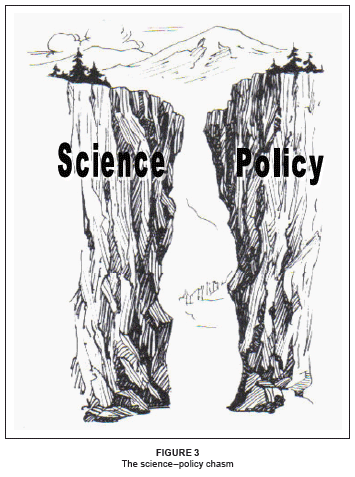
The underlying blame for lack of evidence uptake, therefore, appears to lie squarely on both the side of researchers as well as policymakers. To bridge the gap between the research and policy communities, Bielak et al.7Figure 3).
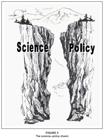
The following section looks at one key way in which this gap can be bridged to increase the value of research and support evidence uptake by policymakers. What Bielak et al.7
A MODEL FOR KNOWLEDGE BROKERINGThe use of evidence-based knowledge is especially vital in developing countries where resource constraints preclude chances of entertaining any dubious solutions and experiments from elsewhere which might result in harmful consequences. Evidence-based advice therefore requires closer co-operation between government, research-based organisations and national academies of science to ensure that policy-making and planning draws on the best available information. 2
The past year has seen society critically question and challenge the apparent lack of inclusion of evidence in government decision-making and planning. South Africa has seen a number of media headlines highlighting environmental and developmental crises facing the country. Society has questioned why there has been a lack of forward planning and insight to medium- and long-term environmental and developmental challenges by government departments, resulting in immediate crises, such as the energy crisis, municipal wastewater treatment crises, water supply crises and food security crises. These media articles have raised questions as to why evidence, provided years or decades before problems surfaced, was not taken up by government and adopted into planning or policy. The Canadian Council of Science and Technology Advisors3
At the same time, government departments responsible for the allocation of funding to research institutions have questioned what impact research is having on society in South Africa, particularly relating to current priority issues facing the country, such as HIV/AIDS, poverty alleviation, job creation, security and environmental sustainability. In order for research organisations to move from outputs and outcomes to impact, however, they are reliant upon the uptake of research by policy-makers, industry and society. Knowledge brokering provides an important means of engaging with key stakeholders upon whom scientists are reliant to ensure uptake and ultimate impact.
The fact is a gap exists between science and policymakers, which results in science communication remaining one-sided, as research findings have to be 'pushed' to policymakers. In addition, current institutional arrangements in research institutions do little to bridge this gap between research and policy. A reason for this problem of policymakers not using research to feed into the policymaking process is because the links between research and policy have not been sufficiently established.911,14
Roux et al.24
fundamentally, there needs to be increased communication and interaction between the research and policy worlds in order to strengthen the integration of policy and evidence. This can be achieved by setting up mechanisms that will facilitate greater use of evidence by policymakers.11
The recent study conducted on research dissemination and uptake in South Africa9 77
One such model is the institutionalisation of knowledge brokering (Figure 4), thereby encouraging the evidence 'pull'. This paper puts forward the knowledge-brokering model as a means of bridging this gap, in the hope of furthering evidence-based policy in South Africa. Bielak et al.7 711
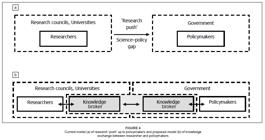
Such institutional arrangements for knowledge brokering and knowledge exchange are currently taking hold internationally. Examples of units set up to foster knowledge brokering include: the Natural Environment Research Council's (NERC) 'Knowledge Exchange' Group, the Economic and Social Research Council's (ESRC) 'Communications and Knowledge Transfer Unit', the National Water Research Institute of Environment Canada's 'Science Liaison Branch', the Land and Water Australia 'Knowledge and Adoption' Manager (developed as a result of the Knowledge for Regional Natural Resource Management Program), and DEFRA's 'Waste Evidence Branch'.
In South Africa, knowledge brokering, while in its infancy, is also taking hold. The Department of Science and Technology is currently developing a Science-Policy-Practice Interface Strategy as part of its Global Change Grand Challenge initiative. The aim of the strategy is to improve evidence-based policymaking in the field of global change and to establish a Bureau for Global Change Research that will function as a knowledge broker to help facilitate and improve interactions between different key stakeholders from the science, policy and business domains by means of a strategic, targeted approach that will undergo regular monitoring and evaluation. The knowledge-brokering function will take place in the context of other initiatives within the Global Change Grand Challenge, including a research-based Centre for Excellence on Global Change and Sustainability, and development and use of the Risk and vulnerability atlas as a science communication tool.
The UK Natural Environmental Research Council25
[i]f research is to be used in policy-making and environmental management, users should be involved throughout the planning and execution stages to ensure the continuing coherence of the research questions and the answers that are needed. The dissemination and implementation of research needs to be properly thought through at the planning stage, and adequate resources and time allocated in project budgets and schedules.26
The knowledge-brokering philosophy requires institutional changes on both sides - within universities and research councils and within government departments. These institutional changes require the creation of 'knowledge-broker' positions or units - 'research brokers' within the research environment and 'evidence brokers' within government (government departments would need to consider all aspects of knowledge not only scientific evidence or research, hence the reference to an 'evidence' broker). Bielak et al.78,10 The Scientific Knowledge for Environmental Protection (SKEP)26
an important role in synthesising results into a useful form, and in providing a balanced overview where there are competing claims to the 'truth'. They need to put the science into context and in proportion, describing uncertainties in a way which is helpful to the users but true to the science. Interpreters need to develop good relationships with both users and researchers, understanding both and able to see the world through their eyes. Good social skills, a breadth of view, and the ability to synthesise information and communicate it clearly are all key skills for interpreters.
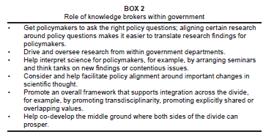
The roles of the knowledge broker are diverse and vary between the research community8,10,13 (Box 1) and the policy community19Box 2).
A knowledge-brokering model provides a means for policymakers to better understand the value of evidence, be more aware of what evidence is available and how best to gain access to it, as well as how to directly solicit focused and directed research in support of key policy questions. For a knowledge-brokering model to work successfully within both research and policy communities, the following conditions7,8 are required:
• an acceptance of the knowledge broker by researchers within research organisations
• an acceptance of the knowledge broker by policymakers within government
• a new brand of researcher that can translate or package research to facilitate uptake
• a new brand of policymaker that can interpret policy questions into research questions
• a mature relationship between research organisations and government that facilitates open communication and sharing
• a close working relationship between researchers and policymakers.
The UK Cabinet Office13
While the knowledge-brokering model requires the establishment of new institutional functions, it is important for this model not to be seen as a new layer of 'middlemen' within organisations, which place additional demands and burdens onto researchers and policymakers in organisations that are already strained to capacity. It will be important for South Africa to learn from other organisations which have implemented such models and, through a process of adaptive management, find an approach that provides maximum benefit to both the research and policy communities. If effective institutional mechanisms are not implemented, the possibility exists that the knowledge-brokers will be ignored by researchers and policymakers, making it difficult for them to play their respective roles effectively. Senior organisational support is thus critical in ensuring the success of a knowledge-brokering model and the sustained credibility of knowledge-brokers (respected by the scientist and policymaker), because if this support is not provided, brokers may simply be ignored or isolated within the organisation. According to Bielak et al. 7
In addition to having knowledge brokers within a research organisation, researchers will need to adapt to a changing policy landscape that requires their input. Researchers will need to
[d]evelop cross-disciplinary capacities in their research teams because today's environmental and sustainability challenges require inter-disciplinary knowledge, responses and policy solutions[and]have an understanding of the political, social and wider perspectives for their scientific evidence so that it is readily translated into a policy-making context; and policy-makers need to appreciate the converse.14
An evidence-based policymaking workshop27
• There is a clear need for knowledge-brokering activities to take place to improve links between science and policy.
• A focus on strategic policy objectives could be a useful way of reorienting research, but more thought needs to be given to how the 'demand pull' from line departments can be stimulated.
• Mechanisms need to be developed to bridge the gaps between general-interest policymakers and specific-interest scientists.
REWARDING RESEARCH TRANSFERHistorically, scientists have not had to show the relevance of their research and, as such, driving research to the point of impact is often an uncomfortable activity for scientists. UK models show how this behaviour can be incentivised through the application of dedicated funding models for ensuring transfer and uptake. The ESRC refers to this as the 'Follow-on programme' where funding is made available to support research projects for which outcomes were not initially planned, but in which resultant findings show potential for impact. Similarly, NERC has the 'knowledge exchange plan', where additional funding is made available where there is evidence of potential research uptake.
CONCLUSION
The increasing recognition of the complexity of problems that South Africa faces, particularly with regards to environmental sustainability, requires close cooperation and co-learning between scientists, policymakers and stakeholders, if they are to be adequately addressed. Previous research on science communication within the South African Council for Scientific and Industrial Research (CSIR)28 297
ACKNOWLEDGEMENTS
The authors would like to express their gratitude to the following institutions for furthering the concept of evidence-based policy in South Africa: the British High Commission, through the UK Trade and Investment Office, which supported a South African delegation to DEFRA, NERC and ESRC, as well as the CSIR, who provided financial support to further research in science communication and knowledge brokering.
REFERENCES
-
1. UK Cabinet Office. Modernising Government. Presented to Parliament by the Prime Minister and the Minister for the Cabinet Office by Command of Her Majesty. Chapter 2: Policy Making [homepage on the Internet]. c1999 [cited 2008 Feb 29]. Available from: http://www.archive.official-documents.co.uk/document/cm43/4310/4310.htm
» http://www.archive.official-documents.co.uk/document/cm43/4310/4310.htm - 2. Mangena M. Evidence-based advice. Opening address by the Honourable Minister of Science and Technology, Mr Mosibudi Mangena. Presented at: The Academy of Science of South Africa Symposium on Evidence-Based Advice; 2006 Mar 3; Pretoria, South Africa.
-
3. Council of Science and Technology Advisors. Science advice for government effectiveness (SAGE). A report of the Council of Science and Technology Advisors [homepage on the Internet]. c1999 [cited 2008 July 4]. Available from: http://www/csta-cest.ca/index.php?ID=90&Lang=En
» http://www/csta-cest.ca/index.php?ID=90& Lang=En -
4. South African Department of Science and Technology. Global change grand challenge executive summary. [homepage on the Internet]. c2008 [cited 2009 May 26]. Available from: http://globalchange.grandchallengeonline.org/documents
» http://globalchange.grandchallengeonline.org/documents - 5. Turton AR, Hattingh HJ, Maree GA, Roux DJ, Claassen M, Strydom WF. Governance as a trialogue: Government-Society-Science in transition. Berlin: Springer-Verlag; 2007.
- 6. Lubchenco J. Entering the century of the environment: A new social contract for science. Science. 1998;279:491-497.
- 7. Bielak AT, Campbell A, Pope S, Schaefer K, Shaxson L. From science communication to knowledge brokering: The shift from 'science push' to 'policy pull'. In: Cheng D, Claessens M, Gascoigne T, Metcalfe J, Schiele B, Shi S, editors. Communicating science in social contexts: New models, new practices. Dordrecht: Springer, 2008; p. 201-226.
- 8. Overseas Development Institute (ODI). Tools for policy impact: A handbook for researchers. Start D, Hovland I, editors. London: RAPID; 2004.
-
9. Funke N, Nortje K, Strydom W, et al. Understanding the dynamics of the uptake of research and development results in a developing South African context. NRF report [homepage on the Internet]. c2008 [cited 2009 May 26]. Available from: http://www.nrf.ac.za/radusarep/index.stm
» http://www.nrf.ac.za/radusarep/index.stm - 10. Shaxson L. Is your evidence robust enough? Questions for policy-makers and practitioners. Evidence & Policy. 2005;1(1):101-111.
- 11. ODI. Toolkit for progressive policymakers in developing countries. Sutcliffe S, Court J, editors. London: RAPID; 2006.
-
12. Government of Canada. A framework for science and technology advice: Principles and guidelines for the effective use of science and technology advice in government decision making [document on the Internet]. c2000 [cited 2008 July 4]. Available from: http://strategis.ic.gc.ca/pics/te/stadvice_e.pdf
» http://strategis.ic.gc.ca/pics/te/stadvice_e.pdf -
13. UK Cabinet Office Strategic Policy Making Team. Professional policy making for the twenty-first century [document on the Internet]. c1999 [cited 2008 Feb 29]. Available from: http://archive.cabinetoffice.gov.uk/moderngov/download/policy.pdf
» http://archive.cabinetoffice.gov.uk/moderngov/download/policy.pdf - 14. Morgan ME, Smith NA, Blakey NC, Wilson DC. Science policy for sustainable waste and resources management: Putting principles into practice. Proceedings of the Sardinia 2007 11th International Waste Management and Landfill Symposium; 2007 Oct 1-5; S. Margherita di Pula, Cagliari, Italy. Cagliari: CISA; 2007.
-
15. Organisation for Economic Cooperation and Development (OECD). The measurement of scientific and technological activities. Proposed standard practice for surveys on research and experimental development Frascati manual [document on the Internet]. Paris: OECD; c2002 [cited 2008 June 26]. Available from: http://213.253.134.43/oecd/pdfs/browseit/9202081E.PDF
» http://213.253.134.43/oecd/pdfs/browseit/9202081E.PDF - 16. Wilson DC, Smith NA, Blakey NC, Shaxson L. Using research-based knowledge to underpin waste and resources policy. Waste Manag Res. 2007;25:247-256.
-
17. ODI. Bridging research and policy in international development. An analytical and practical framework. Briefing Paper October 2004 [document on the Internet]. c2004 [cited 2008 May 25]. Available from: http://www.odi.org.uk/resources/download/159.pdf
» http://www.odi.org.uk/resources/download/159.pdf - 18. Godfrey L. The role of data in informed decision-making in emerging democracies: The case for waste data in South Africa. Pretoria: Council for Scientific and Industrial Research (CSIR); 2010 (unpublished report).
- 19. Shaxson L, Morgan M. DEFRA's emerging approach to evidence-based policy making. Presentation to South African delegation; 2008 Feb 25. London: DEFRA.
- 20. Godfrey L. Ecosystem governance and the trialogue debate: An overview of the Trialogue relationship and the engagement along interfaces. In: Turton AR, Hattingh HJ, Maree GA, Roux DJ, Claassen M, Strydom WF, editors. Governance as a trialogue: Government-Society-Science in transition. Berlin: Springer-Verlag, 2007; p. 319-336.
- 21. Strydom WF, Hill L, Eloff E. The role of communication in governance: The River Health Programme as a case study. In: Turton AR, Hattingh HJ, Maree GA, Roux DJ, Claassen M, Strydom WF, editors. Governance as a trialogue: Government-Society-Science in transition. Berlin: Springer-Verlag, 2007; p. 281-304.
-
22. UK National Audit Office. Getting the evidence: Using research in policy making. Report by the Comptroller and Auditor General, HC 586-I Session 2002-2003: 2003 April 16 [document on the Internet]. c2003 [cited 2008 Feb 29]. Available from: http://www.nao.org.uk/publications/nao_reports/02-03/0203586-i.pdf
» http://www.nao.org.uk/publications/nao_reports/02-03/0203586-i.pdf - 23. Watson-Wright W. Science as a foundation for decision making. Presentation by the Assistant Deputy Minister, Science, Professional Institute of the Public Service of Canada. Presented at: The Science Policy Symposium; 2007 Sep 7; Gatineau, Canada.
- 24. Roux DJ, Rogers KH, Biggs HC, Ashton PJ, Sergeant A. Bridging the science-management divide: Moving from unidirectional knowledge transfer to knowledge interfacing and sharing. Ecol Soc. 2006;11(1):4.
-
25. Natural Environmental Research Council (NERC). Science into policy - Taking part in the process [homepage on the Internet]. c2005 [cited 2008 Jun 29]. Available from: http://www.nerc.ac.uk/using/publicsector/sciencetopolicy.asp
» http://www.nerc.ac.uk/using/publicsector/sciencetopolicy.asp - 26. Scientific Knowledge for Environmental Protection (SKEP) ERA-NET. Dissemination and implementation of environmental research. Report 5681. Stockholm: Swedish Environmental Protection Agency; 2008.
- 27. Funke N, Shaxson L, Bielak AT. Evidence-based policy for environmental sustainability: A path forward for South Africa. Pretoria: CSIR; 2009.
- 28. Funke N, Van Wyk E. The scientist's never ending challenge of influencing high-level decision-making: How to play the political game and other lessons. CSIR report CSIR/NRE/WR/IR/2007/0019/A. Pretoria: CSIR; 2007.
- 29. Van Wyk E, Roux DJ, Drackner M, McCool S. The impact of scientific information on ecosystem management: Making sense of the contextual gap between information providers and decision makers. Environ Manage. 2008;41(5):779-791.

 Correspondence to:
Linda Godfrey
Postal address:
CSIR Natural Resources and the Environment
PO Box 395, Pretoria
0001, South Africa
email: lgodfrey@csir.co.za
Accepted: 12 Apr. 2010
Published: 10 June 2010
This article is available at:
http://www.sajs.co.zaNote: Carmel Mbizvo was formerly affiliated to the CSIR Natural Resources and the Environment, Pretoria, South Africa.