Can the posterior:anterior urethral ratio on voiding cystourethrogram be used as a reliable predictor of successful posterior urethral valve ablation in male children?
Abstract
BACKGROUND: The role of the voiding cystourethrogram (VCUG) in the follow-up of children with posterior urethral valves (PUVs) post-ablation has been considered a standard practice. The urethral ratio and gradient of change have proven to be useful. OBJECTIVES: We aimed to review the role of the 'ideal' ratio on predicting residual PUV post-ablation. METHODS: A systematic review of the PubMed, SCOPUS and Web of Science databases was performed (April 2019). The search terms included 'Urethral Ratio and Posterior urethral valve ablation'. All cited reference lists were further evaluated for additional inclusive studies RESULTS: Eleven studies were identified, of which nine were relevant to the topic. Case reports, comments and adult and animal studies were excluded, leaving four studies for critical review. In total, 338 patients were assessed. The control group consisted of 167 age-matched, male children. Study regions included India and Australia. The ages ranged from 15 days to 3.4 years. Ablation methods included the use of a resectoscope with cutting diathermy, cold knife or Bugbee electrode. The mean urethral ratios in the control group ranged from 1.04 to 1.73. The suggested predictive urethral cut-off ratios recommended include 2.2 (p = 0.001), 2.5-3 and 3.5. CONCLUSION: Although the precise cut-off ratio could not be clearly defined in this review, a urethral ratio less than a range of 2.2-3.5 has proven to be a beneficial predictor of ablation success and should thus be incorporated into standard VCUG reporting templates in the follow-up of PUVs in male children in resource-limited settings.
Posterior urethral valves; Urethral ratio; Posterior anterior urethral ratio; Voiding cystourethrogram; Golden ratio
Introduction
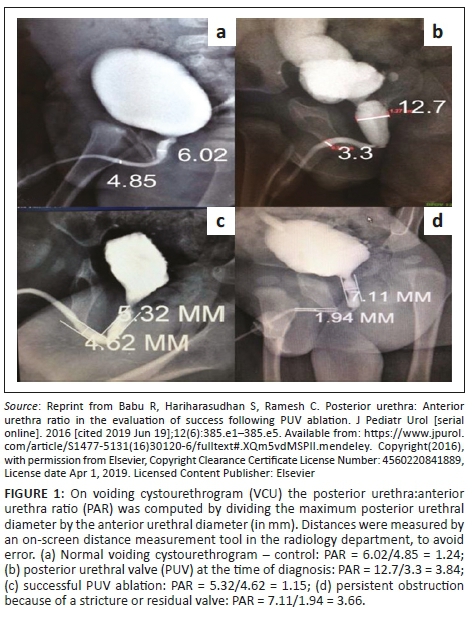
The role of the voiding cystourethrogram (VCUG) in the follow-up of male children with posterior urethral valve (PUV) ablation has been considered as standard practice in the treatment and follow-up algorithm. Since 2006, the use of the posterior:anterior urethral ratio (PUR) and gradient of change has proven to be beneficial.1,2,3,4 The urethral ratio is calculated on standard VCUG images, as shown in Figures 1a-d. In this systematic review, we aimed to determine the 'ideal' ratio and assess the role of this ratio in predicting residual PUV in the follow-up of post-ablation male children.
Methods
To illustrate and better define the role of calculating the urethral ratio as part of routine assessment during the reporting of the VCUG study, a systematic review of the PubMed, Web of Science and SCOPUS databases was performed in April 2019.
The search terms 'Urethral Ratio and Posterior urethral valve ablation' were utilised. The cited reference lists of studies were identified and deemed relevant and were further evaluated for additional inclusive studies assessing this parameter.
Ethical considerations
This article followed all ethical standards for a research without direct contact with human or animal subjects.
Results
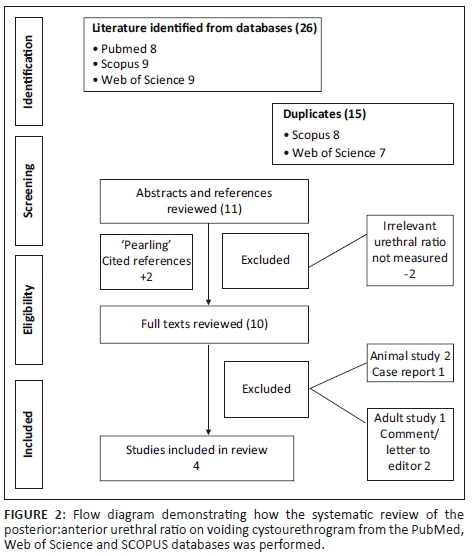
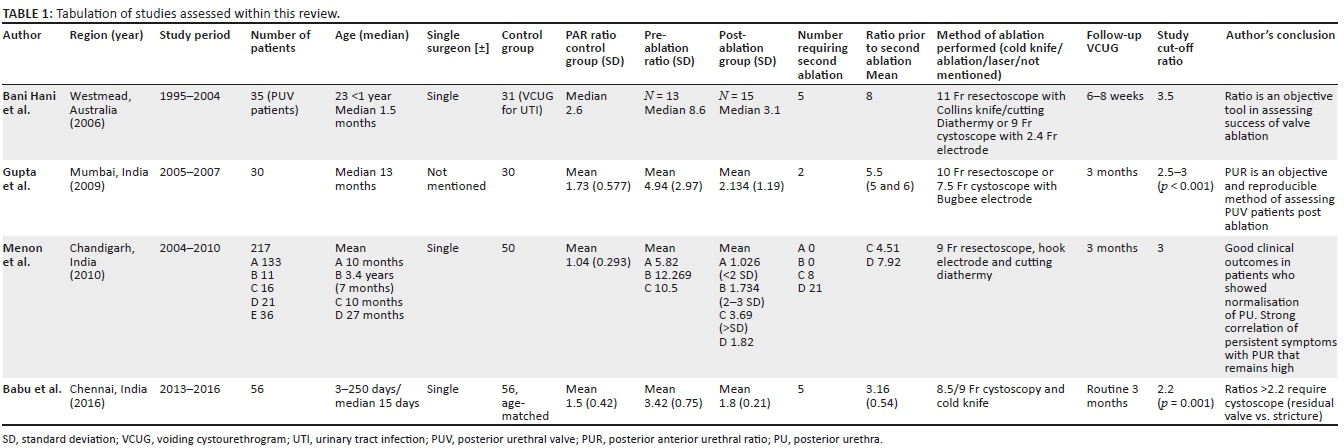
Eleven studies were identified using search terms 'Urethral Ratio and Posterior urethral valve ablation'. There were 10 full-text reviews, of which two were animal studies, one was a case report, one was an adult study and two were letters to the editor; these were excluded (Figure 2). The remaining four prospective studies in male children were evaluated in detail and the results are tabulated in Table 1.
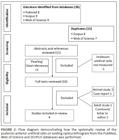
Study regions included Mumbai, Chandigarh and Chennai, India, as well as Westmead, Australia.1,2,3,41,2,3,42,3,41
The median age for male children with PUVs ranged from 15 days to 13 months.1,2,4 Menon et al.3
A single surgeon was used in three of the four studies to limit confounding factors.1,3,4 Based on the surgeons' preference and patient factors, the methods for ablation included the use of a resectoscope with cutting diathermy, cold knife or Bugbee electrode.1,2,3 Mean pre-operative ablation ratios ranged from 3.342 to 12.269. Post-ablation ratios ranged from a mean of 1.026-3.69.2,3,4 Other authors observed a median ratio of 8.6 preoperatively and 3.1 postoperatively.11,2,3,4 The urethral ratio prior to the second ablation ranged from a mean of 3.16 to 8.1,2,3,4 Menon et al. demonstrated that in 50% of patients in whom the postoperative urethral ratio was >3 SD of the control group, repeat ablation was required. Only 31.3% of patients in this group were asymptomatic. The cut-off ratios recommended include 2.2 (p = 0.001), 2.5-3, 3 and 3.5.1,2,3,4
Method of ratio calculation
All studies emphasise voiding films in oblique views. However, Bani Hani123441,2,3,4
Meta-analysis
A meta-analysis of the relevant data was precluded in this review study because the studies reviewed were performed by different surgeons, using different instruments, and were reported at different follow-up durations.
Discussion
The prevalence of congenital PUVs is 1 in 8000 in male children.5678
In South Africa, post-natal diagnosis is made within the first year of life in most cases.9988
The current suggested workup includes the following:
•Renal function test and blood gas analysis
•Urinalysis
•Kidney-bladder ultrasound
•Voiding cystourethrogram
•Renal dynamic scan in male children older than a month (catheter to be left in situ if there is hydronephrosis)
•Dimercaptosuccinic acid (DMSA) radionuclide scan to assess scarring in the presence of reflux. It is important that this scan is done 6 months after the last UTI.
Primary management involves first stabilising the child, managing sepsis, obtaining adequate hydration, correcting electrolytes and relieving obstruction.889
Children require close follow-up post-ablation. The aims of follow-up are to identify and manage voiding dysfunction early, monitor and optimise renal function, attain continence and minimise infections.88810,11
International guidelines should be modified or adjusted depending on the resources of the country. Routine post-operative cystoscopy on all patients is not feasible in a developing country. Selecting patients on the basis of clinical and radiological parameters for referral for repeat cystoscopy may be necessary.
In 10% - 30% of male children, there may be residual valves that require a second ablation. Twelve per cent of patients in this review required repeat ablation. Persistent symptoms of poor stream, nocturnal enuresis and persistent vesicoureteric reflux (VUR) may be indicators of residual valves.12121,233
Indications for VCUG include recurrent UTI post-ablation, worsening creatinine, assessment for the presence and grade of VUR, persistent or worsening hydro-ureteronephrosis (repeat done at 2, 5 and 10 years) or if further surgical management is being planned, that is, transplant, anti-reflux surgery or bladder augmentation.88
Bladder dysfunction persists in one-third of male patients and causes persistent hydronephrosis and VUR.8131314
Ratios in anatomy have been explored in various previous reports. The concept of the 'golden ratio' is well known and has been derived from the Fibonacci sequence, the numerical value being 1.618.151599166
Conclusion
The urethral ratio has proven beneficial in the international literature and should be incorporated into standard VCUG reporting templates in the follow-up investigations of PUV in male children. Radiologists reporting on post-PUV ablation VCUG studies are requested to measure and report these ratios. A urethral ratio less than a range of 2.2-3.5 has been shown to be a beneficial predictor of ablation success. Further prospective studies are required to better define an exact cut-off point, especially in resource limited settings.
Competing interests
The authors declare that they have no financial or personal relationships that may have inappropriately influenced them in writing this article.
Authors' contributions
All authors contributed equally to this work.
Funding information
This research received no specific grant from any funding agency in the public, commercial or not-for-profit sectors.
Data availability statement
Data sharing is not applicable to this article as no new data were created or analysed in this study.
Disclaimer
The views and opinions expressed in this article are those of the authors and do not necessarily reflect the official policy or position of any affiliated agency of the authors.
Acknowledgements
References
-
1.Bani Hani O, Prelog K, Smith GHH. A method to assess posterior urethral valve ablation. J Urol. 2006;176(1):303-305. https://doi.org/10.1016/s0022-5347(06)00562-3
» https://doi.org/10.1016/s0022-5347(06)00562-3 -
2.Gupta RK, Shah HS, Jadhav V, et al. Urethral ratio on voiding cystourethrogram: A comparative method to assess success of posterior urethral valve ablation. J Pediatr Urol. 2010;6(1):32-36. https://doi.org/10.1016/j.jpurol.2009.05.009
» https://doi.org/10.1016/j.jpurol.2009.05.009 -
3.Menon P, Rao KLN, Vijaymahantesh S, et al. Posterior urethral valves: Morphological normalization of posterior urethra after fulguration is a significant factor in prognosis. J Indian Assoc Pediatr Surg. 2010;15(3):80. https://doi.org/10.4103/0971-9261.71744
» https://doi.org/10.4103/0971-9261.71744 -
4.Babu R, Hariharasudhan S, Ramesh C. Posterior urethra: Anterior urethra ratio in the evaluation of success following PUV ablation. J Pediatr Urol [serial online]. 2016 [cited 2019 Jun 19];12(6):385.e1-385.e5. Available from: https://www.jpurol.com/article/S1477-5131(16)30120-6/fulltext#.XQm5vdMSPlI.mendeley.
» https://www.jpurol.com/article/S1477-5131(16)30120-6/fulltext#.XQm5vdMSPlI.mendeley -
5.Kumar S, Fisk NM. Distal urinary obstruction. Clin Perinatol. 2003;30(3):507-519. https://doi.org/10.1016/s0095-5108(03)00060-5
» https://doi.org/10.1016/s0095-5108(03)00060-5 -
6.Srivastava P. Long term follow up result of posterior urethral valve management. JOJ Urol Nephrol [serial online]. 2018 [cited 2019 Apr 01];5(1). Available from: https://juniperpublishers.com/jojun/JOJUN.MS.ID.555654.php.
» https://juniperpublishers.com/jojun/JOJUN.MS.ID.555654.php -
7.Gordon L. Urethral valves: An update. Radiology. 1986;6(5):753-791. https://doi.org/10.1148/radiographics.6.5.3317550
» https://doi.org/10.1148/radiographics.6.5.3317550 -
8.Sharma S, Joshi M, Gupta D, et al. Consensus on the management of posterior urethral valves from antenatal period to puberty. J Indian Assoc Pediatr Surg. 2018;24(1):4. https://doi.org/10.4103/jiaps.JIAPS_148_18
» https://doi.org/10.4103/jiaps.JIAPS_148_18 -
9.Petersen KL, Moore DP, Kala UK. Posterior urethral valves in South African boys: Outcomes and challenges. S Afr Med J. 2018;108(8):667. https://doi.org/10.7196/SAMJ.2018.v108i8.12934
» https://doi.org/10.7196/SAMJ.2018.v108i8.12934 -
10.Yadav R, Goel A, Smeulders N, et al. The predictive value of a repeat micturating cystourethrogram for remnant leaflets after primary endoscopic ablation of posterior urethral valves. J Pediatr Urol. 2011;7(2):203-208. https://doi.org/10.1016/j.jpurol.2011.04.004
» https://doi.org/10.1016/j.jpurol.2011.04.004 -
11.Oktar T, Salabas E, Acar O, et al. Residual valve and stricture after posterior urethral valve ablation: How to evaluate? J Pediatr Urol. 2013;9(2):184-187. https://doi.org/10.1016/j.jpurol.2012.01.016
» https://doi.org/10.1016/j.jpurol.2012.01.016 -
12.Shirazi M, Farsiani M, Natami M, Izadpanah K, Malekahmadi A, Khakbaz A. Which patients are at higher risk for residual valves after posterior urethral valve ablation? Korean J Urol. 2014;55(1):64-68. https://doi.org/10.4111/kju.2014.55.1.64
» https://doi.org/10.4111/kju.2014.55.1.64 -
13.Niyogi A, Lumpkins K, Robb A, McCarthy L. Cystometrogram appearance in PUV is reliably quantified by the shape, wall, reflux and diverticuli (SWRD) score, and presages the need for intervention. J Pediatr Urol. 2017;13(3):265.e1-265.e6. https://doi.org/10.1016/j.jpurol.2016.12.005
» https://doi.org/10.1016/j.jpurol.2016.12.005 -
14.Keihani S, Kajbafzadeh AM, Kameli SM, Abbasioun R. Long-term impacts of concurrent posterior urethral valve ablation and bladder neck incision on urinary continence and ejaculation. Urology. 2017;99:278-280. https://doi.org/10.1016/j.urology.2016.09.036
» https://doi.org/10.1016/j.urology.2016.09.036 -
15.Yalta K, Ozturk S, Yetkin E. Golden ratio and the heart: A review of divine aesthetics. Int J Cardiol. 2016;214:107-112. https://doi.org/10.1016/j.ijcard.2016.03.166
» https://doi.org/10.1016/j.ijcard.2016.03.166 -
16.Uthup S, Binitha R, Geetha S, Hema R, Kailas L. A follow-up study of children with posterior urethral valve. Indian J Nephrol. 2010;20(2):72. https://doi.org/10.4103/0971-4065.65298
» https://doi.org/10.4103/0971-4065.65298

Accepted: 18 Feb. 2020
Published: 09 June 2020