Disseminated Kaposi sarcoma presenting in unusual locations: A case report
Abstract
Kaposi sarcoma (KS) is the most common malignancy associated with HIV infection. It usually affects the skin, the gastrointestinal tract and the lungs. It is generally described in the setting of CD4 counts < 150 cells/mm3 - 200 cells/mm3. We describe a case of recurrence of KS with a rare presentation of breast and musculoskeletal involvement in the setting of a CD4 count of 374 cell/mm3 and an undetectable viral load. The patient was on highly active antiretroviral therapy for 5 years at the time of the second presentation.
Introduction
Kaposi sarcoma (KS) is a vascular lesion of low-grade malignant potential associated with human herpes virus 8 (HHV-8).121
There have also been reports of KS in unusual locations; breast, gonads, adrenal glands, thyroid glands, bones and skeletal muscles.1
Case report
A 42-year-old HIV-positive woman with a CD4 count of 374 cell/mm3
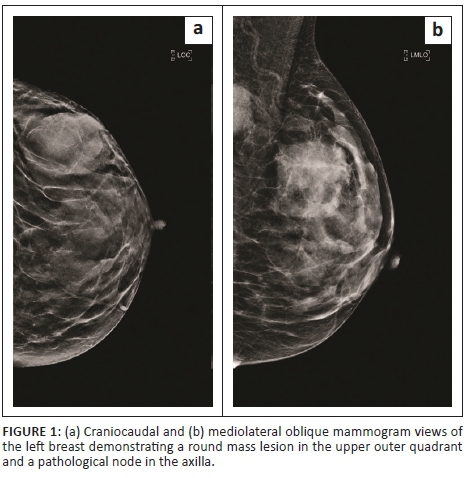
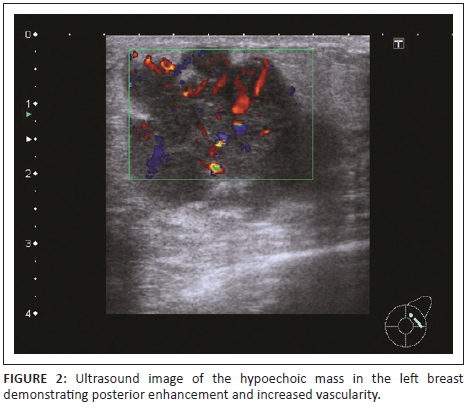
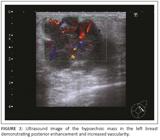
Mammography revealed a large round mass in the superolateral quadrant of the left breast (Figure 1). It had obscured margins, and no calcifications were noted within the mass. Ultrasound showed a heterogeneous mass with increased vascularity and discrete margins measuring 36 mm × 24 mm (Figure 2). There were pathological intramammary and axillary lymph nodes present. An ultrasound-guided core biopsy of the breast mass was performed using a 14-gauge needle. The lower back mass was also biopsied.
Immunohistological findings of the masses were consistent with KS. HHV stain was strongly and diffusely positive.
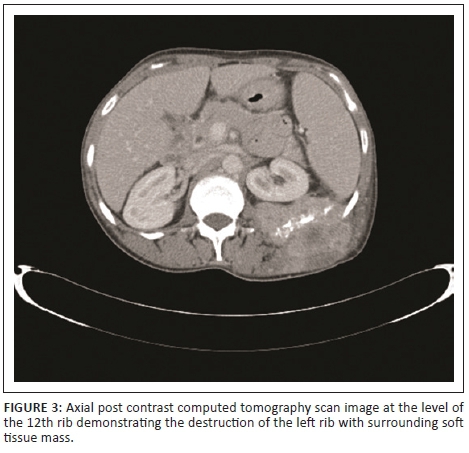
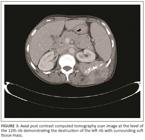
The patient then had a computed tomography (CT) scan from the base of the skull to the symphysis pubis, which showed a heterogeneously enhancing left breast mass, a left lower back mass infiltrating the iliocostalis and quadratus lumborum muscles with encasement and destruction of the 11th and 12th ribs (Figure 3) as well as a lytic lesion in the 11th thoracic vertebra. Further lesions were noted in the liver and spleen with widespread lymphadenopathy.
Discussion
In 2015, the World Health Organization (WHO) reported that 36.7 million people were living with HIV.334
The risk for KS in acquired immunodeficiency syndrome (AIDS) patients is estimated to be 20 000 times greater than the general population and 300 times greater than in other immunocompromised populations.5
Kaposi sarcoma is a low-grade vascular tumour that typically manifests as one of the four variants: classic KS, endemic KS (Africa), iatrogenic KS (organ transplant-related) and AIDS-related KS.251,53325
Frequently KS manifests in mucocutaneous sites, typically the skin of the lower extremities, face, trunk, genitalia and oropharyngeal mucosa.115
In cases of localised disease, treatment with HAART alone could result in improvement or resolution of disease. This is thought to be directly attributable to the suppression of HIV replication and a decrease in viral load with an increase in CD4 lymphocyte count.66
An immune reconstitution inflammatory syndrome (IRIS) has also rarely been reported in patients who are HAART naïve at the time of KS diagnosis. This may vary in severity, and fatal cases have been reported.6,7
Kaposi sarcoma of the breast is rare. In our literature search, we found three reported cases of KS in the breast, two with disseminated disease5,8513,53
Conclusion
The HIV pandemic has resulted in an increased incidence of KS occurring in common sites described above. Our patient presented with multiple rare findings that included involvement of the breast and musculoskeletal system in the setting of good immunity. There are minimal reports in the literature of such cases.
Competing interests
The authors declare that they have no financial or personal relationships that may have inappropriately influenced them in writing this article.
Authors' contributions
A.M. wrote the initial article. N.Z.M. prepared the images and legends and was involved in final editing. F.E.S. edited and formatted the article.
Acknowledgements
References
-
1. Pantanowitz L, Dezube B. Kaposi sarcoma in unusual locations. BMC Cancer. 2008;8:190. https://doi.org/10.1186/1471-2407-8-190
» https://doi.org/10.1186/1471-2407-8-190 -
2. Restrepo C, Marinez S, Lemos J, et al. Imaging manifestation of Kaposi Sarcoma. Radiographics. 2006;26:1185-1185. https://doi.org/10.1148/rg.264055129
» https://doi.org/10.1148/rg.264055129 -
3. Global Health Observatory. HIV/AIDS. 2015 [cited 2017 Jul 18]. Available from: http://www.who.int/gho/hiv/en
» http://www.who.int/gho/hiv/en -
4. Statistics South Africa. Mid year population estimates 2016. 2016 [cited 2017 Jul 18]. Available from: http://www.statssa.gov.za/Publications/P0302/P03022016.pdf
» http://www.statssa.gov.za/Publications/P0302/P03022016.pdf -
5. Hamed K, Muller K, Nawab R. Kaposi's sarcoma of the breast. AIDS Patient Care STDs. 2000;14(2):85-88. https://doi.org/10.1089/108729100318019
» https://doi.org/10.1089/108729100318019 -
6. Odongo FCA. Fatal disseminated Kaposi's Sarcoma due to immune reconstitution inflammatory syndrome following HAART initiation. Case Rep Infect Dis. 2013;2013:Article ID 546578, 1-3. https://doi.org/10.1155/2013/546578
» https://doi.org/10.1155/2013/546578 -
7. Stover KR, Molitorisz S, Swiatlo E, Muzny CA. A fatal case of Kaposi sarcoma due to immune reconstitution inflammatory syndrome. Am J Med Sci. 2012;343(5):421-425. https://doi.org/10.1097/MAJ.0b013e31823eff35
» https://doi.org/10.1097/MAJ.0b013e31823eff35 - 8. Ng CS, Taylor B, O'Donnell PJ, Pozniak AL, Michell MJ. Case Report: Mammographic and Ultrasound appearances of Kaposi's sarcoma of the breast. Clinical Radiology (1996) 51, 735-736.

Accepted: 28 Aug. 2017
Published: 14 Nov. 2017