A review of teleradiology in Africa - Towards mobile teleradiology in Nigeria
Abstract
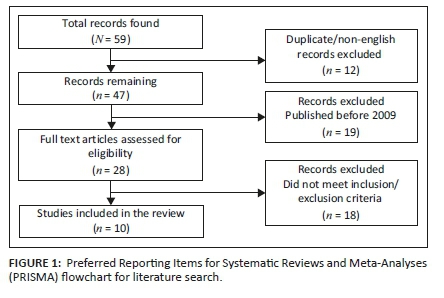
eHealth is promoted as a means to strengthen health systems and facilitate universal health coverage. Sub-components (e.g. telehealth, telemedicine, mhealth) are seen as mitigators of healthcare provider shortages and poor rural and remote access. Teleradiology (including mobile teleradiology), widespread in developed nations, is uncommon in developing nations. Decision- and policy-makers require evidence to inform their decisions regarding implementation of mobile teleradiology in Nigeria and other sub-Saharan countries. To gather evidence, Scopus and PubMed were searched using defined search strings (September 2020). Duplicates were removed, and titles and abstracts reviewed using specified selection criteria. Full-text papers of selected resources were retrieved and reviewed against the criteria. Insight from included studies was charted for eight a priori categories of information: needs assessment, implementation, connectivity, evaluation, costing, image display, image capture and concordance. Fifty-seven articles were identified, duplicates removed and titles and abstracts of remaining articles reviewed against study criteria. Twenty-six papers remained. After review of full-texts, ten met the study criteria. These were summarised, and key insights for the eight categories were charted. Few papers have been published on teleradiology in sub-Saharan Africa. Teleradiology, including mobile teleradiology, is feasible in sub-Saharan Africa for routine X-ray support of patients and healthcare providers in rural and remote locations. Former technical issues (image quality, transmission speed, image compression) have been largely obviated through the high-speed, high-resolution digital imaging and network transmission capabilities of contemporary smartphones and mobile networks, where accessible. Comprehensive studies within the region are needed to guide the widespread introduction of mobile teleradiology.
teleradiology; mobile teleradiology; cellphone; Nigeria; developing country
Introduction
eHealth, the cost-effective and secure use of information and communication technologies (ICTs) for health and health-related fields,12
The term eHealth, more recently Digital Health, is an umbrella term that covers a variety of activities such as:
e-commerce (the business side), e-learning (the training - awareness, teaching, instruction, and education - side), health informatics (the data gathering, storage, analysis, and distribution side), and telehealth including telemedicine (the interactive - real-time or store-and-forward - side).3
More recent applications such as mHealth, the use of mobile devices such as cell phones, can incorporate elements of each.2
One such use is teleradiology. The benefits of teleradiology include earlier diagnosis, leading to quicker treatment and better patient care, and ultimately less burden on the healthcare system, plus less travel and reduced expense for the mainly poverty stricken, rural population and especially for the chronically ill.44
With the advent of the Internet, www, smartphones and cellular networks, teleradiology and mobile teleradiology have emerged. Teleradiology is the electronic capture (using digital detectors or digital photography of X-ray films), transmission (from one location to another), storage (often within erecords) and retrieval and display (on monitors) of radiological patient images. Mobile teleradiology is effectively teleradiology facilitated through the use of mobile devices, primarily smartphones, although related approaches using instant messaging (e.g. WhatsApp) are becoming popular.564
Nigeria, located in West Africa, is the most populous country in Africa and seventh in the world with a population of 206.1 million in 2020 spread across 923 768 km2782,992,999,10
This pre-existing situation is now compounded by the impact of coronavirus disease 2019 (COVID-19), with Nigeria being one of the first nine African countries reporting cases by the first week of March 2020.1112,13,14
Amidst this disarray, practical solutions to address known health needs are required. In Nigeria, because of the scarcity of radiologists, many imaging investigations are performed and interpreted by hospital medical officers or perhaps radiographers.15
Teleradiology would avoid patient travel, reduce out of pocket travel expenses, provide more rapid diagnosis and improve diagnostic accuracy and reliability. This may also reduce patient transfer, re-hospitalisation and length of in-hospital stay.
Although teleradiology has been used in the developing world, it remains relatively rare in Nigeria.2,9
Methods
For this scoping review, a series of focused searches of Scopus and PubMed were performed in September 2020 (M.Y.T. and M.M.). The PubMed search string was ('radiology' [MeSH] AND 'telemedicine' [MeSH]) OR teleradiology [All Fields]) OR 'mobile teleradiology' OR 'mobile tele-radiology' OR ('radiology' [MeSH] AND [mhealth OR m-health OR 'mobile health']) AND 'Africa' [MeSH], and in Scopus, the following search string was used (TITLE-ABS-KEY [radiology AND telemedicine] OR teleradiology OR 'mobile teleradiology' OR 'mobile tele-radiology') OR TITLE-ABS-KEY (radiology AND [mhealth OR m-health OR 'mobile health']) AND TITLE-ABS-KEY [Africa]).
Duplicates were removed. All authors then reviewed titles and abstracts applying the following inclusion criteria: English language, resource addressed use of teleradiology in Africa. Papers were excluded if they were published before 2009 (to ensure currency in this rapidly evolving area) or primarily addressed more sophisticated imaging approaches: picture archiving and communication system (PACS), CT, MRI, US or Nuclear Medicine (NM). Any disagreements were resolved by consensus.
Full papers of remaining resources were retrieved, and each paper again reviewed applying the inclusion and exclusion criteria, with disagreements resolved by consensus. Data from the final selected resources were charted into an Excel spreadsheet (Microsoft® Excel®; Redmond, Washington, United States) by two authors (M.Y.T. and R.E.S.) and cross-checked. Charted data included citation details (authors, title, year), country or region and insight provided regarding eight a priori categories: needs assessment, implementation, connectivity, evaluation, costing, image display, image capture and concordance.
Ethical considerations
Approval was provided by the Humanities and Social Sciences Research Ethics Committee, University of KwaZulu-Natal; Protocol Reference Number - HSS/0508/017D.
Results
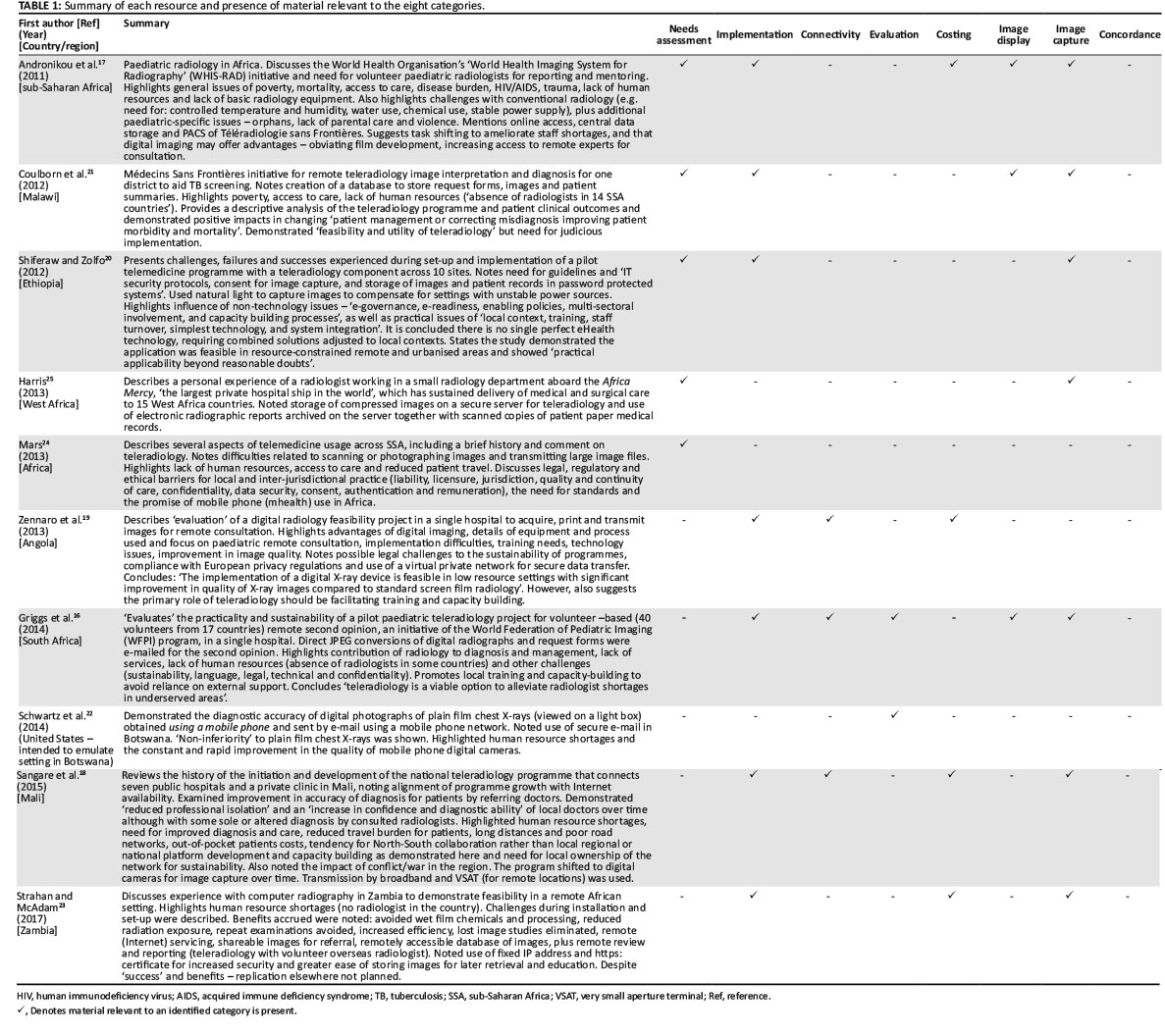
A total of 59 articles were generated from the searches (Figure 1). Ten met the inclusion criteria for the study after a full-text review.16,17,18,19,20,21,22,23,24,2516,242519202118172322Table 1); the results for each category are presented below.
After a preliminary review of the papers, major findings under the eight categories were charted independently by two authors (M.Y.T. and R.E.S.). The findings were jointly reviewed and finalised by consensus and are reported below.
Needs assessment
Needs assessment has been described as a systematic process for determining the gap between the current condition and the desired condition (called a need) and how to address the need and close the gap.2617
Implementation
Implementation was described as the process of putting a decision or plan into effect, describing the step-by-step stages of execution for the plan. No paper provided such a structured description for a project or intervention programme. Simplistic descriptions of some aspects of an intervention for implementations were noted. Thus, the provision of required infrastructure (Internet access and a digital camera) was described to initiate a low-cost telemedicine service linking doctors at hospitals in the developing world with volunteer consultants in the developed world.17
Three papers described clearer examples of implementation18,19,20181920
Connectivity
Papers were examined to determine whether a description was provided of the mode of connection between the source of the image and a reporting station. Six papers addressed connectivity,16,17,18,19,20,21 with e-mail as the predominant mode using transmission through broadband, cellular networks, VSAT, asymmetric digital subscriber line (ADSL) or dial-up Internet access, either transmitted directly, to a website, or using a virtual private network (VPN).
One described the use of a slow Internet connection and downloading of images in compressed format and e-mail to send them for reporting as an attachment.172116182019
Evaluation
Evaluation was considered to be a formal process by which a body of information was systematically gathered and used to make a judgement about the overall value of a teleradiology intervention. Although several papers spoke of 'evaluation', none provided a detailed and structured description for a project or programme evaluation.
An 'evaluation' for a teleradiology programme training course noted that those actually taking the X-rays but who were not trained radiographers, gained little from the course as they lacked the necessary background knowledge.1716
A review of the national teleradiology programme in Mali found that it improved the diagnosis of patients and improved the referring doctor's ability to give an accurate diagnosis.1818
Although not a formal evaluation, one study assessed the diagnostic accuracy of digital photographs of plain film chest X-rays (CXRs) obtained using a mobile phone and demonstrated non-inferiority with plain film CXRs. The authors noted this finding had important implications for resource-constrained countries with limited access to radiologists.222019
Costing
Costing was described as evidence of a structured process being undertaken to determine the expense incurred in establishing a teleradiology program. Five papers addressed some aspects of cost,16,18,19,20,23
Simple low-cost solutions have been successfully employed although in 2011 and 2015 the capital cost of technology remained a major barrier.17,1818
The opportunity cost of telecom services was noted in an Ethiopian study (competing with basic priorities such as food, clothing and school fees) that made Internet and mobile phones unaffordable although increasing penetration rates of mobile technology in SSA may ease this.202319
Image display
Papers were examined to determine whether they described the means by which visual presentation of images was achieved. Four papers provided some insights. Importantly, one report noted that 'several studies' have shown JPEG images obtained by digital photography of film radiographs, using limited image compression, were sufficient for diagnosis in most instances.21202219
Image capture
For capture, papers were required to describe the means by which images were captured for transfer to or from a device connected to the computer or the network. Eight papers described elements related to this, with noted approaches including the use of digital cameras, document scanners, specialised digitisers or computerised radiography systems that directly produced digital images.17,18,19,20,21,22,24,25 Use of digital cameras was common,16,18,21,22,24 but only one paper specifically identified the use of a phone-based digital camera.22
Concordance
For concordance, papers were expected to describe formal and focused assessments of the degree of clinical agreement obtained when using teleradiology or mobile teleradiology versus traditional radiology. None of the papers provided any description of formal 'concordance studies' although equivalence or diagnostic accuracy was assessed. One study addressed mobile teleradiology and demonstrated non-inferiority of mobile phone digital photographs of CXRs compared to plain film CXRs for some pathologies.22
Discussion
This study has identified that there are currently few published papers reporting national teleradiology networks within SSA despite the repeatedly stated need to establish these services and overcome the sub-continent's lack of health human resources (including radiologists).1,20,211816
Surprisingly, only one paper specifically identified the use of a phone-based digital camera, as used for mobile teleradiology.22
Limitations to the study exist. Only two databases were searched: a subject database (PubMed; biomedical literature) and a citation database (Scopus; life sciences, social sciences, physical sciences and health sciences). A further limitation was the a priori selection of the eight categories for charting. Additional issues relevant to mobile-teleradiology arose but were not charted. For example, the following were not charted: legal, regulatory and ethical issues; the quality and quantity of information provided at consultation; data security during transmission; data storage and record keeping and patient identification. Such issues must be considered when establishing any clinical programme. Moreover, more teleradiology focussed issues, such as camera and screen resolution, file format and the use of RIS and PACS, were not charted in depth. Although some of the above issues were noted in a few papers (Table 1), they were not addressed or debated in detail in these literature sources, except by Mars.24
All of the selected papers justified 'need' on the basis of the shortage or absence of radiologists in each setting.16,17,20,2127209,17,20,2128,2920,28,29,30,31
Despite the above, the papers did show that various teleradiology solutions, including mobile teleradiology, are feasible and satisfactory for most routine X-ray needs. Conventional X-ray radiography (with attendant shortcomings: controlled temperature and humidity, water use, chemical use, incomplete drying and films sticking together172218,272019163233,34
Available literature from outside SSA indicates diagnostic imaging reduces mortality and improves the quality of life, is necessary for global health and teleradiology improves specialist access and reduces travel time and cost for patients.35,36,37,38
• A small number of well-designed and comprehensive studies be performed in SSA to confirm the utility and cost of mobile teleradiology versus conventional radiology and provide clear evidence-based guidelines for implementing mobile teleradiology programmes.
• These studies are published in open-access journals to ensure free availability to the developing world, in particular SSA.
• Given that any e-health solution is an opportunity cost and (when competing with vaccination, safe water supply and other primary healthcare priorities) must fill a justified and compelling need, any rural or remote healthcare facility where mobile teleradiology is considered must perform a local needs assessment to confirm projected viability.
• Where viability is determined, mobile teleradiology should be phased in with appropriate training and support.
Conclusion
Teleradiology, the transmission of radiological patient images (X-rays, CTs, MRIs) from one location to another in order to share these studies with other clinicians for consultation or interpretation, is considered one of the oldest, most established, successful and widely used clinical telemedicine specialties. This study confirms that improvements in device and information technology have enabled advances in teleradiology and also opened the field of mobile teleradiology. With contemporary smartphones and mobile networks, technical issues such as image quality, transmission speed and image compression are no longer major barriers although issues such as adequate and reliable local connectivity and electricity remain.
It has also shown that teleradiology, including the use of mobile teleradiology, is simple, feasible and appropriate for routine X-ray support of patients and healthcare providers in rural and remote locations, but woefully underused in SSA, although regional evidence to adequately demonstrate this is limited. Nonetheless, teleradiology has proven benefits for healthcare delivery (e.g. improved referring doctor's diagnostic accuracy) and patient care (e.g. reduced travel and associated expense) and offers a solution to settings where there are few or no radiologists. The almost routine application of teleradiology and mobile teleradiology for routine imaging tasks elsewhere reflects the changing world of clinical practice, service delivery and technology.
The limited mobile teleradiology in SSA, as evidenced in the literature, hampers patient access to basic essential radiological services. There is an urgent need for rigorous published research that will produce high quality and evidence-based guidance for the establishment of mobile teleradiology programmes in SSA. This would both align with the World Health Organization's (WHOs) support of mhealth, the achievement of universal health coverage (UHC) and the United Nation's sustainable development goals (SDGs),3940
Competing interests
The authors declare they have no financial or personal relationships that may have inappropriately influenced the writing of this paper.
Authors' contributions
M.Y.T., M.M. and R.E.S. conceived of the need for the study. M.Y.T. and M.M. contributed to the literature search, all authors to resource selection, and M.Y.T. and R.E.S. to the literature charting. M.Y.T. drafted the first article, and all authors critically reviewed further revisions. All authors approved the final article.
Funding information
Research reported in this publication was supported by the Fogarty International Center of the National Institutes of Health under Award Number D43TW007004-13.
Data availability
Data sharing is not applicable; all data are in the public domain - no new data were created or analysed.
Disclaimer
The views expressed in this manuscript are solely those of the authors and not an official position of their institutions or the Fogarty International Center of the National Institutes of Health or any other affiliated agency of the authors.
Acknowledgements
References
-
1.Regional Committee for Africa, 60. Ehealth solutions in the African Region current context and perspectives [homepage on the Internet]. Regional Committee for Africa Sixtieth Session Malabo, Equatorial Guinea, 30 August-3 September 2010: Provisional agenda item 7.3. [cited 2021 Jun 28]. Available from: https://apps.who.int/iris/handle/10665/1685
» https://apps.who.int/iris/handle/10665/1685 -
2.Soroosh G, Ninalowo H, Hutchens A, Khan S. Nigeria country report for use in radiology outreach initiatives[homepage on the Internet]. Rad-Aid.org; 2015 [cited 2021 Jun 28]. Available from: https://www.rad-aid.org/wp-content/uploads/Nigeria-Country-Report-Final.pdf
» https://www.rad-aid.org/wp-content/uploads/Nigeria-Country-Report-Final.pdf -
3.Scott RE, Mars M. Telehealth in the developing world: Current status and future prospects. Smart Homecare Technol TeleHealth. 2015;3:25-37. https://doi.org/10.2147/SHTT.S75184
» https://doi.org/10.2147/SHTT.S75184 -
4.Bashshur RL, Krupinski EA, Thrall JH, Bashshur N. The empirical foundations of teleradiology and related applications: A review of the evidence. Telemed J E Health. 2016 Nov 1;22(11):868-898. https://doi.org/10.1089/tmj.2016.0149
» https://doi.org/10.1089/tmj.2016.0149 -
5.Giansanti D. WhatsApp in mHealth: An overview on the potentialities and the opportunities in medical imaging. Mhealth. 2020;6:19. https://doi.org/10.21037/mhealth.2019.11.01
» https://doi.org/10.21037/mhealth.2019.11.01 -
6.Rosenkrantz AB, Hanna TN, Steenburg SD, Tarrant MJ, Pyatt RS, Friedberg EB. The current state of teleradiology across the United States: A national survey of radiologists' habits, attitudes, and perceptions on teleradiology practice. J Am Coll Radiol. 2019 Dec 1;16(12):1677-1687. https://doi.org/10.1016/j.jacr.2019.05.053
» https://doi.org/10.1016/j.jacr.2019.05.053 -
7.The World Bank. Nigeria - Population, total [homepage on the Internet]. 2021 [cited 2021 Jun 29]. Available from: https://data.worldbank.org/country/nigeria?view=chart
» https://data.worldbank.org/country/nigeria?view=chart -
8.The World Bank. Rural population (% of total population) - Nigeria [homepage on the Internet] 2021 [cited 2021 Jun 29]. Available from: https://data.worldbank.org/indicator/SP.RUR.TOTL.ZS?locations=NG
» https://data.worldbank.org/indicator/SP.RUR.TOTL.ZS?locations=NG -
9.Idowu BM, Okedere TA. Diagnostic radiology in Nigeria: A country report. J Glob Radiol. 2020;6(1):1072. https://doi.org/10.7191/jgr.2020.1072
» https://doi.org/10.7191/jgr.2020.1072 -
10.PharmAccess Foundation. Nigerian health sector market study report [homepage on the Internet]. Study commissioned by the Embassy of the Kingdom of the Netherlands in Nigeria. March 2015 [cited 2021 Jun 28]. Available from: https://www.rvo.nl/sites/default/files/Market_Study_Health_Nigeria.pdf
» https://www.rvo.nl/sites/default/files/Market_Study_Health_Nigeria.pdf -
11.Loembé MM, Tshangela A, Salyer SJ, Varma JK, Ouma AE, Nkengasong JN. COVID-19 in Africa: The spread and response. Nat Med. 2020 Jul;26(7):999-1003. https://doi.org/10.1038/s41591-020-0961-x
» https://doi.org/10.1038/s41591-020-0961-x -
12.Ajibo H. Effect of Covid-19 on Nigerian socio-economic well-being, health sector pandemic preparedness and the role of nigerian social workers in the war against Covid-19. Soc Work Public Health. 2020 Sep 1;35(7):511-522. https://doi.org/10.1080/19371918.2020.1806168
» https://doi.org/10.1080/19371918.2020.1806168 - 13.Scott RE, Mars M. Behaviour change and e-health - Looking broadly: A scoping narrative review. Stud Health Technol Inform. 2020 Mar 2;268:123-138.
-
14.Awucha NE, Janefrances OC, Meshach AC, Henrietta JC, Daniel AI, Chidiebere NE. Impact of the COVID-19 pandemic on consumers' access to essential medicines in Nigeria. Am J Trop Med Hyg. 2020 Oct 7;103(4):1630-1634. https://doi.org/10.4269/ajtmh.20-0838
» https://doi.org/10.4269/ajtmh.20-0838 -
15.Ekpo EU, Egbe NO, Akpan BE. Radiographers' performance in chest X-ray interpretation: The Nigerian experience. Br J Radiol. 2015 Jul;88(1051):20150023. https://doi.org/10.1259/bjr.20150023
» https://doi.org/10.1259/bjr.20150023 -
16.Griggs R, Andronikou S, Nell R, O'Connell N, Dehaye A, Boechat MI. World Federation of Pediatric Imaging (WFPI) volunteer outreach through tele-reading: The pilot project in South Africa. Pediatr Radiol. 2014 Jun;44(6):648-654. https://doi.org/10.1007/s00247-014-2948-6
» https://doi.org/10.1007/s00247-014-2948-6 -
17.Andronikou S, McHugh K, Abdurahman N, et al. Paediatric radiology seen from Africa. Part I: Providing diagnostic imaging to a young population. Pediatr Radiol. 2011 Jul;41(7):811-825. https://doi.org/10.1007/s00247-011-2081-8
» https://doi.org/10.1007/s00247-011-2081-8 -
18.Sangaré M, Tanner L, Voss S, Laureys F, Hollow D, Touré M. A national teleradiology programme in Mali: Implementation and results. J Telemed Telecare. 2015 Apr;21(3):131-138. https://doi.org/10.1177/1357633X15569966
» https://doi.org/10.1177/1357633X15569966 -
19.Zennaro F, Gomes JA, Casalino A, et al. Digital radiology to improve the quality of care in countries with limited resources: A feasibility study from Angola. PloS One. 2013 Sep 25;8(9):e73939. https://doi.org/10.1371/journal.pone.0073939
» https://doi.org/10.1371/journal.pone.0073939 -
20.Shiferaw F, Zolfo M. The role of information communication technology (ICT) towards universal health coverage: The first steps of a telemedicine project in Ethiopia. Glob Health Action. 2012 Dec 1;5(1):15638. https://doi.org/10.3402/gha.v5i0.15638
» https://doi.org/10.3402/gha.v5i0.15638 -
21.Coulborn RM, Panunzi I, Spijker S, et al. Feasibility of using teleradiology to improve tuberculosis screening and case management in a district hospital in Malawi. Bull World Health Organ. 2012;90:705-711. https://doi.org/10.2471/BLT.11.099473
» https://doi.org/10.2471/BLT.11.099473 - 22.Schwartz AB, Siddiqui G, Barbieri JS, et al. The accuracy of mobile teleradiology in the evaluation of chest X-rays. J Telemed Telecare. 2014 Dec;20(8):460-463.
- 23.Strahan R, McAdam D. Experience with computer radiography and radiology in rural Zambia. Trop Doct. 2017 Oct;47(4):377-380.
- 24.Mars M. Telemedicine and advances in urban and rural healthcare delivery in Africa. Prog Cardiovasc Dis. 2013 Nov 1;56(3):326-335.
-
25.Harris RD. Radiology on the Africa Mercy, the largest private floating hospital ship in the world. Am J Roentgenol. 2013 Feb;200(2):W124-W129. https://doi.org/10.2214/AJR.12.9087
» https://doi.org/10.2214/AJR.12.9087 - 26.Altschuld JW, Kumar DD. Needs Assessment: An overview. Thousand Oaks, CA: Sage; 2010.
-
27.AlDossary S, Martin-Khan MG, Bradford NK, Armfield NR, Smith AC. The development of a telemedicine planning framework based on needs assessment. J Med Syst. 2017 May 1;41(5):74. https://doi.org/10.1007/s10916-017-0709-4
» https://doi.org/10.1007/s10916-017-0709-4 - 28.Adair-Rohani H, Zukor K, Bonjour S, et al. Limited electricity access in health facilities of sub-Saharan Africa: A systematic review of data on electricity access, sources, and reliability. Glob Health Sci Pract. 2013 Aug 1;1(2):249-261.
-
29.Suhlrie L, Bartram J, Burns J, Joca L, Tomaro J, Rehfuess E. The role of energy in health facilities: A conceptual framework and complementary data assessment in Malawi. PLoS One. 2018 Jul 20;13(7):e0200261. https://doi.org/10.1371/journal.pone.0200261
» https://doi.org/10.1371/journal.pone.0200261 -
30.Cariolle J. International connectivity and the digital divide in Sub-Saharan Africa. Inf Econ Policy. 2020 Dec 1;55:100901. https://doi.org/10.1016/j.infoecopol.2020.100901
» https://doi.org/10.1016/j.infoecopol.2020.100901 -
31.Kabbiri R, Dora M, Kumar V, Elepu G, Gellynck X. Mobile phone adoption in agri-food sector: Are farmers in Sub-Saharan Africa connected? Technol Forecast Soc Change. 2018 Jun 1;131:253-261. https://doi.org/10.1016/j.techfore.2017.12.010
» https://doi.org/10.1016/j.techfore.2017.12.010 -
32.Rehani B, Brown I, Dandekar S, et al. Radiology education in Africa: Analysis of results from 13 African countries. J Am Coll Radiol. 2017 Feb;14(2):247-252. https://doi.org/10.1016/j.jacr.2016.08.012
» https://doi.org/10.1016/j.jacr.2016.08.012 -
33.Nicholas JL. Technology-mediated education in global radiology: Opportunities and challenges. Curr Radiol Rep. 2019 May;7(5):1-6. https://doi.org/10.1007/s40134-019-0323-y
» https://doi.org/10.1007/s40134-019-0323-y -
34.Janse van Rensburg L. Continuing medical education in radiology in South Africa. S Afr J Radiol. 2010 Sep 1;14(3):50-78. https://doi.org/10.4102/sajr.v14i3.469
» https://doi.org/10.4102/sajr.v14i3.469 - 35.Jiménez P, Medlen KP, Fleitas-Estévez I. Diagnostic imaging for global health: Implementation and optimization of Radiology in the developing world. In: Mollura DJ, Lungren MP, editors. Radiology in Global Health. New York, NY: Springer, 2014; p. 127-137.
-
36.Otero HJ, Andronikou S, Grassi DC, Silva CT. Providing expert pediatric teleradiology services around the globe: The World Federation of Pediatric Imaging Experience. J Am Coll Radiol. 2020 Jan 1;17(1):53-55. https://doi.org/10.1016/j.jacr.2019.06.006
» https://doi.org/10.1016/j.jacr.2019.06.006 - 37.Latifi R. Initiate-Build-Operate-Transfer (IBOT) strategy twenty years later: Tales from the Balkans and Africa. Latifi R, Merrell RC, Doarn CR, editors. In: Telemedicine, Telehealth and Telepresence. Cham: Springer, 2021; p. 19-42.
-
38.Latifi R, Parsikia A, Boci A, Doarn CR, Merrell RC. Increased access to care through telemedicine in Albania: An analysis of 2,724 patients. Telemed J E Health. 2020 Feb 1;26(2):164-175. https://doi.org/10.1089/tmj.2018.0338
» https://doi.org/10.1089/tmj.2018.0338 - 39.World Health Organization. WHO guideline: Recommendations on digital interventions for health system strengthening. Geneva: World Health Organization; 2019.
-
40.Ibeneme S, Ukor N, Ongom M, Dasa T, Muneene D, Okeibunor J. Strengthening capacities among digital health leaders for the development and implementation of national digital health programs in Nigeria. BMC Proc. 2020 Jul;14(10):1-12. https://doi.org/10.1186/s12919-020-00193-1
» https://doi.org/10.1186/s12919-020-00193-1

Accepted: 18 Oct. 2021
Published: 11 Jan. 2022