Vigorous achalasia: Zebra amongst horses
Abstract
Vigorous achalasia is an oesophageal disorder with clinical and radiological characteristics of classic achalasia and diffuse oesophageal spasm. It is a rarely reported variant. A 60-year-old gentleman presented with complaints of difficulty in swallowing, regurgitation and chest pain for the past 10 years. His symptoms persisted despite the use of proton pump inhibitors. On endoscopy and barium swallow, the diagnosis of vigorous achalasia was confirmed. It is a rare variant of classic achalasia usually misdiagnosed as diffuse oesophageal spasm.
vigorous achalasia; diffuse oesophageal spasm; classic achalasia; barium swallow; proton pump inhibitors
Introduction
Classic achalasia and diffuse oesophageal spasm (DES) both have different clinical, radiological and manometric features.12342
In 1957, Olsen et al. first described the term vigorous achalasia in a group of individuals with classic achalasia whose clinical features and manometric features demonstrated common features of both classic achalasia and DES.533
Case description
A 60-year-old male with no known comorbidities, presented with a 10-year history of difficulty in swallowing (liquids more than solids) and chest pain, which persisted despite the use of proton pump inhibitors. His physical examination and laboratory parameters were unremarkable. A barium swallow study was recommended, followed by upper gastro-intestinal (UGI) endoscopy.
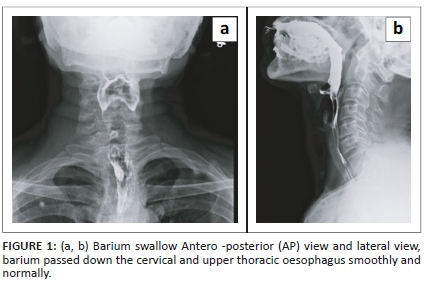
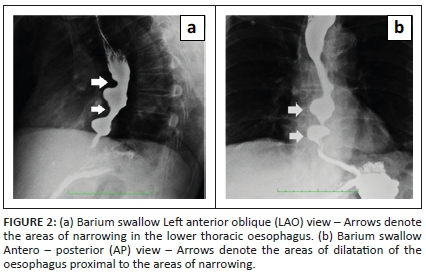
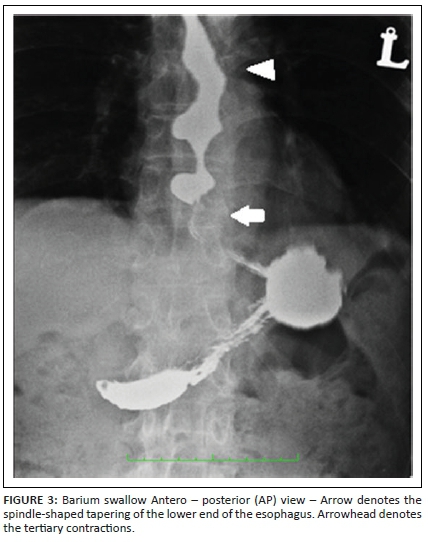
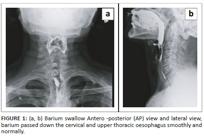
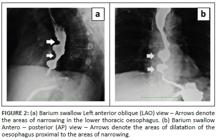
During the barium swallow study (using Baritop powder 100% w/v 250 mL), the cervical and proximal part of the thoracic oesophagus showed normal passage of barium (Figure 1). The distal part of the thoracic oesophagus exhibited a few areas of narrowing and areas of dilatation proximal to the narrowed segments (Figure 2). Tertiary contractions were noted and the distal end of the esophagus displayed spindle-shaped tapering (Figure 3).
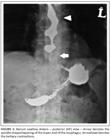
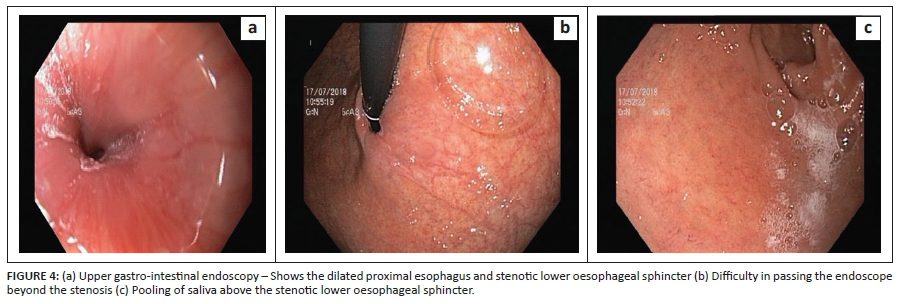
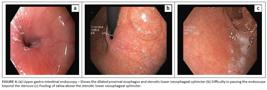
At UGI-endoscopy, (Olympus scope - size 2.8 mm), the upper part of the oesophagus was mildly dilated but otherwise normal. The distal part revealed lower oesophageal sphincter (LES) stenosis with pooling of saliva proximal to it. There was difficulty in passing the UGI scope beyond the site of the stenosis (Figure 4).
Discussion
Vigorous achalasia is an unusual oesophageal disorder that has clinical and radiological characteristics of both achalasia and DES.536,7
Classic achalasia versus vigorous achalasia
Achalasia is an uncommon disorder that involves loss of inhibitory ganglions in the myenteric plexus of the LES and the body of the oesophagus. Over time, the progressive loss of cholinergic neurons results in dilation and low amplitude simultaneous contractions in the oesophageal body, resulting in classic achalasia.8
Regurgitation and retention are the most common symptoms in classic achalasia, whereas chest pain is uncommon.2910Figure 3).
Endoscopy of classic achalasia shows a dilated tortuous oesophagus with retention of fluid or food.11122,131415151617
Diffuse oesophageal spasm versus vigorous achalasia
Diffuse oesophageal spasm (DES) is a rare motility disorder characterised by chest pain, dysphagia and intermittent increased simultaneous contractions.1819234
Endoscopy can sometimes show simultaneous ring-shaped contractions.20212223Figure 3).
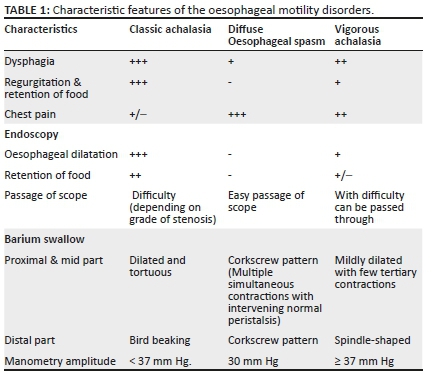
The clinical features, imaging findings, endoscopic and manometric findings of oesophageal motility disorders are summarised in Table 1.
Conclusion
Vigorous achalasia is a rare oesophageal motility disorder, commonly misdiagnosed as DES. Knowledge and recognition of this uncommon entity will help in early recognition and optimal management.
Competing interests
The authors have declared that no competing interests exist.
Authors' contributions
All authors contributed equally to this work.
Funding information
This research received no specific grant from any funding agency in the public, commercial or not-for-profit sectors.
Ethical consideration
This article followed all ethical standards for carrying out research.
Data availability statement
The authors confirm that the data supporting the findings of this study are available within the article.
Disclaimer
The views and opinions expressed in this article are those of the authors and do not necessarily reflect the official policy or position of any affiliated agency of the authors.
Acknowledgements
References
-
1.Castell DO. Achalasia and diffuse esophageal spasm. Arch Intern Med. 1976;136(5):571-579. https://doi.org/10.1001/archinte.1976.03630050053010
» https://doi.org/10.1001/archinte.1976.03630050053010 -
2.Sanderson DR, Ellis FH, Schlegel JF, Olsen AM. Syndrome of vigorous achalasia: Clinical and physiologic observations. Dis Chest. 1967; 52(4):508-517. https://doi.org/10.1378/chest.52.4.508
» https://doi.org/10.1378/chest.52.4.508 -
3.Millan MS, Bourdages R, Beck IT, DaCosta LR. Transition from diffuse esophageal spasm to achalasia. J Clin Gastroenterol. 1979;1(2):107-117. https://doi.org/10.1097/00004836-197906000-00003
» https://doi.org/10.1097/00004836-197906000-00003 -
4.Olsen AM, Ellis FH, Creamer B. Cardiospasm (achalasia of the cardia). Am J Surg. 1957;93(2):299-307. https://doi.org/10.1016/0002-9610(57)90782-1
» https://doi.org/10.1016/0002-9610(57)90782-1 -
5.What is vigorous achalasia ? [homepage on the Internet]. [cited 2020 May 19]. Available from: http://www.oeso.org/OESO/books/Vol_4_Prim_Motility/Articles/ART122.HTML
» http://www.oeso.org/OESO/books/Vol_4_Prim_Motility/Articles/ART122.HTML -
6.Cohen S, Motor disorders of the esophagus. N Engl J Med. 1979;301(20):1124-1125. https://doi.org/10.1056/NEJM197911153012016
» https://doi.org/10.1056/NEJM197911153012016 -
7.Schima W, Ryan JM, Harisinghani M, et al. Radiographic detection of achalasia: Diagnostic accuracy of videofluoroscopy. Clin Radiol. 1998;53(5):372-375. https://doi.org/10.1016/S0009-9260(98)80012-3
» https://doi.org/10.1016/S0009-9260(98)80012-3 -
8.Ghoshal UC, Daschakraborty SB, Singh R. Pathogenesis of achalasia cardia. World J Gastroenterol. 2012;18(24):3050-3057. https://doi.org/10.3748/wjg.v18.i24.3050
» https://doi.org/10.3748/wjg.v18.i24.3050 -
9.Camacho-Lobato L, Katz PO, Eveland J, Vela M, Castell DO. Vigorous achalasia: Original description requires minor change. J Clin Gastroenterol. 2001;33(5):375-377. https://doi.org/10.1097/00004836-200111000-00006(1)
» https://doi.org/10.1097/00004836-200111000-00006(1) -
10.Rhee K, Jeon H, Kim J-H, Yoon YH, Park H, Lee SI. An evidence of esophageal decompensation in patients with achalasia in the view of its subtype: A retrospective study. J Neurogastroenterol Motil. 2013;19(3):319-323. https://doi.org/10.5056/jnm.2013.19.3.319
» https://doi.org/10.5056/jnm.2013.19.3.319 -
11.McCormick SE, Kozarek RA. Endoscopic evaluation of esophageal motility disorders. GI Motil Online [serial online]. 2006 [cited 2020 May 25]. Available from: https://www.nature.com/gimo/contents/pt1/full/gimo29.html
» https://www.nature.com/gimo/contents/pt1/full/gimo29.html -
12.Goldenberg SP, Burrell M, Fette GG, Vos C, Traube M. Classic and vigorous achalasia: A comparison of manometric, radiographic, and clinical findings. Gastroenterology. 1991;101(3):743-748. https://doi.org/10.1016/0016-5085(91)90534-R
» https://doi.org/10.1016/0016-5085(91)90534-R - 13.Giuli R. O.E.S.O. the Esophagogastric: The Esophagogastric Junction. Arcueil: John Libbey Eurotext; 1998, p. 1674.
-
14.Okike N, Payne WS, Neufeld DM, Bernatz PE, Pairolero PC, Sanderson DR. Esophagomyotomy versus forceful dilation for achalasia of the esophagus: Results in 899 patients. Ann Thorac Surg. 1979;28(2):119-125. https://doi.org/10.1016/S0003-4975(10)63767-8
» https://doi.org/10.1016/S0003-4975(10)63767-8 -
15.Parrilla Paricio P, Martinez de Haro LF, Ortiz Escandell A, Morales Cuenca G, Molina Martinez J. Short myotomy for vigorous achalasia. Br J Surg. 1993;80(12):1540-1542. https://doi.org/10.1002/bjs.1800801215
» https://doi.org/10.1002/bjs.1800801215 -
16.Eleftheriadis N, Inoue H, Ikeda H, et al. Training in peroral endoscopic myotomy (POEM) for esophageal achalasia. Ther Clin Risk Manag. 2012;8:329-342. https://doi.org/10.2147/TCRM.S32666
» https://doi.org/10.2147/TCRM.S32666 -
17.POEM effective in spastic esophageal disorders [homepage on the Internet]. [cited 2020 Sep 4]. Available from: https://www.healio.com/news/gastroenterology/20190613/poem-effective-in-spastic-esophageal-disorders
» https://www.healio.com/news/gastroenterology/20190613/poem-effective-in-spastic-esophageal-disorders -
18.Patel DA, Vaezi MF. A spiraling case of persistent dysphagia. Gastroenterology. 2015;149(2):298-299. https://doi.org/10.1053/j.gastro.2015.04.049
» https://doi.org/10.1053/j.gastro.2015.04.049 -
19.Roman S, Kahrilas PJ. Distal esophageal spasm. Curr Opin Gastroenterol. 2015;31(4):328-333. https://doi.org/10.1097/MOG.0000000000000187
» https://doi.org/10.1097/MOG.0000000000000187 -
20.Kato T, Naiki T, Araki H, Nagaki M, Moriwaki H. Diffuse esophageal spasm. Gastrointest Endosc. 2004;60(4):428. https://doi.org/10.1016/S0016-5107(04)01706-7
» https://doi.org/10.1016/S0016-5107(04)01706-7 -
21.Carucci LR, Turner MA. Dysphagia revisited: Common and unusual causes. Radiogr Rev Publ Radiol Soc N Am Inc. 2015;35(1):105-122. https://doi.org/10.1148/rg.351130150
» https://doi.org/10.1148/rg.351130150 - 22.Achem SR. Diffuse esophageal spasm in the era of high-resolution manometry. Gastroenterol Hepatol. 2014;10(2):130-133.
-
23.Del PozoCalzada C, Molina Llorente H, González Gutiérrez M. Vigorous achalasia. Med Clin (Barc). 2018;150(3):124. https://doi.org/10.1016/j.medcli.2017.03.019
» https://doi.org/10.1016/j.medcli.2017.03.019

Accepted: 09 Sept. 2020
Published: 30 Nov. 2020