Female breast cancer trends: A South African perspective
Abstract
BACKGROUND: Some clinicians and radiologists in South Africa (SA) suspect that aggressive subtypes of breast cancer are becoming more prevalent and that patients are presenting at younger ages OBJECTIVES: This study aimed to analyse the prevalence and trends in female breast cancer presentations at a Breast Unit in Johannesburg, SA, by comparing data from 2012 and 2022 METHOD: A retrospective study was conducted at a tertiary hospital in Johannesburg. Records of female patients diagnosed with breast cancer between 2012 and 2022 were analysed. Demographic data, ultrasound or mammography findings, and tumour characteristics were compared RESULTS: A total of 493 records were reviewed: 165 (33.5%) from 2012 and 328 (66.5%) from 2022. The mean ± standard deviation (s.d.) age at presentation was 56.8 ± 16.8 years in 2012 and 54.1 ± 13.6 years in 2022 (p = 0.056). Tumours were smaller in 2022 (mean ± s.d., 35.0 mm ± 24.0 mm) compared to 2012 (48.1 mm ± 21.5 mm) (p < 0.001). A higher proportion of women had positive oestrogen receptor status in 2022 (p = 0.005). No differences were observed in molecular subtypes CONCLUSION: No significant change was found in the mean age at presentation, suggesting a stable demographic profile. However, reproductive, hormonal, and lifestyle factors may contribute to the rising prevalence among women aged 40-49 years. Smaller tumours likely reflect increased awareness and clinical breast examinations at local clinics CONTRIBUTION: This single-institution study underscores the need for broader national research to inform breast cancer screening and imaging guidelines
breast cancer; age; demographic characteristics; tumour characteristics; breast cancer trends; breast imaging unit
Introduction
According to some research, breast cancer is increasingly affecting younger individuals.1,2,3
Based on the 2020 Global Cancer Statistics (GLOBOCAN) data, breast cancer is the most diagnosed cancer among women, with approximately 2.3 million new cases reported annually, making up 11.7% of all cancer cases.4456,7,84,9,106,9
Although most breast cancer patients are postmenopausal,3,931,2,32
Definitions of 'young women' with breast cancer vary but generally refer to women who are less than or equal to 40 years old.111,3,9,1111,1213,1413,1413151513
The high prevalence of human immunodeficiency virus (HIV) in SA may lead to the coexistence of HIV positivity and breast carcinoma.161616,17
Compared to other developed nations, less is known in SA about the risk factors, clinical and histological characteristics, gene expression and molecular patterns among breast cancer patients.12,18,19
This study assessed the prevalence and compared the demographic and tumour characteristic trends of female breast cancer at Helen Joseph Hospital (HJH) Breast Imaging Unit (BIU), a tertiary public hospital in Johannesburg, SA.
Research methods and design
The HJH Breast Clinic is one of the few specialised public breast clinics in Gauteng, SA that provides open access to all patients needing breast examinations and investigations. The clinic diagnoses and treats over 300 new breast cancer cases per year.
In this retrospective analysis within the study periods (2012 and 2022) at the BIU of HJH, females aged 18 years and older with histologically verified breast cancer and/or with a second primary breast cancer diagnosed in these years, were included. Patients with recurrent breast cancer of the same histological type, breast sarcomas and those undergoing follow-up were excluded.
Demographic variables such as the age at breast cancer diagnosis and the HIV status were collected. The imaging tumour characteristics included the size of the primary tumour (the largest dimension measured on either breast ultrasound or mammography) and suspicious microcalcifications. The recorded histological tumour characteristics consisted of the morphological tumour type (ductal, lobular, mixed or other), nuclear grade (1, 2 or 3), immunohistochemistry (tumour receptor status), Ki-67 percentage and the breast cancer subtypes (Luminal A, Luminal B, human epidermal growth factor receptor 2 [HER2]-enriched or triple-negative breast cancer [TNBC]).
The morphological tumour types were categorised into invasive ductal carcinoma, invasive lobular carcinoma, mixed category (ductal and invasive lobular carcinoma combined) and other (mucinous, invasive papillary, micropapillary, metaplastic and secretory carcinomas). The Allred scoring system quantified the oestrogen receptor (ER) and progesterone receptor (PR) status. A total score of less than or equal to 2 was considered negative, while a score greater than or equal to 3 was classified as positive. Interpretation of the HER2 status considered a tumour staining intensity of 3+ or a positive FISH test result as positive. A staining of 0, 1+ or 2+ (equivocal) and an absent FISH result were recorded as HER2 negative. Breast cancer subtypes were classified as Luminal A (ER+ and/or PR+, HER2-), Luminal B (ER+ and/or PR+, HER2+), HER2-enriched (HER2+, ER-, PR-) and TNBC (ER-, PR-, HER2-). As Ki-67 was unavailable in the 2012 data set, nuclear grade, HER2 and FISH results were used to classify the Luminal cancers.
The data from patients' files was entered into a Microsoft Excel spreadsheet. Categorical variables were presented as frequency and percentages, while continuous variables were presented as mean ± standard deviation (s.d.) or median and interquartile range (IQR) if not normally distributed. A bar graph was used to demonstrate the differences between the molecular subtypes. Continuous variables were compared between the two years using the Student's t-test. Categorical variables were compared between the two years using Pearson's Chi-square test and Fisher's exact test, where data were skewed. A two-sided p-value <0.05 was considered statistically significant throughout. Analysis was performed using Stata Version 18.
Ethical considerations
The study was approved by the Human Research Ethics Committee (HREC) of the University of the Witwatersrand (reference no.: M230324).
Results
Demographic characteristics of the study population
Of all the women seen in the BIU over the 2 years, 493 records were selected for inclusion and made up the study sample. In 2012 165 (33.5%) records were evaluated, compared to 328 records (66.5%) in 2022.
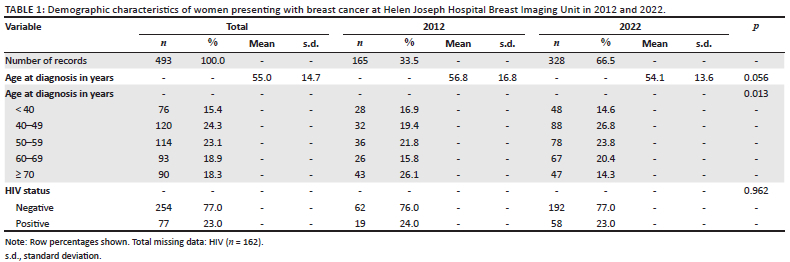
Table 1 describes and compares the demographic characteristics of the study population. The mean age ± s.d. was similar between the two years (p = 0.056). There was a statistically significant difference in the age distribution between the years, p = 0.013. The prevalence of women with breast cancer aged 40-49 years in 2012 was 19.4% versus 26.8% in 2022. In women aged ≥ 70 years, the prevalence was 26.1% in 2012 versus 14.3% in 2022. The prevalence of HIV-positive individuals was similar (p = 0.962).
Tumour characteristics of the study population
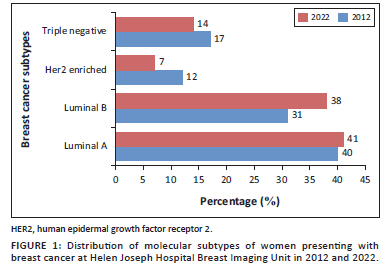
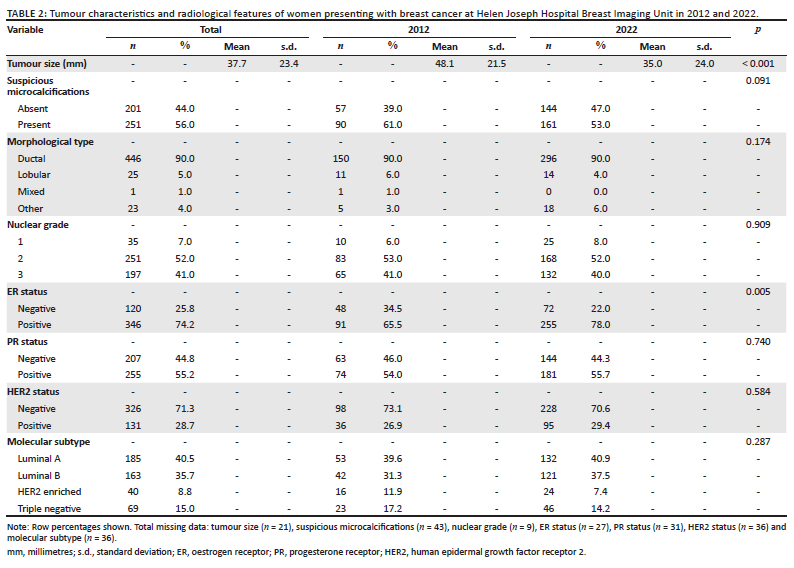
The tumour characteristics are presented in Table 2. In 2022, the mean ± s.d. tumour size reported on imaging was 35.0 mm ± 24.0 mm, whereas, in 2012, it was 48.1 mm ± 21.5 mm, p < 0.001. A significantly higher percentage of women had a positive ER status in 2022 compared to 2012 (78.0% vs. 65.5%, p = 0.005). Despite the latter, however, the molecular subtype did not differ, and for both years, Luminal A was the most common (39.6% in 2012 vs. 40.9% in 2022, p = 0.287), as demonstrated in Figure 1.
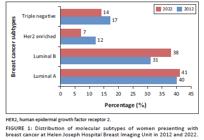
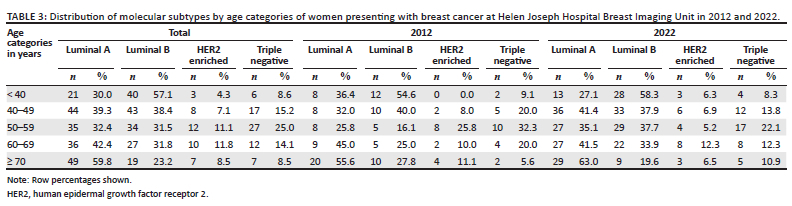
Table 3 shows the distribution of molecular subtypes across age categories. Overall, Luminal A was the most prevalent breast cancer subtype in women aged 70 years and older (59.8%). In contrast, Luminal B was the most common subtype of breast cancer in women under 40 years (57.1%). A similar trend to the combined total data were shown in 2012 and 2022. Triple-negative breast cancer was most prevalent among patients aged 50-59 years within the study population (25.0%). The proportion of patients with TNBC in the two comparative years was comparable to the total, with 32.3% in 2012 and 22.1% in 2022. The proportion of patients aged 50-59 years with HER2 enriched was 25.8% in 2012 and 5.2% in 2022.
Discussion
This study assessed the prevalence and comparisons between the demographic and tumour characteristic trends of 493 women diagnosed with breast cancer, 165 (33.5%) of which were recorded in 2012 and 328 (66.5%) in 2022. There was no change in the mean ± s.d. age of breast cancer presentation, in 2012 it was 56.8 ± 16.8 and in 2022 it was 54.1 ± 13.6 (p = 0.056). The tumours were smaller in 2022 (mean ± s.d., 35.0 mm ± 24.0 mm) than in 2012 (48.1 mm ± 21.5 mm), p < 0.001 and a higher percentage of women had a positive ER status in 2022 compared to 2012 (p = 0.005).
The number of reviewed records doubled in 2022 (66.5%) compared to 2012 (33.5%). This could be because of increased awareness of breast cancer, leading more patients to present to the breast clinic and possibly more external referrals. Additionally, access to the older records was hampered by poor record keeping and administration, making the records unretrievable in 2012, which could also have contributed to the fewer records that year. A new Picture Archiving and Communication System (PACS) was also introduced, which led to a lack of continuity.
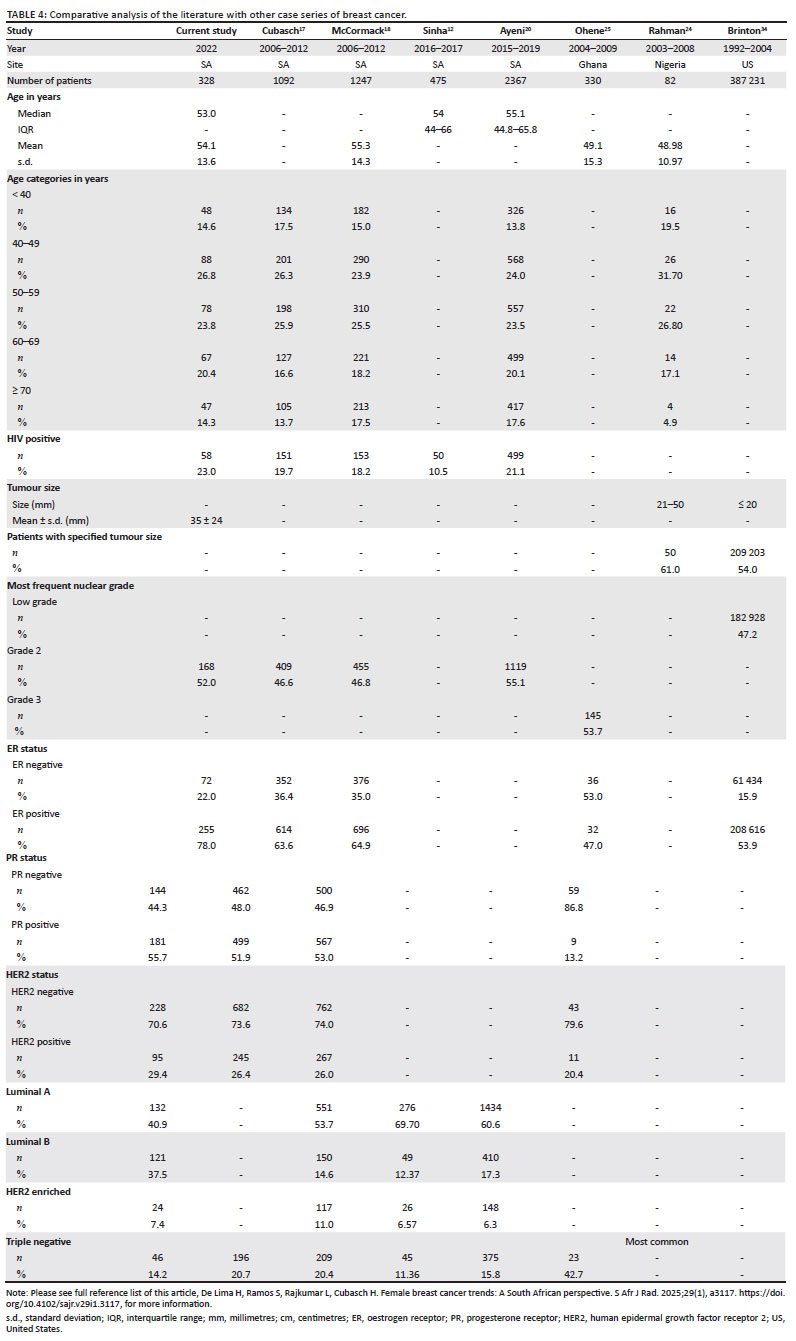
This study examined the trend differences between population groups in 2012 and 2022. The authors recognised the importance of understanding the latest trends within the 2022 data subset and compared the study's findings to several local and international studies. These comparative references are integrated within the text and are further summarised in Table 4.
This study found the mean age ± s.d. to be similar between the two years (56.8 ± 16.8 years in 2012 vs. 54.1 ± 13.6 years in 2022, p = 0.056), consistent with another study1812,2011,12
Although the mean age in this study was comparable, there were some significant differences in the categorical age distribution (p = 0.013) between 2012 and 2022. The percentage of women in the 40-49 years age range who received a breast cancer diagnosis rose from 19.4% in 2012 to 26.8% in 2022. Similar to findings in Brazil, there has been a consistent rise in hospital admissions for female breast cancer patients in this age category.216,21,22,236,21,22,236,21,22,2317,20,24,25
This study found that the prevalence of breast cancer in women 40 years and younger did not increase from 2012 to 2022; instead, it slightly decreased (16.9% in 2012 vs. 14.6% in 2022). There was also a difference between the 60-69 years age group (15.8% in 2012 vs. 20.4% in 2022) and the 70-year-old and older subgroup categories (26.1% in 2012 vs. 14.3% in 2022). The women 70 years and older presented less in 2022, which may be explained by barriers to care affecting the elderly, as they were less likely to present to the hospital during the coronavirus disease 2019 (COVID-19) pandemic. Soyder, et al. found that the elderly population, particularly those aged 65 years and older, faced significant barriers to accessing care during the pandemic, which included fear of COVID-19 transmission, high mortality rates because of comorbidities and restrictions on movement.2627
In this study, the recorded HIV status did not indicate a change over the 10 years. The prevalence of HIV among breast cancer patients was approximately 23.0% in 2022 and 24.0% in 2012 (p = 0.962). Other studies reported similar prevalence results for HIV-positive patients who were newly diagnosed with breast cancer in SA.17,18,202820,29173029
In 2022, the mean ± s.d. tumour size reported on imaging was 35 mm ± 24 mm, compared to 48.1 mm ± 21.5 mm in 2012 (p < 0.001), indicating that tumours were significantly smaller in 2022. Despite the impact of COVID-19, this trend could be attributed to improved patient health education. Women are identifying tumours earlier, at smaller sizes and lower stages than in previous years, thanks to public health campaigns and awareness programmes that inform them about the risks, signs and symptoms of breast cancer.3115152713,15,32
The morphological tumour types observed in this study were consistent with those reported in the literature. As documented in previous studies, invasive ductal carcinoma was the most frequently diagnosed type, comprising 90.0% of the total tumours for 2012 and 2022.9,18,20,25,33,34
Not only does the understanding of the hormone receptor status and molecular subtypes describe the biology of breast cancer and influence its clinical behaviour, but it is also essential for determining the most effective treatment and management plans as the treatment strategies differ depending on the molecular subtype.9,339,339,339,33
This study observed a statistically significant difference in ER status between 2012 and 2022, with ER-positive cases increasing from 65.5% to 78.0% (p = 0.005). This shift in the hormone receptor may be attributed to changes in pathology reporting and analysis, potentially involving a more rigorous application of the Allred scoring system by histopathologists.353512,17,18,3425343,18
The distribution of breast cancer subtypes in this study population closely aligns with the proportions reported in a review.99
In contrast to the widely held notion that SSA women are more likely to be diagnosed with more aggressive breast cancer subtypes, especially TNBC,12,19,24Figure 1. A comparative analysis revealed that the most prevalent subtype of breast cancer in SA was also Luminal A.12,20,293517,18,20,29
Research has found an association between the patient's age and the molecular subtype.3,993,93,9,12,20,34
Strengths and limitations
The study provided valuable information on the trend of breast cancer 10 years apart in SA concerning age distribution, tumour size, receptor status and molecular subtypes. Because of the doubled number of records in 2022 versus 2012, the authors had to compare two populations of different sizes. The introduction of a new PACS contributed to the lack of continuity. The inconsistent terminology in pathology reports and the absence of Ki-67 reporting in 2012 hindered direct comparisons. Incomplete data regarding receptor status and grade were accounted for as missing, which may have led to an underestimation of molecular subtype representations.
Future applications
A cancer registry would help compare results within SA and globally. Although this study covered 10 years, future research could enable a more detailed comparative analysis for the 5 years before and after 2022, uncovering more accurate and comparable trend variations. While there may have been more women diagnosed in the 40-49 year age group in this study, this might not reflect the national trend, suggesting that more research will be necessary to determine whether this indicates a trend in the years following 2022. Future research may also benefit from incorporating the stage at diagnosis to understand better the factors influencing the aggressiveness of breast cancer.
Conclusion
The average age of breast cancer diagnosis remained consistent for 2012 and 2022, suggesting that the demographic profile of breast cancer patients has remained stable. Reproductive and hormonal factors and lifestyle changes, however, could be contributing to the increasing prevalence of breast cancer in women aged 40-49 years. Newly diagnosed tumours in 2022 were significantly smaller, attributing to an increased breast cancer awareness, the DoH policy implementing CBE in local clinics and screening, which have facilitated earlier detection. Despite these trends, additional research is required on the age at first breast cancer presentation and its associated characteristics across more provincial healthcare facilities. This will assist in determining whether a national trend towards younger presentation is emerging. Such findings could help guide national screening and imaging guidelines for breast cancer and improve patient care.
Competing interests
The authors declare that they have no financial or personal relationships that may have inappropriately influenced them in writing this article.
Authors' contributions
H.D.L. was the principal investigator responsible for the study's concept and design, literature review, data collection and analysis, and writing of the article. S.R. and L.R. participated in supervising the study and oversaw the editing and reviewing process. H.C. contributed resources and participated in editing, reviewing and supervising the study.
Funding information
This research received no specific grant from any funding agency in the public, commercial or not-for-profit sectors.
Data availability
The data that support the findings of this study are available on request from the corresponding author, H.D.L. The data are not publicly available because of privacy restrictions.
Disclaimer
The views and opinions expressed in this article are those of the authors and are the product of professional research. The article does not necessarily reflect the official policy or position of any affiliated institution, funder, agency or that of the publisher. The authors are responsible for this article's results, findings and content.
Acknowledgements
References
-
1. Dodelzon K, Starikov A, Reichman M, et al. Breast cancer in women under age 40: A decade of trend analysis at a single institution. Clin Imaging. 2021;78:165-170. https://doi.org/10.1016/j.clinimag.2021.03.031
» https://doi.org/10.1016/j.clinimag.2021.03.031 -
2. Leclère B, Molinié F, Trétarre B, Stracci F, Daubisse-Marliac L, Colonna M. Trends in incidence of breast cancer among women under 40 in seven European countries: A GRELL cooperative study. Cancer Epidemiol. 2013;37(5):544-549. https://doi.org/10.1016/j.canep.2013.05.001
» https://doi.org/10.1016/j.canep.2013.05.001 -
3. Kudela E, Samec M, Kubatka P, et al. Breast cancer in young women: Status quo and advanced disease management by a predictive, preventive, and personalized approach. Cancers (Basel). 2019;11(11):1791. https://doi.org/10.3390/cancers11111791
» https://doi.org/10.3390/cancers11111791 -
4. Sung H, Ferlay J, Siegel RL, et al. Global cancer statistics 2020: GLOBOCAN estimates of incidence and mortality worldwide for 36 cancers in 185 countries. CA Cancer J Clin. 2021;71(3):209-249. https://doi.org/10.3322/caac.21660
» https://doi.org/10.3322/caac.21660 -
5. Summary statistics of cancer diagnosed histologically in 2019 [homepage on the Internet]. South African National Cancer Registry; 2019 [cited 2023 Jan 06]. Available from: https://www.nicd.ac.za/wp-content/uploads/2021/12/NCR_Path_2019_Full_Report_8dec2021.pdf
» https://www.nicd.ac.za/wp-content/uploads/2021/12/NCR_Path_2019_Full_Report_8dec2021.pdf -
6. Singh E, Joffe M, Cubasch H, Ruff P, Norris SA, Pisa PT. Breast cancer trends differ by ethnicity: A report from the South African National Cancer Registry (1994-2009). Eur J Public Health. 2016;27(1):173-178. https://doi.org/10.1093/eurpub/ckw191
» https://doi.org/10.1093/eurpub/ckw191 -
7. Ayeni OA, Norris SA, Joffe M, et al. The multimorbidity profile of South African women newly diagnosed with breast cancer. Int J Cancer. 2020;147(2):361-374. https://doi.org/10.1002/ijc.32727
» https://doi.org/10.1002/ijc.32727 -
8. Rayne S, Schnippel K, Kruger D, Benn CA, Firnhaber C. Delay to diagnosis and breast cancer stage in an urban South African breast clinic. S Afr Med J. 2019;109(3):159-163. https://doi.org/10.7196/SAMJ.2019.v109i3.13283
» https://doi.org/10.7196/SAMJ.2019.v109i3.13283 -
9. Łukasiewicz S, Czeczelewski M, Forma A, Baj J, Sitarz R, Stanisławek A. Breast cancer-epidemiology, risk factors, classification, prognostic markers, and current treatment strategies - An updated review. Cancers (Basel). 2021;13(17):4287. https://doi.org/10.3390/cancers13174287
» https://doi.org/10.3390/cancers13174287 -
10. Lei S, Zheng R, Zhang S, et al. Global patterns of breast cancer incidence and mortality: A population-based cancer registry data analysis from 2000 to 2020. Cancer Commun (Lond). 2021;41(11):1183-1194. https://doi.org/10.1002/cac2.12207
» https://doi.org/10.1002/cac2.12207 -
11. Sun X, Liu J, Ji H, Yang M, Lu Y. Clinicopathological characteristics and prognosis of breast cancer in young women - A single center study in a developing country. Cancer Manag Res. 2021;13:1601-1607. https://doi.org/10.2147/cmar.S299066
» https://doi.org/10.2147/cmar.S299066 -
12. Sinha S, Bhatia R, Narasimamurthy M, Rayne S, Grover S. Epidemiology of breast cancer presentation in Botswana, South Africa, and the United States. J Surg Res. 2022;279:533-539. https://doi.org/10.1016/j.jss.2022.04.071
» https://doi.org/10.1016/j.jss.2022.04.071 -
13. Lipschitz S. Screening mammography with special reference to guidelines in South Africa. SA J Radiol. 2018;22(2):1370. https://doi.org/10.4102/sajr.v22i2.1370
» https://doi.org/10.4102/sajr.v22i2.1370 -
14. Monticciolo DL, Malak SF, Friedewald SM, et al. Breast cancer screening recommendations inclusive of all women at average risk: Update from the ACR and society of breast imaging. J Am Coll Radiol. 2021;18(9):1280-1288. https://doi.org/10.1016/j.jacr.2021.04.021
» https://doi.org/10.1016/j.jacr.2021.04.021 - 15. South African National Department of Health. Breast cancer prevention and control policy. National Department of Health, 2017; p. 25-32.
- 16. Reddy P, Ebrahim S, Singh B, Ramklass S, Buccimazza I. Breast cancer and HIV: A South African perspective and a critical review of the literature. S Afr J Surg. 2017;55(1):10-15.
-
17. Cubasch H, Joffe M, Hanisch R, et al. Breast cancer characteristics and HIV among 1,092 women in Soweto, South Africa. Breast Cancer Res Treat. 2013;140(1):177-186. https://doi.org/10.1007/s10549-013-2606-y
» https://doi.org/10.1007/s10549-013-2606-y -
18. McCormack VA, Joffe M, Van den Berg E, et al. Breast cancer receptor status and stage at diagnosis in over 1,200 consecutive public hospital patients in Soweto, South Africa: A case series. Breast Cancer Res. 2013;15(5):R84. https://doi.org/10.1186/bcr3478
» https://doi.org/10.1186/bcr3478 -
19. Dlamini Z, Molefi T, Khanyile R, et al. From incidence to intervention: A comprehensive look at breast cancer in South Africa. Oncol Ther. 2024;12(1): 1-11. https://doi.org/10.1007/s40487-023-00248-1
» https://doi.org/10.1007/s40487-023-00248-1 -
20. Ayeni OA, O'Neil DS, Pumpalova YS, et al. Impact of HIV infection on survival among women with stage I-III breast cancer: Results from the South African breast cancer and HIV outcomes study. Int J Cancer. 2022;151(2):209-221. https://doi.org/10.1002/ijc.33981
» https://doi.org/10.1002/ijc.33981 -
21. Da Silva Santos S, Melo LR, Koifman RJ, Koifman S. Breast cancer incidence and mortality in women under 50 years of age in Brazil. Cad Saude Publica. 2013;29(11):2230-2240. https://doi.org/10.1590/0102-311x00030713
» https://doi.org/10.1590/0102-311x00030713 -
22. Gabriel CA, Domchek, SM. Breast cancer in young women. Breast Cancer Res. 2010;12(5):212. https://doi.org/10.1186/bcr2647
» https://doi.org/10.1186/bcr2647 -
23. Nelson HD, Zakher B, Cantor A, et al. Risk factors for breast cancer for women aged 40 to 49 years: A systematic review and meta-analysis. Ann Intern Med. 2012;156(9):635-648. https://doi.org/10.7326/0003-4819-156-9-201205010-00006
» https://doi.org/10.7326/0003-4819-156-9-201205010-00006 -
24. Rahman GA, Olatoke SA, Agodirin SO, Adeniji KA. Socio-demographic and clinical profile of immuno-histochemically confirmed breast cancer in a resource limited country. Pan Afr Med J. 2014;17:182. https://doi.org/10.11604/pamj.2014.17.182.2257
» https://doi.org/10.11604/pamj.2014.17.182.2257 - 25. Ohene-Yeboah M, Adjei E. Breast cancer in Kumasi, Ghana. Ghana Med J. 2012;46(1):8-13.
-
26. Soyder A, Güldoğan N, Isıklar A, Arıbal E, Başaran G. What has changed in patients aged 65 and over diagnosed with breast cancer during the COVID-19 pandemic: A single-center experience. Breast Care (Basel). 2022;55(4):1-6. https://doi.org/10.1159/000523673
» https://doi.org/10.1159/000523673 -
27. McGuire A, Brown JA, Malone C, McLaughlin R, Kerin MJ. Effects of age on the detection and management of breast cancer. Cancers (Basel). 2015;7(2):908-929. https://doi.org/10.3390/cancers7020815
» https://doi.org/10.3390/cancers7020815 -
28. Peltzer K, Parker W, Mabaso M, Makonko E, Zuma K, Ramlagan S. Impact of national HIV and AIDS communication campaigns in South Africa to reduce HIV risk behaviour. ScientificWorldJournal. 2012;2012:384608. https://doi.org/10.1100/2012/384608
» https://doi.org/10.1100/2012/384608 -
29. Ayeni OA, Joffe M, Mapanga W, et al. Multimorbidity and overall survival among women with breast cancer: Results from the South African breast cancer and HIV outcomes study. Breast Cancer Res. 2023;25(1):7. https://doi.org/10.1186/s13058-023-01603-w
» https://doi.org/10.1186/s13058-023-01603-w -
30. Nietz S, O'Neil DS, Ayeni O, et al. A comparison of complete pathologic response rates following neoadjuvant chemotherapy among South African breast cancer patients with and without concurrent HIV infection. Breast Cancer Res Treat. 2020;184(3):861-872. https://doi.org/10.1007/s10549-020-05889-8
» https://doi.org/10.1007/s10549-020-05889-8 -
31. Xu S, Murtagh S, Han Y, Wan F, Toriola AT. Breast cancer incidence among US women aged 20 to 49 years by race, stage, and hormone receptor status. JAMA Netw Open. 2024;7(1):e2353331. https://doi.org/10.1001/jamanetworkopen.2023.53331
» https://doi.org/10.1001/jamanetworkopen.2023.53331 -
32. Monticciolo DL, Newell MS, Hendrick RE, et al. Breast cancer screening for average-risk women: Recommendations from the ACR commission on breast imaging. J Am Coll Radiol. 2017;14(9):1137-1143. https://doi.org/10.1016/j.jacr.2017.06.001
» https://doi.org/10.1016/j.jacr.2017.06.001 -
33. Weigelt B, Geyer FC, Reis-Filho JS. Histological types of breast cancer: How special are they? Mol Oncol. 2010;4(3):192-208. https://doi.org/10.1016/j.molonc.2010.04.004
» https://doi.org/10.1016/j.molonc.2010.04.004 -
34. Brinton LA, Sherman ME, Carreon JD, Anderson WF. Recent trends in breast cancer among younger women in the United States. J Natl Cancer Inst. 2008;100(22):1643-1648. https://doi.org/10.1093/jnci/djn344
» https://doi.org/10.1093/jnci/djn344 - 35. Qureshi A, Pervez S. Allred scoring for ER reporting and it's impact in clearly distinguishing ER negative from ER positive breast cancers. J Pak Med Assoc. 2010;60(5):350-353.

Accepted: 16 Mar. 2025
Published: 31 May 2025