Perceptions and attitudes towards AI among trainee and qualified radiologists at selected South African training hospitals
Abstract
BACKGROUND: Artificial intelligence (AI) is transforming industries, but its adoption in healthcare, especially radiology, remains contentious. OBJECTIVES: This study evaluated the perceptions and attitudes of trainee and qualified radiologists towards the adoption of AI in practice. METHOD: A cross-sectional survey using a paper-based questionnaire was completed by trainee and qualified radiologists. Survey questions covered AI knowledge, perceptions, attitudes, and AI training in the registrar programme on a 3-point Likert scale. RESULTS: A total of 100 participants completed the survey; 54% were aged 26-65 years and 61% were female, with none currently using AI in daily radiology practice. The majority (78%) of participants understood the basics and knew the role of AI in radiology. Most knew about AI from media reports (77%) and majority (95%) were never involved in AI training; only 3% of participants had no knowledge of AI at all. Participants agreed that AI could reliably detect pathological conditions (89%), reach reliable diagnosis (89%), improve daily work (78%), and 89% favoured AI practice; 89% believed that in the future, machine learning will not be independent of the radiologist. Participants were willing to learn (98%) and contribute towards advancing AI software (97%) and agreed that AI will improve the registrars' programme (97%), also noting that AI applications are as important as medical skills (87%).. CONCLUSION: The findings suggest AI in radiology is in its infancy, with a need for educational programmes to upskill radiologists. CONTRIBUTION: Participants were positive about AI implementation in practice and in the registrar learning programme.
artificial intelligence; attitudes; perceptions; qualified radiologist; trainee radiologist
Introduction
Artificial intelligence (AI) is an advancing field of computer science that builds machines that utilise data to perform cognitive tasks that require human intelligence.1,2,3112,4
In radiology, digital images have been implemented since the beginning of the 21st century, making the field well-positioned to deploy AI technologies as there now exists a large repository of data ready to be translated.445,678,93,5,7,10,11
Although studies exist on perceptions and attitudes of healthcare practitioners, including radiologist and radiology students, on AI technologies,5,6,8,9,101213
South Africa, like many other African countries, grapples with inadequate human resources, unequal distribution of health professionals, including specialists such as radiologists, between private and public sectors, and provinces, as well as resource shortages which might affect the implementation of AI.14
The aim of this study was to evaluate the perceptions and attitudes of qualified and trainee radiologists, from six training hospitals in University of the Witwatersrand radiology training circuit in South Africa, towards the adoption of AI in clinical practice.
Research methods and design
Study design and participants
The cross-sectional survey consisted of 25 questions divided into four sections, each designed to ask questions related to participants' demographic information and to rate their knowledge, perceptions and attitudes towards AI, respectively, using a 3-point Likert scale. The questionnaire was administered to trainee (registrars), and qualified radiologists based at six academic hospitals within the University of Witwatersrand radiology circuit, namely, Charlotte Maxeke Johannesburg Academic Hospital, Chris Hani Baragwanath Academic Hospital, Rahima Moosa Mother and Child Hospital, Helen Joseph Hospital, Thelle Mogoerane Regional Hospital and Klerksdorp Tshepong Hospital. Trainee radiologists were defined as medical practitioners with a Bachelor of Medicine degree training to specialise in radiology and qualified radiologists were those with radiology-specific certifications regardless of their level of experience post-qualification. Participation was voluntary and was not associated with any duties and/or activities of the trainees nor qualified radiologists at the time of the research.
Sampling design
Minimum sample size required for this cross-sectional study was determined using Equation 1:

assuming a prevalence rate of 9% against the use of AI in radiology (P) at a 95% confidence interval (D = 0.05), and normal standard deviation at 80% power of 1.96 (Z), the minimum sample size was determined as N = 132. To avoid collecting unnecessary data, the purposive sampling technique was used to recruit participants more likely to offer relevant information for answering the research question.12
Data analysis
Participants' responses from the questionnaire were recorded and processed using Microsoft Excel (Microsoft, RedMond, WA, United States). A de-identified Excel spreadsheet was imported into Stata Version 18 (StataCorp, College Station, TX, United States) for further analysis. Categorical variables were presented as frequencies and percentages.
Ethical considerations
Ethics approval was obtained from the Human Research and Ethics Committee of the University of the Witwatersrand (Approval Number: MED230910). Further permission to conduct the research with the registrars and radiologists affiliated to the University of the Witwatersrand within academic hospitals was obtained from the Academic Head of Radiology in the University of the Witwatersrand. Prior to each participant filling out the survey, their informed consent was acquired.
Results
Demographics
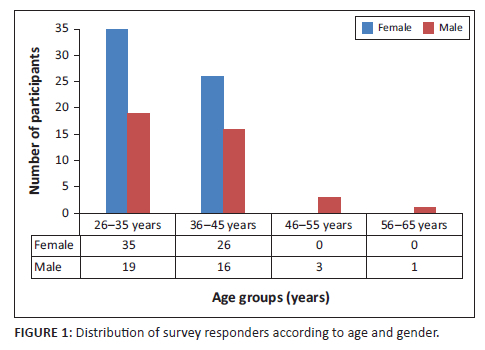
A total of 100 participants completed the survey representing a 76% response rate from the proposed 132 participants. Given that the overall acceptability of AI in the sample was 89%, the sample size was deemed sufficient to make inference. The sex distribution of the participants by age classes is presented in Figure 1. The majority of the participants were in the 26-35 years old (54%) age group, and most (61%) were female (Figure 1).
Knowledge of artificial intelligence
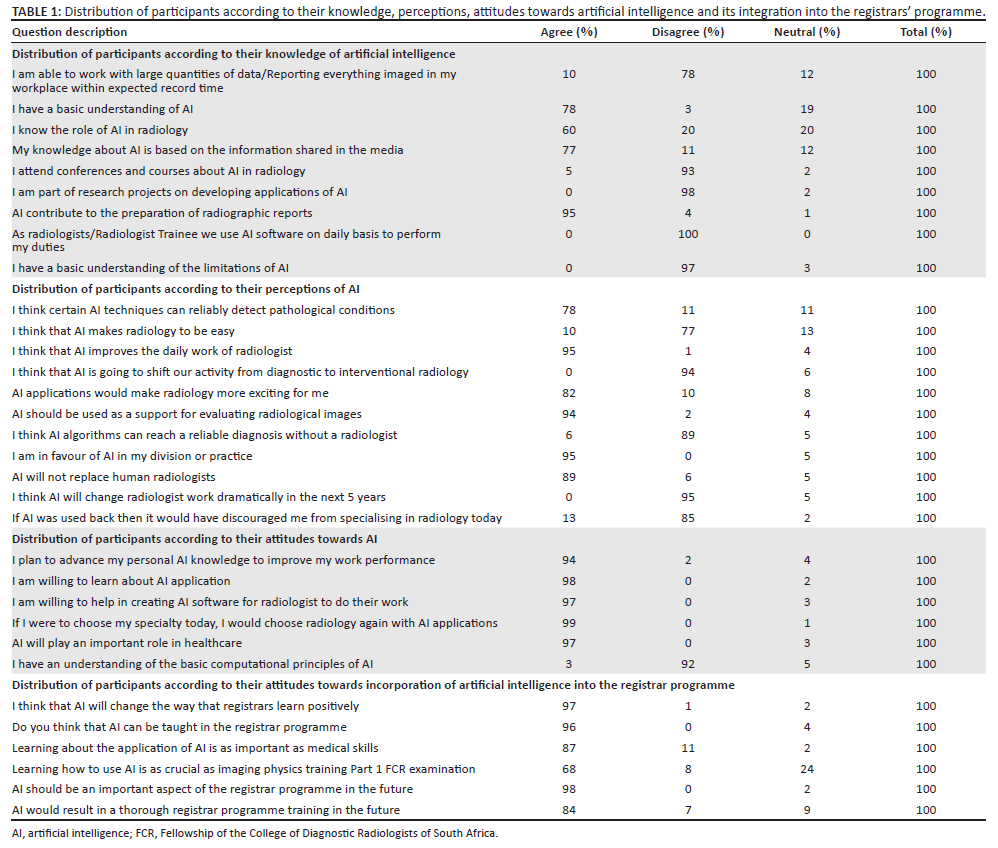
Table 1 shows the participants' distribution according to their knowledge of AI. All participants indicated that they did not use AI to perform their daily duties. When asked of their ability to work with data, most participants (78%) indicated that they were unable to work with large quantities of data. Similarly, 78% of participants understood the basics of AI; only 3% had no knowledge of AI at all. Sixty per cent believed that they knew the role of AI in radiology while 20% were unsure. Regarding sources of information, 77% indicated that their knowledge about AI was based on what was shared in the media. The majority of participants had never attended either a conference or a course of AI in radiology (93%) and had never been involved in AI development projects (98%). The majority of the participants (95%) believed that AI has the potential to contribute to the preparation of radiographic reports. Regarding limitations, 97% indicated that they understood the limitations of AI.
Perceptions towards artificial intelligence
Table 1 shows the distribution of perceptions towards AI among trainee and qualified radiologists in the current study. The majority of participants agreed that AI techniques could reliably detect pathological conditions (78%). They disagreed that AI algorithms can independently reach diagnosis for all radiology modalities and pathology spectrum (89%). They believed that for algorithms to be accurately adopted for diagnosis, they need to go through a developmental stage of machine learning that relies on inputs by experts and in this case, through their expert input, radiologists will play a vital role in creating and shaping these AI algorithms. The majority of participants agreed that AI techniques will improve daily work (95%), were exciting (82%), should be used to evaluate radiologic images (94%); 89% were in favour of AI in their practice. Participants were of the view that AI will encourage and /or increase radiology specialisation (95%). Most participants did not think that AI would make radiology easy (77%), shift radiological activities from diagnostic to interventional (95%), could reach a reliable diagnosis without a radiologist (89%), will not replace human radiologists (95%), dramatically change the scope of work for radiologists in the next 5 years (95%), discourage specialisation in radiology had it already have been implemented (85%). Results from the survey showed that 98-100% of participants thought AI would eventually influence the future of all subspecialties of radiology (data not shown).
Attitudes towards artificial intelligence
The attitude towards AI had majority agreements in willingness to advancing personal AI knowledge to increase work performance (94%), learn about AI application (98%), willingness to help create AI software (97%), choose to practice radiology with AI applications (99%) and that AI would play an important role in healthcare (97%) (Table 1). On another hand, most participants lacked basic understanding of the computational principles of AI (92%); only 3% indicated that they were knowledgeable (Table 1).
Attitudes towards incorporation of artificial intelligence into the registrar programme
When participants were asked if AI should be incorporated in the registrar programme, majority agreed that AI will positively change how registrars learn (97%) and could be taught in the registrar programme (96%) (Table 1). It was evident from the survey that learning about AI applications is as important as medical skills (87%), is as crucial as the imaging physics training Part 1 Fellowship of the College of Radiologists of South Africa (68%) (Table 1). Participants thought that AI should be an important aspect (98%) of the registrar programme in the future and would result in thorough registrar programme training (84%) (Table 1).
Discussion
The current study investigated the perceptions and attitudes of qualified and trainee radiologists towards the implementation of AI in radiology, representing the first such study among South African radiologists in any setting. The respondents in this study were diverse across age and gender. The observation that all participants did not use AI to perform their daily duties is indicative that this field is still in its infancy.15,16
Generally, participants interviewed were knowledgeable about AI and its potential role in radiology including preparation of radiological reports. About 78% indicated that they could not work with large quantities of data, suggesting a potential skills gap should AI be considered or start to be implemented in practice. Fortunately, research has shown that most radiologists with insufficient previous information on AI show willingness to upskill in this field.158,15,1717
Overall, this investigation showed that participants were mostly positive about the integration of AI in daily radiology practice and perceived it would be an integral part of radiology - enabling reliable and efficient diagnosis of pathological conditions, ultimately improving daily work outcomes. Similar findings have been reported in other studies,2,4,5,68,951819,20152122,23,242518
Regarding attitudes, findings indicate that the majority of participants had a positive attitude towards incorporating AI into their professional development and future work. Specifically, they agreed that advancing their personal knowledge of AI, learning about AI applications and being willing to help create AI software would improve their work performance; findings that are in accordance with those of Yun et al.172626
The study found that a significant majority of participants agreed that AI will positively impact the registrar programme. This suggests that AI is viewed as a valuable tool for enhancing the learning experience and training of registrars. Based on the responses, the study highlights how AI can improve the efficiency and accuracy of registrar tasks, such as data analysis and administrative tasks, allowing registrars to focus more on patient care and medical skills which our questions indirectly ask. Incorporating AI into the registrar programme can lead to a more comprehensive and effective training experience, ultimately enhancing the overall quality of registrar services. Additionally, the study underscores the importance of teaching AI applications alongside medical skills to ensure registrars are well-equipped to navigate the evolving healthcare landscape. Similar recommendations for including AI training in medical schools have been given in other studies.17,18,272829
Limitations
While the findings were interesting, the sample may not have been representative of South African trainee and qualified radiologists as the sample was from one medical training circuit. The study did not interview the recommended sample size because of staffing constraints, transfer of radiologists to other hospitals and career advancement of trainees having to move out of the circuit. Printing of hard copy questionnaires may have also limited accessibility for potential participants; using a digital platform like Survey Monkey could have augmented reach and will be considered in a future study. The survey and questionnaire were close-ended and can be improved through focus group discussions and open-ended questions. Moreover, participants completed the questionnaire in their own time and space, which may have caused others to not correctly understand the context of some of the questions. Participation in the study was also voluntary and may have skewed the sample size towards participants with an interest in the subject of AI, thereby introducing sampling bias. This study provides a precedent and follow-up country-wide studies should be conducted with a bigger sample size and expanded questionnaire to further understand the intricacies of participants responses.
Recommendations for future research
While it is important to document the healthcare practitioners' attitudes and perceptions, future studies should also be conducted among patients, patient families and the general public's responses towards implementation of AI in radiology, and more broadly in healthcare. Future research must also investigate the key barriers for institutions in integrating AI technologies and how AI in radiology can be implemented on a national scale, both in the current healthcare setting and the impending National Health Insurance in South Africa. Moreover, studies are needed to address the educational gap regarding reservations and ethical concerns surrounding AI in medicine.
Conclusion
The findings from this study indicated that AI in radiology is still in its infancy and trainee and qualified radiologists lacked basic understanding of AI despite their largely positive attitudes and perceptions. Lack of knowledge for AI was largely attributed to lack of educational and institutional structures for learning this topic. From the survey, it was clear that participants were positive about the prospects of AI education integration in medical school and imaging physics training for the Part 1 Fellowship of the College of Diagnostic Radiologists of South Africa (FCR) examination. The findings from this study demonstrate an unmet educational need of AI for healthcare practitioners and reflect the urgent need for amendments to the curriculum to include AI education. Therefore, designing large data- and AI-focused educational courses, programmes and conferences is recommended both for trainees and qualified radiologists (continuous education). Additionally, there is an opportunity to implement new policies on continuous education in South African radiology. Overall, this study also found that radiologists were willing to be involved in developing AI technologies; thus, partnerships with AI software providers could provide a platform for more hands-on training and could lead to a clear paradigm shift in the understanding and update of AI technologies. The field of AI is growing, and healthcare professionals will also need to evolve with it; thus, the need to leverage current positive attitudes and perceptions.
Competing interests
The authors declare that they have no financial or personal relationships that may have inappropriately influenced them in writing this article.
Authors' contributions
A.I.N. and L.T.H. contributed to the study conception and design. A.I.N. was responsible for the literature review, collecting data, writing up the article's initial drafts as per journal requirements. L.T.H. was responsible for supervision of all stages including formal analysis, editing and approving the final article.
Funding information
This research received no specific grant from any funding agency in the public, commercial or not-for-profit sectors.
Data availability
The data that support the findings of this study are available from the corresponding author, A.I.N., upon request. All data were collected in accordance with the ethical guidelines of the University of the Witwatersrand, South Africa, and the participants' confidentiality has been strictly maintained. Requests for access to anonymised survey data will be evaluated by the University's Research Ethics Committee. The data may be made available for academic purposes only, subject to ethical review and participant consent.
Disclaimer
The views and opinions expressed in this article are those of the authors and are the product of professional research. They do not necessarily reflect the official policy or position of any affiliated institution, funder, agency or that of the publisher. The authors are responsible for this article's results, findings and content.
Acknowledgements
The authors acknowledge Professor Linda Tebogo Hlabangana and Dr Maryke Nel, for guidance and support throughout the research process. This article is partially based on the author's thesis entitled 'Radiologists and trainees' perceptions and attitudes on AI in South Africa' towards the degree of Masters in Diagnostic Radiology in the Department of Radiology, Faculty of Health Sciences, University of the Witwatersrand, Johannesburg, South Africa on 17 November 2024, with supervisors Prof Linda Tebogo Hlabangana and Dr Maryke Nel.
References
-
1.Goldenberg SL, Nir G, Salcudean SE. A new era: Artificial intelligence and machine learning in prostate cancer. Nat Rev Urol. 2019;16:391-403. https://doi.org/10.1038/s41585-019-0193-3
» https://doi.org/10.1038/s41585-019-0193-3 -
2.Tătaru OS, Vartolomei MD, Rassweiler JJ, et al. Artificial intelligence and machine learning in prostate cancer patient management - Current trends and future perspectives. Diagnostics. 2021;11:354. https://doi.org/10.3390/diagnostics11020354
» https://doi.org/10.3390/diagnostics11020354 -
3.Pesapane F, Volonté C, Codari M, Sardanelli F. Artificial intelligence as a medical device in radiology: Ethical and regulatory issues in Europe and the United States. Insights Imaging. 2018;9:745-753. https://doi.org/10.1007/s13244-018-0645-y
» https://doi.org/10.1007/s13244-018-0645-y -
4.Ahmad Z, Rahim S, Zubair M, Abdul-Ghafar J. Artificial intelligence (AI) in medicine, current applications and future role with special emphasis on its potential and promise in pathology: Present and future impact, obstacles including costs and acceptance among pathologists, practical and philosophical considerations. A comprehensive review. Diagn Pathol. 2021;16:24. https://doi.org/10.1186/s13000-021-01085-4
» https://doi.org/10.1186/s13000-021-01085-4 -
5.Codari M, Melazzini L, Morozov SP, Van Kuijk CC, Sconfienza LM, Sardanelli F. Impact of artificial intelligence on radiology: A EuroAIM survey among members of the European Society of Radiology. Insights Imaging. 2019;10:105. https://doi.org/10.1186/s13244-019-0798-3
» https://doi.org/10.1186/s13244-019-0798-3 -
6.Coppola F, Faggioni L, Regge D, et al. Artificial intelligence: Radiologists' expectations and opinions gleaned from a nationwide online survey. Radiol Med. 2021;126:63-71. https://doi.org/10.1007/s11547-020-01205-y
» https://doi.org/10.1007/s11547-020-01205-y -
7.Oprea S-V, Nica I, Bâra A, Georgescu I-A. Are skepticism and moderation dominating attitudes toward AI-based technologies?. Am J Econ Sociol. 2024;83(3):567-607. https://doi.org/10.1111/ajes.12565
» https://doi.org/10.1111/ajes.12565 -
8.Wong K, Gallant F, Szumacher E. Perceptions of Canadian radiation oncologists, radiation physicists, radiation therapists and radiation trainees about the impact of artificial intelligence in radiation oncology - National survey. J Med Imaging Radiat Sci. 2021;52:44-48. https://doi.org/10.1016/j.jmir.2020.11.013
» https://doi.org/10.1016/j.jmir.2020.11.013 -
9.Van Hoek J, Huber A, Leichtle A, et al. A survey on the future of radiology among radiologists, medical students and surgeons: Students and surgeons tend to be more skeptical about artificial intelligence and radiologists may fear that other disciplines take over. Eur J Radiol. 2019;121:108742. https://doi.org/10.1016/j.ejrad.2019.108742
» https://doi.org/10.1016/j.ejrad.2019.108742 -
10.Busch F, Hoffmann L, Truhn D, et al. International pharmacy students' perceptions towards artificial intelligence in medicine - A multinational, multicentre cross-sectional study. Br J Clin Pharmacol. 2024;90(3):649-661. https://doi.org/10.1111/bcp.15911
» https://doi.org/10.1111/bcp.15911 -
11.Geis JR, Brady AP, Wu CC, et al. Ethics of artificial intelligence in radiology: Summary of the Joint European and North American Multisociety Statement. Radiology. 2019;293(2):436-440. https://doi.org/10.1148/radiol.2019191586
» https://doi.org/10.1148/radiol.2019191586 -
12.Akinmoladun JA, Smart AE, Atalabi OM. Knowledge, attitude, and perception of radiologists about artificial intelligence in Nigeria. West Afr J Radiol. 2022;29(2):112-117. https://doi.org/10.4103/wajr.wajr_42_21
» https://doi.org/10.4103/wajr.wajr_42_21 -
13.Mwaniki EK, Onyambu CK, Rodrigues JC. The role of artificial intelligence in diagnostic radiology: Knowledge, attitude, and practice of radiologists and radiology residents in Kenya. Res Sq. 2023;1-22. https://doi.org/10.21203/rs.3.rs-2492173/v1
» https://doi.org/10.21203/rs.3.rs-2492173/v1 -
14.Maphumulo WT, Bhengu BR. Challenges of quality improvement in the healthcare of South Africa post-apartheid: A critical review. Curationis. 2019;42(1):e1-e9. https://doi.org/10.4102/curationis.v42i1.1901
» https://doi.org/10.4102/curationis.v42i1.1901 -
15.Waymel Q, Badr S, Demondion X, Cotten A, Jacques T. Impact of the rise of artificial intelligence in radiology: What do radiologists think?. Diagn Interv Imaging. 2019;100(6):327-336. https://doi.org/10.1016/j.diii.2019.03.015
» https://doi.org/10.1016/j.diii.2019.03.015 -
16.Lincoln CM, Chatterjee R, Willis MH. Augmented radiology: Looking over the horizon. Radiol Artif Intell. 2019;1(1):e180039. https://doi.org/10.1148/ryai.2019180039
» https://doi.org/10.1148/ryai.2019180039 -
17.Yun D, Xiang Y, Liu Z, et al. Attitudes towards medical artificial intelligence talent cultivation: An online survey study. Ann Transl Med. 2020;8(11):708. https://doi.org/10.21037/atm.2019.12.149
» https://doi.org/10.21037/atm.2019.12.149 -
18.Pinto dos Santos D, Giese D, Brodehl S, et al. Medical students' attitude towards artificial intelligence: A multicentre survey. Eur Radiol. 2019;29:1640-1646. https://doi.org/10.1007/s00330-018-5601-1
» https://doi.org/10.1007/s00330-018-5601-1 -
19.Langlotz CP. Will artificial intelligence replace radiologists?. Radiol Artif Intell. 2019;1(3):e190058. https://doi.org/10.1148/ryai.2019190058
» https://doi.org/10.1148/ryai.2019190058 -
20.Reardon S. Rise of robot radiologists. Nature. 2019;576:S54-s58. https://doi.org/10.1038/d41586-019-03847-z
» https://doi.org/10.1038/d41586-019-03847-z -
21.Letzen B, Wang CJ, Chapiro J. The role of artificial intelligence in interventional oncology: A primer. J Vasc Interv Radiol. 2019;30(1):38-41. https://doi.org/10.1016/j.jvir.2018.08.032
» https://doi.org/10.1016/j.jvir.2018.08.032 -
22.Burlina P, Billings S, Joshi N, Albayda J. Automated diagnosis of myositis from muscle ultrasound: Exploring the use of machine learning and deep learning methods. PLoS One. 2017;12(8):e0184059. https://doi.org/10.1371/journal.pone.0184059
» https://doi.org/10.1371/journal.pone.0184059 -
23.Cheng PM, Malhi HS. Transfer learning with convolutional neural networks for classification of abdominal ultrasound images. J Digit Imaging. 2017;30:234-243. https://doi.org/10.1007/s10278-016-9929-2
» https://doi.org/10.1007/s10278-016-9929-2 -
24.Huang Q, Zhang F, Li X. Machine learning in ultrasound computer-aided diagnostic systems: A survey. BioMed Res Int. 2018;2018(1):5137904. https://doi.org/10.1155/2018/5137904
» https://doi.org/10.1155/2018/5137904 -
25.Grandjean GA, Hossu G, Bertholdt C, Noble P, Morel O, Grangé G. Artificial intelligence assistance for fetal head biometry: Assessment of automated measurement software. Diagn Interv Imaging. 2018;99(11):709-716. https://doi.org/10.1016/j.diii.2018.08.001
» https://doi.org/10.1016/j.diii.2018.08.001 -
26.Abuzaid MM, Elshami W, Tekin H, Issa B. Assessment of the willingness of radiologists and radiographers to accept the integration of artificial intelligence into radiology practice. Acad Radiol. 2022;29(1):87-94. https://doi.org/10.1016/j.acra.2020.09.014
» https://doi.org/10.1016/j.acra.2020.09.014 -
27.Gallix B, Chong J. Artificial intelligence in radiology: Who's afraid of the big bad wolf?. Eur Radiol. 2019;29:1637-1639. https://doi.org/10.1007/s00330-018-5995-9
» https://doi.org/10.1007/s00330-018-5995-9 -
28.Dai CP, Ke F. Educational applications of artificial intelligence in simulation-based learning: A systematic mapping review. Comput Educ Artif Intell. 2022;3:100087. https://doi.org/10.1016/j.caeai.2022.100087
» https://doi.org/10.1016/j.caeai.2022.100087 -
29.Van Kooten MJ, Tan CO, Hofmeijer EI, et al. A framework to integrate artificial intelligence training into radiology residency programs: Preparing the future radiologist. Insights Imaging. 2024;15:15. https://doi.org/10.1186/s13244-023-01595-3
» https://doi.org/10.1186/s13244-023-01595-3
Accepted: 17 Nov. 2024
Published: 10 Jan. 2025