Interventional radiology practice in a tertiary hospital in South Africa: A 5-year record review
Abstract
BACKGROUND: Interventional radiology (IR) is a rapidly advancing speciality which uses various imaging modalities to guide diagnostic and therapeutic procedures. Because of its many proven benefits, IR is becoming an integral part of clinical medicine, often taking preference over traditional therapies. While a vast amount of data have been published on IR experiences, there is a paucity of data from South Africa. An objective understanding of the scope and trajectory of our local IR practice is warranted given the global increasing demand for IR services OBJECTIVES: This study investigated the scope of IR practice in a tertiary public hospital in South Africa over a period of 5 years METHOD: Records for all IR procedures performed at Groote Schuur Hospital (GSH) from 01 January 2019 to 30 December 2023 were retrieved from the hospital Picture Archiving and Communications System (PACS) and radiographers' records RESULTS: The unit performed a total of 7438 procedures ranging from body, biliary, urology, angiography to oncology interventions over the 5-year period. Across all years, abscess drainages were consistently the most common procedure, followed by percutaneous transhepatic cholangiogram (PTC) drainages and nephrostomies CONCLUSION: The unit plays a major role in infection control with an increase in oncologic interventions in line with international practices. There is room for growth in refining the role of IR in trauma and other lifesaving emergency procedures CONTRIBUTION: This study provides information on the scope and utilisation patterns of IR services in South Africa and can serve as a baseline for future monitoring and comparison studies
interventional radiology; interventional procedures; image-guided interventions; utilisation; public hospital; South Africa
Introduction
Interventional radiology (IR) is a globally recognised and growing speciality that uses various imaging modalities to guide diagnostic and therapeutic procedures.12,34
Interventional radiology has many uses in various clinical settings, including the management of acute conditions and emergencies, such as treating various causes of haemorrhage through arterial embolisation, relieving nephro-ureteric obstruction, managing acute cholangitis and biliary obstruction and draining abscesses to treat sepsis.5,6,75,89,10,11
In select patients, many clinicians consider IR as the treatment of choice over traditional surgical procedures because of its minimally invasive nature and proven improved outcomes, specifically, less post-procedural complications, faster recovery times and reduced hospital stay.12,131413
Despite the many proven benefits of IR, more than half of the world's population still has no access to IR services, while in sub-Saharan Africa, over 1 billion people have limited or no access to IR.1516163,9,101718
South Africa currently has approximately 73 interventional radiologists (as of October 2023), serving a population of approximately 62 million (as of the 2022 census).19,202122,23
With the apparent global increase in demand for IR services, there is a need to document the scope of local IR practice and monitor its evolution and trajectory over time with new developments in our health system as well as with international advancements in medicine. Furthermore, the data will provide the basis to advocate for industry investment, government support and establishment of local IR training programmes. Driven by the paucity of data in this area, the objective of the current investigation is to uncover data on the status of IR practice in South Africa by assessing the utilisation patterns of IR service in a single public tertiary hospital over a 5-year period. This study should aid in providing an accurate, competitive value proposition for IR in a resource-constrained environment.
Research methods and design
Study design and setting
This was a retrospective, single-centre, cross-sectional record review. At the time of writing, the Groote Schuur Hospital (GSH) IR unit was operating in two IR suites. The older suite uses a Siemens Artis Zee Bi Plane floor-mounted unit installed in 2014, and the other a Siemens Artis Zee Mono Plane ceiling-mounted unit installed in 2018.
A wide range of procedures are performed by the IR team and other surgical departments, namely, neurosurgery, vascular surgery, hepatobiliary surgery and others such as the pain clinic. The unit provides both day-time and after hour (24/7) services.
The unit staff consist of one Canadian fellowship-trained interventional radiologist who joined the department in 2023, four radiographers, five nurses and one operations manager. The unit offers training to two rotating radiology registrars at a time, under the University of Cape Town, Master of Medicine in Diagnostic Radiology programme. Depending on the stage of training, the registrars perform various procedures both independently and under the supervision of the interventional radiologist or another senior registrar.
Referrals to the department are through the 'Vula' mobile application (a patient referral mobile phone application) and through the hospital ordering portal. Prioritisation and waiting time are on a case-by-case basis. In general, the radiology department has a prioritisation system of classifying cases into P1, P2 and P3 in descending order of emergency.
Data collection
The data set included all IR procedures conducted only by the radiology department from 01 January 2019 to 31 December 2023. Interventional procedures performed by other departments were excluded. Data were retrieved from the IR unit's register which includes a record of all the procedures performed in the unit daily.
To corroborate the register, a search was made on the hospital Picture Archiving and Communications System (PACS) to retrieve all reports of IR procedures performed during the specified period. The data were tabulated into a spreadsheet, divided into months and years. Each procedure has a specific code on the physician booking portal, and they are categorised systematically into biliary, urology, angiograms and general. For ease of interpretation, the procedure names, codes and categories were maintained and are presented as they appeared on the booking portal and PACS.
The retrieved data were then filtered to highlight which of the procedures were emergencies (annotated by a radiology registrar as P1 or P2) and which were elective procedures (annotated as P3). Another filter was applied to divide the data set into outpatients and inpatients. The outpatient data were further divided to indicate the various facilities patients were referred from.
For comparison, similar studies from other tertiary hospitals (2 local and 2 international) were reviewed, and the average number of procedures performed at these facilities per year as well as the most frequently performed procedures were tabulated along with those of GSH.
Data analysis
The frequency of each procedure per year and per category was tabulated on Microsoft Excel. The most frequent procedures were identified and expressed as a percentage of the total for the respective categories. The average number of procedures per year was calculated. The data were further analysed using SPSS version 28. To determine any statistically significant correlations between the frequency of procedures performed across the years, a cut-off value of p < 0.05 was used.
Ethical considerations
Ethical approval to conduct this study was obtained from the Human Research Ethics Committee, Faculty of Health Sciences of the University of Cape Town (reference number: 173/2024). Permission to conduct the research was obtained from Groote Schuur Hospital. Because of the retrospective nature of this study, no patient outcomes were affected.
Results
Type and frequency of interventional radiology procedures performed at Groote Schuur hospital
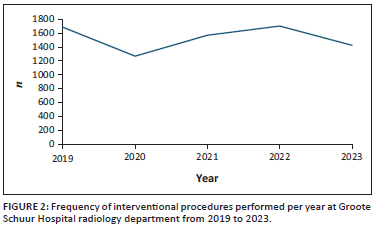
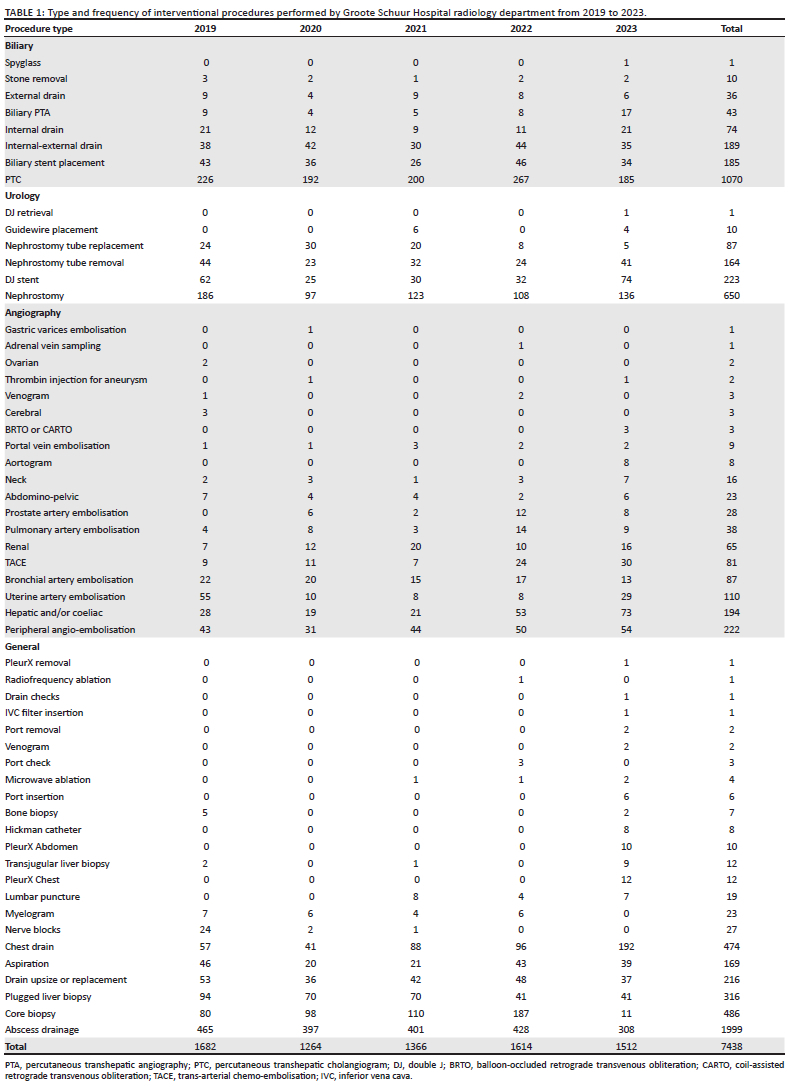
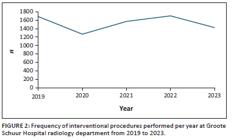
Over the 5-year period, a total of 7438 interventional procedures were performed by the GSH radiology department. The average number of procedures performed per year was 1488.
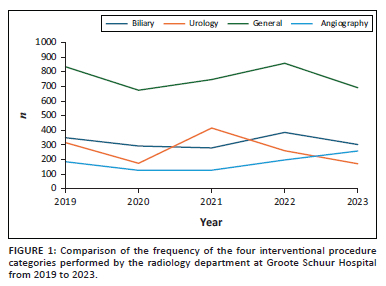
The procedures are categorised into biliary, urology, angiography and general (Table 1) according to the targeted body systems. Across all five years, general category procedures were most frequent, accounting for 51% (n = 3799) of all procedures (Figure 1). More specifically, abscess drainage, percutaneous transhepatic cholangiography (PTC) and nephrostomy were the most common procedures over the 5 years accounting for 27% (n = 1999), 14% (n = 1070) and 9% (n = 650), respectively, of the total workload.
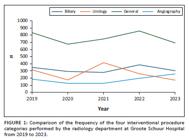
There was a decrease in the number of procedures between 2019 and 2020 (p = 0.0018) owing to the coronavirus disease 2019 (COVID-19) pandemic. From 2020 to 2021, the number of procedures increased significantly (p = 0.00625), stabilising between 2021 and 2022 (p = 0.2246) before dropping again from 2022 to 2023 (p = 0.001108) during a transition within the unit when the radiologist who had been operating the unit pursued a fellowship (Figure 2).
Prioritisation of procedures
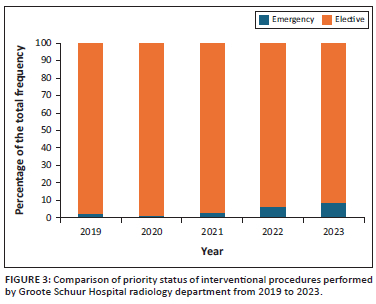
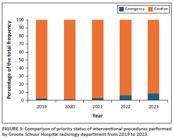
Across the years, elective procedures far outweighed emergency procedures. However, elective procedures decreased over the years from 97% of the total procedures in 2019 to 91% of the total procedures in 2023 (p < 0.001; Figure 3), indicating a statistically significant increase in emergency procedures over the years.
Utilisation patterns of Groote Schuur Hospital interventional radiology service
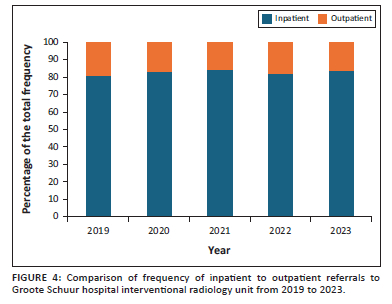
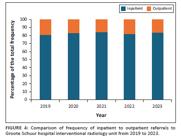
From 2019 to 2023, inpatient referrals far outweighed outpatient referrals (Figure 4). The proportion of outpatient to inpatient referrals did not change significantly over the years (p = 0.06).
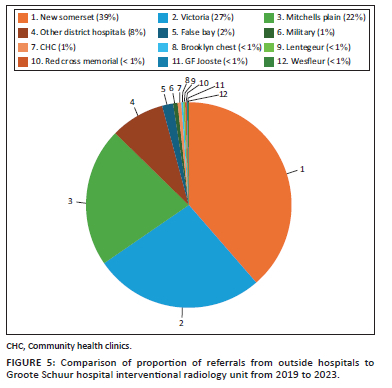
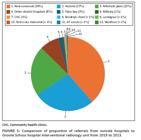
Across all years, the highest volume of referrals from other facilities were from three referral hospitals: New Somerset accounting for 39% of all external referrals, Victoria and Mitchells Plain hospitals accounting for 27% and 22% respectively (Figure 5).
Discussion
Interventional radiology is a critical component of any institution delivering high-quality care, providing minimally invasive solutions which have been proven to be safe with low morbidity and mortality rates and lower costs.5,13,26,278,28
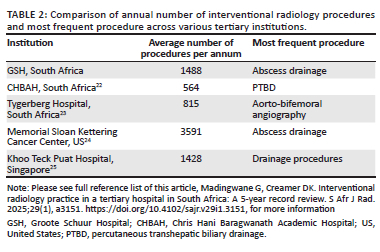
The output of the GSH IR service compares to that of a 590-bed hospital in Singapore that served a population of more than 700 000 people at the time of the study, compared to GSH, a 975-bed hospital serving a population of approximately 3 million (25). During the 5-year study (2010-2015), the hospital performed a total of 7140 IR procedures with a team of four interventionalists offering a 24/7 IR service. This equates to 4% less than the output at GSH, which currently has only one interventionalist, over the same duration of years though different time frames. Another study conducted in a single cancer centre in New York demonstrated that in 1 year alone, the centre performed 59% more procedures than GSH24Table 2). This reflects that one of the greatest barriers to IR access in South Africa and perhaps even Africa as a whole, is the lack of qualified personnel.
The recommendation by the Society of African Interventional Radiology and Endovascular Therapy (SAFIRE) is one interventional radiologist per 1 million population, while South Africa, as of 2023, is at one per 2.7 million,1928
Although limited, two recent studies conducted at public, tertiary academic hospitals in South Africa demonstrated the scope of IR practice at these facilities and can be used along with this study to depict the utilisation patterns of IR service in South Africa (Table 2). One study conducted at Chris Hani Baragwanath Academic Hospital (CHBAH) in the Gauteng province (the largest hospital in Africa), demonstrated that in 2019 the hospital performed a total of 564 interventional procedures compared to 1682 performed at GSH in the same year. Unlike at GSH, the most frequent interventional procedure offered at this institution is percutaneous transhepatic biliary drainage accounting for 26% of the workload. Important to note is that during the study period, the CHBAH biplane angiography suite was non-functional for 4 months; hence, these numbers are not a true reflection of the actual hospital IR output.22
Another similar study conducted at Tygerberg Hospital in the Western Cape province (affiliated with Stellenbosch University) over a period of 3 years (2015-2018) reported a total of 2446 fluoroscopically guided interventional procedures, averaging 815 per year. The most frequently performed procedures were aorto-bifemoral diagnostic and interventional angiography,8,23
Similar to a global survey conducted in 2023424,257,29
The variety of procedures performed has evolved over the years, especially with the addition of a fellowship trained interventional radiologist to the team in 2023. This saw the introduction of procedures such as Spyglass, tunnelled drains (PleurX) and advanced techniques of balloon-occluded retrograde transvenous obliteration (BRTO) and coil-assisted retrograde transvenous obliteration (CARTO). Procedures which were traditionally offered by surgical departments such as transjugular liver biopsy, IVC filter placement and Hickman line placement are also now being performed primarily by the IR unit. Oncology interventions, specifically TACE also demonstrated an overall increase in numbers over the 5 years. This is a major step towards matching international standards of practice where IR now forms part of the multidisciplinary care team caring for cancer patients in addition to surgical, medical and radiation oncologists.9,10
There is still room for growth through contributing to the management of acute cases in the emergency setting. With the high trauma rates in Cape Town and the increasing number of emergency cases depicted by the results, the IR unit has a role to play in the non-operative management of splenic, hepatic and renal injuries, as has been proven to be effective in other institutions and international trauma centres.6
The Royal College of Radiologists recommends a minimum of 6 radiologists for a population < 1 million to provide 24/7 IR service with provisions for full night cover and an exchange next-day cover to allow for sufficient rest and to avoid patient compromise.30
Study limitations
This study only depicts interventional procedures performed specifically by the IR unit and does not include interventional procedures performed in the ultrasound unit (which include thyroid and lymph node fine needle aspiration and musculoskeletal interventions), CT unit (CT-guided lung and spine biopsies) and mammography unit (breast ultrasound guided biopsies and placement of markers) as well as by other non-radiology departments such as vascular surgery, neurosurgery and hepatobiliary surgery, thus underestimating the actual interventional service at GSH. The studies from other institutions used for comparison had many factors that could account for the variations such as different time periods (the current study included COVID-19 pandemic), staffing and availability of equipment. The introduction of the P1, P2 and P3 prioritisation and annotation system in 2022 also caused discrepancies in the data. Some of the cases were discussed and accepted via 'Vula' and had no priority annotation on the PACS, so only the radiographers' register was used to determine the urgency level of the case. These results may not be a true representation of the ratio of elective to emergency procedures from 2022 onwards.
Recommendations
For future institutional, national or international comparative studies, there is a need to standardise IR procedure terminology to accurately document the trends in practices. For statistics and future comparison studies, the prioritisation of cases needs to be standardised, and every case must be annotated accordingly. A potential area for future studies is to investigate the time taken between accepting and annotating a case as an emergency to the procedure being done.
Conclusion
This study depicted the type and frequency of procedures offered by the GSH IR unit and the evolution of the IR service for a period of 5 years. The unit plays a substantial role in infection control and has an increasing contribution to oncologic interventions, which is consistent with international standards of practice. While there has been a progressive increase in the volume and complexity of procedures offered, particularly after the addition of a fellowship trained interventional radiologist in 2023, the unit still has a long way to go in matching the international standards of practice especially in providing acute care and comprehensive, 24/7 service. A significant number of trained interventionalists is still required to ensure the provision of a sustainable, quality standard of care without compromising on patient safety or staff wellbeing.
Competing interests
The authors declare that they have no financial or personal relationships that may have inappropriately influenced them in writing this article.
Authors' contributions
G.M. was the principal investigator, wrote the original draft, collected data and wrote the final article. D.C.K. was the supervisor of the study, edited and assisted in compiling the article.
Funding information
This research received no specific grant from any funding agency in the public, commercial or not-for-profit sectors.
Data availability
The data supporting the findings of this study are available from the corresponding author, G.M., on request.
Disclaimer
The views and opinions expressed in this article are those of the authors and are the product of professional research. The article does not necessarily reflect the official policy or position of any affiliated institution, funder, agency or that of the publisher. The authors are responsible for this article's results, findings and content.
Acknowledgements
The authors acknowledge Prof. Steve J. Beningfield for being a critical reader of the article, Joshua Anirhude (PACS administrator) and Cherral Bourne (chief radiographer) for assisting with the retrieval of PACS and radiography records. This article is based on the author's thesis entitled 'Interventional Radiology practice in a tertiary public hospital in South Africa: A 5-year study' towards the degree of Master of Medicine in the Department of Radiation Medicine, Faculty of Health Sciences, University of Cape Town, South Africa on 28 February 2025, with supervisor Dr Dale K. Creamer.
References
-
1. Brock KK, Chen SR, Sheth RA, Siewerdsen JH. Imaging in interventional radiology: 2043 and beyond. Radiology. 2023;308(1):e230146. https://doi.org/10.1148/radiol.230146
» https://doi.org/10.1148/radiol.230146 -
2. Harries-Jones EP. Interventional radiology. S Afr J Contin Med Educ [serial online]. 1985 [cited 2023 Aug 26];3(6):41-42, 45. Available from: https://inis.iaea.org/search/search.aspx?orig_q=RN:16068030
» https://inis.iaea.org/search/search.aspx?orig_q=RN:16068030 -
3. Charalel RA, McGinty G, Brant-Zawadzki M, et al. Interventional radiology delivers high-value health care and is an imaging 3.0 vanguard. J Am Coll Radiol. 2015;12(5):501-506. https://doi.org/10.1016/j.jacr.2014.10.024
» https://doi.org/10.1016/j.jacr.2014.10.024 -
4. Guan J, Elkahim T, Matsumoto M, Laage-Guapp F, Iqbal S, Sofocleous C. Interventional radiology global survey on the status of awareness and access to interventional radiology resources. J Vasc Interv Radiol. 2024;35(3):S77. https://doi.org/10.1016/j.jvir.2023.12.207
» https://doi.org/10.1016/j.jvir.2023.12.207 -
5. Arnold MJ, Keung JJ, McCarragher B. Interventional radiology: Indications and best practices. Am Fam Physician [serial online]. 2019 [cited 2025 Apr 13];99(9):547-556. Available from: https://www.aafp.org/pubs/afp/issues/2019/0501/p547.html
» https://www.aafp.org/pubs/afp/issues/2019/0501/p547.html -
6. Padia SA, Ingraham CR, Moriarty JM, et al. Society of interventional radiology position statement on endovascular intervention for trauma. J Vasc Interv Radiol. 2020;31(3):363-369.e2. https://doi.org/10.1016/j.jvir.2019.11.012
» https://doi.org/10.1016/j.jvir.2019.11.012 -
7. Hynes D, Aghajafari P. Role of interventional radiology in the management of infection. Seminars in Ultrasound, CT and MRI. 2019;41(1), 20-32. https://doi.org/10.1053/j.sult.2019.10.006
» https://doi.org/10.1053/j.sult.2019.10.006 -
8. Tsetis D, Uberoi R, Fanelli F, et al. Cirse standards of practice guidelines the provision of interventional radiology services in Europe: CIRSE recommendations. Cardiovasc Intervent Radiol. 2016;39:500-506. https://doi.org/10.1007/s00270-016-1299-0
» https://doi.org/10.1007/s00270-016-1299-0 -
9. Elsayed M, Solomon SB. Interventional oncology: 2043 and beyond. Radiology. 2023;301(1):1-14. https://doi.org/10.1148/radiol.230139
» https://doi.org/10.1148/radiol.230139 -
10. O'Neill S, O'Connor OJ, Ryan MF, Maher MM. Interventional radiology and the care of the oncology patient. Radiol Res Pract. 2011;2011:160867. https://doi.org/10.1155/2011/160867
» https://doi.org/10.1155/2011/160867 -
11. Reitano E, de'Angelis N, Bianchi G, et al. Current trends and perspectives in interventional radiology for gastrointestinal cancers. World J Radiol. 2021;13(10):314-326. https://doi.org/10.4329/wjr.v13.i10.314
» https://doi.org/10.4329/wjr.v13.i10.314 -
12. Murphy TP, Soares GM. The evolution of interventional radiology. Semin Intervent Radiol. 2005;22(1):6. https://doi.org/10.1055/s-2005-869570
» https://doi.org/10.1055/s-2005-869570 -
13. White Sarah B. Value in interventional radiology: Achieving high quality outcomes at a lower cost. Radiology. 2020;297(2):247-494. https://doi.org/10.1148/radiol.2020203407
» https://doi.org/10.1148/radiol.2020203407 -
14. Ljungqvist O, Scott M, Fearon KC. Enhanced recovery after surgery: A review. JAMA Surg. 2017;152(3):292-298. https://doi.org/10.1001/jamasurg.2016.4952
» https://doi.org/10.1001/jamasurg.2016.4952 -
15. Hashaam J, Waleed T, Muhammad AA, et al. Interventional radiology in low- and middle-income countries. Ann Med Surg. 2022;77(1):103594. https://doi.org/10.1016/j.amsu.2022.103594
» https://doi.org/10.1016/j.amsu.2022.103594 -
16. McKenney AS, Garg T, Kim E, Kesselman A. Addressing global radiology disparities: Increasing access to interventional radiology education. RadioGraphics. 2021;41(5):E142-E144. https://doi.org/10.1148/rg.2021210176
» https://doi.org/10.1148/rg.2021210176 -
17. Interventional radiology market size & share analysis - Growth trends & forecasts (2024-2029) [homepage on the Internet]. 2024 [cited 2024 Jul 22]. Available from: https://www.mordorintelligence.com/industry-reports/interventional-radiology-market
» https://www.mordorintelligence.com/industry-reports/interventional-radiology-market -
18. Silverstein J. Most of the world doesn't have access to X-Rays. The Atlantic. 2016. Available from: https://www.theatlantic.com/health/archive/2016/09/radiology-gap/501803/
» https://www.theatlantic.com/health/archive/2016/09/radiology-gap/501803/ - 19. South African Interventional Radiology Society. Tokai: SAINTS register; 2023.
-
20. Department of Statistics SA. Census 2022 results. Statistics South Africa. 2023 [cited 2024 Nov 11]. Available from: https://census.statssa.gov.za/#/
» https://census.statssa.gov.za/#/ -
21. Sharma S, Ganga K. Establishing IR in emerging countries: A skill development initiative. J Vasc Interv Radiol. 2019;30(8):956-960. https://doi.org/10.1016/j.jvir.2018.12.728
» https://doi.org/10.1016/j.jvir.2018.12.728 -
22. Slave O, Mahomed N. An audit of patient radiation doses in interventional radiology at a South African hospital. SA J Radiol. 2023;21(1):a2559. https://doi.org/10.4102/sajr.v27i1.2559
» https://doi.org/10.4102/sajr.v27i1.2559 -
23. Malan L, Pitcher R, Da Sliva M, Breuninger S, Groenewald Wi. Diagnostic reference levels for fluoroscopically guided procedures in a South African tertiary hospital. Acta Radiol. 2020;62(6):807-814. https://doi.org/10.1177/0284185120938371
» https://doi.org/10.1177/0284185120938371 -
24. Erinjeri JP, Doustaly R, Avignon G, et al. Utilization of integrated angiography-CT interventional radiology suites at a tertiary cancer center. BMC Med Imaging. 2020;20(1):1-9. https://doi.org/10.1186/s12880-020-00515-x
» https://doi.org/10.1186/s12880-020-00515-x -
25. Chung R, Chawla A, Shikhare S, Babu S. Trends and implications of 24/7 interventional radiology in a newly opened acute hospital. CVIR Endovasc. 2018;1(1):26. https://doi.org/10.1186/s42155-018-0033-1
» https://doi.org/10.1186/s42155-018-0033-1 -
26. Hawkins CM, Duszak R, Hughes DR, et al. Defining the value of interventional radiology to healthcare stakeholders: Proceedings from a society of interventional radiology research consensus panel. J Vasc Interv Radiol. 2021;32(7):1088.e1-1088.e8. https://doi.org/10.1016/j.jvir.2021.04.011
» https://doi.org/10.1016/j.jvir.2021.04.011 -
27. Matsumoto AH. Capitalizing the value of IR. J Vasc Interv Radiol. 2020;31(11):1864-1865. https://doi.org/10.1016/j.jvir.2020.07.017
» https://doi.org/10.1016/j.jvir.2020.07.017 -
28. Baerlocher MO, Kennedy SA, Ward TJ, et al. Society of interventional radiology position statement: Staffing guidelines for the interventional radiology suite. J Vasc Interv Radiol. 2016;27(5):618-622. https://doi.org/10.1016/j.jvir.2016.02.010
» https://doi.org/10.1016/j.jvir.2016.02.010 -
29. Ukweh ON, Alswang JM, Iya-Benson JN, et al. Comparative analysis of percutaneous drainage versus operative drainage of intra-abdominal abscesses in a resource-limited setting: The Tanzanian experience. Ann Glob Health. 2023;89(1):35-36. https://doi.org/10.5334/aogh.4070
» https://doi.org/10.5334/aogh.4070 -
30. Royal College of Radiologists: Standards for providing a 24-hour interventional radiology service [homepage on the Internet]. 2008 Royal College of Radiologists, 2008 [cited 2025 Apr 19]. Available from: https://scholar.google.com/scholar_lookup?title=Standards%20for%20providing%20a%2024-hour%20interventional%20radiology%20service,%20second%20edition&publication_year=2017&#d=gs_cit&t=1745077166738&u=%2Fscholar%3Fq%3Dinfo%3AC-JBDHpz5F8J%3Ascholar.google.com%2F%26output%3Dcite%26scirp%3D0%26hl%3Den
» https://scholar.google.com/scholar_lookup?title=Standards%20for%20providing%20a%2024-hour%20interventional%20radiology%20service,%20second%20edition&publication_year=2017&#d=gs_cit&t=1745077166738&u=%2Fscholar%3Fq%3Dinfo%3AC-JBDHpz5F8J%3Ascholar.google.com%2F%26output%3Dcite%26scirp%3D0%26hl%3Den

Accepted: 23 Apr. 2025
Published: 30 June 2025