Teaching the ICF or using the ICF to teach? Lessons from first-time clinical practice
Abstract
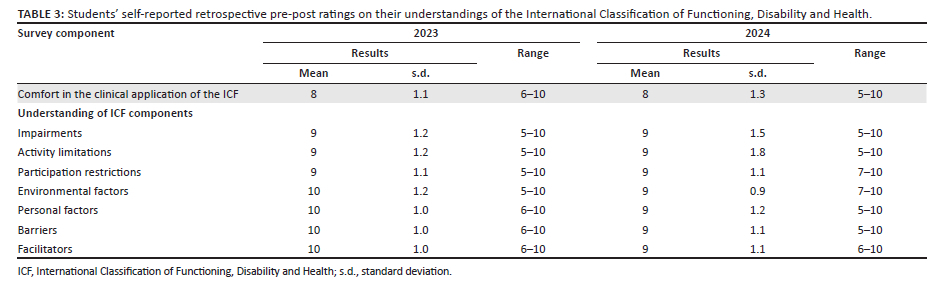
BACKGROUND: Clinical education is central to physiotherapy training, yet many students enter their first placements with limited experience in holistic clinical reasoning. The International Classification of Functioning, Disability and Health (ICF) provides a biopsychosocial framework for understanding functioning, yet its use in early clinical education remains underexplored. OBJECTIVES: This study aimed to investigate second-year physiotherapy students' self-reported understanding and application of the ICF following first time clinical exposure within a redesigned clinical course. METHOD: A quantitative cross-sectional descriptive study was conducted. All second-year physiotherapy students completing their first clinical placements in 2023 and 2024 at a South African university were invited to complete a self-developed survey. The survey assessed perceived understanding and application of ICF components using Likert-scale and categorical items. Descriptive statistics were used for analysis. RESULTS: Of the 138 eligible students, 106 responded (76.9%). Students reported improved perceived understanding of the ICF, with retrospective ratings increasing from a mean of 6 before placement to 9 after placement. Confidence in applying the ICF was high (mean = 8). CONCLUSION: Early clinical exposure structured around the ICF may support the development of holistic reasoning and encourage students to move beyond impairment-focused thinking. CLINICAL IMPLICATIONS: Embedding the ICF into early placements may strengthen patient-centred clinical reasoning.
International Classification of Functioning; Disability and Health; physiotherapy education; clinical reasoning; undergraduate students; early clinical placements; patient-centred care
 Thumbnail
 Thumbnail
 Thumbnail