Retrospective review: Factors impacting length of stay in Bipolar Disorder at a tertiary hospital
Abstract
BACKGROUND: Bipolar disorder (BD) is a chronic, disabling mental illness that may require recurrent hospitalisation. The length of hospital stay (LOS) for BD patients is variable, and literature suggests that this is because of clinical and socio-demographic factors. AIM: To determine the average LOS for patients admitted for BD at a hospital and its relation to clinical and socio-demographic factors. SETTING: A public tertiary hospital in South Africa. METHODS: Clinical and socio-demographic data were obtained from a retrospective record review of patient admissions at a hospital over 1 year. Length of hospital stay, defined as the duration between admission and discharge date, and other variables were retrieved. RESULTS: A total of 215 patients were admitted during the study period. The mean LOS was 30 days. The mean age of the patients was 35.9 years (standard deviation [s.d.] = 12.4, range 18-72 years). There were similar numbers of males and females admitted. Significantly more patients were not married (p < 0.001), unemployed (p < 0.001), and had a history of substance use (p < 0.001). Employed patients were 2.5 times more likely to have a short stay than those unemployed (p = 0.03). There was a statistically significant association between the number of comorbidities and LOS. CONCLUSION: The study findings align with the literature's results. The median length of stay was 25 days and was impacted by socio-demographic but not clinical factors. CONTRIBUTION: The study provided insight into the impact of variable factors in LOS for BD patients.
Bipolar Disorder; length of stay; clinical factors; socio-demographic factors; hospitalisation
Introduction
Bipolar disorder (BD) is a chronic, disabling mood disorder characterised by episodes of severe mood disturbance associated with a profound impact on the well-being of the patient.1234
Hospitalisation is generally indicated in the acute manic phase mainly because outpatient treatment is unlikely to be successful because of non-adherence, disorganised behaviour and impaired functional capacity. In-patients with severe depressive symptoms and at risk to attempt suicide are additional factors to consider.56782,7
Lee et al. investigated the effect of combination therapy of lithium and antipsychotics on the length of hospital stay (LOS).99101112
Electroconvulsive treatment (ECT) is the oldest and most efficient therapy that can be used for a manic episode.11314151611
Patients with treatment-resistant BD are usually challenging to manage because of their poor response to known effective regimens. Fornaro et al. investigated predictors of LOS in patients with an established history of pharmacologically resistant BD in Europe. In this study, it was found that female gender, current use of second-generation antipsychotics and being on an antidepressant were associated with prolonged admission.171618181111
Martin-Carraso et al. found that a high number of previous episodes and the presence of depressive symptoms are associated with prolonged LOS.1916202020
Literature suggests that socio-demographic factors have a significant impact on the LOS. Ismail et al. looked at age as a factor in LOS by comparing geriatrics and adult patients with mood disorders. It was found that geriatrics had more extended hospitalisation.2111622
Ismail et al. investigated LOS in geriatrics and found that living alone negatively impacted LOS. A safe discharge for someone living alone requires reasonable symptom control and a high level of functional independence compared to someone with a close support structure.21
Aims and objectives
The study aimed to determine the LOS in patients with BD and determine which (if any) clinical and socio-demographic factors impact this.
The objectives of this study are:
-
To determine the average length of stay of patients hospitalised with BD over the study period from 01 January 2022 to 31 December 2022.
-
To determine whether any demographic and clinical factors affect the length of hospitalisation.
Research methods and design
Study design
This study is an institution-based, retrospective record review of patients managed for BD at a hospital in South Africa.
Study setting
The tertiary hospital provides psychiatric services to a large population from around the area. In addition, it receives numerous patients referred from district-level hospitals, which lack the resources and capacity to manage severely ill or complex patients. The period reviewed was from 01 January 2022 to 31 December 2022.
Study population
The study population included all patients admitted to the hospital during the study period diagnosed with BD. The most recent admission was included in patients with more than one admission in the year. The inclusion criteria were in-patients diagnosed with BD as per the Diagnostic and Statistical Manual of Mental Disorders, Fifth Edition (DSM-V), patients aged 18 years and older, and patients admitted to the hospital for acute management of BD (mania or depression). Patients who were still hospitalised by the end date of the study period, pregnant women (to mitigate the effect of pregnancy on LOS), and patients who absconded or died before discharge were excluded from the analysis.
Statistical analyses
The length of stay in the hospital was described as the total number of days between the admission and discharge dates. The data were captured in Microsoft ExcelTM. Statistical analyses were conducted using R software (version 3.4.2;2α ≤ 0.05. Continuous variables and categorical data were reported accordingly. The association between length of stay and multiple variables was analysed using Pearson's chi-squared or Fisher's tests. Further analysis included binary post-hoc tests and pairwise Fisher's tests. Odds ratios are reported for significant Fisher's p values. The continuous variables were assessed for departure from normality using the Shapiro-Wilk test and subsequently analysed using a Mann-Whitney U test.
Ethical considerations
Ethical clearance to conduct this study was obtained from the University of the Witwatersrand, Human Research Ethics Committee (No. M230443). Written permission was obtained from the hospital management. Privacy and confidentiality of the participants were maintained by ensuring that no identifying information was on the data collection form; instead, the researcher allocated the participants a unique number associated with their clinical records, and the linked file was kept separately. Signed patient informed consent was not required for the record review.
Results
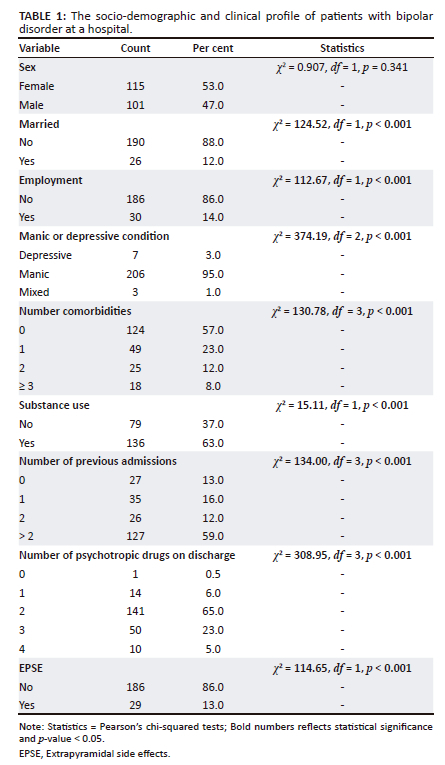
This retrospective study included 215 patients. Sample sizes in the analyses might vary because of missing data for some variables. The mean age of the patients was 35.95 years (s.d. = 12.45, range: 18-72 years). Table 1 summarises the socio-demographic and clinical profiles of the study participants. The number of females did not differ significantly from that of males (Table 1). In contrast, significantly more patients were not married than married, and significantly more patients were not employed than employed (Table 1). For the polarity of the episodes, significantly more patients had manic episodes than depressed and mixed episodes (binary post hoc), and the majority of patients had no comorbidities compared to those with 1, 2 and 3 or more comorbidities. There was a significantly higher number of patients who used substances than those without a history of substance use. Most patients had more than two previous admissions compared to those with 0-2 admissions (binary post hoc). In the category of patients on psychotropic medications on discharge, significantly more patients were on two psychotropics compared to those on 0, 1, 3 and 4 psychotropics (binary post hoc), and only one patient was on no psychotropic. Significantly more patients did not have EPSE than those who did. Finally, none of the patients were treated with ECT (see Table 1).
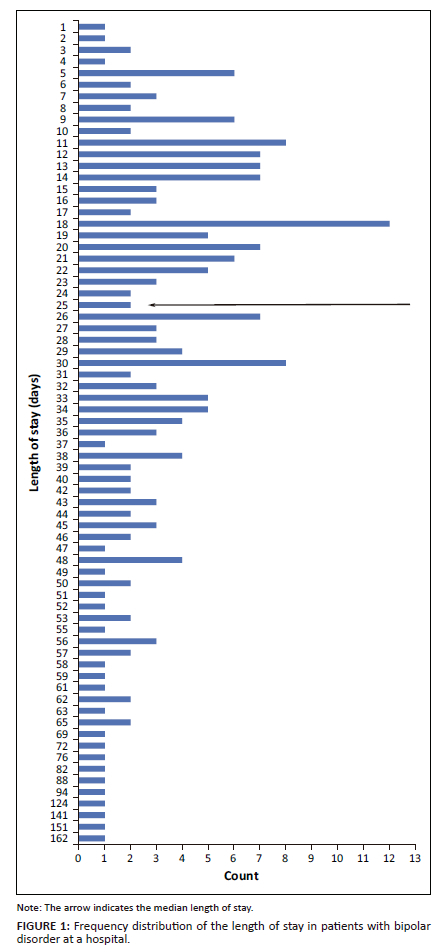
The median length of stay was 25 days (1st interquartile range [IQR] = 14 days, 3rd IQR = 38 days). The mean length of stay was 30 days (s.d. = 23.89, IQR 1-162 days). Based on the median score, the length of stay of patients was divided into short-stay patients (< 25 days) and long-stay patients (≥ 25 days). Figure 1 shows a frequency distribution of the length of stay in patients in this study. Most patients spent 18 days in hospital.
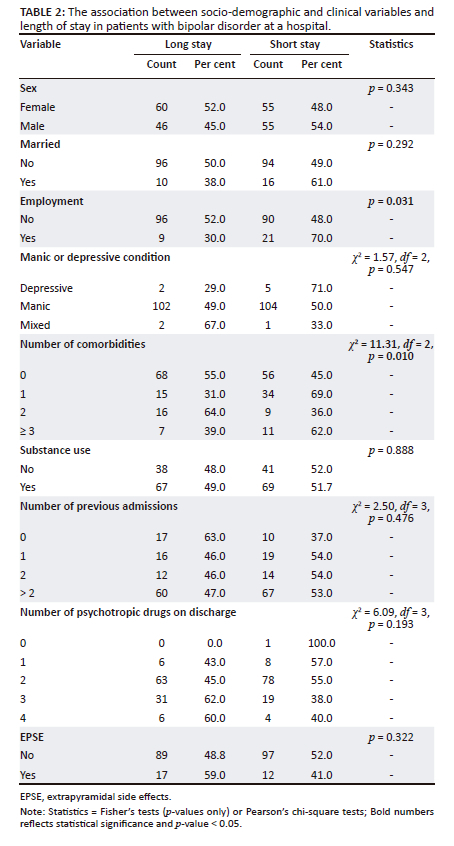
The age of the patients was not a significant predictor of the length of stay (W = 5377.00, p = 0.682). Most other socio-demographic and clinical variables were not significant predictors of the length of stay (Table 2). However, employment and the number of comorbidities were significant predictors of the length of stay (Table 2). Employed patients were 2.5 times more likely to have short stays than those not employed (odds ratio [OR]). Patients with one comorbidity were 2.7 and 3.9 times more likely to have short stays than those with no and two comorbidities, respectively. Similarly, those with three or more comorbidities were 1.7 times more likely to have a short stay than those without.
Discussion
This study aimed to determine the LOS and factors associated with prolonged length of stay in patients admitted to the hospital with BD. The median length of stay was 25 days (1st IQR = 14 days, 3rd IQR = 38 days). The mean length of stay was 30 days (s.d. = 23.89, IQR 1-162 days). This median LOS was comparable to a study conducted by Wang et al. which found a median LOS of 28 days in 4451 patients.23 24 12,16 A Malawian study found the length of stay in their facility to be 22.08 ± 27.20 days.11
The variability of LOS across different countries may be because of resource availability, which impacts the quality of psychiatric care. The lack of access to other medications may potentially delay the clinical response and recovery of patients admitted with BD. It has been reported that some institutions have limited access to atypical antipsychotics and other effective drugs that are used commonly.11,12
Concerning the socio-demographic variables, there were no significant differences in the numbers of males and females, but the majority of the patients were single, unemployed and used substances. The similarities in the presentation of males and females are congruent with a previous study on BD that found a 1:1 presentation of males and females.226,27 This can partly be explained by the overwhelming majority of patients presenting with a manic episode. It appears that patients are more likely to be brought to the hospital when manic, probably because of the level of disruption experienced by those around them.
Gender was also not a statistically significant predictor of prolonged stay in the BD patients in this sample. These findings are congruent with a study conducted in Malawi.11128282829
In this study, age was also not a significant predictor of prolonged LOS. This finding concurs with the Malawian study.11111,30 The low proportion of married participants in the sample may impact this.
Employment was a significant predictor of LOS; employed patients had shorter stays than those not employed. These findings were congruent with those of a study conducted in China, which found that unemployment was associated with prolonged LOS.24313030
Regarding the clinical characteristics, the polarity of the disorder (manic/depressive) was not a significant predictor of LOS. The majority of the patients in this sample presented with mania, thus making the sample of patients with depressive symptoms inadequate to generate statistical significance. The findings on episode polarity are congruent with the study conducted by Shi et al., which found that polarity was not a significant predictor of LOS.2417
On the other hand, comorbidities were a significant predictor of LOS. The study by Shi et al. found that comorbid anxiety disorders did not increase LOS in their sample.2420
This study found that the number of patients with comorbid substance abuse was significantly higher in the group with prolonged length of stay compared to the short stay group. However, neither variable was an independent predictor of LOS in this study. These findings again contradict previous studies that show comorbid substance abuse to be an independent predictor of LOS. Patients with comorbid substance use might be admitted with symptoms secondary to misuse rather than BD symptoms. Therefore, this might lead to a shorter hospital stay as the symptoms generally resolve quickly.2828
Similar to the findings on LOS, the findings on independent predictors of LOS vary from study to study, necessitating a need for context-specific research. In their study, Harman et al. concluded that about 11% of the variation in the length of stay for psychiatric disorders could be attributed to the treatment practices at the facility where patients are being treated.32
Strengths and limitations
The quality of the data collected is dependent on how comprehensively the information was captured initially. Patients are usually admitted with an acute manic episode or unstable condition, which may prevent the accurate collection of socio-demographic data and past medical history. The study includes patients from only one unit, which will affect generalisability. Each clinician in an institution likely has a similar way of managing BD. This is borne out by the absence of ECT use in any of the patients. The diagnosis cannot be corroborated since it is a retrospective review where there is always a risk of information bias. Literature on the length of stay for hospitalised patients with BD has investigated extensively the impact of socio-demographic factors. It is well documented that the results may not be fully applicable to other populations because of the retrospective nature of the studies, small sample size and other study limitations. In the same way, this review did not identify specific comorbidities that are known to individually contribute to prolonged length of stay because of the nature of the disorder. Additionally, the substance use variable was not fully described in terms of the nature of use and type of substance.
Although this study provides South African data on LOS in BD patients for the first time, there were limitations. This study could not determine whether or not some of the observed associations were related to institutional practices. Future research using primary data such as interviews would improve the robustness of these findings.
Conclusion
This study's findings are comparable with those from other studies in low- and middle-income countries and developed countries. Notwithstanding the limitations, the study provides data regarding the socio-demographic and clinical factors that impact the LOS in BD patients admitted to a hospital. This has predictive value for optimising care and minimising admission duration in patients with BD. This, in turn, may result in better patient outcomes and cost savings for the institution. Multicentre studies are recommended to expand the cohort size, which can increase the statistical power and enhance the generalisability of the findings.
Competing interests
The authors declare that they have no financial or personal relationship(s) that may have inappropriately influenced them in writing this article.
Authors' contributions
N.C.M. and W.F. conceptualised and developed the research proposal, interpreted the results, writing - editing and revision of the draft, and writing the final submitted article.
Funding information
This research received no specific grant from any funding agency in the public, commercial or not-for-profit sectors.
Data availability
The data is not openly accessible as it could potentially violate the privacy of research participants. The data supporting the results of this research can be obtained by contacting the corresponding author, N.C.M.
Disclaimer
The views and opinions expressed in this article are those of the authors and are the product of professional research. The article does not necessarily reflect the official policy or position of any affiliated institution, funder, agency or that of the publisher. The authors are responsible for this article's results, findings and content.
Acknowledgements
The authors would like to extend their gratitude to Prof. N. Pillay for his meticulous statistical analysis, Conny Matlhadisa for her assistance with data capturing, and Dr. Moses Matlhadisa for his unwavering support and encouragement.
References
-
1. Bodicherla KP, Mathialagan K, Caraballo-Rivera EJ, Patel RS. Predictors for extending hospitalization stay in electroconvulsive therapy recipients with bipolar disorder, manic episodes. Cureus. 2020;12(6):e8832. https://doi.org/10.7759/cureus.8832
» https://doi.org/10.7759/cureus.8832 -
2. Kessing LV, Hansen MG, Andersen PK. Course of illness in depressive and bipolar disorders: Naturalistic study, 1994-1999. Br J Psychiatry. 2004;185(5):372-377. https://doi.org/10.1192/bjp.185.5.372
» https://doi.org/10.1192/bjp.185.5.372 -
3. Ciobanu LG, Ferrari AJ, Erskine HE, et al. The prevalence and burden of mental and substance use disorders in Australia: Findings from the Global Burden of Disease Study 2015. Aust N Z J Psychiatry. 2018;52(5):483-490. https://doi.org/10.1177/0004867417751641
» https://doi.org/10.1177/0004867417751641 -
4. Esan O, Esan A. Epidemiology and burden of bipolar disorder in Africa: A systematic review of data from Africa. Soc Psychiatry Psychiatr Epidemiol. 2016;51(1):93-100. https://doi.org/10.1007/s00127-015-1091-5
» https://doi.org/10.1007/s00127-015-1091-5 -
5. Ösby U, Tiainen A, Backlund L, et al. Psychiatric admissions and hospitalization costs in bipolar disorder in Sweden. J Affect Disord. 2009;115(3):315-322. https://doi.org/10.1016/j.jad.2008.09.011
» https://doi.org/10.1016/j.jad.2008.09.011 - 6. Bergeson JG, Kalsekar I, Jing Y, You M, Forbes RA, Hebden T. Medical care costs and hospitalization in patients with bipolar disorder treated with atypical antipsychotics. Am Health Drug Benefits. 2012;5(6):379-386.
-
7. Abaatyo J, Kaggwa MM, Favina A, Olagunju AT. Readmission and associated clinical factors among individuals admitted with bipolar affective disorder at a psychiatry facility in Uganda. BMC Psychiatry. 2023;23(1):474. https://doi.org/10.1186/s12888-023-04960-0
» https://doi.org/10.1186/s12888-023-04960-0 -
8. Hamilton JE, Passos IC, De Azevedo Cardoso T, et al. Predictors of psychiatric readmission among patients with bipolar disorder at an academic safety-net hospital. Aust N Z J Psychiatry. 2016;50(6):584-593. https://doi.org/10.1177/0004867415605171
» https://doi.org/10.1177/0004867415605171 -
9. Lee HK, Prabhudesai S, Vadukapuram R, Eskander N, Patel RS. Combination regimen with lithium and antipsychotic in bipolar manic episodes: Impact on adult hospitalization length of stay. Cureus. 2020;12(6):e8568. https://doi.org/10.7759/cureus.8568
» https://doi.org/10.7759/cureus.8568 -
10. Geoffroy PA, Etain B, Henry C, Bellivier F. Combination therapy for manic phases: A critical review of a common practice. CNS Neurosci Ther. 2012;18(12):957-964. https://doi.org/10.1111/cns.12017
» https://doi.org/10.1111/cns.12017 -
11. Barnett BS, Kusunzi V, Magola L, et al. Factors associated with long length of stay in an inpatient psychiatric unit in Lilongwe, Malawi. Soc Psychiatry Psychiatr Epidemiol. 2019;54(2):235-242. https://doi.org/10.1007/s00127-018-1611-1
» https://doi.org/10.1007/s00127-018-1611-1 -
12. Addisu F, Wondafrash M, Chemali Z, Dejene T, Tesfaye M. Length of stay of psychiatric admissions in a general hospital in Ethiopia: A retrospective study. Int J Ment Health Syst. 2015;9(1):13. https://doi.org/10.1186/s13033-015-0006-x
» https://doi.org/10.1186/s13033-015-0006-x -
13. Perugi G, Medda P, Toni C, Mariani M, Socci C, Mauri M. The role of electroconvulsive therapy (ECT) in bipolar disorder: Effectiveness in 522 patients with bipolar depression, mixed-state, mania and catatonic features. Curr Neuropharmacol. 2017;15(3):359-371. https://doi.org/10.2174/1570159X14666161017233642
» https://doi.org/10.2174/1570159X14666161017233642 -
14. Ross EL, Zivin K, Maixner DF. Cost-effectiveness of electroconvulsive therapy vs pharmacotherapy/psychotherapy for treatment-resistant depression in the United States. JAMA Psychiatry. 2018;75(7):713. https://doi.org/10.1001/jamapsychiatry.2018.0768
» https://doi.org/10.1001/jamapsychiatry.2018.0768 -
15. Patel RS, Jain SB, Youssef NA. Electroconvulsive treatment utilization for the inpatient management of severe manic episodes of bipolar disorder. J ECT. 2019;35(3):195-200. https://doi.org/10.1097/YCT.0000000000000587
» https://doi.org/10.1097/YCT.0000000000000587 - 16. Ukpong D, Mosaku S. [Demographic and clinical correlates of length of stay in a Nigerian university hospital psychiatric unit]. Turk Psikiyatri Derg Turk J Psychiatry. 2009;20(1):49-55.
-
17. Fornaro M, Iasevoli F, Novello S, et al. Predictors of hospitalization length of stay among re-admitted treatment-resistant bipolar disorder inpatients. J Affect Disord. 2018;228:118-124. https://doi.org/10.1016/j.jad.2017.12.009
» https://doi.org/10.1016/j.jad.2017.12.009 -
18. Hoblyn JC, Balt SL, Woodard SA, Brooks JO. Substance use disorders as risk factors for psychiatric hospitalization in bipolar disorder. Psychiatr Serv. 2009;60(1):50-55. https://doi.org/10.1176/ps.2009.60.1.50
» https://doi.org/10.1176/ps.2009.60.1.50 -
19. Martin-Carrasco M, Gonzalez-Pinto A, Galan JL, Ballesteros J, Maurino J, Vieta E. Number of prior episodes and the presence of depressive symptoms are associated with longer length of stay for patients with acute manic episodes. Ann Gen Psychiatry. 2012;11(1):7. https://doi.org/10.1186/1744-859X-11-7
» https://doi.org/10.1186/1744-859X-11-7 -
20. Douzenis A, Seretis D, Nika S, et al. Factors affecting hospital stay in psychiatric patients: The role of active comorbidity. BMC Health Serv Res. 2012;12(1):166. https://doi.org/10.1186/1472-6963-12-166
» https://doi.org/10.1186/1472-6963-12-166 -
21. Ismail Z, Arenovich T, Grieve C, et al. Predicting hospital length of stay for geriatric patients with mood disorders. Can J Psychiatry. 2012;57(11):696-703. https://doi.org/10.1177/070674371205701107
» https://doi.org/10.1177/070674371205701107 -
22. Newman L, Harris V, Evans LJ, Beck A. Factors Associated with length of stay in psychiatric inpatient services in London, UK. Psychiatr Q. 2018;89(1):33-43. https://doi.org/10.1007/s11126-017-9498-7
» https://doi.org/10.1007/s11126-017-9498-7 -
23. Wang W, Du J, Li S, Xie G, Xu J, Ren Y. Demographic, clinical and biochemical correlates of the length of stay for different polarities in Chinese inpatients with bipolar disorder: A real-world study. Front Hum Neurosci. 2023;17:1135403. https://doi.org/10.3389/fnhum.2023.1135403
» https://doi.org/10.3389/fnhum.2023.1135403 -
24. Shi X, Zhao Y, Yang H, et al. Factors associated with hospitalization times and length of stay in patients with bipolar disorder. Front Psychiatry. 2023;14:1140908. https://doi.org/10.3389/fpsyt.2023.1140908
» https://doi.org/10.3389/fpsyt.2023.1140908 -
25. Dell'Osso B, Camuri G, Cremaschi L, et al. Lifetime presence of psychotic symptoms in bipolar disorder is associated with less favorable socio-demographic and certain clinical features. Compr Psychiatry. 2017;76:169-176. https://doi.org/10.1016/j.comppsych.2017.04.005
» https://doi.org/10.1016/j.comppsych.2017.04.005 -
26. De La Fuente-Tomás L, Sierra P, Sanchez-Autet M, et al. A clinical staging model for bipolar disorder: Longitudinal approach. Transl Psychiatry. 2020;10(1):45. https://doi.org/10.1038/s41398-020-0718-9
» https://doi.org/10.1038/s41398-020-0718-9 -
27. Gogos A, Ney LJ, Seymour N, Van Rheenen TE, Felmingham KL. Sex differences in schizophrenia, bipolar disorder, and post-traumatic stress disorder: Are gonadal hormones the link? Br J Pharmacol. 2019;176(21):4119-4135. https://doi.org/10.1111/bph.14584
» https://doi.org/10.1111/bph.14584 -
28. Ragazan DC, Eberhard J, Ösby U, Berge J. Gender influence on the bipolar disorder inpatient length of stay in Sweden, 2005-2014: A register-based study. J Affect Disord. 2019;256:183-191. https://doi.org/10.1016/j.jad.2019.05.052
» https://doi.org/10.1016/j.jad.2019.05.052 -
29. Geniş B, Coşar B. Duration of hospital stay in alcohol/substance addictions and psychiatric disorders: A 12-year retrospective analysis. Hosp Pract Res. 2020;5(1):3-9. https://doi.org/10.34172/hpr.2020.02
» https://doi.org/10.34172/hpr.2020.02 - 30. Adegunloye O, Abdullah Y, Ajiboye P, Issa B, Buhari O. Correlates of length of stay among psychiatric in-patients in a tertiary health institution in Nigeria. Res J Med Sci. 2009;3:56-61.
-
31. Lomastro M, Valerio M, Blasco M, Tagni M, Martino D. Predictors of high psychosocial functioning in bipolar disorder. J Nerv Ment Dis. 2020;208(11):904-907. https://doi.org/10.1097/NMD.0000000000001224
» https://doi.org/10.1097/NMD.0000000000001224 -
32. Harman JS, Cuffel BJ, Kelleher KJ. Profiling hospitals for length of stay for treatment of psychiatric disorders. J Behav Health Serv Res. 2004;31:66-74. https://doi.org/10.1007/BF02287339
» https://doi.org/10.1007/BF02287339

Accepted: 09 Aug. 2024
Published: 07 Oct. 2024