Job satisfaction, personality traits, and its impact on motivation among mental health workers
Abstract
BACKGROUND: Working in a resource setting that caters to people's poor mental health is associated with increased vulnerability to physical, psychological, and social stressors that make motivation to work a difficult goal to attain. One way of viewing physical and social stressors in the workplace is to evaluate job satisfaction which has both intrinsic and extrinsic components. The personality of workers is a component of psychological wellbeing and this determines the way events and situations are perceived. Thus, the achievement of the mission and vision of an organisation will be dependent on the level of motivation of the employees which will be influenced by their predominant personality traits and the level of satisfaction at work. AIM: My study aimed to sought to highlight the relationship between motivation, job satisfaction and personality dimensions. SETTING: The Neuropsychiatric Hospital, Aro, Abeokuta, Ogun State, Nigeria. METHODS: Our study involved a cross-sectional study of staff showing the relationship between motivation, job satisfaction and personality traits among mental health workers. A total of 146 participants using systematic proportional sampling were analysed with a response rate of 67.3%. A Socio-demographic Questionnaire, Minnesota Satisfaction Questionnaire (Short Version), Big Five Inventory and the Multidimensional Work-Motivation Scale were administered to the participants. In the analysis, linear correlation and linear regression were used to determine the relationship between continuous variables (Normality was determined using kurtosis and skewness) while t-test was used to determine the relationship between categorical independent variables and continuous dependent variables RESULTS: The level of significance was set at < 0.05 while higher scores using the Multidimensional Work-Motivation Scale represented motivated participants and vis-a-vis. The socio-demographic variable was explored using descriptive statistics; the relationship between personality, job satisfaction and motivation were explored using t-test. Most of the participants were married (80.8%), female (60.3%), with at least tertiary education (63%) and with an occupational status of class I (76%). The mean age of the participants was 40.29 ± 8.27 with a mean length of service of 13.63 ± 8.49. The most dominant personality traits were agreeableness (97.3%) and conscientiousness (97.3%), and the least was neuroticism (55.5). High agreeableness (0.01), high conscientiousness (0.03), and high openness (0.01) were significant and positively correlated with motivation. The relationship between motivation and gender (t = 4.26; p ≤ 0.001) and occupational status were statistically significant (t = -3.59; p ≤ 0.001). CONCLUSION: To proffer a solution to poor motivation in the workplace, human resource department should give more focus to individuals with high scores in agreeableness, conscientiousness, and openness. This is because it appears that they are more likely to be motivated at work and likely to move the organisation to a greater height. Besides, those with high neurotic scores who have already been employed will require some form of psychological remodelling (therapy), so they can contribute meaningfully to the institution.
job satisfaction; personality; motivation; Aro; Abeokuta; mental health
Introduction
For any organisation to achieve its mission and vision, the employees must be motivated. However, the motivation of employees is influenced by their personality traits and their subjective and objective sense of job satisfaction.
Pencheon defined motivation as the extent to which tenacious effort is directed towards an organisational goal.123
Studies of human motivation have postulated different opinions on how people become motivated. These include Maslow's Hierarchy of Needs, Alderfer's Theory, Herzberg's Two-factor Theory and McClelland's Acquired Needs Theory. This does not leave out the opinions of Skinner's Reinforcement that focuses on external factors and those of Adam's Equity Theory, Vroom's Expectancy Theory, and Locke's Goal-setting Theory which concentrates on internal factors. These theories postulate that to satisfy this intrinsic and extrinsic fulfilment (motivation) within a work environment, the workforce must have a sense of satisfaction with the role they play in their institution (job satisfaction), and their perception of the workplace will be influenced by their personality.2,3,4
Furthermore, job satisfaction can be defined as a prolonged, pleasurable and positive state of feeling based on an individual's job or workplace experiences.34
The evaluation of an employee's duties and possible benefit is coloured by their personality. What is important is that people's personality is not only quantitative but qualitative. Hence, while the terms of reference of a job may appear tedious to one individual, it may be simple to another, not because the volume of activities are reduced but because their personality has input on how things are perceived. To this end, whether or not a challenging work gets appropriate value system such as opportunities to progress in one's chosen career or having a desired and competent supervisor or having cooperative co-workers, the determinant of satisfaction is dependent on an individual's personality trait.3
Theories on personality traits opine that different people have several dispositions to how they respond to physical, psychological and social environments. The understanding of this opinion allows managers to have a better understanding on how to communicate with staff in the workplace and how best to approach job sizing. Moreover, personality traits may serve as key indicators of other parts of an individual's personal life of which motivation and job satisfaction are paramount.1,2,3,5
In any healthcare setting and especially in the mental health sector, the main objectives are to ensure that mental health services are not only available in tertiary and secondary care but are also available in primary healthcare settings. Also, these services should be affordable, accessible and as modern as possible. In order to achieve these objectives, mental and general health workforce are needed in large numbers so that they can function in all the needed multidisciplinary cadre and in all the vital geographical regions. One of the things that inhibit how these objectives are met is the lack of explicit human resource management policies, especially in most less developed countries including Nigeria. Policies should focus on mental health professions such that physical, psychological and social needs are met and also noting that these workforce are heterogeneous with differing economic needs. Thus, health organisations are faced with external pressures that cannot be effectively met without appropriate adjustments. As a result, motivation, job satisfaction and personality traits remain crucial to developing health policies in low to middle-income countries like Nigeria.
The lack of commitment in the healthcare sector, especially mental health services in less developed countries like Nigeria is as a result of the stigma associated with mental illness and mental health workers. To overcome the overwhelming stigma associated with this industry, the workforce must be motivated if the minimum standard of service will be made available.3
Despite this fact, few studies have looked into the topic of motivation among employees in the mental health industry in Nigeria. Moreover, there is little or no literature on the relationship between motivation, job satisfaction and employees' personality traits. The dwindling economic status or power of most mental health workers has made it difficult to improve satisfaction at the workplace with possible harmful gene-environment interaction with healthcare workers' personalities especially in low- and middle-income societies like Nigeria.1
In addition, there is a general consensus that there may be risk factors underlying the relationship between personality traits and job satisfaction, although these have been scarcely studied.1,2,3,4,51,2,3,4,51,2,3,4,5
Materials and methods
This involved a cross-sectional study showing the relationship between motivation, job satisfaction and personality traits among mental health workers. My study was carried out at the Neuropsychiatric Hospital, Aro, Abeokuta, Ogun State, between September and October 2020. The hospital initially started at its annexe in 1944 as an asylum for soldiers who were repatriated home due to mental illness after the Second World War. The current main site, Aro, was built in 1954 when the need for a modern psychiatric hospital arose. The hospital renders services to patients from all over Nigeria and from neighbouring West African countries. It has a total capacity of 546 beds for inpatient care, 153 beds at the main hospital and 393 beds at the Lantoro annexe. As of March 2020, the total staff strength of the Neuropsychiatric Hospital, Aro, Abeokuta was 500.
Sample size and sampling technique
The sample size formula used in epidemiological studies for calculating the mean of a sample from a large population described by Cochran6
Data collection
Based on the fraction that each unit contribute to the entire data population, the systematic sampling frequency was calculated by dividing the unit population by the number they contributed to the sample population. The first participant was picked through random sampling method before systematic random sampling was applied. Subsequently, a Socio-Demographic Questionnaire, Minnesota Satisfaction Questionnaire (Short Version) and the Big Five Personality Inventory were administered.7,8
Data analysis
Data were analysed using the Statistical Package for Social Science (SPSS version 25), Computer Software. Data was presented in frequency tables for descriptive statistics. The level of significance was set at p < 0.05. Some socio-demographic variables and clinical variables were regrouped to make them categorical variables and to eliminate empty cells during analysis. The patient's occupation was classified according to the system of Boroffka and Olatawura as follows9t-test was used to determine the relationship between categorical independent variables and continuous dependent variables.
Ethical considerations
Approval to conduct the study was obtained from the Neuropsychiatric Hospital, Aro Research Ethics Committee, reference number: PR0/14/17.
Result
Response rate
A total of 217 questionnaires were distributed, but only 146 were returned giving a response rate of 67.3%.
Socio-demographic characteristics of study participants
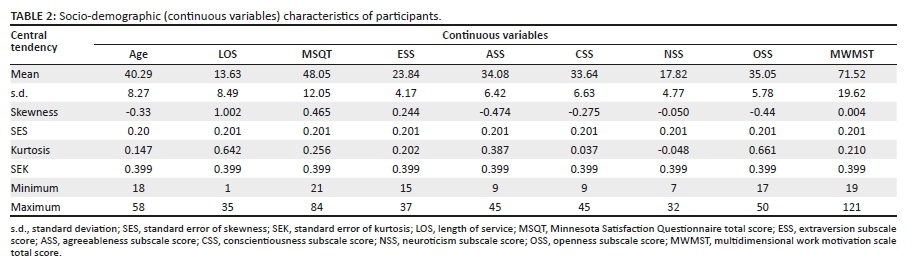
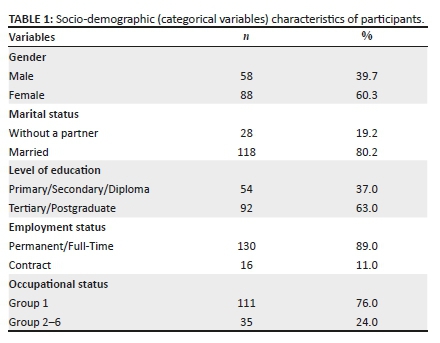
The age range of the respondents was 18-58 years with a mean (s.d.) of 40.29 (8.27) years. Other details can be found in Table 1 and Table 2.
Personality dimensions among study participants
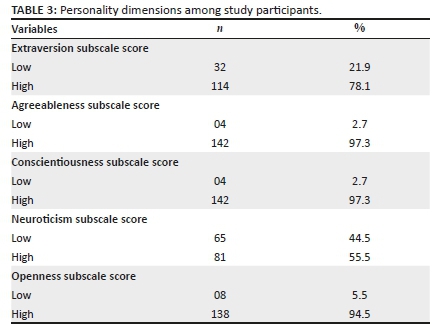
Table 3 shows the personality dimensions of study participants.
Relationship between motivation and sociodemographic variables, job satisfaction and personality
Table 4 shows the relationship between motivation and job satisfaction, age, and personality dimensions.
Relationship between motivation and categorical variables
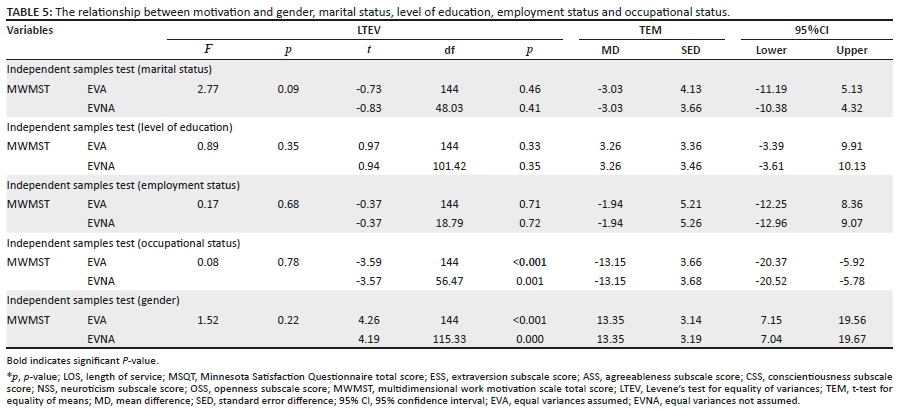
Table 5 shows the relationship between motivation and gender, marital status, level of education, employment status and occupational status.
Discussion
The response rate observed in my study was lower than that of two previous studies conducted among mental health workers in North Central (90%)101111
This study reveals a high mean score for motivation (71.52), which is similar to a study1213
Motivation is believed to have two core dimensions, namely, intrinsic motivation (which has to do with the fact that activities are done because they are enjoyed) and extrinsic motivation (which associates one's willingness to be involved in an activity based on his or her values and beliefs). Furthermore, motivation could be viewed in the following dimensions: Amotivation, where workers have no intention to engage in work; External regulation, where workers do an activity only to obtain a reward; Introjected regulation, where workers are motivated by self-worth and related factors; Identified regulation, where workers recognise the value of the activity and perceive it as their own; Integrated regulation, where the value of the activity is part of a worker's identity; Intrinsic motivation, where workers find the task inherently enjoyable, challenging, and/or a form of self-actualisation. In the light of this information workers in a mental health facility may enjoy their work and thus have an innate interest in their work or their motivation thrust from external, introjected, identified, and integrated regulations. This may explain the finding of high motivation scores despite the economic plight of the nation.
The mean score for job satisfaction was 48.05; this was lower than what was reported within the same facility where my present study was conducted.14
The author's study showed that the most prevalent personality dimensions were agreeableness and conscientiousness. Agreeableness is related to how well people get along with others. The trait of agreeableness includes people who are warm-natured, trustworthy, cooperative, compliant, compassionate, and supportive. They are also altruistic, modest, patient, moderate, tactful, polite, sensitive, amiable, cheerful and considerate.15
On the other hand, conscientiousness encompasses dependability, responsibility, ambition, thoroughness, self-discipline, predictableness, resourcefulness, diligence, dynamism, planning, achievement orientation and deliberation. It entails following established rules and includes people who are persistent and organised. A person who is low in conscientiousness is much more likely to procrastinate, to be flighty, impetuous, and impulsive. Considering this information, the staff of this institution are systematic, purposeful individuals who are soft-hearted and forgiving, determined, strong-willed and helpful. This finding was in contrast to a finding in Istanbul, among nurses and physicians16
The author found a significant relationship between motivation and agreeableness, conscientiousness, and openness. This is interpreted to mean that the staff of the Neuropsychiatric Hospital, Aro, Abeokuta, could be viewed as individuals with communications skills who build connections between different parties and are willing to learn from every opportunity. Besides, they are goal-directed and think outside the box and as managers, they have good learning and performance orientation.17
The results showed a significant relationship between female gender and motivation and thus buttressed the opinion that female gender is a significant factor in workplace motivation.18
In conclusion, the author observed that high motivation among mental health workers at the Neuropsychiatric hospital, Aro, Abeokuta was significantly related to the following socio-demographic variables: gender and occupational status. Also, high motivation in this mental health facility was directly related (positive correlation) to the following personality traits: agreeableness, conscientiousness, and neuroticism.
In the light of the foregoing, the author recommends that, firstly, motivation in the workplace is important and it is heightened by factors such as being female, having tertiary education, class I occupational status and being married. It will be important for government and policymakers to focus their attention on the male gender, those who are not married, staff with an educational status lower than tertiary education and people with an economic class lower than one. Secondly, to proffer a solution to the poor motivation in the workplace, the human resource department should focus more on individuals with high scores in agreeableness, conscientiousness, and openness. It appears that they are more likely to be motivated at work and likely to move the institution to a greater height. Besides, those with high neurotic scores who have already been employed will require some form of psychological remodelling to allow them contribute meaningfully to the institution.
Finally, every workplace should provide mental health services for its employees with a view of promoting mental health and ensuring psychological stability within the workplace. It is important to note that my study is not without its limitations. The limitations of my study include the following: my study is a cross-sectional study and therefore, it was not possible to establish the causality in the relationship between motivation and personality dimensions and job satisfaction. The use of self-reported questionnaires to assess motivation, personality dimension and job satisfaction may be associated with recall bias and it is not certain how this could have affected the findings. Therefore, future studies should consider a longitudinal study as a more realistic and reliable approach to determining causality. Furthermore, qualitative studies may be used to overcome recall bias which will provide more information on the constructs of motivation, personality dimension and job satisfaction.
Competing interests
The author declares that they have no financial or personal relationships that may have inappropriately influenced them in writing this article.
Author's contributions
O.A.S. is the sole author of this article.
Funding information
This research received no specific grant from any funding agency in the public, commercial or not-for-profit sector.
Data availability
Data that support the findings of this study are available from the author upon reasonable request.
Disclaimer
The views and opinions expressed in this article are those of the author and do not necessarily reflect the official policy or position of any affiliated agency of the author.
Acknowledgements
The author appreciates the entire staff of the Neuropsychiatric Hospital, Aro Abeokuta, and his wife, Oluwatoyin Sowunmi, for her help and support during data collection.
References
-
1.Pencheon D. Leadership and motivation. BMJ. 2000;321(7256):S2-S7256. https://doi.org/10.1136/bmj.321.7256.s2-7256
» https://doi.org/10.1136/bmj.321.7256.s2-7256 -
2.Moon TW, Hur WM, Hyun SS. How service employees' work motivations lead to job performance: The role of service employees' job creativity and customer orientation. Curr Psychol. 2019;38(2):517-532. https://doi.org/10.1007/s12144-017-9630-8
» https://doi.org/10.1007/s12144-017-9630-8 -
3.Lambrou P, Kontodimopoulos N, Niakas D. Motivation and job satisfaction among medical and nursing staff in a Cyprus public general hospital. Hum Resour Health. 2010;8:26. https://doi.org/10.1186/1478-4491-8-26
» https://doi.org/10.1186/1478-4491-8-26 - 4.Masa'deh R, Almajali DA, Alrowwad A, Obeidat B. The role of knowledge management infrastructure in enhancing job satisfaction: A developing country perspective. Rev Lit Arts Ame. 1999;178(August):173-178.
-
5.Ransohoff DF. More on gastric lesions, aspirin, and rheumatic disease. Gastroenterology. 1980;78(4):872-873. https://doi.org/10.1016/0016-5085(80)90698-8
» https://doi.org/10.1016/0016-5085(80)90698-8 - 6.Cochran WG. Sampling techniques. John Wiley & Sons; 2007 Nov 21.
- 7.Weiss DJ, Dawis RV, England GW, Lofquist LH. Manual for the Minnesota Satisfaction Questionnaire. Manual for the Minnesota Satisfaction Survey. 1967, p. 125.
-
8.Ali I. Personality traits, individual innovativeness and satisfaction with life. J Innov Knowl. 2019;4(1):38-46. https://doi.org/10.1016/j.jik.2017.11.002
» https://doi.org/10.1016/j.jik.2017.11.002 - 9.Issa BA, Yussuf AD, Ajiboye PO, Adegunloye OA, Buhari ON, Parakoyi MT. Pattern of psychiatric admission in a Nigerian teaching hospital: A 5-year retrospective study. Res J Med Sci. 2008;2(5):231-235.
-
10.Tungchama FP, Egbokhare O, Omigbodun O, Ani C. Health workers' attitude towards children and adolescents with mental illness in a teaching hospital in north-central Nigeria. J Child Adolesc Ment Health. 2019;31(2):125-137. https://doi.org/10.2989/17280583.2019.1663742
» https://doi.org/10.2989/17280583.2019.1663742 - 11.Falola HO, Ogueyungbo OO, Ojebola OO. Influence of workplace management initiatives on talent engagement in the Nigerian pharmaceutical industry. F1000Research. 2020;9.
-
12.Ayandare Ayankola I, Olanrewaju Popoola S. Effects of work motivation and self-esteem on career fulfillment among health information management personnel in federal teaching hospitals in Southern Nigeria. J Hum Resour Manage. 2020;8(2):85. https://doi.org/10.11648/j.jhrm.201200802.16
» https://doi.org/10.11648/j.jhrm.201200802.16 -
13.Kotera Y, Adhikari P, Gordon WV. The relationship between work motivation and worker profile in UK hospitality workers. Pak Bus Rev [serial online]. 2011; 332-347. [cited n.d.] Available from: http://202.69.33.203/PBR/PBR_1107/110700_Complete.pdf#page=128
» http://202.69.33.203/PBR/PBR_1107/110700_Complete.pdf#page=128 - 14.Sowunmi OR, Sowunmi OA, Nwoamah E. Correlates of job satisfaction and quality of life among nurses in Neuropsychiatric Hospital, Aro, Abeokuta. Niger J Psychiatry. 2019;17(2):22-28.
-
15.Hassan H, Asad S, Hoshino Y. Determinants of leadership style in big five personality dimensions. Univ J Manage. 2016;4(4):161-179. https://doi.org/10.13189/ujm.2016.040402
» https://doi.org/10.13189/ujm.2016.040402 - 16.Kimbonguila A, Matos L, Petit J, Scher J, Nzikou J-M. Effect of physical treatment on the physicochemical, rheological and functional properties of Yam Meal of the Cultivar "Ngumvu" from Dioscorea Alata L. of Congo. Int J Recent Sci Res. 2019;9(C):27367-27374.
-
17.Mahlamäki T, Rintamäki T, Rajah E. The role of personality and motivation on key account manager job performance. Indust Market Manage. 2019;83(February):174-184. https://doi.org/10.1016/j.indmarman.2018.11.013
» https://doi.org/10.1016/j.indmarman.2018.11.013 -
18.Hitka M, Kozubikova L, Potkany M. Education and gender-based differences. J Bus Econ Manage. 2018;19(1):80-95. https://doi.org/10.3846/16111699.2017.1413009
» https://doi.org/10.3846/16111699.2017.1413009

Accepted: 20 Jan. 2022
Published: 18 Mar. 2022