Clinical audit of psychotropic medication use at a South African intellectual disability hospital
Abstract
BACKGROUND: Individuals with intellectual disability (ID) are often prescribed psychotropic medications at disproportionately high rates, particularly for managing psychiatric symptoms or behaviours that challenge (BTC). International guidelines emphasise cautious, evidence-based use and the prioritisation of non-pharmacological interventions AIM: This audit evaluated prescribing practices at a specialist psychiatric hospital in South Africa to determine the extent of alignment with internationally recommended standards for psychotropic use in individuals with ID SETTING: Outpatient department (OPD) of an advanced psychiatric care institution in Cape Town METHODS: A retrospective folder and prescription review was conducted for 103 patients with ID who were newly referred between January 2018 and August 2019. Prescribing decisions at the first visit and 6-month follow-up were assessed against guidance from the World Psychiatric Association (WPA) and National Institute for Health and Care Excellence (NICE RESULTS: Psychotropic medications were prescribed to 88% of patients. Antipsychotics were the most frequently used agents, comprising over half of all prescriptions, often for BTC in the absence of a psychotic disorder. While certain elements of guideline-based care were evident - such as use of low effective doses - gaps were noted in documentation of rationale, review scheduling, side-effect monitoring and consistent use of behavioural strategies. These areas highlight opportunities for strengthening practice CONCLUSION: This audit emphasises the complexity of psychotropic prescribing for individuals with ID and the need for structured, multidisciplinary approaches to ensure safe and appropriate medication use CONTRIBUTION: Embedding standard protocols and regular reviews into clinical workflows may support better adherence to international best-practice standards
intellectual disability; psychotropic prescribing; clinical audit; challenging behaviour; psychiatric care; guideline adherence
Introduction
Intellectual disability (ID), characterised by significant limitations in cognitive functioning and adaptive skills before age 18, affects approximately 1% of the global population.1,23,45,6,7
Several factors contribute to the complexity of diagnosing and managing mental illness in PWID. First of all, the predominance of medical, including specialist psychiatric training being centred on typically developing individuals, is a key factor in limited clinician confidence in engaging with, and delivering optimal care to PWID.8,9,106,11,1211,12,13,14,152,11,12,13,16,17,18,19,20
Antipsychotics, which account for 30% - 50% of psychotropic prescriptions in PWID, are frequently used for BTC rather than psychosis, despite limited evidence of efficacy and risks of adverse effects like weight gain and extrapyramidal symptoms.2,11,13,2114,22,23,24,2511,13,2124,26,27
International guidelines, such as those from the National Institute for Health and Care Excellence (NICE) and the World Psychiatric Association (WPA), emphasise comprehensive assessment before prescribing psychotropics to PWID.7,12,20,28,29,30,31,32
This study addresses this gap by auditing psychotropic prescribing patterns among outpatients with ID at a specialist psychiatric hospital in South Africa. We aim to: (1) describe current prescribing practices, (2) identify factors associated with psychotropic medication use, and (3) evaluate adherence to international prescribing standards. By providing the first local evidence on this topic, the study seeks to inform best practices and improve care for PWID in South Africa.
Research methods and design
This retrospective study reviewed patient folders and prescription charts of outpatients attending the outpatient department (OPD) of an advanced psychiatric institution in the Western Cape, South Africa, with initial consultation occurring between January 2018 and August 2019. The study period was selected to meet a minimum sample size of 72 files, identified following input from a statistician, based on the OPD's patient volume. A total of 103 files were included at the initial visit, with 87 available at the 6-month follow-up. No exclusion criteria were applied; files of patients discharged or lost to follow-up by 6 months were analysed at initial assessment only.
The method and analysis of this study have been reported elsewhere as part of the author's master's thesis at the University of Cape Town.33
Study setting
The research was carried out at an advanced psychiatric care institution in the Western Cape, South Africa, that provides inpatient services for adults and outpatient services for children, adolescents and adults with ID and complex mental health needs.533
Data collection
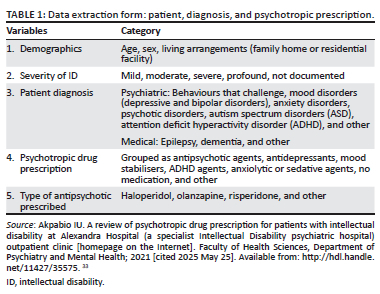
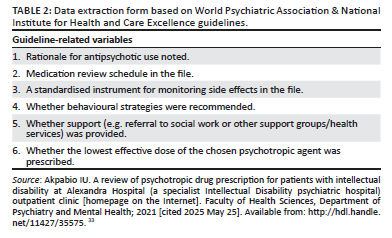
Data were extracted from folders at the initial visit and 6-month follow-up to assess prescribing practices over time.337,12,20,28Table 1 and Table 2, both reproduced from Akpabio et al.33
Statistical analysis
Data were analysed using IBM SPSS Statistics for Windows, version 2025 (IBM Corp., Armonk, NY, US).3433
Ethical considerations
Ethical clearance to conduct this study was obtained from the Human Research Ethics Committee (HREC) of the Faculty of Health Sciences at the University of Cape Town (No. 809/2019). As the study involved a retrospective folder review without direct patient involvement, informed consent was not required. Clearance was obtained from the Western Cape Department of Health and the hospital's Chief Executive Officer. Patient folders were assigned study numbers to ensure confidentiality.
Results
The results presented here are based on findings originally reported in the author's master's thesis (Akpabio et al).33
Demographic characteristics
Of the 103 outpatients, 58.2% (n = 60) were ≤ 18 years (30 children ≤ 12 years, 30 adolescents 13-18 years), 39.8% (n = 41) were 19-59 years, and 1.9% (n = 2) were ≥ 60 years. Male patients comprised 70% (n =72), with 64% (n = 46) of male patients and 45% (n = 14) of female patients ≤ 18 years. Most patients (87.4%, n = 90) lived with family; 13% (n = 13) resided in residential facilities, with only 2 (15%) of these ≤ 18 years.
Intellectual disability and diagnoses
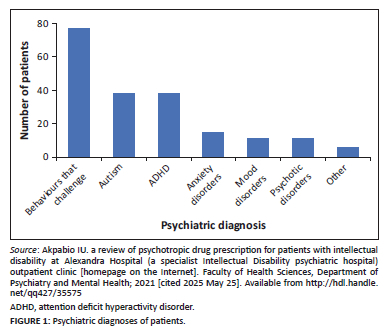
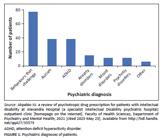
ID severity was mild in 26.2% (n = 27), moderate in 32% (n = 33), severe in 24.2% (n = 25), and profound in 1% (n = 1); 16.5% (n = 17) lacked documented severity. Psychiatric diagnoses (mean 1.9 per patient, s.d. = 0.8, range 1-4) included BTC in 74.8% (n = 77), autism spectrum disorder (ASD) or ADHD in 36.9% each (n = 38 each), psychotic disorders in 10.7% (n = 11), anxiety disorders in 14.6% (n = 15), and mood disorders in 10.7% (n = 11; 1 bipolar, 10 depressive). Children and adolescents accounted for 95% (n = 36) of ADHD, 62% (n = 48) of BTC, and 71% (n = 27) of ASD diagnoses, while adults comprised 91% (n = 10) of psychotic disorders, 44% (n = 7) of anxiety, and 100% (n = 10) of depressive disorders. The most common comorbid psychiatric diagnoses in patients with BTC (n = 45) were autism and ADHD, either as a dual or triple diagnosis. Comorbid medical conditions were present in 46% (n = 47), with epilepsy (n = 25) being most common. See Figure 1.
Medication prescribing patterns
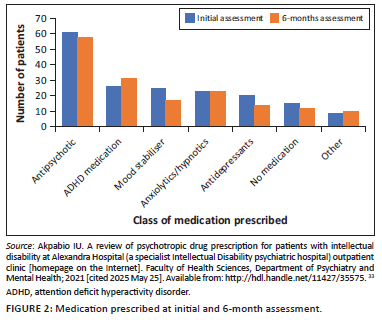
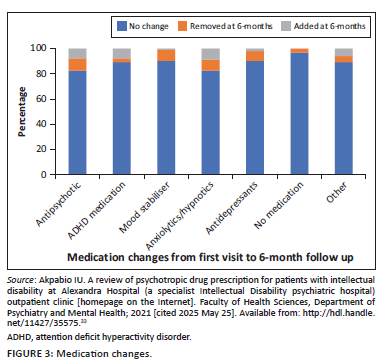
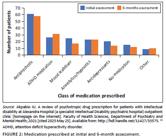
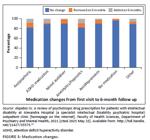
Antipsychotics were prescribed to 59.2% (n = 61) of patients at initial assessment and 56.3% (n = 49) at 6-month follow-up, with risperidone and olanzapine being the most common medications (Figure 2). Children and adolescents received antipsychotics more frequently (56% initial, 62% follow-up) than adults. Anticonvulsant mood stabilisers were primarily used for epilepsy, but were used to manage BTC in 33% (n = 8) of patients initially and 24% (n = 4) at follow-up. The mean number of psychotropics was 1.61 (s.d. = 1.1) initially and 1.65 (s.d. = 1.1) at follow-up. At initial assessment, 14.6% (n = 15) received no medication, 35% (n = 36) one, 32% (n = 33) two, and 18.4% (n = 19) three or more. At follow-up (n = 87), 13.8% (n = 12) received no medication, 27.6% (n = 24) one, 27.6% (n = 24) two, and 31% (n = 27) three or more (Figure 3). At both visits, children and adolescents were more commonly prescribed two or fewer medications, whereas adults were more likely to be treated with three or more psychotropic agents. Over 80% of patients had no medication changes between visits.
Associations between prescribed medications, demographics and diagnoses
Patients ≤ 18 years were significantly more likely to receive ADHD medication (initial: 41.7%, n = 25/60 vs. 2.3%, n = 1/43, p < 0.001, Cramer's V = 0.45; follow-up: 50%, n = 30/60 vs. 2.3%, n = 1/43, p < 0.001, Cramer's V = 0.51). Adults (≥ 19 years) were more likely to receive anxiolytics and/or hypnotics (32.6%, n = 14/43 vs. 15%, n = 9/60, p = 0.035, Cramer's V = 0.21) and antidepressants (37.2%, n = 16/43 vs. 6.7%, n = 4/60, p < 0.001, Cramer's V = 0.38) at initial assessment. Female patients were more likely to receive anxiolytics and/or hypnotics (35.5%, n = 11/31 vs. 16.7%, n = 12/72, p = 0.065, Cramer's V = 0.18). Patients in residential facilities were more likely to receive anxiolytics/hypnotics (53.8%, n = 7/13 vs. 16.7%, n = 12/72, p = 0.007, Cramer's V = 0.28). ID severity was not associated with medication type. Patients with ADHD (63.2%, n = 24/38 vs. 3.1%, n = 2/65, p < 0.001, Cramer's V = 0.67) and mood disorders (63.6%, n = 7/11 vs. 12%, n = 11/92, p < 0.001, Cramer's V = 0.55) were more likely to receive ADHD medication and antidepressants, respectively, at initial assessment.33
Compliance with prescribing guidelines
A rationale for antipsychotic use was documented in 68.9% (n = 42/61) of cases, primarily for BTC (57.1%, n = 24). All antipsychotic prescriptions used the lowest effective dose. However, no files included review schedules or standardised side-effect monitoring. For BTC (n = 77), 46.8% (n = 36) were managed with behavioural interventions alone initially, with nine later receiving medication by 6 months. The remainder received medication alone or combined with behavioural interventions. All patients were informed of support structures (e.g. Autism Western Cape, social services) and referred to psychology or occupational therapy when appropriate.
Discussion
This retrospective study audited psychotropic prescribing patterns among 103 outpatients with ID at an advanced psychiatric care institution in the Western Cape, South Africa.337,12,20,28,33n = 91) of patients received at least one psychotropic agent, a figure that aligns with global trends of high psychotropic use among people with intellectual disability (PWID).2,11,28
Prescribing patterns generally reflected clinical diagnoses: stimulants were used for ADHD, and antidepressants for anxiety or mood disorders.7,16,352,11,13,252,6,11,36,37
Age and living arrangements appeared to shape prescribing trends. Children and adolescents (≤ 18 years) were more likely to receive ADHD medications, while adults (≥ 19 years) were prescribed more anxiolytics, hypnotics and antidepressants - consistent with developmental trajectories of psychiatric diagnoses. Female patients and those in residential facilities were more likely to receive anxiolytics or hypnotics, consistent with evidence linking institutional living to increased exposure to psychotropic medication and polypharmacy.23,26,287,12
Despite alignment in many areas, notable gaps emerged in guideline implementation. No reviewed files included standardised review schedules or systematic side-effect monitoring, which are especially critical for PWID given their increased vulnerability to adverse drug effects.2512,15,18
Several systemic improvements could enhance adherence to best-practice care. For example, standardised templates for documenting treatment rationale, setting review schedules and recording adverse effects would support clinicians - especially in pressured outpatient settings - in delivering more consistent, guideline-concordant care.12,21,29,30,31,323839
Strengths and limitations
This is the first known study to examine psychotropic prescribing practices for PWID in South Africa, providing a crucial baseline for evaluating and improving care at the study site. Its findings offer practical insights that may inform clinical protocols, training needs and policy at both local and national levels. However, the retrospective folder review design introduces limitations because of the variable completeness of documentation. It is unclear whether some prescribing decisions were discussed but not recorded. Moreover, although clinicians at the facility use DSM-5 diagnostic criteria, the fidelity of diagnosis was not independently assessed, leaving room for misclassification. Finally, as a single-site study, findings may not be generalisable to other outpatient settings.
Conclusion
This study provides a valuable initial glimpse into psychotropic prescribing practices for individuals with ID in a South African outpatient psychiatric setting. While prescribing largely aligned with clinical indications for ADHD, anxiety and mood disorders, antipsychotic use was widespread - often for BTC rather than psychosis - and rarely accompanied by behavioural interventions alone. Clinicians demonstrated caution around polypharmacy and prescribed at the lowest effective doses, but gaps remain in review scheduling, rationale documentation and side-effect monitoring. Strengthening clinician training, adopting standardised documentation tools and developing context-specific behavioural interventions are critical next steps. These findings offer a foundation for improving practice at the study site and suggest the need for broader audits and implementation strategies across the country.
The authors would like to thank Prof. Dan Stein and Dr. Helena Thornton for their critique of the study protocol. They would also like to acknowledge Ms. Linda Mange, Ms. Samantha Ross, Mr. Thomas and Nurse Williams for their administrative assistance. Additional thanks to Dr. Michelle Henry for her assistance with the data analysis.
Competing interests
The authors declare that they have no financial or personal relationships that may have inappropriately influenced them in writing this article.
CRediT authorship contribution
Idorenyin U. Akpabio: Conceptualisation, Data curation, Investigation, Methodology, Resources, Writing - original draft, Writing - review & editing. Peter Smith: Conceptualisation, Supervision, Writing - review & editing. Sharon Kleintjes: Supervision, Writing - review & editing. All authors reviewed the article, contributed to the discussion of results, approved the final version for submission and publication, and take responsibility for the integrity of its findings.
Funding information
This research received no specific grant from any funding agency in the public, commercial or not-for-profit sectors.
Data availability
The data supporting the findings in this study are available from the corresponding author, Idorenyin U. Akpabio, upon reasonable request.
Disclaimer
The views and opinions expressed in this article are those of the authors and are the product of professional research. They do not necessarily reflect the official policy or position of any affiliated institution, funder, agency or that of the publisher. The authors are responsible for this article's results, findings and content.
Acknowledgements
This article includes content that overlaps with research originally conducted as part of Idorenyin U. Akpabio's master's thesis titled 'A Review of Psychotropic drug prescription for patients with Intellectual disability at Alexandra Hospital (a specialist Intellectual Disability psychiatric hospital) outpatient clinic', submitted to the University of Cape Town in 2021. The thesis was supervised by Sharon Kleintjes and Peter Smith. Portions of the data, analysis and discussion have been revised, updated and adapted for publication as a journal article. The original thesis is publicly available at: https://open.uct.ac.za/items/c763829e-2fee-41c0-99b1-1d50aeb70268. The author affirms that this article complies with ethical standards for secondary publication, and appropriate acknowledgement has been made of the original work.
References
- 1. American Psychiatric Association. Diagnostic and statistical manual of mental disorders. 5th ed. Arlington, VA: American Psychiatric Association; 2013.
-
2. Sheehan R, Hassiotis A, Walters K, Osborn D, Strydom A, Horsfall L. Mental illness, challenging behaviour, and psychotropic drug prescribing in people with intellectual disability: UK population based cohort study. Br Med J. 2015;351:h4326. https://doi.org/10.1136/bmj.h4326
» https://doi.org/10.1136/bmj.h4326 -
3. Kleintjes S, Flisher AJ, Fick M, et al. The prevalence of mental disorders among children, adolescents and adults in the Western Cape, South Africa. S Afr Psychiatry Rev. 2006;9(3):157-160. https://doi.org/10.4314/ajpsy.v9i3.30217
» https://doi.org/10.4314/ajpsy.v9i3.30217 -
4. Adnams CM. Perspectives of intellectual disability in South Africa: Epidemiology, policy, services for children and adults. Curr Opin Psychiatry. 2010;23(5):436-440. https://doi.org/10.1097/YCO.0b013e32833cfc2d
» https://doi.org/10.1097/YCO.0b013e32833cfc2d -
5. University of Cape town. Clinical services - Alexandra Hospital [homepage on the Internet]. 2025 [cited 2025 May 25]. Available from: https://www.psychiatry.uct.ac.za/psych/alexandra-hospital
» https://www.psychiatry.uct.ac.za/psych/alexandra-hospital -
6. Häβler F, Thome J, Reis O. Polypharmacy in the treatment of subjects with intellectual disability. J Neural Transm. 2015;122:93-100. https://doi.org/10.1007/s00702-014-1219-x
» https://doi.org/10.1007/s00702-014-1219-x -
7. Trollor JN, Salomon C, Franklin C. Prescribing psychotropic drugs to adults with an intellectual disability. Aust Prescr. 2016;39(4):126-130. https://doi.org/10.18773/austprescr.2016.048
» https://doi.org/10.18773/austprescr.2016.048 -
8. Salomon C, Britt H, Pollack A, Trollor J. Primary care for people with intellectual disability - What is prescribed? An analysis of medication recommendations from the BEACH dataset. BJGP Open. 2018;2(2):bjgpopen18X101541. https://doi.org/10.3399/bjgpopen18X101541
» https://doi.org/10.3399/bjgpopen18X101541 -
9. De Menil V, Cohen A. Rational use and rationale for use: Psychiatric medication at an Argentine institution for intellectual disability. Transcult Psychiatry. 2009;46(4):651-671. https://doi.org/10.1177/1363461509351377
» https://doi.org/10.1177/1363461509351377 -
10. Baasland G, Engedal K. Bruk av psykofarmaka hos mennesker med utviklingshemning. Tidsskr den Nor Laegeforening. 2009;129(17):1751-1753. https://doi.org/10.4045/tidsskr.09.30451
» https://doi.org/10.4045/tidsskr.09.30451 -
11. De Kuijper G, Hoekstra P, Visser F, Scholte FA, Penning C, Evenhuis H. Use of antipsychotic drugs in individuals with intellectual disability (ID) in the Netherlands: Prevalence and reasons for prescription. J Intellect Disabil Res. 2010;54(7):659-667. https://doi.org/10.1111/j.1365-2788.2010.01275.x
» https://doi.org/10.1111/j.1365-2788.2010.01275.x -
12. Paton C, Bhatti S, Purandare K, Roy A, Barnes TRE. Quality of prescribing of antipsychotic medication for people with intellectual disability under the care of UK mental health services: A cross-sectional audit of clinical practice. BMJ Open. 2016;6(12):1-7. https://doi.org/10.1136/bmjopen-2016-013116
» https://doi.org/10.1136/bmjopen-2016-013116 -
13. Edelsohn GA, Schuster JM, Castelnovo K, Terhorst L, Parthasarathy M. Psychotropic prescribing for persons with intellectual disabilities and other psychiatric disorders. Psychiatr Serv. 2014;65(2):201-207. https://doi.org/10.1176/appi.ps.201300029
» https://doi.org/10.1176/appi.ps.201300029 -
14. Perry BI, Kwok HF, Mendis J, et al. Problem behaviours and psychotropic medication use in intellectual disability: A multinational cross-sectional survey. J Intellect Disabil Res. 2018;62(2):140-149. https://doi.org/10.1111/jir.12471
» https://doi.org/10.1111/jir.12471 -
15. Deb S, Kwok H, Bertelli M, et al. International guide to prescribing psychotropic medication for the management of problem behaviours in adults with intellectual disabilities. World Psych. 2009;8(3):181-186. https://doi.org/10.1002/j.2051-5545.2009.tb00248.x
» https://doi.org/10.1002/j.2051-5545.2009.tb00248.x -
16. Ji NY, Findling RL. Pharmacotherapy for mental health problems in people with intellectual disability. Curr Opin Psychiatry. 2016;29(2):103-125. https://doi.org/10.1097/YCO.0000000000000233
» https://doi.org/10.1097/YCO.0000000000000233 -
17. Matson JL, Neal D. Psychotropic medication use for challenging behaviors in persons with intellectual disabilities: An overview. Res Dev Disabil. 2009;30(3):572-586. https://doi.org/10.1016/j.ridd.2008.08.007
» https://doi.org/10.1016/j.ridd.2008.08.007 -
18. Shankar R, Wilcock M, Oak K, McGowan P, Sheehan R. Stopping, rationalising or optimising antipsychotic drug treatment in people with intellectual disability and/or autism. Drug Ther Bull. 2019;57(1):2. https://doi.org/10.1136/dtb.2018.000009
» https://doi.org/10.1136/dtb.2018.000009 -
19. Sheehan R, Strydom A, Brown E, Marston L, Hassiotis A. Association of focused medication review with optimization of psychotropic drug prescribing: A systematic review and meta-analysis. JAMA Netw Open. 2018;1(6):e183750. https://doi.org/10.1001/jamanetworkopen.2018.3750
» https://doi.org/10.1001/jamanetworkopen.2018.3750 -
20. De Kuijper G, Degraeve G, Zinkstok JR. Voorschrijven van psychofarmaca bij mensen met een verstandelijke beperking: Handvatten voor de praktijk = Practical guidelines for prescribing psychotropic medication to people with intellectual disability. Tijdschr Psychiatr [serial online]. 2019 [cited 2025 May 25];61(11):786-791. Available from: https://www.tijdschriftvoorpsychiatrie.nl/media/5/61-2019-11-artikel-dekuijper.pdf
» https://www.tijdschriftvoorpsychiatrie.nl/media/5/61-2019-11-artikel-dekuijper.pdf -
21. McQuire C, Hassiotis A, Harrison B, Pilling S. Pharmacological interventions for challenging behaviour in children with intellectual disabilities: A systematic review and meta-analysis. BMC Psychiatry. 2015;15(1):67-73. https://doi.org/10.1186/s12888-015-0688-2
» https://doi.org/10.1186/s12888-015-0688-2 -
22. Ayub M, Saeed K, Munshi TA, Naeem F. Clozapine for psychotic disorders in adults with intellectual disabilities. Cochrane Database Syst Rev. 2015;2015(9):CD010625. https://doi.org/10.1002/14651858.CD010625.pub2
» https://doi.org/10.1002/14651858.CD010625.pub2 -
23. Sheehan R, Hassiotis A. Reduction or discontinuation of antipsychotics for challenging behaviour in adults with intellectual disability: A systematic review. Lancet Psychiatry. 2017;4(3):238-256. https://doi.org/10.1016/S2215-0366(16)30191-2
» https://doi.org/10.1016/S2215-0366(16)30191-2 -
24. Lunsky Y, Modi M. Predictors of psychotropic polypharmacy among outpatients with psychiatric disorders and intellectual disability. Psychiatr Serv. 2018;69(2):242-246. https://doi.org/10.1176/appi.ps.201700032
» https://doi.org/10.1176/appi.ps.201700032 -
25. Herzig L, De Lacy N, Capone G, Radesky J. Intellectual disability and psychotropic medications. J Dev Behav Pediatr. 2018;39(7):591-593. https://doi.org/10.1097/DBP.0000000000000613
» https://doi.org/10.1097/DBP.0000000000000613 -
26. O'Dwyer M, Peklar J, Mulryan N, McCallion P, McCarron M, Henman MC. Prevalence, patterns and factors associated with psychotropic use in older adults with intellectual disabilities in Ireland. J Intellect Disabil Res. 2017;61(10):969-983. https://doi.org/10.1111/jir.12391
» https://doi.org/10.1111/jir.12391 -
27. Haider SI, Ansari Z, Vaughan L, Matters H, Emerson E. Prevalence and factors associated with polypharmacy in Victorian adults with intellectual disability. Res Dev Disabil. 2014;35(11):3071-3080. https://doi.org/10.1016/j.ridd.2014.07.060
» https://doi.org/10.1016/j.ridd.2014.07.060 -
28. Bowring DL, Totsika V, Hastings RP, Toogood S, McMahon M. Prevalence of psychotropic medication use and association with challenging behaviour in adults with an intellectual disability. A total population study. J Intellect Disabil Res. 2017;61(6):604-617. https://doi.org/10.1111/jir.12359
» https://doi.org/10.1111/jir.12359 -
29. Alexander RT, Shankar R, Cooper SA, et al. Challenges and pitfalls of antipsychotic prescribing in people with learning disability. Br J Gen Pract. 2017;67(661):372-373. https://doi.org/10.3399/bjgp17X692081
» https://doi.org/10.3399/bjgp17X692081 -
30. NICE. Psychotropic medicines in people with learning disabilities whose behaviour challenges [homepage on the Internet]. 2017 [cited 2025 May 25]. Available from: http://nice.org.uk/guidance/ktt19
» http://nice.org.uk/guidance/ktt19 -
31. Challenging behaviour and learning disabilities: Prevention and interventions for people with learning disabilities whose behaviour challenges [homepage on the Internet]. 2017 [cited 2025 May 25]. Available from: https://www.nice.org.uk/guidance/ng11
» https://www.nice.org.uk/guidance/ng11 -
32. Mental health problems in people with learning disabilities: Prevention, assessment and management [homepage on the Internet]. 2019 [cited 2025 May 25]. Available from: https://www.nice.org.uk/guidance/ng54
» https://www.nice.org.uk/guidance/ng54 -
33. Akpabio IU. A review of psychotropic drug prescription for patients with intellectual disability at Alexandra Hospital (a specialist Intellectual Disability psychiatric hospital) outpatient clinic [homepage on the Internet]. Faculty of Health Sciences, Department of Psychiatry and Mental Health; 2021 [cited 2025 May 25]. Available from http://hdl.handle.net/11427/35575
» http://hdl.handle.net/11427/35575 - 34. IBM Corp. Released 2017. IBM SPSS Statistics for Windows, Version 25.0. Armonk, NY: IBM Corp.
-
35. Sun CK, Tseng PT, Wu CK, et al. Therapeutic effects of methylphenidate for attention-deficit/hyperactivity disorder in children with borderline intellectual functioning or intellectual disability: A systematic review and meta-analysis. Sci Rep. 2019;9(1):1-10. https://doi.org/10.1038/s41598-019-52205-6
» https://doi.org/10.1038/s41598-019-52205-6 -
36. Eady N, Courtenay K, Strydom A. Pharmacological management of behavioral and psychiatric symptoms in older adults with intellectual disability. Drugs Aging. 2015;32(2):95-102. https://doi.org/10.1007/s40266-014-0236-7
» https://doi.org/10.1007/s40266-014-0236-7 -
37. Koch A, Dobrindt J, Schützwohl M. Psychotropic medication and psychotherapeutic treatment of adults with intellectual disabilities (PROMPT-ID): A cross-sectional, epidemiological study in Saxony, Germany. BMJ Open. 2018;8(12):1-8. https://doi.org/10.1136/bmjopen-2018-025947
» https://doi.org/10.1136/bmjopen-2018-025947 -
38. Stein DJ, Sordsdahl K, Lund C. Intellectual disability in South Africa: Addressing a crisis in mental health services. S Afr Med J. 2018;108(3):147-148. https://doi.org/10.7196/SAMJ.2018.v108i3.13171
» https://doi.org/10.7196/SAMJ.2018.v108i3.13171 -
39. Coetzee O, Swartz L, Capri C, Adnams C. Where there is no evidence: Implementing family interventions from recommendations in the NICE guideline 11 on challenging behaviour in a South African health service for adults with intellectual disability. BMC Health Serv Res. 2019;19(1):1-10. https://doi.org/10.1186/s12913-019-3999-z
» https://doi.org/10.1186/s12913-019-3999-z

Accepted: 26 Nov. 2025
Published: 21 Jan. 2026