Prevalence and predictors of anxiety, depression, and suicidal ideation among Namibian public university students
Abstract
BACKGROUND: Anxiety, depression, and suicidal ideation are prevalent mental health conditions among university students. Persistent anxiety and depression are associated with morbidity and suicidal ideation predicts suicide. Namibian mental health data are limited AIM: This study aimed to determine and analyse the prevalence and predictors of anxiety, depression, and suicidal ideation among Namibian public university students SETTING: The study was conducted at six campuses of the two Namibian public universities METHODS: A quantitative, cross-sectional, descriptive study was conducted among 578 purposively sampled students, using self-administered questionnaire, incorporating Beck's Anxiety Inventory, Patient Health Questionnaire-9, and Columbia Suicide Severity Rating Scale. Data were analysed in SPSS version 30, including descriptive statistics, bivariate regression, Pearson's correlation coefficients, and hierarchical multiple regression RESULTS: Among 578 respondents, 50.7% reported moderate to severe anxiety, 73.2% met depression criteria, and 9.1% reported an active suicidal plan. Current mental illness was significantly associated with depression and suicidal ideation (p < 0.001). Depression was predicted by current mental illness (β = 0.276, p < 0.001) and family conflict (β = -0.144, p < 0.001), while suicidal ideation was predicted by current mental illness (β = -0.198, p < 0.001), (p < 0.001), family conflict (β = -0.171, p < 0.001), and age (β = -0.103, p = 0.007 CONCLUSION: Anxiety, depression, and suicidal ideation are highly prevalent among Namibian university students, necessitating increased mental health awareness and institutional interventions to prevent suicidality CONTRIBUTION: This study provides empirical evidence on the anxiety, depression, and suicidal ideation among Namibian public university students
anxiety; depression; suicidal ideation; student
Introduction
Mental health disorders are the most significant contributors to the global burden of diseases, with anxiety and depression ranking among the foremost challenges in public health.123,45678910
In the Nigerian context, 'depression has been a significant predictor of suicidal ideation among undergraduates at Enugu State University'.11121314
Research methods and design
Study design
A quantitative research design was utilised employing a cross-sectional, descriptive design to establish and analyse the predictors and correlates of ADSI among university students in Namibia. The participants completed the self-administered questionnaire that gathered the demographic information and predictive factors, including academic, lifestyle, current mental illness, personality, alcohol and substance abuse, depression, and anxiety symptoms, including a binary enquiry of suicidal ideation. A sampling frame consisted of UNAM and NUST campuses, being the only two public universities in Namibia. Two NUST main and Eenhana campuses were purposively selected as they represent NUST sites nationwide. For UNAM, a systematic simple random sampling method was applied: from a list of all 12 campuses, every fourth campus was selected, ensuring equal probability of inclusion. This yielded four UNAM campuses: UNAM main and Hage Geingob (Khomas region, Central), Southern campus (Southern campus in //Karas region), and Oshakati campus (Oshana region, North). To test the research hypothesis, a structured questionnaire was distributed in person to respondents to collect relevant data on the main predictors of ADSI among undergraduate students in Namibia.
Setting
Data were collected from NUST and UNAM multiple campuses across Namibia, including in the Khomas, Oshana, Ohangwena, and Omusati regions. These regions were selected based on suicide prevalence: Oshana, Ohangwena, and Omusati ranked among the top five with the highest suicide rates, while the Khomas and //Karas regions have the lowest suicide rate in Namibia.15
Study population and sampling strategy
The study population included undergraduate students aged 18-24 years, specifically those in their second and third academic years who volunteered to participate. The self-administered questionnaires were distributed to 780 participants recruited through a purposive sampling technique, which lasted for a period of 2 months.16n = N ÷ (1 + N × e215
Data collection and instrument
The self-administered questionnaires were designed in English and consisted of three sections. The first section, Section A, included demographic items targeting respondents aged 18-24 years who are current undergraduates in their second and third academic years from the participating campuses. Demographic data were collected from the respondents. Section B contained predictors associated with ADSI among respondents. The hypothesis included economic, family, and academic factors. Section C examined symptoms of anxiety and depression, as well as the evidence of suicidal ideation, which contributed to the prevalence of ADSI among public university students in Namibia. The questionnaires were handed to the participants in person.
Patient health questionnaire-9
The Patient Health Questionnaire-9 (PHQ-9) is a widely used, validated tool to assess depression, consisting of nine items that measure the frequency of depressive symptoms over a specific period.1718
Beck's Anxiety Inventory
The study modified Beck's Anxiety Inventory (BAI) sheet, which included seven items used to determine the prevalence of anxiety symptoms among university students.19
Suicidal ideation
Suicidal ideation was assessed using the Columbia Suicide Severity Rating Scale Version 14 January 2009.20
Data analysis
Descriptive statistics, including frequencies and percentages, were used to summarise the demographic characteristics of the respondents. Descriptive statistics were analysed in SPSS version 30.21p-value < 0.05 was considered statistically significant. All variables, including demographic characteristics, prevalence, and predictors, were analysed to identify independent predictors of ADSI among students.
Ethical considerations
The relevant institutions granted permission to conduct the study. Ethical approval was obtained from the Namibia University of Science and Technology Research Committee, with reference number FHNRAS:60/2023, and from the Namibian Ministry of Health and Social Services, with reference number 22/3/1/2. The six campuses where the study was conducted approved the data collection. The study adhered to ethical standards for health science research. In this quantitative study, steps were taken to ensure anonymity, voluntary participation, the right to withdraw, and respondent confidentiality. The research tool's cover page included an informed consent form, which participants signed before the data collection began. The researcher collected data using self-administered questionnaires distributed to students who met the inclusion criteria, were available, and gave their consent to participate during scheduled campus visits. No emotional distress was observed among participants during the study. However, had any such responses emerged, appropriate referrals for counselling would have been initiated.
Results
Socio-demographic characteristics of respondents
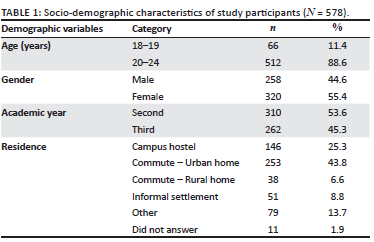
The data set included a total of 578 undergraduates from NUST and its Eenhana satellite campus, as well as the UNAM main campus, Hage Geingob campus, Oshakati campus, and Southern campus. Second- and third-year students enrolled at public universities were recruited for the study's survey (Table 1). Most respondents were female, at 55.4%, while 44.6% were male. They consisted of 53.6% second-year students and 45.4% third-year students. Among the respondents, 25.3% lived in the campus hostel, and 72.9% lived off campus.
The prevalence of anxiety and depression among the students
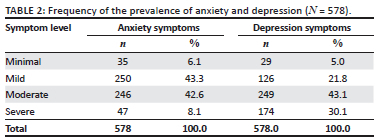
The prevalence of anxiety and depression symptoms was determined using frequencies and percentages to assess the extent of these conditions among respondents. As shown in Table 2, 43.3% experienced mild anxiety symptoms, 42.6% had moderate anxiety symptoms, and 8.1% exhibited severe anxiety symptoms. Regarding depression, 21.8% reported mild symptoms, 43.1% moderate symptoms, and 30.1% had severe depression symptoms.
Prevalence of suicidal ideation
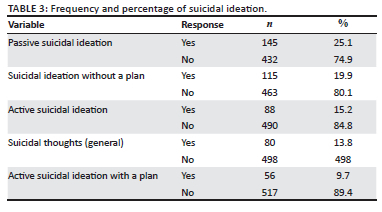
The findings reveal various types of suicidal ideation among university students who answered 'Yes' (Table 3): passive suicidal ideation, 25.1%; suicidal ideation without a plan, 19.9%; active suicidal ideation, 15.2%; and suicidal thoughts in general, 13.5%. Alarmingly, active suicidal ideation with a plan was 9.7%. Although most participants responded 'No' across all variables, it is essential to recognise that 'Yes' indicates a significant mental health concern among students.
Pearson's correlational coefficient analysis of anxiety, depression, and suicidal ideation
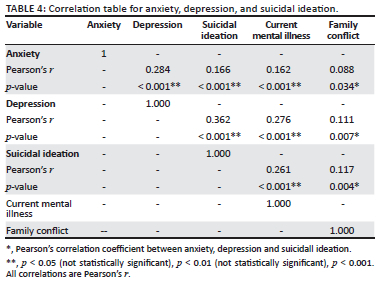
The research aimed to establish the correlation between ADSI and students. Pearson's correlation coefficient was calculated to explore the relationships between anxiety, depression, and suicidal ideation (Table 4). There was a positive correlation between anxiety and depression (r = 284, p < 0.001), and between anxiety and suicidal ideation (r = 166, p < 0.001). Similarly, depression significantly correlated with suicidal ideation (r = 0.362, p < 0.001). Current mental illness was positively associated with anxiety (r = 0.162, p < 0.001), depression (r = 0.276, p < 0.001), and suicidal ideation (r = 0.261, p < 0.001). Family conflict showed a weaker but significant positive correlation with anxiety (r = 0.088, p < 0.034), depression (r = 111, p < 0.007), and suicidal ideation (r = 0.117, p = 0.004), while a weak but statistically significant negative correlation was observed with suicidal ideation (r = -0.111, p = 0.007) indicating that resilience has a protective influence.
Predictors of anxiety, depression, and suicidal ideation
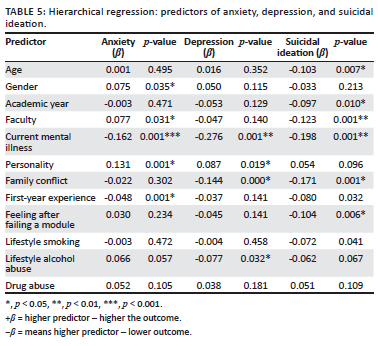
A series of hierarchical regressions was conducted to identify the predictors of ADSI among students at public universities. Table 5 shows that the significant predictors of anxiety included current mental illness (β = -0.162, p < 0.001), personality (β = 0.131, p = 0.001), and faculty (β = 0.077, p = 0.031). Significant predictors of depression included current mental illness (β = -0.276, p < 0.001), family conflict (β = -0.144, p < 0.001), and personality (β = 0.087, p = 0.019). For suicidal ideation, significant predictors included current mental illness (β = -0.198, p < 0.001), faculty (β = -0.123, p < 0.001), family conflict (β = -0.171, p < 0.001), and age (β = -0.103, p = 0.007).
Discussion
The study identified and analysed the prevalence and predictors of anxiety and depression symptoms and suicidal ideation among Namibian public university students. It also examined the relationship between ADSI, demographic factors, and predictors such as academic year, family conflicts, faculties, current mental health issues, alcohol and substance misuse, gender, and age. Using data from primary sources, the prevalence of ADSI was thoroughly determined. The sample reported higher levels of anxiety and depression symptoms compared with suicidal ideation.
In this study, scientific evidence showed that 50.7% of students reported experiencing moderate to severe anxiety symptoms, and 73% reported having moderate to severe depressive symptoms. These findings were notably higher compared with studies carried out in other countries. The prevalence of anxiety and depressive symptoms in our study exceeded 25%, with depression at 45.3%, compared with a study conducted in Germany.21,222323
Assessment of suicidal ideation revealed that some students experienced active thoughts of suicide, with 9.7% of them reporting a specific plan to carry it out. This study's findings contrast with the Nigerian study, which found a much higher rate; 85.2% of students had passive suicidal ideation compared with active ideation. In this study, multiple predictors of suicidal ideation were identified, including age, academic year, faculty of study, current mental illnesses, family conflicts, and educational failure. The predictors of suicidal ideation in Nigeria included academic challenges, substance use, family conflicts, and other psychological stressors, which increase vulnerability among undergraduates.2425
Previous mental illness is a predictor of ADSI, consistent with a study in Sudan, indicating that a prior psychiatric diagnosis of general anxiety disorder (GAD) corresponds to the prevalence of GAD, which ranges from 4% to 7%.2526,272829303132
The study's analysis showed that the faculty of study had no significant effect, implying that age and academic year were negatively linked to suicidal ideation, suggesting that maturity and academic progress might offer protective benefits.33
This study was limited to only two public universities in Namibia, with the sample predominantly composed of females, which may affect the generalisability of the study's findings. The inclusion of only two NUST campuses, compared with broader representation from UNAM, may also influence the prevalence estimates of anxiety, depression, and suicidal ideation per campus. Moreover, the cross-sectional design did not assess clinical diagnosis but rather the symptoms of anxiety and depression. Future longitudinal research is recommended to examine the impact of ADSI on academic performance across diverse age groups, postgraduate cohorts, and institutions to better understand the resilience throughout a student's academic journey.
Conclusion
This study's findings reveal the silent mental health crisis developing among university students, characterised by high rates of anxiety, depression, and suicidal ideation. Although the university provides counselling support for students experiencing ADSI, there is room for improvement, which may involve incorporating the screening tool for early detection and treatment of these conditions. This emphasises that mental illness can no longer be regarded as a peripheral issue. Public university mental health providers must urgently shift from a reactive approach to a proactive one that identifies, supports, and empowers students before a crisis occurs. Addressing student mental health requires immediate and ongoing action, as it is essential for students to succeed amid the pressures of academic demands and socio-economic uncertainty.
This article is based on the research originally conducted as part of Kristine N. Siseho's doctoral thesis entitled, 'An early detection model for anxiety, depression, and suicidal ideation among students at public universities, Namibia', submitted to the Faculty of Health, Natural Resources and Applied Sciences, NUST, Windhoek, Namibia, ongoing 2025. The thesis is currently unpublished and not publicly available. The thesis was supervised by Roswitha Mahalie and Tuwilika Endjala. The authors confirm that the content has not been previously published or disseminated and complies with ethical standards for original publication.
Competing interests
The authors declare that they have no financial or personal relationships that may have inappropriately influenced them in writing this article.
CRediT authorship contribution
Kristine N. Siseho: Conceptualisation, Methodology, Formal analysis, Investigation, Writing - original draft, Visualisation, Project administration, Software, Data curation, Resources, Writing - review & editing, Supervision, Funding acquisition. Roswitha Mahalie: Methodology, Formal analysis, Data curation, Writing - review & editing, Supervision. Tuwilika Endjala: Methodology, Formal analysis, Data curation, Writing - review & editing, Supervision. All authors reviewed the article, contributed to the discussion of results, approved the final version for submission and publication, and take responsibility for the integrity of its findings.
Funding information
The authors received no financial support for the research, authorship, and/or publication of this article.
Data availability
The data that support the findings of this study are available from the corresponding author, Kristine N. Siseho, upon reasonable request.
Disclaimer
The views and opinions expressed in this article are those of the authors and are a product of professional research. It does not necessarily reflect the official policy or position of any affiliated institution. The authors are responsible for this article's results, findings and content.
Acknowledgements
The authors would like tothank the respondents from Namibia University of Science and Technology (NUST) and University of Namibia (UNAM) campuses for participating in this study. They also acknowledge Dr Hileni M. Ndjaba, a psychiatrist at Windhoek Central Hospital Psychiatric Unit, for her evaluation of the data collection tool. This article benefited from the use of ChatGPT version 40 for designing tables and Grammarly for grammar refinement and improving readability. The content was reviewed and edited by the authors, who take full responsibility for its accuracy.
References
-
1. Santomauro DF, Herrera AM, Shadid J, et al. Global prevalence and burden of depressive and anxiety disorders in 204 countries and territories in 2020 due to the COVID-19 pandemic. Lancet. 2021;398(10312):1700-1712. https://doi.org/10.1016/S0140-6736(21)02143-7
» https://doi.org/10.1016/S0140-6736(21)02143-7 -
2. Ntatamala I, Khan S, Chakara Z. Mental health and substance use among rehabilitation sciences students during the COVID-19 pandemic. S Afr J Psychiatry. 2025;31(1):a2376. https://doi.org/10.4102/sajpsychiatry.v31i0.2376
» https://doi.org/10.4102/sajpsychiatry.v31i0.2376 -
3. Luo L, Yuan J, Wu C, Wang Y, Zhu R, Xu H, Zhang L, Zhang Z. Predictors of depression among Chinese college students: A machine learning approach. BMC Public Health. 2025;25(1):470. https://doi.org/10.1186/s12889-025-21632-8
» https://doi.org/10.1186/s12889-025-21632-8 -
4. Polyvianaia M, Yachnik Y, Fegert JM, Sitarski E, Stepanova N, Pinchuk I. Mental health of university students twenty months after the beginning of the full-scale Russian-Ukrainian war. BMC Psychiatry. 2025;25(1):1-4. https://doi.org/10.1186/s12888-025-06654-1
» https://doi.org/10.1186/s12888-025-06654-1 -
5. World Health Organization. Mental health [homepage on the internet]. 2022 [cited 2022 Jun 08]. Available from: https://www.who.int/news-room/fact-sheets/detail/mental-disorders
» https://www.who.int/news-room/fact-sheets/detail/mental-disorders -
6. Dong J, Li Y, Chen J, He L, Li Y. The relationship between depression heterogeneity and academic performance in Chinese university freshmen: A latent profile analysis. Curr Psychol. 2024;43(23):20484-20495. https://doi.org/10.1007/s12144-024-05795-y
» https://doi.org/10.1007/s12144-024-05795-y -
7. Riera-Serra P, Navarra-Ventura G, Castro A, et al. Clinical predictors of suicidal ideation, suicide attempts and suicide death in depressive disorder: A systematic review and meta-analysis. Eur Arch Psychiatry Clin Neurosci. 2024;274(7):1543-1563. https://doi.org/10.1007/s00406-023-01716-5
» https://doi.org/10.1007/s00406-023-01716-5 - 8. World Health Organization. Suicide worldwide in 2021: Global health estimates. Geneva: World Health Organization; 2025.
- 9. World Health Organization. Depression and anxiety disorder in 2025. Geneva: World Health Organization; 2025.
-
10. Quarshie EN, Dickson ED, Quarshie SN, Kpebu SE, Asante KO. Suicidal ideation and suicide attempt among pregnant adolescent girls in Ghana: A cross-sectional study. Gen Psychiatr. 2025;38(1):e101643. https://doi.org/10.1136/gpsych-2024-101643
» https://doi.org/10.1136/gpsych-2024-101643 - 11. Uzoh MN, Nwatu AC, Aneke AC, Anikene BK, Omeje O. Depression as a predictor of suicidal ideation among Enugu State University of Science undergraduate students. Caritas J Psychol Behav Sci. 2024;2(1):1-9.
-
12. Mkhize M, Van der Westhuizen C, Sorsdahl K. Prevalence and factors associated with depression and anxiety among young school-going adolescents in the Western Cape Province of South Africa. Compr Psychiatry. 2024;131:152469. https://doi.org/10.1016/j.comppsych.2024.152469
» https://doi.org/10.1016/j.comppsych.2024.152469 - 13. Namibia. Ministry of Health and Social Services. National mental health policy. Windhoek: Ministry of Health and Social Services; 2005, p. 32.
-
14. Blaauw S. Police: 82% of 2023 suicide victims were men [homepage on the Internet]. The Namibian. 2024 [cited 2025 Jul 26]. Available from: https://www.namibian.com.na/a-suicide-a-day-in-namibia/
» https://www.namibian.com.na/a-suicide-a-day-in-namibia/ - 15. Uakarn C, Chaokromthong K, Sintao N. Sample size estimation using Yamane and Cochran and Krejcie and Morgan and Green formulas and Cohen statistical power analysis by G* power and comparisons. Apheit Int J. 2021;10(2):76-88.
- 16. Fouché CB, Strydom H, Roestenburg WJH, editors. Research at grass roots: For the social sciences and human services professions. 5th ed. Pretoria: Van Schaik Publishers; 2021.
-
17. Kroenke K, Spitzer RL, Williams JB. The PHQ-9: Validity of a brief depression severity measure. J Gen Intern Med. 2001;16(9):606-613. https://doi.org/10.1046/j.1525-1497.2001.016009606.x
» https://doi.org/10.1046/j.1525-1497.2001.016009606.x - 18. Diagnostic AP. Statistical manual of mental disorders: DSM-5 (ed.). Washington, DC: American Psychiatric Association; 2013.
-
19. Beck AT, Epstein N, Brown G, Steer RA. An inventory for measuring clinical anxiety: Psychometric properties. J Consult Clin Psychol. 1988;56(6):893. https://doi.org/10.1037//0022-006X.56.6.893
» https://doi.org/10.1037//0022-006X.56.6.893 -
20. Posner K, Brown GK, Stanley B, et al. The Columbia-suicide severity rating scale: Initial validity and internal consistency findings from three multisite studies with adolescents and adults. Am J Psychiatry. 2011;168(12):1266-1277. https://doi.org/10.1176/appi.ajp.2011.10111704
» https://doi.org/10.1176/appi.ajp.2011.10111704 - 21. IBM Corp. IBM SPSS statistics for windows, Version 30.0. Armonk, NY: IBM Corp; 2023.
-
22. Karing C. Prevalence and predictors of anxiety, depression and stress among university students during the period of the first lockdown in Germany. J Affect Disord Rep. 2021;5:100174. https://doi.org/10.1016/j.jadr.2021.100174
» https://doi.org/10.1016/j.jadr.2021.100174 - 23. Siseho KN, Mahalie R. Anxiety, depression, and suicidal ideation among undergraduates of Namibia University of Science and Technology, Windhoek. Int J SSA Res. 2025;3(3):1-2.
-
24. Mamun MA, Hossain MS, Griffiths MD. Mental health problems and associated predictors among Bangladeshi students. Int J Ment Health Addict. 2022;20(2):657-671. https://doi.org/10.1007/s11469-019-00144-8
» https://doi.org/10.1007/s11469-019-00144-8 -
25. Amu H, Osei E, Kofie P, et al. Prevalence and predictors of depression, anxiety, and stress among adults in Ghana: A community-based cross-sectional study. PLoS One. 2021;16(10):e0258105. https://doi.org/10.1371/journal.pone.0258105
» https://doi.org/10.1371/journal.pone.0258105 -
26. Klonsky ED, May AM, Saffer BY. Suicide, suicide attempts, and suicidal ideation. Ann Rev Clin Psychol. 2016;12(1):307-330. https://doi.org/10.1146/annurev-clinpsy-021815-093204
» https://doi.org/10.1146/annurev-clinpsy-021815-093204 -
27. Adebowale OF, Omotehinse OS. Patterns of suicidal ideation among undergraduate students of Obafemi Awolowo University, Ile-Ife, Nigeria. J Appl Res High Educ. 2024;16(3):763-775. https://doi.org/10.1108/JARHE-10-2022-0319
» https://doi.org/10.1108/JARHE-10-2022-0319 -
28. Hardee JE, Duval ER. Predicting alcohol use in undergraduates: Interactions between social anxiety and impulsivity. Subst Use Misuse. 2025;60(3):345-355. https://doi.org/10.1080/10826084.2024.2427180
» https://doi.org/10.1080/10826084.2024.2427180 -
29. Samek DR, Crumly B, Akua BA, Dawson M, Duke-Marks A. Microaggressions, perceptions of campus climate, mental health, and alcohol use among first-year college students of color. J Res Adolesc. 2024;34(1):96-113. https://doi.org/10.1111/jora.12897
» https://doi.org/10.1111/jora.12897 -
30. Kamruzzaman M, Hossain A, Islam MA, Ahmed MS, Kabir E, Khan MN. Exploring the prevalence of depression, anxiety, and stress among university students in Bangladesh and their determinants. Clin Epidemiol Glob Health. 2024;28:101677. https://doi.org/10.1016/j.cegh.2024.101677
» https://doi.org/10.1016/j.cegh.2024.101677 - 31. Mpako A, Ndoma S. Namibian youth demand that government make job creation a top priority.
-
32. Alemu WG, Due C, Muir-Cochrane E, Mwanri L, Azale T, Ziersch A. Quality of life among people living with mental illness and predictors in Africa: A systematic review and meta-analysis. Qual Life Res. 2024;33(5):1191-1209. https://doi.org/10.1007/s11136-023-03525-8
» https://doi.org/10.1007/s11136-023-03525-8 -
33. Cao X, Liu X. Self-esteem as a predictor of anxiety and academic self-efficacy among Chinese university students: A cross-lagged analysis. Curr Psychol. 2024;43(22):19628-19638. https://doi.org/10.1007/s12144-024-05781-4
» https://doi.org/10.1007/s12144-024-05781-4

Accepted: 11 Nov. 2025
Published: 18 Dec. 2025