Correlates and persistence of OCD and related disorders: Findings from a national LMIC student survey
Abstract
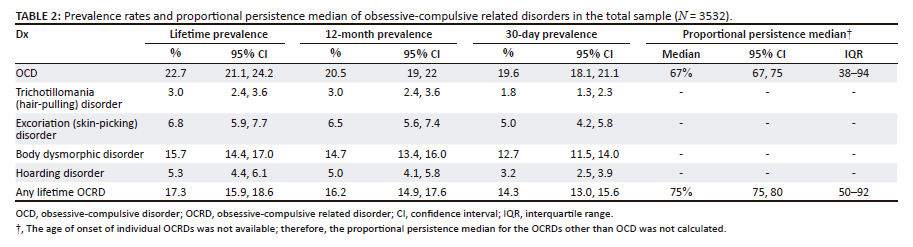
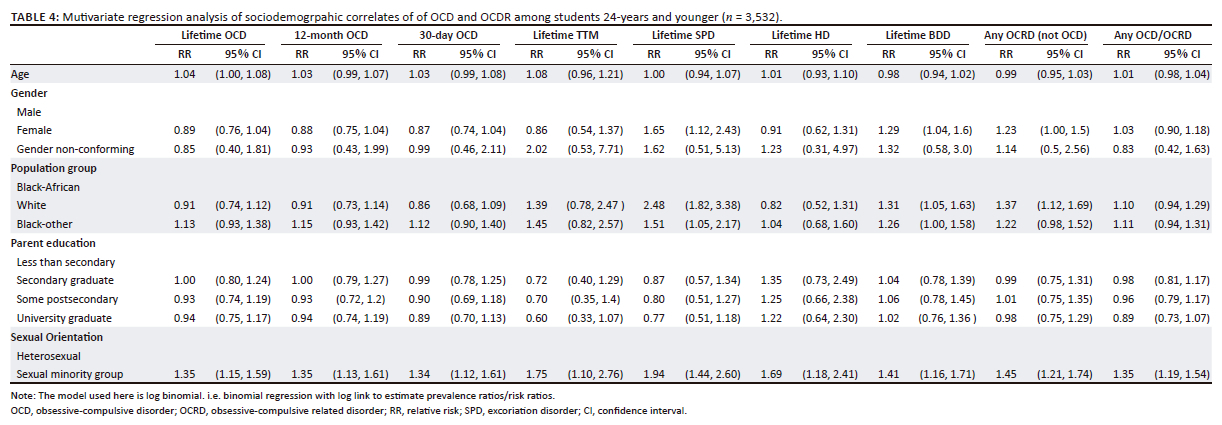
BACKGROUND: Although research on the epidemiology of obsessive-compulsive disorder (OCD) is growing, most studies are from high-income countries, with limited data on obsessive-compulsive related disorders (OCRDs). Whereas age of onset, persistence, and sociodemographic correlates of OCD have been well studied, much less is known about these factors in related conditions. AIM: This study aimed to investigate age of onset, persistence, and sociodemographic correlates of OCD and OCRDs in a national student mental health survey in South Africa. SETTING: This study draws on data collected from 17 universities across South Africa. METHODS: Students completed a survey assessing OCD, body dysmorphic disorder (BDD), trichotillomania (TTM), excoriation disorder (SPD), and hoarding disorder (HD). Multivariable regression using a log-binomial model examined sociodemographic correlates. Persistence was calculated as the proportion of current cases among those with lifetime diagnoses. RESULTS: Among 3532 respondents (63.3% female; mean age 20.9 years), mean age of onset was 15.6 years for OCD and 14.8 years for other OCRDs. The proportional persistence median was 67% for OCD and 75% for other OCRDs. Older students were at an increased risk for OCD (relative risk [RR] 1.04), while females (RR 1.23) and white students (RR 1.37) were at higher risk for OCRDs other than OCD. Students identifying as Lesbian, Gay, Bisexual, Transgender, Queer/Questioning and others (LGBTQ+) were at increased risk for all OCRDs. CONCLUSION: Despite reliance on non-validated self-report measures, this study offers the first survey data on BDD, TTM, SPD, and HD from a low- and middle-income setting. CONTRIBUTION: Results of this study highlight early onset and persistence of OCRDs, calling for greater global mental health attention.
South Africa; university students; obsessive-compulsive disorder; OCD; obsessive-compulsive related disorders; OCRDs; age of onset; persistence