The SASOP/PsychMg child and adolescent attention-deficit/hyperactivity disorder guidelines
Introduction
The concept of hyperactivity in children has been documented in the medical literature since the 18th Century. In 1798, physician and author Sir Alexander Crichton described a mental state much like ADHD, referring to individuals with a 'disease of attention,' who refer to themselves as having 'the fidgets,' and have 'the incapacity of attending with a necessary degree of constancy to any one object,' hallmark symptoms of what we now call ADHD. He was also accurate in other aspects of his portrayal of the condition, such as its early onset and the possibility of improvement with maturity.12
Attention-deficit/hyperactivity disorder is the most common psychiatric disorder in children, affecting around 5%-7% of the school-going population,34567N = 12 447), the prevalence of ADHD was 2.7% - which may be an underestimation as children with predominantly inattentive symptoms were less likely to be referred for screening and assessment.8
It is well recognised that ADHD is highly heritable, in fact among the most heritable of all psychiatric conditions. Family studies have identified a 2 to 8-fold increase in the risk for ADHD in parents and siblings of children with ADHD. Various twin and adoption studies have also highlighted the highly genetic nature of ADHD.91011
Attention-deficit/hyperactivity disorder is a costly, chronic disorder with a significant impact on the quality of life of individuals with ADHD and their families. Comorbidity in children with ADHD is prevalent and can range from poor self-esteem and academic difficulties to clinically relevant mental health disorder diagnoses. This contributes to the burden of disease and reduced quality of life of children with ADHD and their families.1213
Diagnosis and clinical characteristics
The accurate diagnosis of ADHD is a crucial factor in the successful management of this common, but often under- or misdiagnosed condition. The diagnosis should ideally be made by a specialist healthcare professional with appropriate expertise and training in diagnosing ADHD, such as a child psychiatrist, a paediatric neurologist or a neurodevelopmental paediatrician. For a diagnosis of ADHD to be made, symptoms according to the Diagnostic and Statistical Manual of Mental Disorders, fifth edition (DSM-5) diagnostic criteria need to be present (Box 1).14


The diagnosis requires the presence of developmentally inappropriate levels of the triad of hyperactive, impulsive and inattentive symptoms for at least 6 months. Symptoms need to occur in two or more different settings (e.g. home and school), should cause impairment in functioning or development across social, academic or occupational settings and at least some symptoms need to have been present before the age of twelve.
Based on these criteria, three types of ADHD are identified:
• Attention-deficit/hyperactivity disorder combined type: If both criteria A1 and A2 have been met for the past 6 months.
• Attention-deficit/hyperactivity disorder predominantly inattentive type: If criterion A1 has been met, but criterion A2 has not been met for the past 6 months.
• Attention-deficit/hyperactivity disorder predominantly hyperactive-impulsive type: If criterion A2 has been met, but criterion A1 has not been met for the past 6 months.
Further distinctions are made about severity:
• Mild: Few, if any, symptoms above those required to make the diagnosis are present, resulting in no more than minor impairments in social or occupational functioning.
• Moderate: Symptoms or functional impairment between 'mild' and 'severe' are present.
• Severe: Many symptoms above those required to make the diagnosis or several particularly severe symptoms are present or the symptoms result in marked impairment in social or occupational functioning.
Screening
As ADHD is a common neurodevelopmental disorder that presents in early childhood, ideally screening for ADHD symptoms in children in preschool or early primary school would assist in preventing the consequences of delayed or missed diagnosis; however, the practicality of this in South Africa is limited. It is important to note that the agreed minimally acceptable balance of sensitivity and specificity for screening tools is 0.8. Systematic reviews and meta-analyses of screening tools for ADHD have indicated that most acknowledged tools have good overall diagnostic accuracy, but that a single measure completed by a single reporter is unlikely to have sufficient sensitivity and specificity for clinical use or population screening.15
Once children are referred to a specialist, screening for ADHD should occur as part of the psychiatric diagnostic history taking in all patients regardless of the referred complaint. In conjunction with the clinical history, rating scales screening for ADHD are often used. These cannot be used alone to diagnose ADHD; positive screens can prompt full diagnostic evaluations.
In South Africa, the most used screening instruments are the Conners' Parent Rating Scale (CPRS) and the Conners' Teacher Rating Scale (CTRS),16171819
A study comparing a semi-structured interview versus CTRS/CPRS found sensitivity and specificity values to be high for the diagnostic interviews (91.8% and 70.7%, respectively), while sensitivity of the CTRS/CPRS was relatively high (83.5%), but specificity was poor (35.7%).8,20
A systematic review of tools for the diagnosis of ADHD in children and adolescents, indicated the sensitivity of the SNAP-IV for parents as ranging from 96% to 100%, with a 4%-38% specificity in clinical samples. The SNAP-IV for teachers sensitivity ranged from 40% to 97%, with specificity ranging from 26% to 71%.2122
The VADTRS and VADPRS are freely available in the public domain, making it an accessible screening instrument. Studies indicated Cronbach's alpha reliability for the VADPRS of 0.93-0.95 in clinical study samples, while the reliability for the VATRS ranged from 0.9 to 0.92 in school screens and 0.93-0.94 in clinical study samples.1923
Rating scales are also useful for monitoring intervention responses and comparing them to baseline symptoms.
Clinical evaluation
The clinical interview remains the cornerstone of the assessment process in diagnosing ADHD. In assessing a child, a full clinical and psychosocial history should be obtained from parents or caregivers, and the child or adolescent themselves where appropriate. Collateral information from schools, such as report cards and rating scales completed by teachers, is also invaluable. Collateral information and assessment reports from therapists involved with the patient, such as educational psychologists, occupational therapists (OT), optometrists and speech and language pathologists, should also be reviewed. Certain conditions or circumstances may point to an increased risk for ADHD, such as premature birth or a complicated neonatal course, neurodevelopmental disorders (including intellectual disability, autism spectrum disorders (ASD), specific learning disabilities, tic disorders and congenital syndromes), the presence of oppositional defiant symptoms or behavioural challenges, mood and anxiety disorders, epilepsy, traumatic brain injury, substance abuse, the presence of ADHD in a close relative and children in foster or alternative care arrangements.24,25
Medical, laboratory and other special investigations
A thorough medical history and physical examination should be completed to exclude any causative or comorbid medical disorders confounding the diagnosis. It is also important to document baseline blood pressure, pulse rate, height and weight, which should be monitored at follow-up consultations.24
Most patients with ADHD do not require laboratory investigations, which should be reserved to eliminate suspected pathology (e.g. iron deficiency) or for safety monitoring with the use of certain medications (e.g. liver function tests with the use of atomoxetine [ATX]). An electrocardiogram (ECG) may be required if there is a history or family history of significant cardiac pathology, particularly congenital cardiac defects or cardiac surgery. Visual and auditory screening should be done with a referral to optometrists or audiologists for further investigation when indicated. Neurological symptoms may require referral to a neurologist. Routine electroencephalogram (EEG) is not recommended as part of the diagnostic workup for ADHD. If epilepsy is suspected, an EEG should be performed. Although extended-length EEGs have a higher likelihood of detecting interictal phenomena, cost and convenience factors should be considered.2627,28
Although neuroimaging, brain mapping and event-related potentials have detected structural and functional differences in ADHD research studies, there are currently no indications for these costly and inaccessible investigations in clinical practice.11,25
Psychometric evaluation
There are currently no neuropsychological tests for ADHD with sufficient sensitivity and specificity to serve as an individual diagnostic test.11298,3031
Comorbidity
Comorbid conditions are very common with ADHD and often complicate the clinical presentation. Fifty to ninety per cent of children have at least one comorbid condition, while 50% have two or more comorbid conditions.25,32
Comorbid conditions are either current, episodic conditions - the most frequent in childhood being disruptive behavioural disorders (e.g. oppositional defiant disorder, conduct disorder), anxiety disorders (e.g. generalised anxiety disorder, social anxiety and obsessive-compulsive disorder) and mood disorders (e.g. depression and bipolar disorder). Others represent lifespan disorders, such as specific developmental disorders of language, learning and motor development, ASD and intellectual disability.25,32
Attention-deficit/hyperactivity disorder does not have any one symptom that is pathognomonic for the condition and overlap with other disorders can be significant. Comorbid conditions differ according to developmental stage and change over time. In early childhood, the most common comorbid disorders are oppositional defiant disorder, language disorders and anxiety disorders. In middle school children, anxiety and tic disorders become more common. In adolescence, mood disorders and substance use disorders become more prevalent.25
Oppositional defiant disorder and conduct disorder are common comorbidities with ADHD in childhood and adolescence, with 30%-50% fulfilling the criteria for one of these two conditions. Other externalising disorders such as disruptive mood dysregulation disorder and intermittent explosive disorder also occur relatively commonly. These comorbidities are associated with greater functional impairment, higher rates of learning disabilities and academic problems, behavioural problems, aggression and later, substance use and delinquent behaviour.33
Anxiety disorders and mood disorders also commonly co-occur with ADHD. Anxiety disorders are seen in 15%-35% of children with ADHD and depressive disorders in 20%-50%.34353637
Tic disorders including Tourette syndrome are highly comorbid with ADHD, with prevalence rates of 55%-90%. The presence of tics is not a contraindication to using stimulants for ADHD, but careful monitoring is required. If stimulants do increase tics in a particular individual, then ATX should be considered, as it has a lower potential to aggravate tics.3839
In previous editions of the DSM, the diagnosis of ADHD and ASD was mutually exclusive. However, since the publication of DSM-5, there has been a substantial increase in the prevalence of these two disorders, which can now be diagnosed in combination. Thirty to seventy per cent of patients with ASD meet the criteria for ADHD, while many individuals with ADHD display social deficits and ASD-like symptoms.40,41,42434445
Sleep disturbance occurs in around 50% of individuals with ADHD, most commonly initial insomnia. There is growing evidence that individuals with ADHD may be more susceptible to circadian rhythm disruptions.464748,49
Developmental and acquired brain injuries are also associated with ADHD-like symptoms. The association between foetal alcohol syndrome and ADHD is strong and can be particularly difficult to manage.5051
Comorbidity between epilepsy and ADHD is common. Identification of ADHD in patients with epilepsy is difficult because the symptoms and management related to epilepsy can directly contribute to attention deficits.525354,55
The prevalence of ADHD in eating disorders (such as anorexia nervosa and bulimia nervosa) is around 11%, while roughly 20% of children with ADHD also develop eating disorders.5657585960
Attention-deficit/hyperactivity disorder increases the risk for an elimination disorder (enuresis and encopresis) two to three times. Elimination disorders should be investigated and managed, but recent studies have found that treatment of ADHD with both psychostimulants and ATX can result in an improvement in enuresis and encopresis.61
Time spent using digital media for leisure purposes has increased exponentially in the last decade among children and adolescents, and social media use has been found to be just as addictive as gaming. Longitudinal studies have looked at the direction of association between digital media use and ADHD and have revealed that excessive digital media use (EDMU) is a risk factor for the onset of ADHD symptoms, while ADHD predisposes to EDMU. Furthermore, ADHD and EDMU mutually aggravate each other over time.6263
Therefore, from a clinical perspective, it is important for practitioners to educate parents and children about how EDMU may aggravate ADHD symptoms. Various bodies, such as the American Academy of Pediatrics have published guidelines for recreational screen time in children (www.healthychildren.org).
Treatment
Good long-term clinical care is contingent upon adequate patient education about the nature of the disorder and the effects of treatment. Once the diagnosis has been confirmed, clinicians should provide sufficient information to empower families to make informed decisions about treatment options. While published guidelines such as these are important, it must be stressed that a strictly algorithmic approach to treating ADHD is not advised, and management should be holistic, multidisciplinary and tailored to meet the individual needs of patients and their families.
Although pharmacotherapy plays a primary role in the treatment of ADHD, psychosocial interventions form an integral part of a comprehensive, multi-modal management approach for children with ADHD. This multidisciplinary approach is also encapsulated in various international guidelines that recommend psychosocial treatments as complementary to psychopharmacological interventions to provide support, improve acceptance of diagnosis and treat comorbidities and residual symptoms.24,25,64
Factors to consider in choosing attention-deficit/hyperactivity disorder medication
A detailed history outlining previous trials of medication is important to facilitate rational decision-making around medication choice. However, it must be stressed that an individual child may respond very differently to a given medication at different stages of development. Very young children may tolerate the shorter-acting preparations better than the longer-acting ones because of the reduced risk of appetite suppression and insomnia. Of particular importance is the management of preschool children with ADHD. It is well recognised that children below the age of five are more vulnerable to the side effects of ADHD medications. Therefore, it is appropriate to implement environmental modifications and parent management training before considering medications in this age group.24
Comorbid conditions must be managed concomitantly with ADHD and decisions regarding which to treat first depend on the severity of each condition. The more severe condition should generally be addressed first while balancing functional impairment and possible worsening of the comorbid condition.65,66
Access to medication is not a given. Most South Africans are reliant on the state healthcare sector and thus do not have access to the full range of locally available medications. Even in the private sector, stock shortages periodically impact medication choice. Many families struggle to afford the ongoing costs of ADHD medication, and increasingly, more than one individual in a family may be on treatment. Most medical aids do not offer chronic benefits for ADHD and its medications, and most South African families are not covered by medical insurance.67
There is increasing interest in the use of pharmacogenetic testing to guide medication choice for ADHD. However, to date, effect sizes have been small, and few consistent findings have been reported. Given the poor adherence to ADHD medications, perhaps a more appropriate target for pharmacogenetic studies is tolerability. Because many common adverse events are dose-related, pharmacogenetic studies associated with inter-individual variability in drug metabolism may be helpful, such as CYP2D6 for amphetamines (AMP) and ATX and carboxylesterase-1 gene (CES1), which is the sole enzyme involved in methylphenidate (MPH) metabolism.68
Pharmacological treatment
Medication remains the cornerstone of treatment for most children and adolescents with ADHD.24,45,646970
Medications used in the treatment of ADHD in children include stimulants (MPH and AMP) and non-stimulants (ATX, alpha2-adrenoceptor agonists [clonidine and guanfacine] and tricyclic antidepressants [TCAs]). Enhancement of dopaminergic and noradrenergic neurotransmission in the prefrontal cortex is considered critical to the therapeutic efficacy of ADHD medications.71
Stimulants
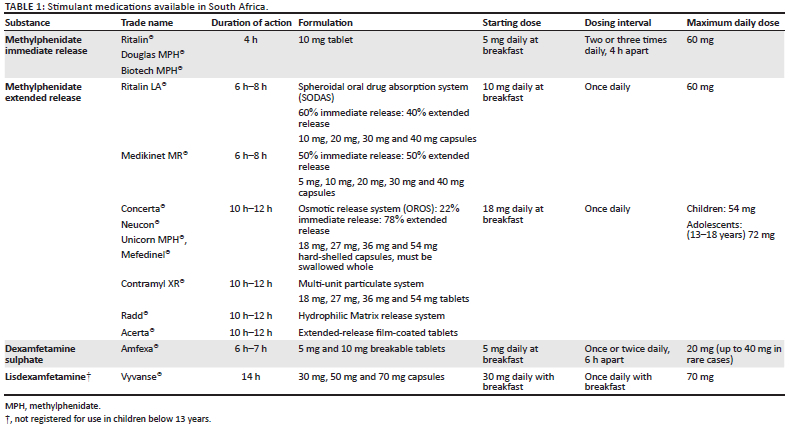
Stimulants are the best-studied pharmacological treatment for ADHD across the lifespan. Methylphenidate and AMP have similar effects, with an average response rate of 70%.721124,25,6424,25,64Table 1 for stimulants available in South Africa.
It is important to note that both classes of stimulant medication have similar efficacy and tolerability profiles at the population level. However, at the individual level, patients may respond to or tolerate one class better than the other.73,74both classes of stimulants to be given before engaging in a trial of non-stimulant alternatives. Attention-deficit/hyperactivity disorder is a highly heterogeneous condition which affects individual patients differently. Some children may be primarily impaired in the classroom, whereas others may be severely impaired at home and less so at school. The duration of action of the chosen medication is thus an important consideration. Long-acting preparations are usually preferred as they diminish the need for multiple intraday dosing and therefore augment adherence, symptom coverage and treatment response.75
However, longer-acting stimulants increase the risk of certain side effects such as appetite suppression and insomnia, especially in younger, treatment-naive children, in whom initiation with a shorter-acting agent may be preferable. Combinations of immediate and extended-release preparations may sometimes be appropriate, for example, a child at boarding school who is required to do homework after 6 pm may require a 'top-up' of a short-acting stimulant in the late afternoon or early evening. Compared to immediate-release psychostimulants, the use of long-acting stimulants may diminish diversion and rebound and are often associated with better tolerability.76
There is very little correlation between body weight and dosage of the stimulant medications. The dosage should be gradually titrated against clinical response and side effects until an optimum response is attained.25
Non-stimulants
Atomoxetine has a slightly lower effect size (overall response rate) compared to psychostimulants.7778798081
Guanfacine is another non-stimulant for ADHD but not available in South Africa. Other agents used off-label (with lower efficacy profiles and more severe side effects) include clonidine (Menograine®) and imipramine (Tofranil®). There is no evidence for the use of bupropion or modafinil in the treatment of children and adolescents with ADHD. Atypical antipsychotics are among the agents used for comorbidities commonly seen with ADHD, often in combination with other agents. These medications are generally reserved for treatment-resistant cases and require specialised care.
Monitoring of treatment
It is important to clearly identify all ADHD-related impairment and the treatment goals at the onset of treatment. Regular re-evaluations of the efficacy and tolerability of treatment for accurate monitoring of progress are needed. It is also important to systematically identify other potential causes of impaired functioning in a patient. Sleep deprivation, poor nutrition, excessive screen time, lack of routines, psychosocial stressors and comorbid disorders can affect outcomes and should always be considered when assessing the patient's condition and when measuring clinical response to treatment.25
After initiation of treatment, the patient should be seen within 4-6 weeks to assess the response to treatment and possible side effects. Thereafter, follow-up intervals are at the doctor's discretion, but legally cannot be longer than six months apart, because of the high schedule classification of the medications involved. Monitoring requires feedback from the child, his or her parents, the schoolteacher and any therapists who may be involved with the care of the child. To this end, rating scales may be useful.25
Interruption in treatment is not recommended. Atomoxetine must be given continuously, inclusive of weekends and holidays, and the same is generally advisable for stimulant medications. Medication may be reduced, temporarily interrupted or completely stopped if the patient experiences unacceptable side effects, ADHD symptoms have improved sufficiently or because of a lack of response. While most children with ADHD will continue to experience symptoms into adolescence and adulthood, there are some whose symptoms remit or in whom the acquisition of coping mechanisms renders the symptoms less impairing.828364
Non-pharmacological interventions for attention-deficit/hyperactivity disorder
Attention-deficit/hyperactivity disorder has a heterogeneous group of causal and contributing factors, including biological, psychological and environmental elements.84,8586
Psychoeducation and therapy
Psychoeducation focussed on ADHD is a vital component of the ongoing management of the condition. This should include the guardians/caregivers and the child or adolescent if developmentally appropriate. The focus of psychoeducation should be on information about symptoms of ADHD, treatment options, possible side effects of medication, compliance with medication and discussions around strategic treatment interruption. Other lifestyle factors such as supplements, diet, physical activity, screen time, sleep and discipline strategies may also form part of ongoing psychoeducation. Psychoeducation may also extend to other individuals involved in the child's life such as teachers, tutors and caregivers.24,25
Behavioural therapy principles including social learning theory and other cognitive techniques form the basis of parent counselling and skills training and may take place over multiple sessions. Other formats include group-based parent training, teacher training interventions and child training interventions. Topics to be included are organisational skills, social skills, problem-solving and cognitive restructuring.87
Systematic reviews of randomised control trials found small effects on academic outcomes, small to medium effects on parenting and medium to large effects on organisational skills.87,888887,89,90,91
Randomised controlled trials of mindfulness-based interventions compared with no treatment have shown some improvement in ADHD symptoms at 6-month follow-up.92,9387,94
Cognitive training, neurofeedback and brain stimulation
The large variation in targeted areas and frequency of dosing make cognitive training difficult to appraise as an evidence-based treatment. If only blinded studies are considered, no effect of cognitive training and neurofeedback on ADHD symptoms is seen. High costs and low efficacy of cognitive training, even in game-like form, do not support this as an intervention.95,96,97
There has been an increasing interest in and the use of computer-based cognitive training (CBCT) as a treatment of ADHD, with some empirical support in recent years from controlled studies.9899
Trigeminal nerve stimulation (TNS) and transcranial magnetic stimulation (TMS) have been advocated for children with ADHD but cannot yet be recommended because of insufficient evidence.87,100,101
Allied therapies
Children who have difficulties in coordination, both fine and gross motor function as well as visual motor integration problems may benefit from referral to an OT. Sensory processing disorder is also a common comorbid finding, which might necessitate occupational therapy. Speech and language delays and articulation disorders require referral to speech and language therapists for assessment and treatment. Children with motor coordination disorders may require referral to a neurodevelopmental physiotherapist.12
Exercise
Exercise as an intervention for ADHD is appealing, with positive effects on cognitive, motor and socio-emotional development, as well as low cost and safety aspects. Exercise has been shown to enhance dopamine and monoamine neurotransmission, brain-derived neurotrophic factor (BDNF) levels, brain oxygenation and cell metabolism and has been postulated to support brain structural growth and functional neurocognitive development.102
In a recent meta-analysis, exercise was found to improve attention, motor skills and executive function in ADHD children compared to controls but did not significantly improve hyperactivity, depression, aggression and social problems.102103
Because of a large difference in study designs and outcome measures, there is still insufficient data to recommend a specific type of exercise, intensity, duration and frequency. Immediate cognitive effects of exercise may not equate to longer-lasting effects of repeated exercise on ADHD symptoms.87
Dietary interventions
Dietary interventions for ADHD are safe but can be laborious to implement and adequate nutrition needs to be ensured. Such interventions have included eliminating artificial food colouring, additives, salicylates and antigenic foods (oligo-antigenic diet), and the Dietary Approaches to Stop Hypertension (DASH) diet, the latter two demonstrating some evidence in improving ADHD symptoms.104,105,106,107,108106,107
Complementary and alternative medications
Complementary and alternative medicine (CAM) refers to health and wellness products and techniques not presently considered to be part of conventional Western medicine.109
The World Federation of ADHD International Consensus Statement reiterates that non-medication treatments for ADHD are less effective than medication treatments but are frequently useful to help symptoms that remain after the medication has been optimised.11110,111,112113114
Recent studies highlighted the role of micronutrients and vitamins in ADHD management although the findings remain controversial. Vitamin D supplementation (if deficient) has some benefit, but no evidence was found for supplementation with nutrients such as zinc, vitB12, iron and folate.115
Although many individuals, with and without ADHD, report benefits from 'brainsmart foods' such as bacopa monnieri, mentat, zinc, L-carnitine, vitamin B6, magnesium, ginkgo biloba, ginseng, Celastrus paniculata, passionflower, acetyl L-carnitine (ALCAR), dimethylethanolamine (DMAE), L-theanine, DHA (dosahexaenoic acid), citicoline, curcumin, phosphatidylserine, vincopetine, L-alpha-glycerylphosphorylcholine and huperzine A, formal studies of the effectiveness of these agents are lacking. At present, there is no consistent evidence from randomised controlled trials for the use of any food supplements, and the use of these products, especially in children, should not be recommended.116
Transitioning from child and adolescent to adult services
It is now well established that ADHD continues into adulthood in most affected individuals and continues to cause significant impairment.80117
Summary
Attention-deficit/hyperactivity disorder is a common neurodevelopmental disorder of childhood, persisting across the lifespan. It is associated with significant morbidity and economic burden. A comprehensive diagnostic assessment and diagnostic certainty prior to initiating drug treatment are crucial. Effective treatments are available, leading to a significant reduction in impairment and improvement in quality of life for both patients and their families. It is hoped that these guidelines will raise awareness of the plight of children and adolescents with ADHD, assist practitioners in diagnosing and managing ADHD, and inform funders about the importance of comprehensive, multidisciplinary care in improving outcomes across the lifespan.
Competing interests
The authors declare that they have no financial or personal relationships that may have inappropriately influenced them in writing this article. Dr Belsham serves on the pharmaceutical advisory boards of Adcock Ingram and Acino. He has received honoraria, sponsorships and speakers' fees from Takeda, Sanofi, Viatris and Adcock Ingram. Dr Kelly serves on the pharmaceutical advisory board of Adcock Ingram and has received honoraria, sponsorships and speakers' fees from Adcock Ingram and Viatris. Prof. Schoeman serves on the South African Ministerial Advisory Committee for Mental Health, where she chairs the subcommittee for Child, Adolescent and Family Mental Health. She is also a member of the pharmaceutical advisory boards of Adcock Ingram and Acino and has received honoraria, sponsorships and speakers' fees from Acino, Adcock Ingram, Dr Reddy's, PharmaDynamics, Sandoz and Viatris.
Authors' contributions
B.B., L.K. and R.S. were involved in the conceptualisation, methods and writing of the manuscript. In addition, R.S. was involved in the visualisation and project administration.
Ethical considerations
The article is an original work and adheres to the ethical guidelines outlined by the South African Journal of Psychiatry. The article does not contain any data that would require ethical review.
Funding information
This research received no specific grant from any funding agency in the public, commercial or not-for-profit sectors.
Data availability
Data sharing is not applicable to this article as no new data were created or analysed in this study.
Disclaimer
The views and opinions expressed in this article are those of the authors and are the product of professional research. It does not necessarily reflect the official policy or position of any affiliated institution, funder, agency or that of the publisher. The authors are responsible for this article's results, findings and content.
Acknowledgements
The authors would like to extend their gratitude to the following colleagues for their peer review and constructive input in the writing of these guidelines: Dr Wendy Duncan, Dr Stacey Kretzmer, Dr Kedi Motingoe, Dr Fiona Schulte, Prof Andre Venter and Dr Merryn Young.
References
- 1. Crichton A. An inquiry into the nature and origin of mental derangement: Comprehending a concise system of the physiology and pathology of the human mind and a history of the passions and their effects. London: T. Cadell and W. Davies; 1798.
- 2. Goldstein S. Managing attention and learning disorders in late adolescence and adulthood. New York, NY: Wiley; 1997.
-
3. Thomas R, Sanders S, Doust J, Beller E, Glasziou P. Prevalence of attention-deficit/hyperactivity disorder: A systematic review and meta-analysis. Pediatrics. 2015;135(4):e994-1001. https://doi.org/10.1542/peds.2014-3482
» https://doi.org/10.1542/peds.2014-3482 -
4. Salari N, Ghasemi H, Abdoli N, et al. The global prevalence of ADHD in children and adolescents: A systematic review and meta-analysis. Ital J Pediatr. 2023;49(1):48-60. https://doi.org/10.1186/s13052-023-01456-1
» https://doi.org/10.1186/s13052-023-01456-1 -
5. Simon V, Czobor P, Bálint S, et al. Prevalence and correlates of adult attention-deficit hyperactivity disorder: Meta-analysis. Br J Psychiatry. 2009;194(3):204-211. https://doi.org/10.1192/bjp.bp.107.048827
» https://doi.org/10.1192/bjp.bp.107.048827 -
6. Polanczyk G, De Lima MS, Horta BL, Biederman J, Rohde LA. The worldwide prevalence of ADHD: A systematic review and metaregression analysis. Am J Psychiatry. 2007;164(6):942-948. https://doi.org/10.1176/ajp.2007.164.6.942
» https://doi.org/10.1176/ajp.2007.164.6.942 -
7. Meyer A, Eilertsen D-E, Sundet JM, Tshifularo J, Sagvolden T. Cross-cultural similarities in ADHD-like behaviour amongst South African primary school children. S Afr J Psychol. 2004;34(1):122-138. https://doi.org/10.1177/008124630403400108
» https://doi.org/10.1177/008124630403400108 -
8. Schoeman R, Enright J, James A, Vermeulen C, De Beer N. Removing mental health barriers to education: A community project. S Afr J Psychiat. 2018;24:a1293. https://doi.org/10.4102/sajpsychiatry.v24i0.1293
» https://doi.org/10.4102/sajpsychiatry.v24i0.1293 -
9. Banerjee TD, Middleton F, Faraone SV. Environmental risk factors for attention-deficit hyperactivity disorder. Acta Paediatr. 2007;96(9):1269-1274. https://doi.org/10.1111/j.1651-2227.2007.00430.x
» https://doi.org/10.1111/j.1651-2227.2007.00430.x -
10. Cortese S. The neurobiology and genetics of attention-deficit/hyperactivity disorder (ADHD): What every clinician should know. Eur J Paediatr Neurol. 2012;16(5):422-433. https://doi.org/10.1016/j.ejpn.2012.01.009
» https://doi.org/10.1016/j.ejpn.2012.01.009 -
11. Faraone SV, Banaschewski T, Coghill D, et al. The World Federation of ADHD International Consensus Statement: 208 Evidence-based conclusions about the disorder. Neurosci Biobehav Rev. 2021;128:789-818. https://doi.org/10.1016/j.neubiorev.2021.01.022
» https://doi.org/10.1016/j.neubiorev.2021.01.022 -
12. Schoeman R, Liebenberg R. The South African Society of Psychiatrists/Psychiatry Management Group management guidelines for adult attention-deficit/hyperactivity disorder. S Afr J Psychiat. 2017;23:a1060. https://doi.org/10.4102/sajpsychiatry.v23i0.1060
» https://doi.org/10.4102/sajpsychiatry.v23i0.1060 - 13. Radmanovic MB, Burgic S-S. Comorbidity in children and adolescents with ADHD. In: Kupersack HG, editor. ADHD: From etiology to comorbidity. London: IntechOpen; 2021; p. 1-20.
- 14. American Psychiatric Association (APA). Diagnostic and statistical manual of mental disorders. 5th ed. Arlington, VA: American Psychiatric Publishing, Inc.; c2013.
-
15. Mulraney M, Arrondo G, Musullulu H, et al. Systematic review and meta-analysis: Screening tools for attention-deficit/hyperactivity disorder in children and adolescents. J Am Acad Child Adolesc Psychiatry. 2022;61(8):982-996. https://doi.org/10.1016/j.jaac.2021.11.031
» https://doi.org/10.1016/j.jaac.2021.11.031 -
16. Conners CK, Sitarenios G, Parker JD, Epstein JN. The revised Conners' Parent Rating Scale (CPRS-R): Factor structure, reliability, and criterion validity. J Abnorm Child Psychol. 1998;26(4):257-268. https://doi.org/10.1023/A:1022602400621
» https://doi.org/10.1023/A:1022602400621 - 17. Swanson JM, Schuck S, Porter MM, et al. Categorical and dimensional definitions and evaluations of symptoms of ADHD: History of the SNAP and the SWAN rating scales. Int J Educ Psychol Assess. 2012;10(1):51-70.
-
18. Wolraich ML, Lambert W, Doffing MA, Bickman L, Simmons T, Worley K. Psychometric properties of the Vanderbilt ADHD diagnostic parent rating scale in a referred population. J Pediatr Psychol. 2003;28(8):559-568. https://doi.org/10.1093/jpepsy/jsg046
» https://doi.org/10.1093/jpepsy/jsg046 -
19. Parker A, Corkum P. ADHD diagnosis: As simple as administering a questionnaire or a complex diagnostic process? J Atten Disord. 2016;20(6):478-486. https://doi.org/10.1177/1087054713495736
» https://doi.org/10.1177/1087054713495736 - 20. Copeland E. Copeland symptom checklist for attention deficit disorders. Atlanta, GA: Southeastern Psychological Institute; 1987.
-
21. Peterson BS, Trampush J, Brown M, et al. Tools for the diagnosis of ADHD in children and adolescents: A systematic review. Pediatrics. 2024;153(4):e202406585. https://doi.org/10.1542/peds.2024-065854
» https://doi.org/10.1542/peds.2024-065854 -
22. Hall CL, Guo B, Valentine AZ, et al. The validity of the SNAP-IV in children displaying ADHD symptoms. Assessment. 2020;27(6):1258-1271. https://doi.org/10.1177/1073191119842255
» https://doi.org/10.1177/1073191119842255 - 23. Khambule NN. Investigating the psychometric properties of the Vanderbilt-Attention-Deficit-Hyperactivity-Disorder diagnostic rating scale (VADRS) within the South African context [master's thesis]. Pietermaritzburg: University of KwaZulu-Natal; 2021.
-
24. National Institute for Health and Clinical Excellence. Attention deficit hyperactivity disorder: Diagnosis and management [homepage on the Internet]. NICE guideline [NG87]. c2019 [updated 2019 Sept 13; cited 2024 Jun 06]. Available from: https://www.nice.org.uk/guidance/ng87
» https://www.nice.org.uk/guidance/ng87 - 25. Canadian ADHD Resource Alliance. Canadian ADHD practice guidelines. 4.1 ed. Toronto, ON: CADDRA; 2020.
-
26. Burkholder DB, Britton JW, Rajasekaran V, et al. Routine vs extended outpatient EEG for the detection of interictal epileptiform discharges. Neurology. 2016;86(16):1524-1530. https://doi.org/10.1212/WNL.0000000000002592
» https://doi.org/10.1212/WNL.0000000000002592 -
27. Lenartowicz A, Loo SK. Use of EEG to diagnose ADHD. Curr Psychiatry Rep. 2014;16(11):498. https://doi.org/10.1007/s11920-014-0498-0
» https://doi.org/10.1007/s11920-014-0498-0 -
28. Slater J, Joober R, Koborsy BL, Mitchell S, Sahlas E, Palmer C. Can electroencephalography (EEG) identify ADHD subtypes? A systematic review. Neurosci Biobehav Rev. 2022;139:104752. https://doi.org/10.1016/j.neubiorev.2022.104752
» https://doi.org/10.1016/j.neubiorev.2022.104752 - 29. Leark RA, Greenberg LM, Kindschi CL. T.O.V.A. professional manual. Test of variables of attention continuous performance test. Los Alamitos, CA: The TOVA Company; 2007.
- 30. Berger I, Goldzweig G. Objective measures of attention-deficit/hyperactivity disorder: A pilot study. Isr Med Assoc J. 2010;12(9):531-535.
-
31. Emser TS, Johnston BA, Steele JD, Kooij S, Thorell L, Christiansen H. Assessing ADHD symptoms in children and adults: Evaluating the role of objective measures. Behav Brain Funct. 2018;14(1):11. https://doi.org/10.1186/s12993-018-0143-x
» https://doi.org/10.1186/s12993-018-0143-x -
32. Jensen PS, Hinshaw SP, Kraemer HC, et al. ADHD comorbidity findings from the MTA study: Comparing comorbid subgroups. J Am Acad Child Adolesc Psychiatry. 2001;40(2):147-158. https://doi.org/10.1097/00004583-200102000-00009
» https://doi.org/10.1097/00004583-200102000-00009 -
33. Barkley RA, Fischer M, Smallish L, Fletcher K. Young adult follow-up of hyperactive children: Antisocial activities and drug use. J Child Psychol Psychiatry. 2004;45(2):195-211. https://doi.org/10.1111/j.1469-7610.2004.00214.x
» https://doi.org/10.1111/j.1469-7610.2004.00214.x -
34. Duffy A. The nature of the association between childhood ADHD and the development of bipolar disorder: A review of prospective high-risk studies. Am J Psychiatry. 2012;169(12):1247-1255. https://doi.org/10.1176/appi.ajp.2012.11111725
» https://doi.org/10.1176/appi.ajp.2012.11111725 -
35. Youngstrom EA, Arnold LE, Frazier TW. Bipolar and ADHD comorbidity: Both artifact and outgrowth of shared mechanisms. Clin Psychol Sci Pract. 2010;17(4):350-359. https://doi.org/10.1111/j.1468-2850.2010.01226.x
» https://doi.org/10.1111/j.1468-2850.2010.01226.x -
36. Biederman J, Mick E, Faraone SV. Depression in attention deficit hyperactivity disorder (ADHD) children: 'True' depression or demoralization? J Affect Disord. 1998;47(1-3):113-122. https://doi.org/10.1016/S0165-0327(97)00127-4
» https://doi.org/10.1016/S0165-0327(97)00127-4 -
37. Arnold LE, Demeter C, Mount K, et al. Pediatric bipolar spectrum disorder and ADHD: Comparison and comorbidity in the LAMS clinical sample. Bipolar Disord. 2011;13(5-6):509-521. https://doi.org/10.1111/j.1399-5618.2011.00948.x
» https://doi.org/10.1111/j.1399-5618.2011.00948.x -
38. Roessner V, Becker A, Banaschewski T, Freeman RD, Rothenberger A, Tourette Syndrome International Database Consortium. Developmental psychopathology of children and adolescents with Tourette syndrome - Impact of ADHD. Eur Child Adolesc Psychiatry. 2007;16(Suppl. 1):24-35. https://doi.org/10.1007/s00787-007-1004-6
» https://doi.org/10.1007/s00787-007-1004-6 -
39. Coffey BJ, Rapoport J. Obsessive-compulsive disorder and Tourette's disorder: Where are we now? J Child Adolesc Psychopharmacol. 2010;20(4):235. https://doi.org/10.1089/cap.2010.2041
» https://doi.org/10.1089/cap.2010.2041 -
40. Leitner Y. The co-occurrence of autism and attention deficit hyperactivity disorder in children - What do we know? Front Hum Neurosci. 2014;8:268. https://doi.org/10.3389/fnhum.2014.00268
» https://doi.org/10.3389/fnhum.2014.00268 -
41. Stevens T. The comorbidity of ADHD in children diagnosed with autism spectrum disorder. Res Autism Spectr Disord. 2016;31:11-18. https://doi.org/10.1016/j.rasd.2016.07.003
» https://doi.org/10.1016/j.rasd.2016.07.003 -
42. Antshel K, Zhang-James Y, Wagner KE, Ledesma A, Faraone SV. An update on the comorbidity of ADHD and ASD: A focus on clinical management. Expert Rev Neurother. 2016;6(3):279-293. https://doi.org/10.1586/14737175.2016.1146591
» https://doi.org/10.1586/14737175.2016.1146591 -
43. Sadeh A, Pergamin L, Bar-Haim Y. Sleep in children with attention-deficit hyperactivity disorder: A meta-analysis of polysomnographic studies. Sleep Med Rev. 2006;10(6):381-398. https://doi.org/10.1016/j.smrv.2006.03.004
» https://doi.org/10.1016/j.smrv.2006.03.004 -
44. Reichow B, Volkmar FR, Bloch MH. Systematic review and meta-analysis of pharmacological treatment of the symptoms of ADHD in children with pervasive developmental disorders. J Autism Dev Disord. 2013;43(10):2435-2441. https://doi.org/10.1007/s10803-013-1793-z
» https://doi.org/10.1007/s10803-013-1793-z -
45. DuPaul GJ, Gormley MJ, Laracy SD. Comorbidity of LD and ADHD: Implications of DSM-5 for assessment and treatment. J Learn Disabil. 2013;46(1):43-51. https://doi.org/10.1177/0022219412464351
» https://doi.org/10.1177/0022219412464351 -
46. Coogan AN, Baird AL, Popa-Wagner A, Thome J. Circadian rhythms and attention deficit hyperactivity disorder: The what, the when and the why. Prog Neuropsychopharmacol Biol Psychiatry. 2016;3(67):74-81. https://doi.org/10.1016/j.pnpbp.2016.01.006
» https://doi.org/10.1016/j.pnpbp.2016.01.006 -
47. Galland BC, Tripp EG, Taylor BJ. The sleep of children with attention deficit hyperactivity disorder on and off methylphenidate: A matched case-control study. J Sleep Res. 2010;19(2):366-373. https://doi.org/10.1111/j.1365-2869.2009.00795.x
» https://doi.org/10.1111/j.1365-2869.2009.00795.x -
48. Cortese S, Brown TE, Corkum P, et al. Assessment and management of sleep problems in youths with attention-deficit/hyperactivity disorder. J Am Acad Child Adolesc Psychiatry. 2013;52(8):784-796. https://doi.org/10.1016/j.jaac.2013.06.001
» https://doi.org/10.1016/j.jaac.2013.06.001 -
49. Masi G, Fantozzi P, Villafranca A, et al. Effects of melatonin in children with attention-deficit/hyperactivity disorder with sleep disorders after methylphenidate treatment. Neuropsychiatr Dis Treat. 2019;15:663-667. https://doi.org/10.2147/NDT.S193891
» https://doi.org/10.2147/NDT.S193891 -
50. Lange S, Shield K, Rehm J, Anagnostou E, Popova S. Fetal alcohol spectrum disorder: Neurodevelopmentally and behaviorally indistinguishable from other neurodevelopmental disorders. BMC Psychiatry. 2019;19(1):322. https://doi.org/10.1186/s12888-019-2289-y
» https://doi.org/10.1186/s12888-019-2289-y -
51. Ilie G, Vingilis ER, Mann RE, et al. The association between traumatic brain injury and ADHD in a Canadian adult sample. J Psychiatr Res. 2015;69:174-179. https://doi.org/10.1016/j.jpsychires.2015.08.004
» https://doi.org/10.1016/j.jpsychires.2015.08.004 -
52. Ettinger AB, Ottman R, Lipton RB, Cramer JA, Fanning KM, Reed ML. Attention-deficit/hyperactivity disorder symptoms in adults with self-reported epilepsy: Results from a national epidemiologic survey of epilepsy. Epilepsia. 2015;56(2):218-224. https://doi.org/10.1111/epi.12897
» https://doi.org/10.1111/epi.12897 -
53. Wang S, Yao B, Zhang H, et al. Comorbidity of epilepsy and attention-deficit/hyperactivity disorder: A systematic review and meta-analysis. J Neurol. 2023;270(9):4201-4213. https://doi.org/10.1007/s00415-023-11794-z
» https://doi.org/10.1007/s00415-023-11794-z -
54. Fan HC, Chiang KL, Chang KH, Chen CM, Tsai JD. Epilepsy and attention deficit hyperactivity disorder: Connection, chance, and challenges. Int J Mol Sci. 2023;24(6):5270. https://doi.org/10.3390/ijms24065270
» https://doi.org/10.3390/ijms24065270 -
55. Ono KE, Bearden DJ, Lee SM, et al. Interventions for ADHD in children & adolescents with epilepsy: A review and decision tree to guide clinicians. Epilepsy Behav. 2022;135:108872. https://doi.org/10.1016/j.yebeh.2022.108872
» https://doi.org/10.1016/j.yebeh.2022.108872 -
56. Villa FM, Crippa A, Rosi E, Nobile M, Brambilla P, Delvecchio G. ADHD and eating disorders in childhood and adolescence: An updated minireview. J Affect Disord. 2023;321:265-271. https://doi.org/10.1016/j.jad.2022.10.016
» https://doi.org/10.1016/j.jad.2022.10.016 -
57. Biederman J, Ball SW, Monuteaux MC, Surman CB, Johnson JL, Zeitlin S. Are girls with ADHD at risk for eating disorders? Results from a controlled, five-year prospective study. J Dev Behav Pediatr. 2007;28(4):302-307. https://doi.org/10.1097/DBP.0b013e3180327917
» https://doi.org/10.1097/DBP.0b013e3180327917 -
58. Cortese S, Moreira-Maia CR, St Fleur D, Morcillo-Peñalver C, Rohde LA, Faraone SV. Association between ADHD and obesity: A systematic review and meta-analysis. Am J Psychiatry. 2016;173(1):34-43. https://doi.org/10.1176/appi.ajp.2015.15020266
» https://doi.org/10.1176/appi.ajp.2015.15020266 -
59. Ravi P, Khan S. Attention deficit hyperactivity disorder: Association with obesity and eating disorders. Cureus. 2020;12(12):e12085. https://doi.org/10.7759/cureus.12085
» https://doi.org/10.7759/cureus.12085 -
60. Wentz E, Björk A, Dahlgren J. Is there an overlap between eating disorders and neurodevelopmental disorders in children with obesity? Nutrients. 2019;11(10):2496. https://doi.org/10.3390/nu11102496
» https://doi.org/10.3390/nu11102496 -
61. Niemczyk J, Equit M, Hoffmann L, Von Gontard A. Incontinence in children with treated attention-deficit/hyperactivity disorder. J Pediatr Urol. 2015;11(3):141.e1-e6. https://doi.org/10.1016/j.jpurol.2015.02.009
» https://doi.org/10.1016/j.jpurol.2015.02.009 -
62. Thorell LB, Burén J, Ström Wiman J, Sandberg D, Nutley SB. Longitudinal associations between digital media use and ADHD symptoms in children and adolescents: A systematic literature review. Eur Child Adolesc Psychiatry. 2022;33(8):2503-2526. https://doi.org/10.1007/s00787-022-02130-3
» https://doi.org/10.1007/s00787-022-02130-3 -
63. Berloffa S, Salvati A, D'Acunto G, et al. Internet gaming disorder in children and adolescents with attention deficit hyperactivity disorder. Children (Basel). 2022;9(3):428. https://doi.org/10.3390/children9030428
» https://doi.org/10.3390/children9030428 - 64. ADHD Guideline Development Group. Australian evidence-based clinical practice guideline for attention deficit hyperactivity. Melbourne: Australian ADHD Professionals Association; 2022.
-
65. Gnanavel S, Sharma P, Kaushal P, Hussain S. Attention deficit hyperactivity disorder and comorbidity: A review of literature. World J Clin Cases. 2019;7(17):2420-2426. https://doi.org/10.12998/wjcc.v7.i17.2420
» https://doi.org/10.12998/wjcc.v7.i17.2420 -
66. Tung I, Li JJ, Meza JI, et al. Patterns of comorbidity among girls with ADHD: A meta-analysis. Pediatrics. 2016;138(4):e20160430. https://doi.org/10.1542/peds.2016-0430
» https://doi.org/10.1542/peds.2016-0430 -
67. Botha J, Schoeman R. Attention deficit hyperactivity disorder: Insights into underfunding in the private healthcare sector in South Africa. S Afr J Psychiatr. 2023;29:2050. https://doi.org/10.4102/sajpsychiatry.v29i0.2050
» https://doi.org/10.4102/sajpsychiatry.v29i0.2050 -
68. Buitelaar J, Bolte S, Brandeis D, et al. Toward precision medicine in ADHD. Front Behav Neurosci. 2022;16:900981. https://doi.org/10.3389/fnbeh.2022.900981
» https://doi.org/10.3389/fnbeh.2022.900981 -
69. Dalsgaard S, Østergaard SD, Leckman JF, Mortensen PB, Pedersen MG. Mortality in children, adolescents, and adults with attention deficit hyperactivity disorder: A nationwide cohort study. Lancet. 2015;385(9983):2190-2196. https://doi.org/10.1016/S0140-6736(14)61684-6
» https://doi.org/10.1016/S0140-6736(14)61684-6 -
70. Wu EQ, Hodgkins P, Ben-Hamadi R, et al. Cost effectiveness of pharmacotherapies for attention-deficit hyperactivity disorder: A systematic literature review. CNS Drugs. 2012;26(7):581-600. https://doi.org/10.2165/11633900-000000000-00000
» https://doi.org/10.2165/11633900-000000000-00000 -
71. Heal DJ, Smith SL, Findling RL. ADHD: Current and future therapeutics. Curr Top Behav Neurosci. 2012;9:361-390. https://doi.org/10.1007/7854_2011_125
» https://doi.org/10.1007/7854_2011_125 -
72. Faraone SV, Biederman J, Mick E. The age-dependent decline of attention deficit hyperactivity disorder: A meta-analysis of follow-up studies. Psychol Med. 2006;36(2):159-165. https://doi.org/10.1017/S003329170500471X
» https://doi.org/10.1017/S003329170500471X -
73. Arnold LE. Methylphenidate vs. amphetamine: Comparative review. J Atten Disord. 2000;3(4):200-211. https://doi.org/10.1177/108705470000300403
» https://doi.org/10.1177/108705470000300403 -
74. Ramtvedt BE, Røinås E, Aabech HS, Sundet KS. Clinical gains from including both dextroamphetamine and methylphenidate in stimulant trials. J Child Adolesc Psychopharmacol. 2013;23(9):597-604. https://doi.org/10.1089/cap.2012.0085
» https://doi.org/10.1089/cap.2012.0085 - 75. Cascade E, Kalali AH, Weisler RH. Short-acting versus long-acting medications for the treatment of ADHD. Psychiatry (Edgmont). 2008;5(8):24-27.
-
76. Wilens T, Pelham W, Stein M, et al. ADHD treatment with once-daily OROS methylphenidate: Interim 12-month results from a long-term open-label study. J Am Acad Child Adolesc Psychiatry. 2003;42(4):424-433. https://doi.org/10.1097/01.CHI.0000046814.95464.7D
» https://doi.org/10.1097/01.CHI.0000046814.95464.7D - 77. Faraone SV, Biederman J, Spencer TJ, Aleardi M. Comparing the efficacy of medications for ADHD using meta-analysis. MedGenMed. 2006;8(4):4.
-
78. Mechler K, Banaschewski T, Hohmann S, Häge A. Evidence-based pharmacological treatment options for ADHD in children and adolescents. Pharmacol Ther. 2022;230:107940. https://doi.org/10.1016/j.pharmthera.2021.107940
» https://doi.org/10.1016/j.pharmthera.2021.107940 -
79. Banaschewski T, Roessner V, Dittmann RW, Santosh PJ, Rothenberger A. Non-stimulant medications in the treatment of ADHD. Eur Child Adolesc Psychiatry. 2004;13(1):102-116. https://doi.org/10.1007/s00787-004-1010-x
» https://doi.org/10.1007/s00787-004-1010-x -
80. Wilens TE, Upadhaya HP. Impact of substance use disorder on ADHD and its treatment. J Clin Psychiatry. 2007;68(8):E20. https://doi.org/10.4088/JCP.0807e20
» https://doi.org/10.4088/JCP.0807e20 -
81. León-Barriera R, Ortegon RS, Chaplin MM, Modesto-Lowe V. Treating ADHD and comorbid anxiety in children: A guide for clinical practice. Clin Pediatr (Phila). 2023;62(1):39-46. https://doi.org/10.1177/00099228221111246
» https://doi.org/10.1177/00099228221111246 -
82. Breda V, Rohde LA, Menezes AMB, et al. The neurodevelopmental nature of attention-deficit hyperactivity disorder in adults. Br J Psychiatry. 2021;218(1):43-50. https://doi.org/10.1192/bjp.2020.200
» https://doi.org/10.1192/bjp.2020.200 -
83. Van Vyve AL, Dierckx B, Lim CG, et al. Pharmacotherapy for ADHD in children and adolescents: A summary and overview of different European guidelines. Eur J Pediatr. 2024;183(3):1047-1056. https://doi.org/10.1007/s00431-023-05370-w
» https://doi.org/10.1007/s00431-023-05370-w -
84. Faraone SV, Bonvicini C, Scassellati C. Biomarkers in the diagnosis of ADHD - Promising directions. Curr Psychiatry Rep. 2014;16(11):497. https://doi.org/10.1007/s11920-014-0497-1
» https://doi.org/10.1007/s11920-014-0497-1 -
85. Wang L-J, Yang C-Y, Chou WJ, et al. Gut microbiota and dietary patterns in children with attention-deficit/hyperactivity disorder. Eur Child Adolesc Psychiatry. 2020;29(3):287-297. https://doi.org/10.1007/s00787-019-01352-2
» https://doi.org/10.1007/s00787-019-01352-2 -
86. Sonuga-Barke EJS, Brandeis D, Cortese S, et al. Nonpharmacological interventions for ADHD: Systematic review and meta-analyses of randomized controlled trials of dietary and psychological treatments. Am J Psychiatry. 2013;170(3):275-289. https://doi.org/10.1176/appi.ajp.2012.12070991
» https://doi.org/10.1176/appi.ajp.2012.12070991 -
87. Sibley MH, Bruton AM, Zhao X, et al. Non-pharmacological interventions for attention-deficit hyperactivity disorder in children and adolescents. Lancet Child Adolesc Health. 2023;7(6):415-428. https://doi.org/10.1016/S2352-4642(22)00381-9
» https://doi.org/10.1016/S2352-4642(22)00381-9 -
88. Groenman AP, Hornstra R, Hoekstra PJ, et al. An individual participant data meta-analysis: Behavioral treatments for children and adolescents with attention-deficit/hyperactivity disorder. J Am Acad Child Adolesc Psychiatry. 2022;61(2):144-158. https://doi.org/10.1016/j.jaac.2021.02.024
» https://doi.org/10.1016/j.jaac.2021.02.024 -
89. Evans SW, Owens JS, Wymbs BT, Ray AR. Evidence-based psychosocial treatments for children and adolescents with attention deficit/hyperactivity disorder. J Clin Child Adolesc Psychol. 2018;47(2):157-198. https://doi.org/10.1080/15374416.2017.1390757
» https://doi.org/10.1080/15374416.2017.1390757 -
90. Fabiano GA, Pelham WE, Coles EK, Gnagy EM, Chronis-Tuscano A, O'Connor BC. A meta-analysis of behavioral treatments for attention-deficit/hyperactivity disorder. Clin Psychol Rev. 2009;29(2):129-140. https://doi.org/10.1016/j.cpr.2008.11.001
» https://doi.org/10.1016/j.cpr.2008.11.001 -
91. Chin LP, Wing N, Jan YH, Hung CVC, Chung LK. A meta-analysis of behavioral parent training for children with attention deficit hyperactivity disorder. Res Dev Disabil. 2012;33(6):2040-2049. https://doi.org/10.1016/j.ridd.2012.05.011
» https://doi.org/10.1016/j.ridd.2012.05.011 -
92. Kretschmer CR, Göz Tebrizcik B, Dommett EJ. Mindfulness interventions for attention deficit hyperactivity disorder: A systematic review and meta-analysis. Psychiatry Int. 2022;3(4):363-399. https://doi.org/10.3390/psychiatryint3040031
» https://doi.org/10.3390/psychiatryint3040031 -
93. Cassone AR. Mindfulness training as an adjunct to evidence-based treatment for ADHD within families. J Atten Disord. 2015;19(2):147-157. https://doi.org/10.1177/1087054713488438
» https://doi.org/10.1177/1087054713488438 -
94. Smalley SL, Loo SK, Hale TS, et al. Mindfulness and attention deficit hyperactivity disorder. J Clin Psychol. 2009;65(10):1087-1098. https://doi.org/10.1002/jclp.20618
» https://doi.org/10.1002/jclp.20618 -
95. Westwood SJ, Conti AA, Tang W, Xue S, Cortese S, Rubia K. Clinical and cognitive effects of external trigeminal nerve stimulation (eTNS) in neurological and psychiatric disorders: A systematic review and meta-analysis. Mol Psychiatry. 2023;28(10):4025-4043. https://doi.org/10.1038/s41380-023-02227-4
» https://doi.org/10.1038/s41380-023-02227-4 -
96. Rutledge KJ, Van Den Bos W, McClure SM, Schweitzer JB. Training cognition in ADHD: Current findings, borrowed concepts, and future directions. Neurotherapeutics. 2012;9(3):542-558. https://doi.org/10.1007/s13311-012-0134-9
» https://doi.org/10.1007/s13311-012-0134-9 -
97. Cortese S, Ferrin M, Brandeis D, et al. Cognitive training for attention-deficit/hyperactivity disorder: Meta-analysis of clinical and neuropsychological outcomes from randomized controlled trials. J Am Acad Child Adolesc Psychiatry. 2015;54(3):164-174. https://doi.org/10.1016/j.jaac.2014.12.010
» https://doi.org/10.1016/j.jaac.2014.12.010 -
98. Sonuga-Barke E, Brandeis D, Holtmann M, Cortese S. Computer-based cognitive training for ADHD: A review of current evidence. Child Adolesc Clin N Am. 2014;23(4):807-824. https://doi.org/10.1016/j.chc.2014.05.009
» https://doi.org/10.1016/j.chc.2014.05.009 -
99. Holtmann M, Sonuga-Barke E, Cortese S, Brandeis D. Neurofeedback for ADHD: A review of current evidence. Child Adolesc Clin N Am. 2014;23(4):789-806. https://doi.org/10.1016/j.chc.2014.05.006
» https://doi.org/10.1016/j.chc.2014.05.006 -
100. Rubia K. Neurotherapeutics for ADHD: Do they work? Psych J. 2022;11(3):419-427. https://doi.org/10.1002/pchj.544
» https://doi.org/10.1002/pchj.544 -
101. Rubio B, Boes AD, Laganiere S, Rotenberg A, Jeurissen D, Pascual-Leone A. Noninvasive brain stimulation in pediatric ADHD: A review. J Child Neurol. 2016;31(6):784-796. https://doi.org/10.1177/0883073815615672
» https://doi.org/10.1177/0883073815615672 -
102. Sun W, Yu M, Zhou X. Effects of physical exercise on attention deficit and other major symptoms in children with ADHD: A meta-analysis. Psychiatry Res. 2022;311:114509. https://doi.org/10.1016/j.psychres.2022.114509
» https://doi.org/10.1016/j.psychres.2022.114509 -
103. Zang Y. Impact of physical exercise on children with attention deficit hyperactivity disorders: Evidence through a meta-analysis. Medicine (Baltimore). 2019;98(46):e17980. https://doi.org/10.1097/MD.0000000000017980
» https://doi.org/10.1097/MD.0000000000017980 -
104. Mattes JA. The Feingold diet: A current reappraisal. J Learn Disabil. 1983;16(6):319-323. https://doi.org/10.1177/002221948301600602
» https://doi.org/10.1177/002221948301600602 -
105. Lange KW, Reissmann A, Nakamura Y, Lange KM. Food intolerance and oligoantigenic diet in children with attention-deficit hyperactivity disorder. Food Sci Hum Wellness. 2024;13(4):1729-1738. https://doi.org/10.26599/FSHW.2022.9250146
» https://doi.org/10.26599/FSHW.2022.9250146 -
106. Siervo M, Lara J, Chowdhury S, Ashor A, Oggioni C, Mathers JC. Effects of the dietary approach to stop hypertension (DASH) diet on cardiovascular risk factors: A systematic review and meta-analysis. Br J Nutr. 2015;113(1):1-15. https://doi.org/10.1017/S0007114514003341
» https://doi.org/10.1017/S0007114514003341 -
107. Lange KW. Micronutrients and diets in the treatment of attention-deficit/hyperactivity disorder: Chances and pitfalls. Front Psychiatry. 2020;11:102. https://doi.org/10.3389/fpsyt.2020.00102
» https://doi.org/10.3389/fpsyt.2020.00102 -
108. Khoshbakht Y, Moghtaderi F, Bidaki R, Hosseinzadeh M, Salehi-Abargouei A. The effect of dietary approaches to stop hypertension (DASH) diet on attention-deficit hyperactivity disorder (ADHD) symptoms: A randomized controlled clinical trial. Eur J Nutr. 2021;60(7):3647-3658. https://doi.org/10.1007/s00394-021-02527-x
» https://doi.org/10.1007/s00394-021-02527-x -
109. National Center for Complementary and Integrative Health. Complementary, alternative, or integrative health: What's in a name? [homepage on the Internet]. 2021 [cited 2024 Mar 1]. Available from: https://www.nccih.nih.gov/health/complementary-alternative-or-integrative-health-whats-in-a-name
» https://www.nccih.nih.gov/health/complementary-alternative-or-integrative-health-whats-in-a-name -
110. Bloch MH, Qawasmi A. Omega-3 fatty acid supplementation for the treatment of children with attention-deficit/hyperactivity disorder symptomatology: Systematic review and meta-analysis. J Am Acad Child Adolesc Psychiatry. 2011;50(10):991-1000. https://doi.org/10.1016/j.jaac.2011.06.008
» https://doi.org/10.1016/j.jaac.2011.06.008 -
111. Chang JC, Su KP, Mondelli V, et al. Omega-3 polyunsaturated fatty acids in youths with attention deficit hyperactivity disorder: A systematic review and meta-analysis of clinical trials and biological studies. Neuropsychopharmacol. 2018;43(3):534-545. https://doi.org/10.1038/npp.2017.160
» https://doi.org/10.1038/npp.2017.160 -
112. Hawkey E, Nigg JT. Omega-3 fatty acid and ADHD: Blood level analysis and meta-analytic extension of supplementation trials. Clin Psychol Rev. 2014;34(6):496-505. https://doi.org/10.1016/j.cpr.2014.05.005
» https://doi.org/10.1016/j.cpr.2014.05.005 -
113. Cooper RE, Tye C, Kuntsi J, Vassos E, Asherson P. The effect of omega-3 polyunsaturated fatty acid supplementation on emotional dysregulation, oppositional behaviour and conduct problems in ADHD: A systematic review and meta-analysis. J Affect Disord. 2016;190:474-482. https://doi.org/10.1016/j.jad.2015.09.053
» https://doi.org/10.1016/j.jad.2015.09.053 - 114. Barragán E, Breuer D, Dopfner M. Efficacy and safety of omega-3/6 fatty acids, methylphenidate, and a combined treatment in children with ADHD. J Atten Disord. 2014;31(6):1-9.
-
115. Rucklidge JJ, Frampton CM, Gorman B, Boggis A. Vitamin-mineral treatment of attention-deficit hyperactivity disorder in adults: Double-blind randomised placebo-controlled trial. Br J Psychiatry. 2014;204:306-315. https://doi.org/10.1192/bjp.bp.113.132126
» https://doi.org/10.1192/bjp.bp.113.132126 -
116. Sarris J, Kean J, Schweitzer I, Lake J. Complementary medicines (herbal and nutritional products) in the treatment of attention deficit hyperactivity disorder: A systematic review of the evidence. Complement Ther Med. 2011;19(4):216-227. https://doi.org/10.1016/j.ctim.2011.06.007
» https://doi.org/10.1016/j.ctim.2011.06.007 -
117. Reale L, Costantino MA, Sequi M, Bonati M. A regional ADHD center-based network project for the diagnosis and treatment of children and adolescents with ADHD. J Atten Disord. 2018;22(6):601-608. https://doi.org/10.1177/1087054714560823
» https://doi.org/10.1177/1087054714560823
Accepted: 11 Nov. 2024
Published: 25 Feb. 2025