Changes in schizophrenia symptoms, tryptophan metabolism, neuroinflammation and the GABA-glutamate loop: A pilot study
Introduction
Schizophrenia, a severe psychiatric disorder characterised by psychosis, imposes a significant disability burden, particularly with acute episodes.1234
Several models, as reviewed by Stahl,5678,9
While traditional theories of schizophrenia focus on dopamine and glutamate signalling, newer research explores the redox-immune-inflammatory hypothesis, linking brain changes with immune and redox system dysfunctions.10,11,12 The presence of inflammatory markers in the periphery of patients suggests that chronic inflammation underlies schizophrenia.13,14 Pro-inflammatory signals activate microglia, triggering anti-inflammatory cytokines and brain-derived neurotrophic factor (BDNF) production to promote tissue repair.151617,18 generating neuroactive metabolites with opposing effects namely kynurenic acid (KYNA) and quinolinic acid (QUIN).1819,20 leaving their roles in symptomatology unclear.
This pilot study therefore explored whether biomarkers related to tryptophan metabolism, neuroinflammation and the GABA-glutamate loop are associated with changes in schizophrenia and psychotic symptoms after 6 weeks of treatment in South African individuals with schizophrenia.
Methods
Study design and assessments
Twenty-eight black African patients with a diagnosis of schizophrenia (DSM-5 criteria) were recruited upon admission to a psychiatric hospital in the Dr Kenneth Kaunda District, North West province, South Africa, between January 2021 and June 2022. Patients were either newly diagnosed (first-episode psychosis) or had relapsed and had been antipsychotic free (i.e. did not receive any antipsychotics at dosages indicated for antipsychotic effects for at least 6 months prior to admission). Exclusion criteria included non-African descent, neurological disorders, head trauma, pregnancy, lactation, tympanum temperatures >37°C, substance abuse and tested positive for coronavirus disease 2019 (COVID-19). Patients exhibiting destructive, aggressive, or violent behaviour, as well as those who explicitly expressed dissent (indicating they did not wish to participate or refusal to have their blood drawn) were also excluded from the study. Fifteen patients met the inclusion criteria. Participation was voluntary, and independent psychiatrists assessed participants' capacity to provide informed consent. Participants provided informed consent; those unable to do so provided assent. After the 6-week follow-up period, patients who initially provided assent were asked to provide delayed informed consent. Participants could withdraw at any time without explanation. Following baseline data collection, psychiatrists initiated individualised treatment based on hospital protocols. After 6 weeks, patients were followed up as inpatients or outpatients.
Psychiatrists assessed psychiatric symptom severity at baseline and follow-up using the Positive and Negative Syndrome Scale (PANSS). Fasting blood samples (10 mL) were collected at baseline and follow-up in serum-separating tubes via venepuncture before 09:00 to minimise diurnal variation. The samples were kept at room temperature for 30 min in a closed container during transport and upon arrival at the laboratory. Afterwards, they were centrifuged, aliquoted into cryovials and stored at −80°C in biofreezers following standardised procedures. Serum biomarkers, including tryptophan, kynurenine, KYNA, QUIN, 5-HT, 5-hydroxyindoleacetic acid (HIAA), dopamine, 3-methoxytyramine (MT), norepinephrine, 3,4-dihydroxyphenylacetic acid (DOPAC), homovanillic acid, glutamate and GABA, were measured using a validated liquid chromatography-mass spectrometry (LCMS) procedure.21 Briefly, serum was treated with equal volumes of a specified internal standard solution, after which protein precipitation was induced, and the samples were centrifuged according to specified standards. Thereafter, the supernatant was injected into the LCMS system. Tryptophan and metabolites thereof were detected through the Ultivo Triple Quadrupole LC-MS system, which is controlled by the MassHunter software. High-sensitivity enzyme-linked immunosorbent assay (ELISA) kits (catalogue numbers HS600C, HS100C and HSTA00E) were used to measure interleukin (IL)-6, IL-10 and tumour necrosis factor (TNF)-alpha (α), respectively. For BDNF, a sandwich ELISA (catalogue number DBNT00) was used. These kits are designed for the enzyme-linked detection and quantification of antibodies or antigens. All samples were analysed in duplicate following the manufacturer's protocols (R&D Systems).
Statistical analyses
Statistical analysis was conducted using IBM® SPSS® Statistics version 28 and GraphPad Prism version 8 for graphical illustrations. Descriptive statistics were calculated for clinical and demographic variables. Normality was assessed with QQ-plots, and non-Gaussian variables (KYNA, 5-HT, MT, glutamate, GABA, BDNF, IL-6, IL-10) were logarithmically transformed. Paired sample t-tests assessed changes over time and percentage changes over time (%Δ) were calculated as: ([follow-up−baseline]/baseline) × 100. Backward stepwise regression analyses determined associations between %Δ of PANSS scores (total, positive, negative, general) and baseline or %∆ biomarker levels. Significance was set at p ≤ 0.05, with age and socio-economic status as confounders. Sensitivity analyses were performed by substituting age and socio-economic status for body weight, respectively, to avoid model overfitting. However, the inclusion of body weight as confounder did not influence the outcome of the results and was therefore not included in the final models. To lower the false discovery rate of statistically significant relationships, we used the Benjamini-Hochberg procedure to calculate the corrected level of significance (reported as q-values). To address multicollinearity in our regression models, we ensured that all variance inflation factor (VIF) values were below 5.00.
Ethical considerations
Ethical clearance to conduct this study was obtained from the North-West University Health Research Ethics Committee (No. NWU-00929-19-A1) and the North West Provincial Department of Health Research Committee.
Results
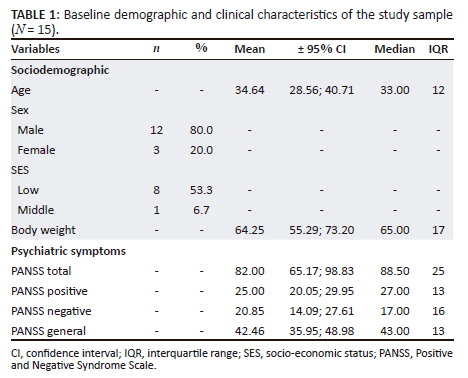
This pilot study sample of 15 patients (12 men, three women), aged 22-35 years (mean 35 years), is shown in Table 1. Follow-up data were obtained for 53.5% (8/15) of the sample, all men. Socio-economic data were available for only nine patients, of these 53.3% classified as a low socio-economic status.
Paired t-tests revealed significant decreases in PANSS positive, general and total scores over 6 weeks (p ≤ 0.001), but no changes in PANSS negative scores (Figure 1a-d). In Figure 1e-h, reductions are shown for KYNA (p = 0.04), 5-HIAA (p = 0.004), BDNF (p = 0.04) and GABA (p = 0.02). No changes were observed for tryptophan, kynurenine, QUIN or other biomarkers including 5-HT, dopamine, 3-MT, norepinephrine, DOPAC, homovanillic acid, glutamate, IL-6, IL-10 or TNF- α.
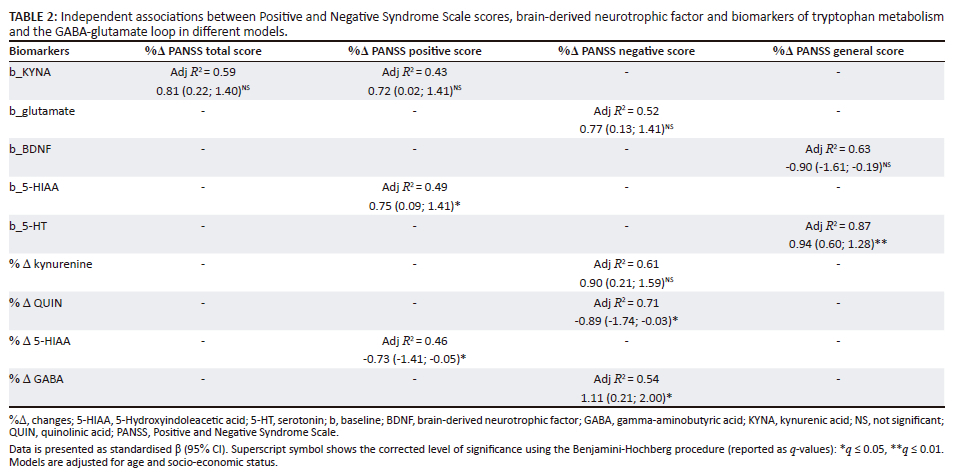
Associations between %∆ in PANSS scores with baseline and %∆ biomarkers are shown in Table 2. Initial significant associations shown between %∆PANSS total score with baseline KYNA (p = 0.015), %∆PANSS positive score with baseline KYNA (p = 0.046), %∆PANSS general score with baseline BDNF (p = 0.023) and %∆PANSS negative score with baseline glutamate (p = 0.027) and % ∆ kynurenine (p = 0.020) were lost after calculation of the corrected level of significance.
Significant associations remained between %∆PANSS positive score with baseline 5-HIAA (p = 0.032, q = 0.035) and inversely with %∆5-HIAA (p = 0.039, q = 0.040), %∆PANSS general score with baseline 5-HT (p < 0.001, q = 0.005), as well as %∆PANSS negative score with %∆GABA (p = 0.024, q = 0.025) and inversely with %∆QUIN (p = 0.046, q = 0.045). No associations were revealed for any of the other biomarkers including tryptophan, dopamine, 3-MT, norepinephrine, DOPAC, homovanillic acid, IL-6, IL-10 or TNF-α.
Discussion
This study assessed peripheral biomarkers and psychiatric symptom changes after 6 weeks of antipsychotic treatment in a cohort of South Africans with schizophrenia. Significant improvements were observed in the positive, general and total PANSS scores, potentially linked to tryptophan metabolism. However, negative scores showed no improvement, which may be related to tryptophan metabolism and the GABA-glutamate loop.
Psychiatric symptom changes
Distinct treatment response patterns have been observed in first-episode schizophrenia. Regarding negative symptoms, some of our patients may not have responded to treatment by the 6-week follow-up. Even in studies with longer follow-ups (8 weeks and 18 months), no significant improvement in negative symptom scores was found, despite improvement in other PANSS scores.22,23 This lack of improvement may be because of the limited efficacy of antipsychotics and antidepressants, prescribed in our study, for negative symptoms, which tend to improve more gradually than positive symptoms. Additionally, only two patients in our study sample were treated with selective serotonin reuptake inhibitors (data not shown), indicated for negative symptoms, and the varied treatments prescribed limit our ability to comprehensively explain the role of treatment in this regard.
Tryptophan metabolism: The kynurenine pathway
The kynurenine pathway produces neuroactive substances like QUIN and KYNA, which have neuroprotective and neurodegenerative effects. Kynurenic acid, an NMDAR antagonist, can be neuroprotective but may disrupt neurotransmission at high levels by inducing NMDAR hypo-functioning. Our study does not support KYNA's neuroprotective role, as no significant associations were found between KYNA changes and any of the PANSS scores, despite the significant reductions observed for KYNA. This contrasts with another study, which reported a correlation between KYNA levels at admission with changes in PANSS positive scores.2418
Tryptophan metabolism: The serotonin pathway
Decreases in the PANSS general score associated with baseline 5-HT levels. Somewhat consistent with our findings, 5-HIAA, the primary metabolite of 5-HT, measured post-mortem correlated with general schizophrenia symptoms assessed perimortem.25
Increases in 5-HT transmission, particularly in the striatum, have been suggested to contribute to positive symptoms in animal models of schizophrenia,9
Gamma-aminobutyric acid-glutamate loop
Changes in the PANSS negative score associated with decreases in GABA. Similarly, individuals with schizophrenia that did not respond to antipsychotic treatment had lower GABA levels in the anterior cingulate cortex compared to healthy controls.267
Limitations
The primary limitation of this study is the small sample size, which may increase the risk of Type I errors and reduce the reliability of the results. As this was a pilot exploratory study, the findings should be interpreted with caution, recognising that they serve as a preliminary step for generating hypotheses rather than drawing definitive conclusions. Additionally, as participants were recruited from a single psychiatric hospital and ethnic group, this limits the generalisability to the broader South African population. It has been shown that an increase in body weight is related to the efficacy of antipsychotics and might predict general schizophrenia symptomatology improvement.27
Conclusion
After 6 weeks of antipsychotic treatment, improvements were seen in PANSS total, positive and general sub-scores, along with decreases in KYNA, 5-HIAA, BDNF and GABA levels. It remains unclear if symptom relief was because of antipsychotics' effects on tryptophan metabolism. The lack of significant reduction in negative symptoms may be linked to unchanged QUIN levels, as well as decreases in GABA. Further research is needed to clarify the role of these biomarkers in antipsychotic treatment response, which could guide treatment strategies, particularly in African populations.
Competing interests
The author declares that they have no financial or personal relationships that may have inappropriately influenced them in writing this article.
Authors' contributions
E.V.d.W. contributed towards the data collection, sample and data analysis, data curation and interpretation, writing: initial draft and revisions; C.B.B. assisted with the writing - revisions and student supervision; E.J.v.V. assisted with the data collection, analysis, interpretation and curation, writing - initial draft and revisions, student supervision, project management and leadership.
Funding information
The authors received funding from the North-West University (NWU), South Africa and the National Research Foundation (NRF).
Data availability
Data sharing is not applicable to this article.
Disclaimer
The views and opinions expressed in this article are those of the authors and are the product of professional research. It does not necessarily reflect the official policy or position of any affiliated institution, funder, agency or that of the publisher. The authors are responsible for this article's results, findings and content.
Acknowledgements
The authors would like to acknowledge Dr Marisa Möller-Wolmarans for the conceptualisation of this study. They would also like to thank the individuals participating voluntarily in the study as well as the dedication of the staff of the psychiatric hospital, especially Dr Magdalena Maria Gonzalez Mendez and Dr Lamia Houarbi.
References
-
1. Collaborators GMD. Global, regional, and national burden of 12 mental disorders in 204 countries and territories, 1990-2019: A systematic analysis for the Global Burden of Disease Study 2019. Lancet Psychiatry. 2022;9(2):137-150. https://doi.org/10.1016/S2215-0366(21)00395-3
» https://doi.org/10.1016/S2215-0366(21)00395-3 -
2. Charlson FJ, Ferrari AJ, Santomauro DF, et al. Global epidemiology and burden of schizophrenia: Findings from the global burden of disease study 2016. Schizophr Bull. 2018;44(6):1195-203. https://doi.org/10.1093/schbul/sby058
» https://doi.org/10.1093/schbul/sby058 -
3. Purgato M, Adams C, Barbui C. Schizophrenia trials conducted in African countries: A drop of evidence in the ocean of morbidity? Int J Mental Health Syst. 2012;6:1-10. https://doi.org/10.1186/1752-4458-6-9
» https://doi.org/10.1186/1752-4458-6-9 -
4. Emsley RA, Roberts MC, Rataemane S, et al. Ethnicity and treatment response in schizophrenia: A comparison of 3 ethnic groups. J Clin Psychiatry. 2002;63(1):9-14. https://doi.org/10.4088/JCP.v63n0103
» https://doi.org/10.4088/JCP.v63n0103 -
5. Stahl SM. Beyond the dopamine hypothesis of schizophrenia to three neural networks of psychosis: Dopamine, serotonin, and glutamate. CNS Spectr. 2018;23(3):187-91. https://doi.org/10.1017/S1092852918001013
» https://doi.org/10.1017/S1092852918001013 -
6. Kumar V, Vajawat B, Rao NP. Frontal GABA in schizophrenia: A meta-analysis of 1H-MRS studies. World J Biol Psychiatry. 2021;22(1):1-13. https://doi.org/10.1080/15622975.2020.1731925
» https://doi.org/10.1080/15622975.2020.1731925 -
7. Schwartz TL, Sachdeva S, Stahl SM. Glutamate neurocircuitry: Theoretical underpinnings in schizophrenia. Front Pharmacol. 2012;3:195. https://doi.org/10.3389/fphar.2012.00195
» https://doi.org/10.3389/fphar.2012.00195 -
8. Gruber O, Chadha Santuccione A, Aach H. Magnetic resonance imaging in studying schizophrenia, negative symptoms, and the glutamate system. Front Psychiatry. 2014;5:32. https://doi.org/10.3389/fpsyt.2014.00032
» https://doi.org/10.3389/fpsyt.2014.00032 -
9. Moller M, Swanepoel T, Harvey B. Neurodevelopmental animal models reveal the convergent role of neurotransmitter systems, inflammation, and oxidative stress as biomarkers of schizophrenia: Implications for novel drug development. ACS Chem Neurosci. 2015;6(7):987-1016. https://doi.org/10.1021/cn5003368
» https://doi.org/10.1021/cn5003368 -
10. Silveira C, Marques-Teixeira J, De Bastos-Leite AJ. More than one century of schizophrenia: An evolving perspective. J Nerv Ment Dis. 2012;200(12):1054-1057. https://doi.org/10.1097/NMD.0b013e318275d249
» https://doi.org/10.1097/NMD.0b013e318275d249 -
11. Watkins CC, Andrews SR. Clinical studies of neuroinflammatory mechanisms in schizophrenia. Schizophr Res. 2016;176(1):14-22. https://doi.org/10.1016/j.schres.2015.07.018
» https://doi.org/10.1016/j.schres.2015.07.018 -
12. Steullet P, Cabungcal J, Monin A, et al. Redox dysregulation, neuroinflammation, and NMDA receptor hypofunction: A 'central hub' in schizophrenia pathophysiology? Schizophr Res. 2016;176(1):41-51. https://doi.org/10.1016/j.schres.2014.06.021
» https://doi.org/10.1016/j.schres.2014.06.021 -
13. Petrikis P, Voulgari PV, Tzallas AT, Archimandriti DT, Skapinakis P, Mavreas V. Cytokine profile in drug-naïve, first episode patients with psychosis. J Psychosom Res. 2015;79(4):324-327. https://doi.org/10.1016/j.jpsychores.2015.06.011
» https://doi.org/10.1016/j.jpsychores.2015.06.011 -
14. Trovão N, Prata J, VonDoellinger O, Santos S, Barbosa M, Coelho R. Peripheral biomarkers for first-episode psychosis - Opportunities from the neuroinflammatory hypothesis of schizophrenia. Psychiatry Investig. 2019;16(3):177. https://doi.org/10.30773/pi.2018.12.19.1
» https://doi.org/10.30773/pi.2018.12.19.1 -
15. Charlton T, Prowse N, McFee A, et al. Brain-derived neurotrophic factor (BDNF) has direct anti-inflammatory effects on microglia. Front Cell Neurosci. 2023;17:1188672. https://doi.org/10.3389/fncel.2023.1188672
» https://doi.org/10.3389/fncel.2023.1188672 -
16. Li M, Wu Y, Xu Y, et al. Peripheral tryptophan-kynurenine pathway dysfunction in first-episode schizophrenia. Sci Rep. 2025;15(1):2432. https://doi.org/10.1038/s41598-025-86390-4
» https://doi.org/10.1038/s41598-025-86390-4 -
17. Myint A, Schwarz MJ, Verkerk R, et al. Reversal of imbalance between kynurenic acid and 3-hydroxykynurenine by antipsychotics in medication-naive and medication-free schizophrenic patients. Brain Behav Immun. 2011;25(8):1576-1581. https://doi.org/10.1016/j.bbi.2011.05.005
» https://doi.org/10.1016/j.bbi.2011.05.005 -
18. Pedraz-Petrozzi B, Elyamany O, Rummel C, Mulert C. Effects of inflammation on the kynurenine pathway in schizophrenia - A systematic review. J Neuroinflammation. 2020;17:1-17. https://doi.org/10.1186/s12974-020-1721-z
» https://doi.org/10.1186/s12974-020-1721-z - 19. Ensink K, Robertson B, Hodson P, Tredoux C. Expression of schizophrenia in black Xhosa-speaking and white English-speaking South Africans. S Afr Med J. 1998;88(7):883-887.
- 20. Gillis L, Jakoet, A., Trollop, D., Sandler, R., Elk R. The outcome of psychiatric illness-a 2-year follow-up study. S Afr Med J. 1987;72(9):598-602.
-
21. Karsten L. Tryptophan metabolism in the deer mouse and its response to serotonergic intervention [Dissertation - MSc]. Potchefstroom: North-West University; 2022 [cited n.d.]. Available from: http://hdl.handle.net/10394/39488
» http://hdl.handle.net/10394/39488 -
22. Guan X, Xu J, Xiu M, Li X, Liu H, Wu F. Kynurenine pathway metabolites and therapeutic response to olanzapine in female patients with schizophrenia: A longitudinal study. CNS Neurosci Ther. 2022;28(10):1539-1546. https://doi.org/10.1111/cns.13895
» https://doi.org/10.1111/cns.13895 -
23. Shang P, Ho AM-C, Tufvesson-Alm M, et al. Identification of cerebrospinal fluid and serum metabolomic biomarkers in first episode psychosis patients. Transl Psychiatry. 2022;12(1):229. https://doi.org/10.1038/s41398-022-02000-1
» https://doi.org/10.1038/s41398-022-02000-1 -
24. Halaris A, Myint A-M, Savant V, et al. Does escitalopram reduce neurotoxicity in major depression? J Psychiatr Res. 2015;66:118-126. https://doi.org/10.1038/s41398-022-02000-1
» https://doi.org/10.1038/s41398-022-02000-1 -
25. Afia AB, Vila È, MacDowell KS, et al. Kynurenine pathway in post-mortem prefrontal cortex and cerebellum in schizophrenia: Relationship with monoamines and symptomatology. J Neuroinflammation. 2021;18:1-15. https://doi.org/10.1186/s12974-021-02260-6
» https://doi.org/10.1186/s12974-021-02260-6 -
26. Bojesen KB, Ebdrup BH, Jessen K, et al. Treatment response after 6 and 26 weeks is related to baseline glutamate and GABA levels in antipsychotic-naïve patients with psychosis. Psychol Med. 2020;50(13):2182-2193. https://doi.org/10.1017/S0033291719002277
» https://doi.org/10.1017/S0033291719002277 -
27. Luckhoff H, Phahladira L, Scheffler F, et al. Weight gain and metabolic change as predictors of symptom improvement in first-episode schizophrenia spectrum disorder patients treated over 12 months. Schizophr Res. 2019;206:171-176. https://doi.org/10.1016/j.schres.2018.11.031
» https://doi.org/10.1016/j.schres.2018.11.031

Accepted: 13 Feb. 2025
Published: 14 Apr. 2025