Cyberbullying perpetration and victimisation amongst adolescent psychiatric patients at Lentegeur Hospital, South Africa
Abstract
BACKGROUND: Cyberbullying is a type of harassment that is perpetrated or experienced by a person or groups of persons via the use of electronic devices, and it frequently occurs amongst young people. Research has shown that cyberbullying is associated with psychiatric comorbidity, which could indicate a need for screening adolescents who present for mental health services. AIM: This study aimed to determine the prevalence of cyberbullying amongst adolescents. The secondary aim was to determine the Diagnostic and Statistical Manual of Mental Disorders (DSM)-5 psychiatric diagnoses associated with cyberbullying. SETTING: Lentegeur Hospital Child and Adolescent Mental Health Service in the Western Cape, South Africa. METHODS: This cross-sectional study included a convenience sample of 97 participants (sampled from both inpatient and outpatient services) between the ages of 13 years and 18 years. Adolescent assent and parental consent were obtained. Demographic and clinical data were collected from patient folders, and the Revised Cyber Bullying Inventory II was used to assess cyberbullying behaviours. RESULTS: The overall prevalence rate of some form of cyberbullying in this sample was 56.7%, of which 6.2% were cyberbullies, 20.6% were cyber-victims and 29.9% were cyberbullies and cyber-victims. Female participants were more likely to be involved in cyberbullying than males. The most prevalent primary psychiatric diagnoses in adolescents involved in cyberbullying included major depressive disorder (72.4%), schizophrenia (57.1%) and attention deficit hyperactivity disorder (22%). There was no significant association between cyberbullying and any psychiatric diagnoses. CONCLUSION: The high prevalence rate of adolescents involved in cyberbullying suggests that this behaviour is a cause for concern in the South African population. More screening and treatment programmes should be implemented to address this issue.
cyberbullying; cyber-victimisation; adolescents; psychiatric comorbidity; mental health; South Africa
Introduction
Cyberbullying is a type of bullying that is perpetrated or experienced by a person or groups of persons via the use of electronic devices. It occurs repetitively1234
The prevalence rate of cyber-victimisation amongst adolescents varies from 10% to 40%, with some studies showing a prevalence rate of up to 72%.45,6,7
There is a growing body of literature exploring the negative consequences of being a cyberbully or cyber-victim. Certain research studies have shown that cyberbullies and cyber-victims have worse consequences than traditional bullying.8,9,1011,12,1311121314
A meta-analysis conducted by van Dam that explored traditional bullying and psychosis did not find any association between psychosis and traditional bullying.151617
A local epidemiological study by Kleintjes et al.1818
The prevalence estimates of cyberbullying and cyber-victimisation amongst children and adolescents worldwide are limited as there are few studies published. To our knowledge, there also appears to be a lack of information available for the prevalence of cyberbullying and cyber-victimisation amongst mentally ill adolescents, both locally and abroad. However, the high use of technology coupled with high rates of face--to-face bullying across the world suggests a potentially higher prevalence rate than that which is documented. This suggests that surveillance and screening for the presence of cyberbullying may be valuable, considering the known link with adverse emotional outcomes, including suicidal behaviour. Adolescents presenting with mental disorders are a particularly vulnerable population who could potentially be screened for the presence of cyberbullying during a mental health visit and expand the role of the healthcare practitioners to screening, psychoeducation and management of the consequences of being a cyberbully or cyber-victim.1
The aim of this study was to establish the prevalence of cyberbullying amongst patients presenting to the child and adolescent psychiatry unit at Lentegeur Hospital, South Africa and to determine whether there were any correlations between specific psychiatric diagnoses and cyberbullying.
Methods
Study design
This cross-sectional study used a convenience sample of adolescent patients (aged 13-18 years) who presented to the child and adolescent mental health services at Lentegeur Hospital, Cape Town, South Africa between 01 April 2018 and 30 July 2018.
Study setting
The child and adolescent mental health service at Lentegeur Hospital is a tertiary-level service that provides ambulatory, an inpatient psychosis recovery, and a therapeutic programme for hospitalised adolescents.
Study sample
Male and female participants, who were not actively psychotic, suicidal or in a crisis and who were able to provide assent were recruited from both in- and out-patients. OpenEpi software (www.openepi.com) was used to calculate the required sample size using α = 0.05, power = 95% and previous reported data that the incidence of cybervictimisation is about 37% - 47.9%.19
Data collection
The demographic and diagnostic data were obtained by applying multiple data collection methods, including an interview by the registrar or medical officer of the parents and the participant and from clinical folders. Demographic information (age, gender, etc.) and psychiatric diagnoses, based on the Diagnostic and Statistical Manual of Mental Disorders (DSM-5)20 were obtained from patient files. The primary diagnosis was considered based on the main problem that the patient presented with. For example, many participants had both autism and ADHD, and in all these cases autism was the primary diagnosis. Where this information was missing it was gained from the parents and/or guardian during administration of the survey and recorded. The Revised Cyberbullying Inventory-II (RCBI-II) was used to collect information regarding cyberbullying behaviours, with permission granted by the author. The questionnaire was administered by the primary investigator (M.E.P.) or the medical officer.
Measures
The RCBI-II measures being either a cyberbully and/or a cyber-victim during the preceding six months.21
Examples of activities include spreading rumours and threatening someone. Participants rated the occurrence of the activities during the previous six months using a four-point Likert scale (1 = never, 2 = once, 3 = twice to three times and 4 = more than three times). Summed scores range from 10 to 40 with higher scores representing higher severity. In this study, participants were categorised as cyberbullies, cyber-victims, cyberbullies and cyber-victims, or neither a cyberbully nor a cyber-victim (uninvolved). To be categorised as a cyberbully and a cyber-victim, participants were required to have reported perpetrating and experiencing at least 1 of the 10 items on the RCBI-II on more than one occasion, as the definition of cyberbullying and cyber-victimisation requires the behaviour to be repeated.2221
Data analysis
Continuous variables were summarised as mean and standard deviation (s.d.), whilst nominal variables were summarised as counts and percentages. Pearson's Chi-square test was used to determine significant relationships between cyberbullying category and nominal variables (gender, in- or out-patient, primary diagnosis, school attendance, parental marital status and primary caregiver). When the results of the Chi-square test were significant, we conducted a post hoc z-test on adjusted residuals with Bonferroni correction. All analyses were performed using Statistical Package for Social Sciences (SPSS), version 25 (IBM Corp., Armonk, NY, United States of America), and statistically significant differences were established at p < 0.05.
Ethical considerations
The study was approved by the Health Research Ethics Committee (HREC) of Stellenbosch University (Study number: S18/01/008) and by the Research and Ethics Committee of the Department of Health (Western Cape Government).
Participation was voluntary, with participants having provided assent and their parents informed consent. All data were anonymised by assigning unique identifiers to each participant. All data were stored in a single Excel file and kept on a password protected computer.
Results
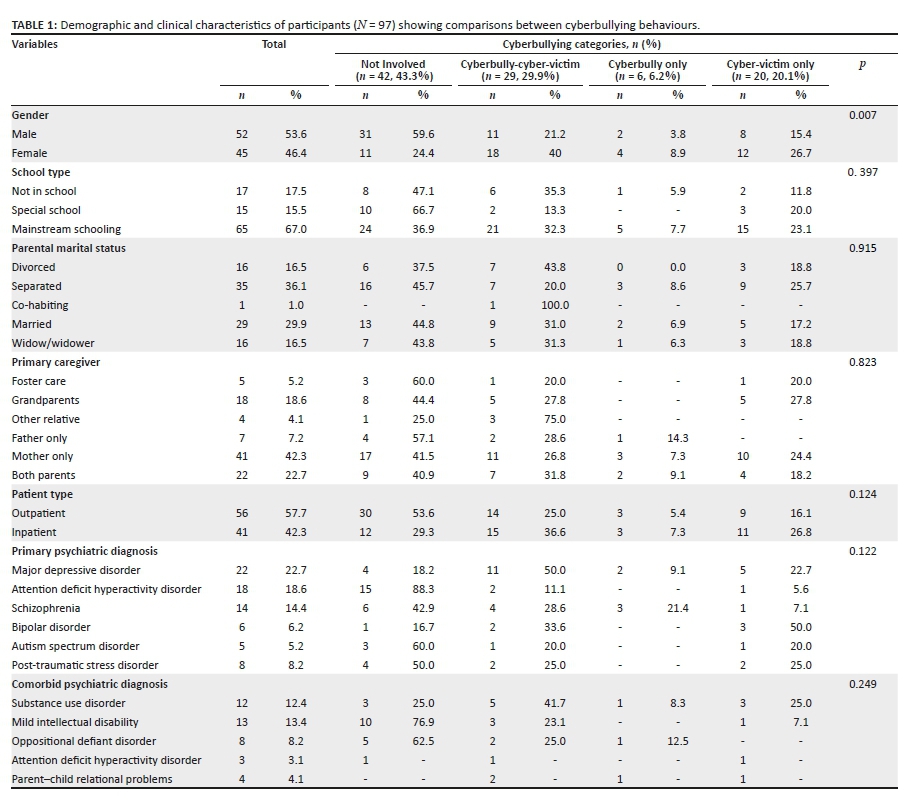
The demographical and clinical characteristics of adolescents in this study are summarised in Table 1. There were more male (53.6%; n = 52) than female participants (46.4%; n = 45). The majority of participants attended mainstream schooling (67.0%; n = 65) and stayed with at least one parent (72.9%; n = 63). Only 9.9% (n = 29) had biological parents who were married.
The most common primary psychiatric diagnosis was MDD (29.9%; n = 29), followed by ADHD (18.6%; n = 18), schizophrenia (14.4%; n = 14), BD (6.2%; n = 6), adjustment disorder (5.2%; n = 5) and autism spectrum disorder (ASD, 5.1%; n = 5) (Table 1). The most common comorbid psychiatric diagnosis was substance use disorder (SUD, 23%; n = 20) (which included alcohol, cannabis, opioid and stimulant use disorders), followed by mild intellectual disability (MID, 17.2%; n = 15), and oppositional defiant disorder (ODD, 9.2%; n = 8). Other notable comorbid illnesses were ADHD (9.2%; n = 8), PTSD (6.9%; n = 6) and a DSM 5 v-code of parent-child relational problems (5.7%; n = 5). Most participants with ASD (n = 4) were not attending mainstream school, 3 had comorbid ADHD, 2 had comorbid GAD, 1 had mild ID and 1 had schizophrenia.
More than half of all participants (56.7%, n = 55) were involved in one of the three categories of cyberbullying (Table 1). Almost one-third of the participants (29.9%, n = 29) were both cyberbullies and cyber-victims, 20.6% (n = 20) were cyber-victims only, and 6.2% (n = 6) were cyberbullies only. More female participants (75.6%, n = 34) were involved in cyberbullying behaviours than male participants (40.4%, n = 21), where 8.9% (n = 4) of female participants and 3.8% (n = 2) of male participants were cyberbullies. Results from Pearson's Chi-square tests demonstrated that gender was the only variable significantly associated with bullying type (χ2p = 0.007, Table 1). Post hoc analyses with Bonferroni correction found that females were significantly more likely (p < 0.001) to be involved in cyberbullying behaviour.
Of those patients who had a primary diagnosis of MDD (n = 29), the largest proportion (44.8%) were cyberbullies and cyber-victims. Most patients with ADHD (77.8%, n = 14) and ASD (n = 3) were not involved in cyberbullying behaviour. The proportions of cyberbully only and cyber-victim only were highest amongst individuals with schizophrenia (n = 3) and BD (n = 3), respectively. Amongst participants with comorbid PTSD, none were only cyberbullies, n = 2 were cyberbullies and cyber-victims, and n = 2 were cyber-victims only. The percentage of patients with some form of cyberbullying and with both schizophrenia and a comorbid SUD was 26.8% (n = 26).
Discussion
This is one of the first studies to assess the prevalence of cyberbullying in a sample of adolescent psychiatric patients. It was found that more than half of the participants were involved in cyberbullying behaviour, either as cyber-victims, cyberbullies or cyberbullies and cyber-victims, the majority of which were female participants. This is higher than the global prevalence, which ranges from 10% to 40%.4
Almost a third of this study participants were cyberbullies and cyber-victims. This is in keeping with other studies that have found that bullies are often victims first and then progress to perpetrate as retaliation to being victimised. Such bullies would justify their acts as an outlet for their feelings of frustration and harassment.23
The prevalence rate of being a cyber-victim only was lower than that reported in previous studies. South African studies by Vodafone and the Department of Justice reported prevalence rates of 24% and 46.8%, respectively.24,25
In this study, the prevalence rate of being a cyberbully was 6.2%. It is possible that this could be an underestimation as cyberbullies may minimise the harm they cause.2425
The most prevalent psychiatric diagnosis was MDD, which was not unexpected considering the increased expected prevalence of MDD during adolescence.262728,2928
Only 22.2% of participants with a primary diagnosis of ADHD experienced cyberbullying, which was expected to be higher considering the potential impulse control behaviours (and comorbidities) that youth with ADHD may struggle with, including disruptive and oppositional defiant behaviours.303132
In this study, those with a diagnosis of ODD had a 37.5% prevalence of cyberbullying. As a higher prevalence was once again expected, it was postulated that this lower-than-expected rate of cyberbullying amongst adolescents diagnosed with ODD and ADHD may be because of under-reporting as a result of the lower mean age of participants in the study, the majority of whom were under 15 years.33
More than half of participants with schizophrenia had some involvement in cyberbullying. This, too, is in keeping with increased rates of cyberbullying amongst people with psychotic symptoms, as reported by Dooley et al.123435
No statistically significant association between primary psychiatric diagnoses, comorbid diagnoses and cyberbullying behaviours was observed in this study. This may be because of the small sample sizes in individual diagnostic groups. Studies with larger sample sizes and possibly different study design would be required to define these specific relationships more accurately.
Some studies have shown that females are more involved in cyberbullying as it is a type of relational or verbal aggression rather than direct, 'face-to-face' bullying, which is more commonly observed amongst boys.36,37383936,37
Limitations and recommendations
The findings of this study have limited generalisability as the sample consisted of psychiatrically referred adolescents. This study also relied on self-reporting measures and may be susceptible to recall bias. The use of convenience sampling means that this may not be a true representation of the patient population found at the child and adolescent mental health services unit in Lentegeur Hospital. We suggest a more systematic sampling method. This study was only based on participants' responses, whereas a study monitoring chat rooms and with direct access to the messages may reveal a more accurate picture. There is also a referral bias as patients with less severe illness may be treated at a district level of care, and thus not be referred to a tertiary unit and would, therefore, not be included in the study. Future studies should include a larger population size in order to better assess the possible association between cyberbullying behaviour and psychiatric diagnoses. The RCBI II has not been validated in South Africa. Given the high prevalence of cyberbullying in our sample, there is a need to develop rigorous local screening tools and a more systematic recruitment process.
The diagnostic profile of the study population may not correspond with the patient profile assessed at the clinic as the convenience sampling method assessed a random sample whereby certain diagnostic categories may have been missed. For example, there were lower-than-expected numbers of patients with trauma-related disorders such as PTSD, even though there is a high rate of violence in the community, and therefore, overall higher rates of PTSD might have been expected.
Conclusion
This study focussed on a vulnerable adolescent population and may be an important vehicle through which to increase both public and clinicians' awareness of the high prevalence of cyberbullying amongst psychiatrically referred South African adolescents. It provides opportunities for clinicians to review assessment protocols and to incorporate questions and interventions related to supporting adolescents involved with cyberbullying, be they cyber-victims, cyberbullies, or cyberbullies and cyber-victims.
This study focussed on a vulnerable adolescent population referred for the assessment and management of mental disorders. Whilst findings may not be generalisable to the general adolescent population, it may be the vehicle by which to raise clinicians' awareness of the high prevalence of cyberbullying amongst psychiatrically referred South African adolescents. It may also suggest that assessment protocols may benefit from review and routinely include questions related to cyberbullying, including specific support measures that could be considered to support adolescents involved with cyberbullying. Mental health practitioners assessing adolescents should consider screening for cyberbullying by routinely asking questions relating to both cyberbullying and cyber-victimisation.
Competing interests
The authors declare that they have no financial or personal relationships that may have inappropriately influenced them in writing this article.
Authors' contributions
M.E.P. and R.N. contributed equally to the design and implementation of the research, to the analysis of the results and to the writing of the article.
Funding information
This research received no specific grant from any funding agency in the public, commercial, or not-for-profit sectors.
Data availability
Data are available upon reasonable request from the corresponding author, M.E.P.
Disclaimer
The views and opinions expressed in this article are those of the authors and are not the official position of the affiliated institutions.
Acknowledgements
The authors acknowledge Dr. Jeannie Fagan (medical officer at Lentegeur Hospital) for assisting with recruiting and interviewing participants, Dr Karis Moxley and Dr. Muneeb Salie who helped with data analysis and editing of the article and Özgür Erdur-Baker (Middle East Technical University, Turkey) for freely providing the RCBI-II questionnaire.
References
-
1.Peebles E. Cyberbullying: Hiding behind the screen. Paediatr Child Health. 2014;19(10):527-528. https://doi.org/10.1093/pch/19.10.527
» https://doi.org/10.1093/pch/19.10.527 -
2.Smith PK, Mahdavi J, Carvalho M, Fisher S, Russell S, Tippett N. Cyberbullying: Its nature and impact in secondary school pupils. J Child Psychol Psychiatry. 2008;49(4):376-385. https://doi.org/10.1111/j.1469-7610.2007.01846.x
» https://doi.org/10.1111/j.1469-7610.2007.01846.x -
3.Qing L. A cross-cultural comparison of adolescents' experience related to cyberbullying. Educ Res. 2008;50(3):223-234. https://doi.org/10.1080/00131880802309333
» https://doi.org/10.1080/00131880802309333 -
4.Kowalski RM, Giumetti GW, Schroeder AN, Lattanner MR. Bullying in the digital age: A critical review and meta-analysis of cyberbullying research among youth. Psychol Bull. 2014;140(4):1073-1137. https://doi.org/10.1037/a0035618
» https://doi.org/10.1037/a0035618 -
5.Dooley J, Pyżalski J, Cross D. Cyberbullying versus face-to-face bullying: A theoretical and conceptual review. J Psychol. 2009;217(4):182-188. https://doi.org/10.1027/0044-3409.217.4.182
» https://doi.org/10.1027/0044-3409.217.4.182 -
6.Tokunaga RS. Following you home from school: A critical review and synthesis of research on Cyberbullying victimization. Comput Hum Behav. 2010;26(3):277-287. https://doi.org/10.1016/j.chb.2009.11.014
» https://doi.org/10.1016/j.chb.2009.11.014 -
7.Ybarra ML, Diener-West M, Leaf PJ. Examining the overlap in internet harassment and school bullying: Implications for school intervention. J Adolesc Health. 2007;41(6 Suppl 1):S42-S50. https://doi.org/10.1016/j.jadohealth.2007.09.004
» https://doi.org/10.1016/j.jadohealth.2007.09.004 -
8.Fahy AE, Stansfeld SA, Smuk M, Smith NR, Cummins S, Clark C. Longitudinal associations between Cyberbullying involvement and adolescent mental health. J Adolesc Health. 2016;59(5):502-509. https://doi.org/10.1016/j.jadohealth.2016.06.006
» https://doi.org/10.1016/j.jadohealth.2016.06.006 -
9.Moore SE, Norman RE, Suetani S, Thomas HJ, Sly PD, Scott JG. Consequences of bullying victimization in childhood and adolescence: A systematic review and meta-analysis. World J Psychiatry. 2017;7(1):60-76. https://doi.org/10.5498/wjp.v7.i1.60
» https://doi.org/10.5498/wjp.v7.i1.60 -
10.Goebert D, Else I, Matsu C, Chung-Do J, Chang JY. The impact of cyberbullying on substance use and mental health in a multiethnic sample. Matern Child Health J. 2011;15(8):1282-1286. https://doi.org/10.1007/s10995-010-0672-x
» https://doi.org/10.1007/s10995-010-0672-x -
11.Stapinski LA, Araya R, Heron J, Montgomery AA, Stallard P. Peer victimization during adolescence: Concurrent and prospective impact on symptoms of depression and anxiety. Anxiety Stress Coping. 2015;28(1):105-120. https://doi.org/10.1080/10615806.2014.962023
» https://doi.org/10.1080/10615806.2014.962023 -
12.Dooley JJ, Shaw T, Cross D. The association between the mental health and behavioural problems of students and their reactions to cyber-victimization. Eur J Dev Psychol. 2012;9(2): 275-289. https://doi.org/10.1080/17405629.2011.648425
» https://doi.org/10.1080/17405629.2011.648425 -
13.Rice E, Petering R, Rhoades H, et al. Cyberbullying perpetration and victimization among middle-school students. Am J Public Health. 2015;105(3):e66-e72. https://doi.org/10.2105/AJPH.2014.302393
» https://doi.org/10.2105/AJPH.2014.302393 - 14.Kochenderfer BJ, Ladd GW. Peer victimization: Cause or consequence of school maladjustment? Child Dev. 1996;67(4):1305-1317.
-
15.Van Dam DS, Van der Ven E, Velthorst E, Selten JP, Morgan C, De Haan L. Childhood bullying and the association with psychosis in non-clinical and clinical samples: A review and meta-analysis. Psychol Med. 2012;42(12):2463-2474. https://doi.org/10.1017/S0033291712000360
» https://doi.org/10.1017/S0033291712000360 -
16.Didden R, Scholte RH, Korzilius H, et al. Cyberbullying among students with intellectual and developmental disability in special education settings. Dev Neurorehabil. 2009;12(3):146-151. https://doi.org/10.1080/17518420902971356
» https://doi.org/10.1080/17518420902971356 -
17.Kowalski RM, Fedina C. Cyber bullying in ADHD and Asperger syndrome populations. Res Autism Spectr Disord. 2011;5(3):1201-1208. https://doi.org/10.1016/j.rasd.2011.01.007
» https://doi.org/10.1016/j.rasd.2011.01.007 -
18.Kleintjes S, Flisher A, Fick M, et al. The prevalence of mental disorders among children, adolescents and adults in the Western Cape, South Africa. Afr J Psychiatry. 2006;9(3):157-160. https://doi.org/10.4314/ajpsy.v9i3.30217
» https://doi.org/10.4314/ajpsy.v9i3.30217 - 19.Popovac M, Leoschut L. Cyber bullying in South Africa: Impact and responses. CJCP Issue Paper No. 13. Claremont: Centre for Justice and Crime Prevention; 2012.
- 20.American Psychiatric Association. Diagnostic and Statistical Manual of Mental Disorders. 5th ed. Arlington, VA: American Psychiatric Association; 2013.
-
21.Topcu C, Erdur-Baker, O. RCBI-II: The second revision of the revised Cyber Bullying Inventory. Measure Eval Couns Dev. 2018;51(1):32-41. https://doi.org/10.1080/07481756.2017.1395705
» https://doi.org/10.1080/07481756.2017.1395705 -
22.Patchin JW, Hinduja S. Bullies move beyond the schoolyard: A preliminary look at cyberbullying. Youth Viol Juvenile Just. 2006;4(2):148-169. https://doi.org/10.1177/1541204006286288
» https://doi.org/10.1177/1541204006286288 -
23.Vandebosch H, Van Cleemput K. Cyberbullying among youngsters: Profiles of bullies and victims. N Media Soc. 2009;11(8):1349-1371. https://doi.org/10.1177/1461444809341263
» https://doi.org/10.1177/1461444809341263 -
24.Walrave M, Heirman W. Cyberbullying: Predicting victimisation and perpetration. Child Soc. 2011;25(1):59-72. https://doi.org/10.1111/j.1099-0860.2009.00260.x
» https://doi.org/10.1111/j.1099-0860.2009.00260.x -
25.Law DM, Shapka JD, Domene JF, Gagné MH. Are Cyberbullies really bullies? An investigation of reactive and proactive online aggression. Comput Hum Behav. 2012;28(2):664-672. https://doi.org/10.1016/j.chb.2011.11.013
» https://doi.org/10.1016/j.chb.2011.11.013 -
26.Merikangas KR, Nakamura EF, Kessler RC. Epidemiology of mental disorders in children and adolescents. Dialogues Clin Neurosci. 2009;11(1):7-20. https://doi.org/10.31887/DCNS.2009.11.1/krmerikangas
» https://doi.org/10.31887/DCNS.2009.11.1/krmerikangas -
27.Selkie EM, Kota R, Chan YF, Moreno M. Cyberbullying, depression, and problem alcohol use in female college students: A multisite study. Cyberpsychol Behav Soc Netw. 2015;18(2):79-86. https://doi.org/10.1089/cyber.2014.0371
» https://doi.org/10.1089/cyber.2014.0371 -
28.Skilbred-Fjeld S, Reme SE, Mossige S. Cyberbullying involvement and mental health problems among late adolescents. Cyberpsychol J Psychosoc Res Cyberspace. 2020;14(1):Article 5. https://doi.org/10.5817/CP2020-1-5
» https://doi.org/10.5817/CP2020-1-5 -
29.Paykel ES. The evolution of life events research in psychiatry. J Affect Disord. 2001;62(3):141-149. https://doi.org/10.1016/s0165-0327(00)00174-9
» https://doi.org/10.1016/s0165-0327(00)00174-9 -
30.Gnanavel S, Sharma P, Kaushal P, Hussain S. Attention deficit hyperactivity disorder and comorbidity: A review of literature. World J Clin Cases. 2019;7(17):2420-2426. https://doi.org/10.12998/wjcc.v7.i17.2420
» https://doi.org/10.12998/wjcc.v7.i17.2420 -
31.Sourander A, Brunstein Klomek A, Ikonen M, et al. Psychosocial risk factors associated with cyberbullying among adolescents: A population-based study. Arch Gen Psychiatry. 2010;67(7):720-728. https://doi.org/10.1001/archgenpsychiatry.2010.79
» https://doi.org/10.1001/archgenpsychiatry.2010.79 -
32.Russell G, Rodgers LR, Ford T. The strengths and difficulties questionnaire as a predictor of parent-reported diagnosis of autism spectrum disorder and attention deficit hyperactivity disorder. PLoS One. 2013;8(12):e80247. https://doi.org/10.1371/journal.pone.0080247
» https://doi.org/10.1371/journal.pone.0080247 -
33.Ryoo JH, Wang C, Swearer SM. Examination of the change in latent statuses in bullying behaviors across time. Sch Psychol Q. 2015;30(1):105-122. https://doi.org/10.1037/spq0000082
» https://doi.org/10.1037/spq0000082 -
34.Jessor R. Risk behavior in adolescence: A psychosocial framework for understanding and action. J Adolesc Health. 1991;12(8):597-605. https://doi.org/10.1016/1054-139x(91)90007-k
» https://doi.org/10.1016/1054-139x(91)90007-k -
35.Gámez-Guadix M, Orue I, Smith PK, Calvete E. Longitudinal and reciprocal relations of cyberbullying with depression, substance use, and problematic internet use among adolescents. J Adolesc Health. 2013;53(4):446-452. https://doi.org/10.1016/j.jadohealth.2013.03.030
» https://doi.org/10.1016/j.jadohealth.2013.03.030 -
36.Erdur-Baker Ö. Cyberbullying and its correlation to traditional bullying, gender and frequent and risky usage of internet-mediated communication tools. N Media Soc. 2010;12(1):109-125. https://doi.org/10.1177/1461444809341260
» https://doi.org/10.1177/1461444809341260 - 37.Keith S, Martin ME. Cyber-Bullying: Creating a culture of respect in a cyber world. Reclaim Child Youth J Strength-based Interven. 2005;13(4):224.
- 38.Tustin DH, Zulu GN, Basson A. Bullying among secondary school learners in South Africa with specific emphasis on cyber bullying. Child Abuse Res S Afr [serial online]. 2014;15(2):13-25.
-
39.Barlett C, Coyne SM. A meta-analysis of sex differences in cyber-bullying behavior: The moderating role of age. Aggress Behav. 2014;40(5):474-488. https://doi.org/10.1002/ab.21555
» https://doi.org/10.1002/ab.21555

Accepted: 10 Jan. 2022
Published: 31 Mar. 2022