Validation of the Sleep Quality Questionnaire among senior students in Benin City, Nigeria
Abstract
BACKGROUND: The Sleep Quality Questionnaire (SQQ) is a short and easy-to-understand resourceful tool for measuring poor sleep quality; however, it remains to be validated. AIM: The focus of this study is to determine its reliability and validity among Nigerian adolescents. SETTING: Four gender-mixed schools within Benin City, Nigeria were selected to participate in the study. METHODS: Questionnaires containing the SQQ, the Sleep Condition Indicator (SCI), which is a validated scale, and the Hospital Anxiety and Depression Scale (HADS) from 377 students selected from the junior and senior secondary school students were analysed RESULTS: The mean age calculated was 14.78 years for 174 male and 203 female students. Cronbach's alpha for the SQQ scale was 0.70. It correlated strongly with the SCI (rho = 0.93, p = 0.00), weakly with the HADS depression (rho = -0.19, p < 0.01) and anxiety (rho = -0.30, p < 0.01), but had no association with gender. Factor analysis revealed three factors with an eigenvalue greater than 1. Factors 1-3 accounted for 31.78%, 15.16% and 11.26% of the variance, respectively, totalling 58.2%. The reliability of each of the three factors was as follows: factor 1, 0.75; factor 2, 0.47; and factor 3, 0.62. The SQQ demonstrated good specificity and sensitivity at a cut-off point of 18. CONCLUSION: It is therefore recommended that the SQQ be included in the screening of sleep-related problems in adolescents, both in the primary and secondary care settings in Nigeria. CONTRIBUTION: The research shows that the Sleep Quality Questionnaire is both a reliable and valid screening tool among adolescents in Nigeria. Its brevity and simplicity further promote its use in clinical and non-clinical settings.
insomnia; Nigeria; psychometrics; Sleep Quality Questionnaire; students
Introduction
Sleep is a universal process that is a naturally recurring physiological phenomenon essential for rest, repair, learning and development.123
Insomnia is the commonest form of sleep disruption among adolescents.45
Many instruments have been designed to identify insomnia among adolescents; a commonly used and reliable one is the Pittsburgh Sleep Quality Index. However, it takes a total of 15 min to complete and score.6,789
The two instruments have the same items, except that the SQQ has an additional item. Also, they differ in that the SQQ is yet to be validated whereas the SCI has been previously validated.99,101011
Research methods and design
Study setting and population
The study was conducted in Benin City, the capital of Edo State, located in the South-South geopolitical zone of Nigeria. It was carried out among secondary school adolescents who were expected to understand the English language enough to fill the questionnaire appropriately. Within the city are schools either owned by the government (public) or individuals (private). The secondary school system is divided into junior and senior levels, and each is a three-year program. Therefore, the study population consisted of students from both levels of secondary education.
Sampling method
Sampling was based on convenience. Four gender-mixed schools consisting of two public and private schools were selected from the schools in the city. The selection was purposefully made to ensure the representation of public and private schools. The students were thereafter randomly selected from both junior and senior secondary levels of the chosen schools. In total, 420 students were sampled, which is well beyond the recommended ratio of 10 cases for each item to be factor analysed.12
Data collection
The authors used a questionnaire which consisted of four sections.
Sociodemographic characteristics section
This was used to collect information such as the gender, age, family structure, school type, religion and ethnicity of the students. It was purposefully designed and structured to meet the objectives of the study.
The Sleep Condition Indicator
It is an eight-item self-report scale used to assess one's sleep quality over a one month time interval.9
The Sleep Quality Questionnaire
The Sleep Quality Questionnaire is a nine-item scale that was yet to be validated.1314
The Hospital Anxiety Depression Scale
This scale is used to screen for anxiety or depression in clinical and nonclinical populations. It consists of seven depression and anxiety items each and has been validated for use in Nigeria.15
Procedure
Before the collection of data, approval was obtained from the Ministry of Education and the authorities of the schools involved. Informed consent was obtained from the participants and their parents or teachers if the participants were below the age of 18 years. Only the students who could give consent or assent were selected. Two adequately trained research assistants were employed for the collection of data. The training entailed understanding the questionnaire's content enough to assist the students when necessary. The administration of the questionnaire was done in the classroom, mostly during the break period. During the questionnaire administration, the students understood the wording of the questionnaire and needed no form of assistance in filling it out. Data were collected between 22 January 2018 and 02 February 2018.
Data analysis
The data were imputed into the Statistical Package for the Social Sciences (SPSS) version 22 (IBM Corporation, Armonk, New York, United States) for analysis. The participants' characteristics were summarised using descriptive statistics. A normality testing using the Kolmogorov-Smirnov test was performed on the sleep variable. The reliability of the SQQ scale was assessed using Cronbach's alpha coefficients. Convergent validity was verified by correlating it with the SCI and the anxiety and depression scores of the Hospital Anxiety and Depression Scale (HADS), using a Spearman's correlation, whereas the association with gender was ascertained by an independent t-test. Exploratory factor analysis was performed to delineate the underlying factor structure of the SQQ in the sample. Before the factor analysis, Bartlett's tests of sphericity and the Kaiser-Meyer-Olkin index were carried out to assess the data's suitability for factor analysis. Principal components analysis was used to extract the factors, followed by an oblique rotation of factors using oblimin rotation to aid the interpretation of the components extracted. The number of factors to be retained was guided by the scree plot and the Kaiser's criterion of eigenvalues above 1. The level of significance was set at p < 0.05 a priori.
Ethical considerations
Prior to the collection of data, approval was obtained from the Ministry of Education's Research and Statistics Department (STT1465T/188) and the authorities of the schools involved. Informed consent was obtained from the participants and their parents and/or teachers if the participants were below the age of 18 years.
Result
Sociodemography of the participants
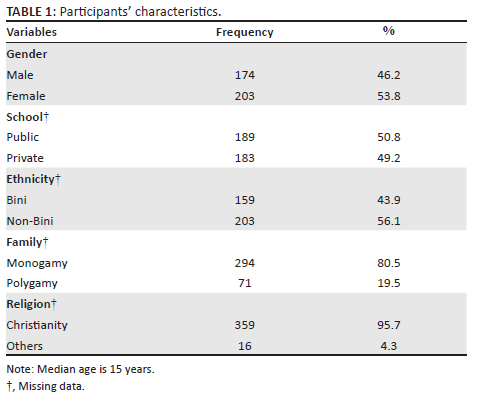
In total, 377 copies of the questionnaire out of the 420 filled ones, which is 90%, were analysed. The participants comprised 174 (46.2%) male and 203 (53.8%) female students. The ages ranged between 10 and 21 years, with a mean of 14.78 years (standard deviation [s.d.] = 1.83) and a median of 15.00 years. They consisted of 189 students from public schools and 183 (49.2%) from private schools. Other characteristics of the participants are indicated in Table 1.
Reliability of the Sleep Quality Questionnaire
The median score of the SQQ scale was 27, with the scores ranging between 3 and 36. There were no differences in mean SQQ scores across gender (t = 0.58, p = 0.56). Cronbach's alpha for the scale was moderately strong at 0.70, and the range of α-if-item-deleted was 0.65-0.70. The mean inter-item correlation was 0.22, which is acceptable for a scale with items less than 10. Furthermore, the McDonald's omega point coefficient measured 0.71 (confidence interval [CI]: 0.65-076), which is acceptable.
Concurrent validity and relationship with psychological domains
A normality testing using the Kolmogorov-Smirnov test was performed on the sleep variable, and it came out not normally distributed. Hence, a nonparametric test using Spearman's correlations was applied to determine the relationship between the variables. The concurrent validity of the nine-item SQQ was established by correlating the scores with the validated eight-item SCI. The result showed a significant positive correlation with a strong degree of association (rho = 0.93, p = 0.00), thus making it acceptable for the study. On the other hand, the analysis of SQQ revealed a negative but weak relationship with the depression (rho = -0.19, p < 0.01) and anxiety (rho = -0.30, p < 0.01) component of the HADS.
Exploratory factor structure of the Sleep Quality Questionnaire
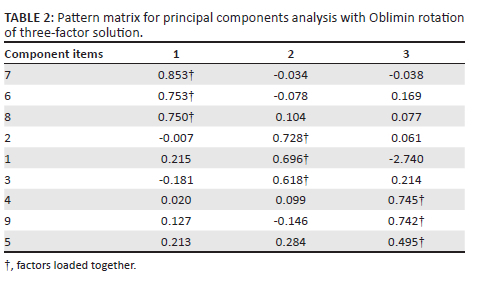
The assessment carried out for the suitability of the scale for factor analysis confirmed the factorability of the matrix. Bartlett's test of sphericity was significant (p = 0.00), and also the Kaiser-Meyer-Olkin index yielded an adequate value of 0.77. Three factors appeared to emerge on inspecting the scree plot, and this was confirmed following a principal component analysis with eigenvalues greater than 1. Factors 1-3 accounted for 31.78%, 15.16% and 11.26% of the variance, respectively, totalling 58.2%. The reliability of each of the three factors was as follows: factor 1, 0.75; factor 2, 0.47; and factor 3, 0.62. Following a direct oblimin rotation, a simple structure of each of the variables loading strongly on only one component was reported on the pattern and structure matrix (Table 2). Going by the items which loaded together, the factors were named factor 1: Insomnia consequences (on the mood, relationships, concentration and productivity, generally); factor 2: Insomnia type (early, middle, late); factor 3: Insomnia characteristics (frequency, severity, duration). The lowest communality was above the acceptable 0.3 value, indicating that all the items fit well with the other items.
Diagnostic accuracy of Sleep Quality Questionnaire
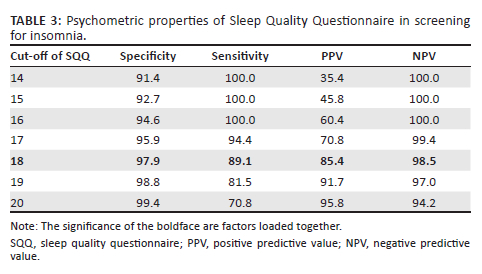
To standardise the scale for diagnostic use, the sensitivity, specificity, positive predictive value, and negative predictive value of the various cut-off scores of SQQ were determined. Table 3 shows, how they were measured against the SCI standardised cut-off score of 16. A score of 18 was found to be the ideal cut-off score to screen for cases of insomnia using the SQQ because it achieved a sensitivity of 89.1% and specificity of 97.9% at that point.
Discussion
This study is an effort to validate a screening tool for insomnia problems among Nigerian adolescents. Sleep problems are common among children and adolescents in Nigeria, and they are associated with physical and mental health indices.16
The validation of the instrument was found to require no adaptation for use among the sample. There was no need for translating the instrument because the participants were literate enough to comprehend the English language. However, because adaptation has been suggested for scales measuring health-related variables when they are to be applied in another cultural setting,14
The present study found that the SQQ correlated well with the SCI, a well-established and validated eight-item instrument, thus suggesting the possibility of giving similar results when used in the study population. Compared to the SCI's ability to predict depression and anxiety, the SQQ showed a weaker correlation with depression on the depressive component of the HADS, possibly because of the nature of our sample. However, its correlation with anxiety on the HADS was modest and similar to that of the SCI (r = -0.400).91017
This study indicates acceptable reliability of the SQQ among Nigerian adolescents in terms of internal consistency. These data support the performance of the SQQ as a measure of sleep problems. This finding is comparable to the validation of the Sleep Difficulty subscale by Kato,17
The structure matrix of SQQ was established by the EFA because there was no proposed theory of any underlying factor. The criteria applied for extraction are considered dependable, although the scree plot has some subjectivity to its interpretation. With items fewer than 30, an average extracted communality of approximately 0.60 and an adequate sample size, the conditions required for the Kaiser criterion to be reliable were met.1819
The outcome of the analysis supports three structures, which were most strongly related to the underlying construct meeting the criteria for poor sleep quality. These three subscales are namely insomnia type, its characteristics and the consequences. Each has three items; for example, the items (1, 2 and 3) that measure the 'insomnia type' indicated if the insomnia is early, middle or late. Whereas the items (4, 5 and 9) on the 'insomnia characteristics' indicated the frequency, severity and duration of poor sleep, the 'insomnia consequences' subscale has items (6, 7 and 8) that measure the impact of insomnia on the mood and relationships, concentration and productivity and in general. Notably, two of these subscales have inadequate alpha reliabilities, which creates a challenge for their independent use. It is thus advisable for the instrument to be used as a whole, because the composite internal consistency score is acceptable.
When the SQQ was compared with the standard SCI, it showed reasonable accuracy in identifying insomnia cases. Although at a cut-off score of 17, the SQQ could have achieved better specificity, it drastically reduced the positive predictive value to a much lower value of 70.8. However, when the SQQ is compared with the SCI at a cut-off score of 18, it showed very good specificity and diagnostic ability in detecting probable insomnia in the sampled population.
This study has some limitations to be noted. Firstly, the selection of the schools was based on convenience; a multistage sampling would have been a better sampling technique to provide a representative sample. Secondly, the stability of the SQQ was not determined because it was a cross-sectional study, although a test-retest would have solved this challenge. Despite these limitations, the SQQ is a resourceful and suitable tool for detecting poor sleep quality in the adolescent population in Nigeria.
Conclusion
The Sleep Quality Questionnaire is considered a simple, reliable and accurate instrument suitable for detecting poor sleep quality in the adolescent population in Nigeria. It demonstrates good specificity and sensitivity at a cut-off point of 18. In addition, this screening tool can assist mental health professionals, such as psychiatrists, clinicalpsychologists and therapists operating at various healthcare centres in Nigeria. Therefore, it is recommended that the SQQ be included in the screening of insomnia in adolescents, both in Nigeria's primary and secondary care settings.
Competing interests
The authors declare that they have no financial or personal relationships that may have inappropriately influenced them in writing this article.
Authors' contributions
O.A. conceived the idea. O.A., A.O. and O.K. prepared the initial manuscript and the final manuscript. All authors read and approved the final manuscript.
Funding information
This research received no specific grant from any funding agency in the public, commercial, or not-for-profit sectors.
Data availability
The datasets used and analysed during the current study are available from the corresponding author, O.A., upon reasonable request.
Disclaimer
The views and opinions expressed in this article are those of the authors and do not necessarily reflect the official policy or position of any affiliated agency of the authors, and the publisher.
Acknowledgements
The authors gratefully acknowledge the participants.
References
- 1.Kolo E, Ahmed A, Hamisu A, Ajiya A, Akhiwu B. Sleep health of healthcare workers in Kano, Nigeria. Niger J Clin Pract. 2017;20(4):479-483.
-
2.Ohayon M, Wickwire EM, Hirshkowitz M, et al. National Sleep Foundation's sleep quality recommendations: First report. Sleep Health. 2017;3(1):6-19. https://doi.org/10.1016/j.sleh.2016.11.006
» https://doi.org/10.1016/j.sleh.2016.11.006 -
3.Alsaggaf MA, Wali SO, Merdad RA, Merdad LA. Sleep quantity, quality, and insomnia symptoms of medical students during clinical years: Relationship with stress and academic performance. Saudi Med J. 2016;37(2):173. https://doi.org/10.15537/smj.2016.2.14288
» https://doi.org/10.15537/smj.2016.2.14288 -
4.Donskoy I, Loghmanee D. Insomnia in adolescence. Med Sci. 2018;6(3):72. https://doi.org/10.3390/medsci6030072
» https://doi.org/10.3390/medsci6030072 -
5.Johnson EO, Roth T, Schultz L, Breslau N. Epidemiology of DSM-IV insomnia in adolescence: Lifetime prevalence, chronicity, and an emergent gender difference. Pediatrics. 2006;117(2):e247-e256. https://doi.org/10.1542/peds.2004-2629
» https://doi.org/10.1542/peds.2004-2629 -
6.Buysse DJ, Reynolds III, CF, Monk TH, Berman SR, Kupfer DJ. The Pittsburgh Sleep Quality Index: A new instrument for psychiatric practice and research. Psychiatry Res. 1989;28(2):193-213. https://doi.org/10.1016/0165-1781(89)90047-4
» https://doi.org/10.1016/0165-1781(89)90047-4 -
7.Aloba OO, Adewuya AO, Ola BA, Mapayi BM. Validity of the Pittsburgh sleep quality index (PSQI) among Nigerian university students. Sleep Med. 2007;8(3):266-270. https://doi.org/10.1016/j.sleep.2006.08.003
» https://doi.org/10.1016/j.sleep.2006.08.003 - 8.Usman S, Olowoyeye E, Adegbamigbe O, et al. Patient waiting time: Gaps and determinants of patients waiting time in hospitals in our communities to receive quality services. Age. 14(25):26-35.
-
9.Espie CA, Kyle SD, Hames P, Gardani M, Fleming L, Cape J. The sleep condition indicator: A clinical screening tool to evaluate insomnia disorder. BMJ Open. 2014;4(3):e004183. https://doi.org/10.1136/bmjopen-2013-004183
» https://doi.org/10.1136/bmjopen-2013-004183 -
10.Espie CA, Farias Machado P, Carl JR, et al. The sleep condition indicator: Reference values derived from a sample of 200 000 adults. J Sleep Res. 2018;27(3):e12643. https://doi.org/10.1111/jsr.12643
» https://doi.org/10.1111/jsr.12643 -
11.Luik AI, Machado PF, Siriwardena N, Espie CA. Screening for insomnia in primary care: Using a two-item version of the sleep condition indicator. Br J Gen Pract. 2019;69(679):79-80. https://doi.org/10.3399/bjgp19X701045
» https://doi.org/10.3399/bjgp19X701045 -
12.Nunnally JC. Psychometric theory - 25 years ago and now. Educ Res. 1975;4(10):7-21. https://doi.org/10.3102/0013189X004010007
» https://doi.org/10.3102/0013189X004010007 - 13.Huffington A. The sleep revolution: Transforming your life, one night at a time. London: Harmony; 2016.
-
14.Arafat S, Chowdhury HR, Qusar M, Hafez M. Cross cultural adaptation & psychometric validation of research instruments: A methodological review. J Behav Health. 2016;5(3):129-136. https://doi.org/10.5455/jbh.20160615121755
» https://doi.org/10.5455/jbh.20160615121755 -
15.Abiodun O. A validity study of the Hospital Anxiety and Depression Scale in general hospital units and a community sample in Nigeria. Br J Psychiatry. 1994;165(5):669-672. https://doi.org/10.1192/bjp.165.5.669
» https://doi.org/10.1192/bjp.165.5.669 -
16.Olashore AA, Akanni OO, Ayilara OO. Psychological distress, drug use, and internet use: The association with poor sleep quality in a sample of secondary school students. Subst Abuse. 2020;14:1178221820957306. https://doi.org/10.1177/1178221820957306
» https://doi.org/10.1177/1178221820957306 -
17.Kato T. Development of the Sleep Quality Questionnaire in healthy adults. J Health Psychol. 2014;19(8):977-986. https://doi.org/10.1177/1359105313482168
» https://doi.org/10.1177/1359105313482168 -
18.Field ADSUSISMre. Discovering statistics using SPSS: Introducing statistical method. 3rd ed. Thousand Oaks, CA: Sage; 2009.
» 3 - 19.Costello AB, Osborne J. Best practices in exploratory factor analysis: Four recommendations for getting the most from your analysis. Pract Assess Res Eval. 2005;10(1):7.

Accepted: 22 Aug. 2022
Published: 14 Dec. 2022