Assessing the prevalence of psychotic symptoms in epileptic patients at a tertiary clinic
Abstract
BACKGROUND: The International League against Epilepsy (ILAE) defines epilepsy as a brain disorder characterised by an enduring risk to generate seizures with neurobiological, cognitive, psychological and social consequences. Psychotic disorders in epilepsy are a serious psychiatric complication affecting the prognosis, morbidity and mortality of patients. There is a paucity in literature with regard to the prevalence of psychotic symptoms in epileptic patients in low- to middle-income countries. AIM: This study aimed to look at the prevalence of psychotic symptoms in epileptic patients at an outpatient clinic using the prodromal questionnaire 16 (PQ-16). SETTING: The study was conducted at the epilepsy clinic at Charlotte Maxeke Academic Hospital (CMJAH), a tertiary hospital located in Johannesburg, South Africa. METHOD: The PQ-16 was distributed to patients at the epilepsy clinic at CMJAH. RESULTS: The study consisted of 121 participants. The prevalence of patients found to be at high risk of psychosis (i.e., PQ-16 score > 6) was 61.2% (95% lower confidence interval (LCI): 0.53, upper confidence interval (UCI): 0.70). None of the demographic variables showed significant associations in the percentage of patients found to be at high risk. No association was found between any antiepileptic drug and high risk of psychosis. CONCLUSION: The high prevalence of psychotic like experiences found suggests it is imperative to screen for psychotic disorders in epileptic patients and if required to involve neuropsychiatrists in their management. CONTRIBUTION: This study highlights the importance of assessing psychotic symptoms in epileptic patients and the importance of a multidisciplinary approach in managing these complex patients.
prevalence; psychosis; psychotic like experiences; epilepsy; ultra high risk for psychosis; prodromal questionnaire 16
Introduction
The International League against Epilepsy (ILAE) defines epilepsy as a brain disorder characterised by an enduring predisposition to generate seizures and by the neurobiological, cognitive, psychological and social consequences of this condition.1231,4,5,6,7,859
There is a paucity of data with regard to rates of health service utilisation in PWE in Africa, but studies in the UK have shown that PWE with psychiatric comorbidity had higher rates of health service utilisation than PWE without psychiatric comorbidity.10112
Psychotic disorders are defined by the presence of two or more of the following abnormalities: delusions, hallucinations, disorganized thinking, grossly disorganized or abnormal motor behaviour and negative symptoms.12992,413
A recent study conducted in Thailand found a prevalence of psychotic disorders in PWE of 8.2%, which is higher than in the general population. They also explored the demographics of PWE and psychotic disorders and found no significant association between demographic characteristics and the presence of psychotic disorders in PWE.6
Multiple studies have explored the relationship between epilepsy and psychosis, with varying reports on the onset of psychotic symptoms in relation to the occurrence of seizures.7,914
This hypothesis could have a massive impact on the treatment and diagnosis of both epilepsy and psychiatric disorders. The global understanding of the relationship between epilepsy and psychiatric disorders is vitally important as it informs the strategies to ensure adequate treatment with appropriate medication, appropriate usage of health resources and it helps to reduce stigma towards both epilepsy and psychiatric disorders and therefore improve the quality of life of patients.13
Psychosis in epilepsy can be described in many ways, namely interictal psychosis, post-ictal psychosis and psychosis secondary to antiepileptic drugs.415
Postictal psychosis occurs when there is a clear temporal relationship between psychosis and the occurrence of a preceding seizure. This should not be confused with postictal confusion, which occurs immediately postseizure whereas with postictal psychosis there is a lucid interval between the seizure event and the onset of psychosis.1513
A confounding factor in studies assessing psychosis in epilepsy is anti-epileptic medication and the link thereof. Prevalence rates have been described as 1%-2% with various contributions from the different agents (topiramate: 0.8%, vigabatrin: 2.5%, zonisamide: 1.9% to 2.3%, Levetiracetam: 0.3% to 0.7% and gabapentin: 0.5%).2,922
To investigate the prevalence of psychotic symptoms, appropriate, easily administered screening tools can be helpful.3,16,1712173,18
A French study recently showed that both neurologists and psychiatrists underrecognized and failed to treat epileptic psychoses.15
The study objectives were as follows:
•To determine the prevalence of psychotic symptoms among patients attending an epilepsy clinic in a tertiary hospital using the PQ-16
•To determine any associations between demographic factors and the occurrence of psychotic symptoms in PWE
•To determine any associations between antiepileptic drugs and psychotic symptoms in PWE
•To determine the temporal relationship between seizures and the onset of psychotic symptoms
Research methods and design
Study design and setting
This was a cross-sectional, quantitative study in which self-administered questionnaires were handed out to consenting participants. The study was conducted at the epilepsy clinic at Charlotte Maxeke Academic Hospital (CMJAH), a tertiary hospital located in Johannesburg, South Africa. Charlotte Maxeke Hospital services patients referred from the greater Johannesburg metro district.
Participants
The patients seen at CMJAH are complex cases who were referred from primary or secondary level health care. The sample population included all consenting participants attending the epilepsy clinic at CMJAH who were over the age of 18, able to read and write in English and diagnosed with epilepsy. The questionnaires were handed out to all willing participants awaiting review with the neurologist. The participants were then given time to complete the questionnaire. The treating neurologists were asked to complete a section on the current antiepileptic drug treatment (AED) of the participant as well as the type of epilepsy the participant was diagnosed with. The questionnaires were then collected as the participants left the clinic after they had seen the neurologist. Patients with a pre-existing diagnosis of a psychotic disorder were excluded from the study. An assessment of Z scores indicated that a total sample size of 320 patients would detect significant differences at a low effect size. However, a sample size of 120 patients was adequate, assuming a large effect size.
Instruments
The questionnaire used was the PQ-16, a validated self-report questionnaire used to screen for psychotic symptoms. The PQ-16 has good concurrent validity with the CAARMS and PQ-92.1616,17,18
Data collection
A total of 131 questionnaires were collected from November 2021 to May 2022. Five participants were excluded from statistical analysis because of incomplete questionnaires and incomplete consent forms. Four questionnaires were omitted from the results as they were completed by participants who had already submitted a questionnaire.
Some of the questionnaires had incomplete information about the current antiepileptic medication and the type of epilepsy. These participants files were collected and reviewed to complete the missing information.
Statistical analysis
Statistical analyses were conducted in R software (version 4.00; www.R-project.org). The prevalence of ultra-high psychosis was calculated as a percentage of the total sample size with 95% CIs. The data set comprised of categorical data that were analysed using Pearson's chi-squared goodness of fit, followed by binary post hoc tests for significant outcomes. Fisher's exact tests for 2 × 2 and 2 × k data were used to test the associations between variables. In these analyses, categories of low scores from some variables were omitted from the analyses to increase the probability of detecting statistical significance. Tests were two-tailed, and the model significance was set at 0.05. Data are reported as counts and percentages and presented descriptively in tables, text or in a chart.
Ethical considerations
The study was approved by the Wits Human Research Ethics committee - approval number M210404. Permission was obtained from the CEO of CMJAH and the head of department of neurology. Participation in the study was voluntary and informed consent was obtained from each participant. A distress protocol was included in the study.
Results
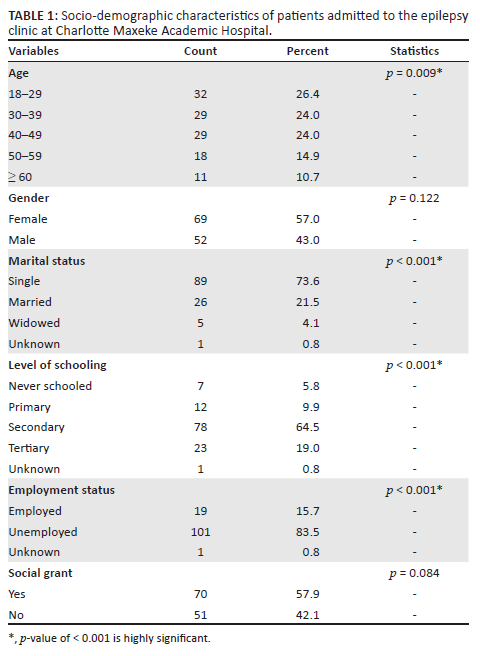
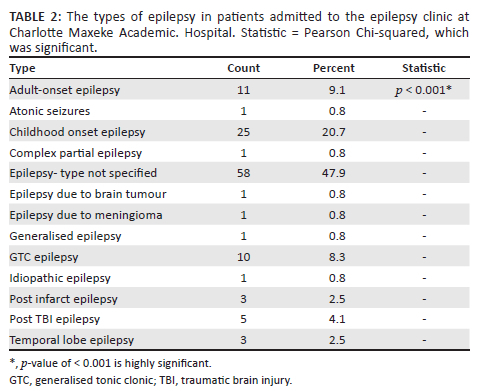
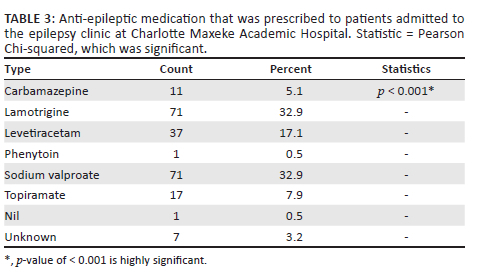
The dataset comprised a total of 121 patients admitted to the epilepsy clinic at CMJAH. In reviewing demographic variables, statistical significance was found, fewer patients were > 60 years old (p = 0.009), were single (p < 0.001), had completed secondary school (p < 0.001) and were unemployed (p < 0.001) (Table 1). There were no significant differences in the number of female patients compared with male patients (p = 0.122) and the number of patients who received social grants compared with those who did not (p = 0.084) (Table 1). There were significantly more patients who had a diagnosis of unspecified epilepsy (p < 0.001) (Table 2). It was found that 66.1% of patients were taking more than one antiepileptic drug and significantly more patients were on lamotrigine and sodium valproate (p < 0.01). One patient was not taking any medication (Table 3).
Objective 1
The prevalence of patients found to be at ultra-high risk (UHR) for psychosis (i.e. PQ-16 score > 6) among patients was 61.2% (95% LCI: 0.53, UCI: 0.70).
Objective 2
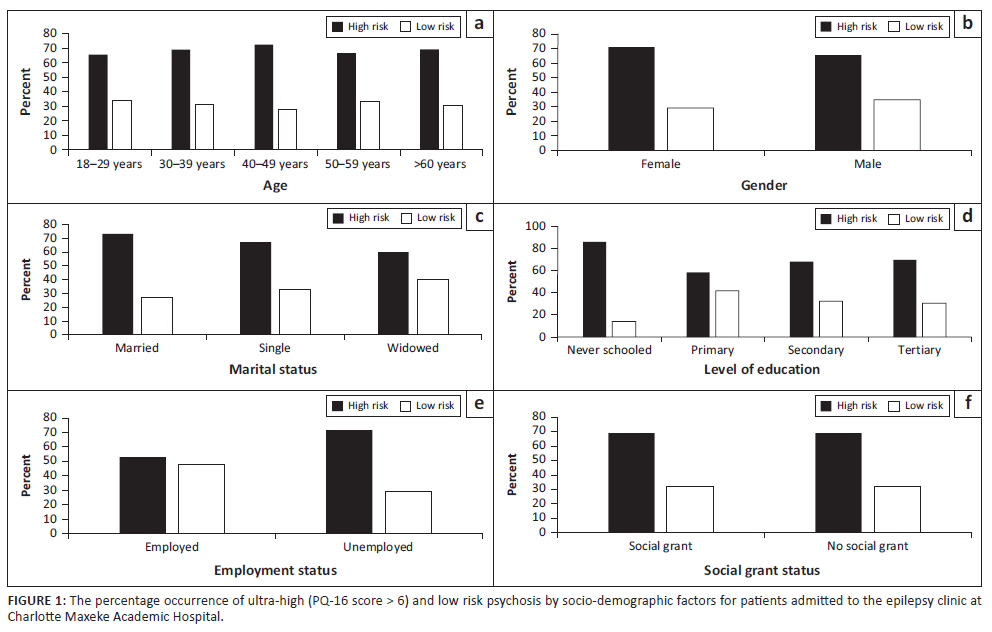
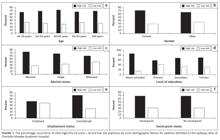
None of the demographic variables showed significant variations in the percentage of patients was found to be high risk versus low risk psychosis, including age (Fisher's exact test = 0.988), gender (Fisher's exact test = 0.556), marital status (Fisher's exact test = 0.755), level of schooling (Fisher's exact test = 0.716), employment status (Fisher's exact test = 0.117) and having a social grant (Fisher's exact test = 1.000) (Figure 1).
Objective 3
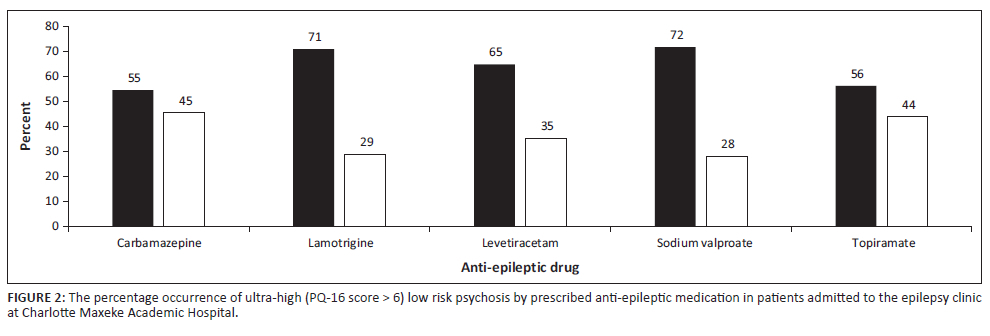
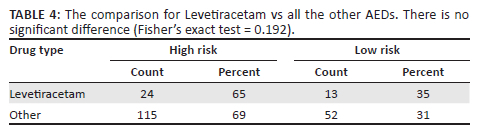
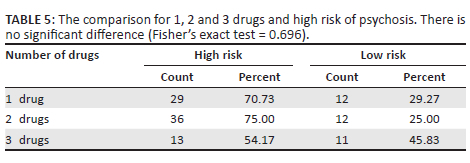
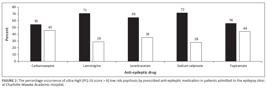
No association between any specific antiepileptic drug and being at high risk of psychosis was found (Fisher's exact test = 0.523) (Figure 2). The authors also compared Levetiracetam specifically with other antiepileptic drugs and being high risk of psychosis and found no significant difference (Fisher's exact test = 0.192) (Table 4). Also found no significant difference between patients taking multiple antiepileptic drugs being found at high risk of psychosis compared with those taking one antiepileptic drug (Fisher's exact test = 0.696) (Table 5).
Discussion
Key findings
Prevalence of ultra-high risk of psychosis
It was found that 61.2% of the patients attending the epilepsy clinic at CMJAH were at ultra-high risk for psychotic symptoms (i.e. had a PQ 16 score > 6). This is a much higher prevalence than in similar studies, which reported prevalence rates of 4%-6%.2,4,66319
The negative symptom subscale of the PQ has been noticed to have poor convergent and divergent validity. It has been shown that the factors assessing negative features have been more strongly correlated with depressive and anxiety symptoms.202121
The high prevalence rate may also have been affected indirectly by the COVID-19 pandemic. Psychotic symptoms are more likely to occur in patients with poorly controlled seizures922
Socio-demographic factors
There was no association between high risk of psychosis and any socio-demographic factors. This is in keeping with a study performed in Thailand to assess the prevalence of psychiatric disorders in PWE.6p = 0.009); this could be a reflection of the lower average life expectancy of epileptic patients as opposed to the general population. The risk of premature death in epilepsy is up to three times greater than the general population.11p < 0.001) was also noticed. A possible explanation could be related to the impact of refractory seizures and complications thereof on social and occupational functioning including relationships.
Antiepileptic medication
Antiepileptic drugs have been shown to cause psychotic symptoms in some PWE. Antiepileptic drug induced psychotic disorder (AIPD) has prevalence rates from 1% to 8.4% in clinical trials.22522
Types of epilepsy
Strengths and limitations
This study is to the best of the authors' knowledge, the first of its kind to be carried out in an African setting. The WHO has highlighted that the prevalence of epilepsy is highest in low- and middle-income countries and the importance of fully treating the psychiatric comorbidity of epilepsy is becoming more apparent.11
The PQ-16 was used to assess the presence of psychotic symptoms in epileptic patients. The PQ-16 is a validated tool used internationally with good reliability. It is also inexpensive, quick and easy to administer. This makes this study easy to replicate in other African settings.
This study was a cross-sectional study and therefore no inferences can be made about causation or progression from high risk of psychosis to diagnosable psychotic disorders. Researchers did not have a control group and thus could not compare the prevalence rate obtained with that of the general population in the given setting. The sample size was small and limited the power of the statistical calculations. The study sample consisted of patients with complicated and often treatment-resistant epilepsy and therefore the results cannot be generalised to the larger epileptic population. The PQ-16 was designed and validated in populations in which English is the first language of most participants. As a result of language differences, many patients may have found it difficult to understand some of the statements in the PQ-16. Many of the patients did not understand the Likert scale on symptom severity in the questionnaire and thus did not complete the section. As a result of the low numbers of responses to the severity grading, it was excluded from the final results. The severity scale has been noticed to improve specificity of the prodromal questionnaire brief: a predecessor to the PQ-16.9
Conclusion
Findings show a high prevalence of psychotic-like experiences in PWE attending a tertiary epileptic clinic. This finding shows how imperative it is to not only screen for affective disorders in epileptic patients but also to screen for psychotic disorders. It also suggests the need for further involvement of neuropsychiatrists in the treatment and management of epilepsy.
Competing interests
The authors declare that they have no financial or personal relationships that may have inappropriately influenced them in writing this article.
Authors' contributions
M.M.H. conceptualised and designed the study, collected the data and wrote the article. K.L. supervised the study and helped in the writing of the article. All authors have read and approved the final manuscript.
Funding information
The study was funded by the research investigator.
Data availability
The data upon which the findings of this study are based are available on request from co-author M.M.H.
Disclaimer
The views and opinions expressed in this article are those of the authors and do not necessarily reflect the official policy or position of any affiliated agency of the authors.
Acknowledgements
The following acknowledgements are made in gratitude: The nursing staff and doctors at Charlotte Maxeke Academic Hospital who assisted with data collection, Prof Neville Pillay who assisted with statistical analysis and the colleagues who provided guidance, mentorship and support.
References
-
1.Kanner AM. Obstacles in the treatment of common psychiatric comorbidities in patients with epilepsy: What is wrong with this picture? Epilepsy Behav. 2019;98:291-292. https://doi.org/10.1016/j.yebeh.2019.03.013
» https://doi.org/10.1016/j.yebeh.2019.03.013 -
2.Chen Z, Lusicic A, O'Brien TJ, Velakoulis D, Adams SJ, Kwan P. Psychotic disorders induced by antiepileptic drugs in people with epilepsy. Brain. 2016;139:2668-2678. https://doi.org/10.1093/brain/aww196
» https://doi.org/10.1093/brain/aww196 -
3.Loewy RL, Bearden CE, Johnson JK, Raine A, Cannon TD. The prodromal questionnaire (PQ): Preliminary validation of a self-report screening measure for prodromal and psychotic symptoms. Schizophr Res. 2005;79:117-125. https://doi.org/10.1016/j.schres.2005.03.007
» https://doi.org/10.1016/j.schres.2005.03.007 -
4.Salpekar JA, Mula M. Common psychiatric comorbidities in epilepsy: How big of a problem is it? Epilepsy Behav. 2019;98:293-297. https://doi.org/10.1016/j.yebeh.2018.07.023
» https://doi.org/10.1016/j.yebeh.2018.07.023 -
5.Singh P, Pandey AK. Psychiatric morbidity in epilepsy. IJRMS. 2017;5(10):4267-4270. https://doi.org/10.18203/2320-6012.ijrms20174187
» https://doi.org/10.18203/2320-6012.ijrms20174187 -
6.Kuladee S, Prachason T, Srisopit P, et al. Prevalence of psychiatric disorders in Thai patients. Epilepsy Behav. 2019;90:20-24. https://doi.org/10.1016/j.yebeh.2018.11.004
» https://doi.org/10.1016/j.yebeh.2018.11.004 -
7.Kanemoyo K, Tadokoro Y, Oshima T. Psychotic illness in patients with epilepsy. Ther Adv Neurol Disord. 2012;5(6):321-334. https://doi.org/10.1177/1756285612454180
» https://doi.org/10.1177/1756285612454180 -
8.Hesdorffer DC. Comorbidity between neurological illness and psychiatric disorders. CNS Spectr. 2016;21(3):130-238. https://doi.org/10.1017/S1092852915000929
» https://doi.org/10.1017/S1092852915000929 -
9.Maguire M, Singh J, Marson A. Epilepsy and psychosis: A practical approach. Pract Neurol. 2018;18(2):106-114. https://doi.org/10.1136/practneurol-2017-001775
» https://doi.org/10.1136/practneurol-2017-001775 -
10.Clancy JM, Clarke MC, Connor DJ, Cannon M, Cotter DR. The prevalence of psychosis in epilepsy; a systematic review and meta-analysis. BMC Psychiatry. 2014;14:1-9. https://doi.org/10.1186/1471-244X-14-75
» https://doi.org/10.1186/1471-244X-14-75 -
11.WHO. Epilepsy fact sheet [homepage on the Internet]. c2020 [cited 25 May 2020]. Available from: https://www.who.int/news-room/fact-sheets/detail/epilepsy/en/
» https://www.who.int/news-room/fact-sheets/detail/epilepsy/en/ - 12.American Psychiatric Association. Diagnostic and statistical manual of mental disorders: DSM-5. 5th ed. Arlington, VA: American Psychiatric Publishing, 2013; p. 87-123.
- 13.Hilger E, Zimprich F, Pataraia E, et al. Psychoses in epilepsy: A comparison of postictal and interictal psychoses. Epilepsy Behav. 2016;60:58-62.
-
14.Berg AT, Altalib HH, Devinsky O. Psychiatric and behavioral comorbidities in epilepsy: A critical appraisal. Epilepsia. 2017;58(7):1123-1130. https://doi.org/10.1111/epi.13766
» https://doi.org/10.1111/epi.13766 -
15.Tarrada A, Hingray C, Sachdev P, Le Thien M, Kanemoto K, De Toffol B. Epileptic psychoses are underrecognized by French neurologists and psychiatrists. Epilepsy Behav. 2019;100:1-5. https://doi.org/10.1016/j.yebeh.2019.106528
» https://doi.org/10.1016/j.yebeh.2019.106528 -
16.Ising HK, Veling W, Loewy RL, et al. The validity of the 16-item version of the prodromal questionnaire (PQ-16) to screen for ultra-high risk of developing psychosis in the general help-seeking population. Schizophr Bull. 2012;38(6):1288-1296. https://doi.org/10.1093/schbul/sbs068
» https://doi.org/10.1093/schbul/sbs068 -
17.Schiffman J. Considerations for the development and implementation of brief screening tools in the identification of early psychosis. Schizophr Res. 2018;199:41-43. https://doi.org/10.1016/j.schres.2018.03.002
» https://doi.org/10.1016/j.schres.2018.03.002 -
18.Loewy RL, Pearson R, Vinogradov S, Bearden CE, Cannon TD. Psychosis risk screening with the prodromal questionnaire - Brief version (PQ-B). Schizophr Res. 2011;129(1):42-46. https://doi.org/10.1016/j.schres.2011.03.029
» https://doi.org/10.1016/j.schres.2011.03.029 -
19.Hanssen M, Peeters F, Krabbendam L, Radstake S, Verdoux H, Van Os J. How psychotic are individuals with non-psychotic disorders? Soc Psychiatry Psychiatr Epidemiol. 2003;38(3):149-154. https://doi.org/10.1007/s00127-003-0622-7
» https://doi.org/10.1007/s00127-003-0622-7 -
20.Pierce KM, Maxwell SD, Olino TM, Cooper S, Ellman LM. Factor structure, convergent, and divergent validity of the prodromal questionnaire-negative symptom subscale. Sage J. 2021;28(1):153-168. https://doi.org/10.1177/1073191119899981
» https://doi.org/10.1177/1073191119899981 -
21.Sylla M, Vogel AC, Bah AK, et al. Prevalence, severity and associations of depression in people with epilepsy in Guinea: A single-center study. Epilepsy Behav. 2020;113:107475. https://doi.org/10.1016/j.yebeh.2020.107475
» https://doi.org/10.1016/j.yebeh.2020.107475 -
22.Tashakori-Miyanroudi M, Souresrafil A, Hashemi P, Ehsanzadeh SJ, Farrahizadeh M, Behroozi Z. Prevalence of depression, anxiety and psychological distress in patients with epilepsy during COVID-19: A systematic review. Epilepsy Behav. 2021;125:108410. https://doi.org/10.1016/j.yebeh.2021.108410
» https://doi.org/10.1016/j.yebeh.2021.108410 -
23.Qin P, Xu H, Laursen TM, Vestergaard M, Mortensen PB. Risk for schizophrenia and schizophrenia -like psychosis among patients with epilepsy: Population based cohort study. Br Med J. 2005;331:23. https://doi.org/10.1136/bmj.38488.462037.8F
» https://doi.org/10.1136/bmj.38488.462037.8F

Accepted: 25 July 2023
Published: 11 Sept. 2023