Antipsychotics-related hyperprolactinaemia among patients with schizophrenia in Maiduguri
Abstract
BACKGROUND: Hyperprolactinaemia among patients on antipsychotic medications is generally overlooked due to lack of outwardly visible symptoms, patient resistance to reporting because the symptoms are perceived as shameful, or to clinician's insufficient knowledge AIM: The study aimed to evaluate the patterns and correlates of hyperprolactinemia among patients with schizophrenia on antipsychotic medications. SETTING: The study was conducted in a psychiatric facility in Maiduguri, Northeastern Nigeria. METHODS: A total of 209 patients with schizophrenia were evaluated through a cross-sectional design and assayed for serum prolactin with ELISA Kits. Frequencies and percentages were tabulated for categorical variables. Variables with significant associations with hyperprolactinaemia on chi-square (p < 0.05) were subjected to logistic regression analysis. RESULTS: The prevalence of hyperprolactinaemia was 45.9% in all patients on antipsychotic medication. The prevalence because of the use of typical and atypical antipsychotics was 51.5% and 25.0%, respectively. Hyperprolactinaemia was significantly associated with typical antipsychotics (β = 0314, p = 0.002), high overall drug dosage (β = 2.340, p = 0.003), high-dose typical antipsychotics (β = 3.228, p = 0.000), twice daily dosing frequency (β = 2.751, p = 0.001) and polypharmacy (β = 1.828, p = 0.0024). CONCLUSION: The findings support that patients on typical, high-dose antipsychotic medications and polypharmacy have a high prevalence of hyperprolactinaemia. As hyperprolactinaemia is often undetectable, screening and patient psycho-education on the significance of the signs and symptoms of hyperprolactinaemia is required for necessary clinical intervention. CONTRIBUTION: The study provides evidence for the rational use of antipsychotic medications in sub-Saharan Africa.
hyperprolactinaemia; antipsychotics; prolactin; schizophrenia; Nigeria
Introduction
The hormone prolactin is secreted by the anterior pituitary gland, and its release is mainly under the control of dopamine (prolactin inhibitory factor) in the hypothalamic-pituitary axis and an increase in dopamine availability inhibits prolactin production, while a blockade of dopamine (D2 receptors) leads to increased prolactin production.1,232,3,41
Hyperprolactinaemia has been observed among patients on antipsychotic medications with greater D2 receptor binding, especially those on typical antipsychotics.5,67,89,1011
The prevalence of hyperprolactinaemia among patients with schizophrenia on antipsychotic medications has been estimated to range between 30% and 75%.12,13,1414,15,1617,181,4
The only prior study on the prevalence and correlates of hyperprolactinaemia in Nigeria was carried out in the southern part and only explored on the relationship of hyperprolactinaemia with medication class (typical or atypical) and medication dosage and found that the greatest predictor of hyperprolactinaemia was the medication dosage.12
Research methods and design
Study setting
The study was conducted at Federal Neuro-Psychiatric Hospital, Maiduguri. The hospital is a tertiary centre that is located along Baga Road. It serves as a referral centre from neighbouring countries of Chad, Niger and Cameroun.
Study population
A total of 209 patients with schizophrenia completed the study. The inclusion criteria were participants between ages 18 and 65 years with an International Classification of disease (ICD-10) diagnosis of schizophrenia who have been attending the clinic for at least 6 months and have given informed consent in writing. Exclusion criteria included pregnant and lactating women and the presence of endocrinological disorders such as hypothyroidism, pituitary gland disease and diabetes mellitus.
Study design and procedure
The study was cross-sectional in design. Each patient was interviewed in a private and well-secured room to assure privacy, confidentiality and safety and the administration of the questionnaires took on average about 45 min to complete. The questionnaires have been validated for use in Nigeria.
Study measures
A socio-demographic questionnaire requesting information about the participants' age, gender, educational status, marital status, occupational status, type, dosage and frequency of antipsychotic medications was administered. A single venous blood sample was collected for serum prolactin analysis. The severity of symptoms was measured with PANSS and the medication adherence with Medication Adherence Rating Scale (MARS).
Methods for serum prolactin measurements
Blood samples were taken at least 2 h after the last meal and 30 min of rest. Venous blood was extracted for centrifugation in a glass tube, and the plasma was stored in a plastic tube at -80°C. Prolactin concentration was assayed using the Enzyme Immunoassay Test Kit [Microparticle enzyme immunoassay (MEIA)] in the serum. The prolactin hormone (PRL) AccuBindTMELISA Test kit was used to quantitatively measure prolactin in the serum of patients with schizophrenia. The kit is a rapid, sensitive and reliable assay for the measurement of prolactin level based on a principle of a solid-phase enzyme-linked immunosorbent assay.1919
Positive and Negative Symptoms Scale
The PANSS is used to measure the severity of illness among patients with schizophrenia. It is a clinician-based interview that takes approximately 45 min to complete, rated on a 7-point scale ranging from 1 (no symptoms) to 7 (extreme symptoms).202021
Medication Adherence Rating Scale
It is a 10-item self-reporting dimensional scale designed to measure drug-taking behaviour with a dichotomised response option of yes or no.2222,23
Statistical analysis
Frequencies and percentages were used for descriptive analysis. A chi-square test was used to analyse the association between socio-clinical factors and prolactin levels. Variables with significant associations were subjected to binary logistic regression analysis. All tests were two tailed with the significance level set at 0.05. SPSS version 18 was used for data entry and analysis.
Ethical considerations
The study was registered with the National Health Research Ethics Committee (NHREC/06/01/2020) and ethical approval was obtained from the Research Ethics Committee of Federal Neuro-psychiatric Hospital Maiduguri. Patients with written informed consent with an established diagnosis of schizophrenia, schizoaffective disorder and delusional disorder using ICD-10 diagnostic criteria participated in the study (FNPH/072021/REC133). Only those who consented in writing were interviewed. To ensure privacy, only codes were used as means of identification.
Results
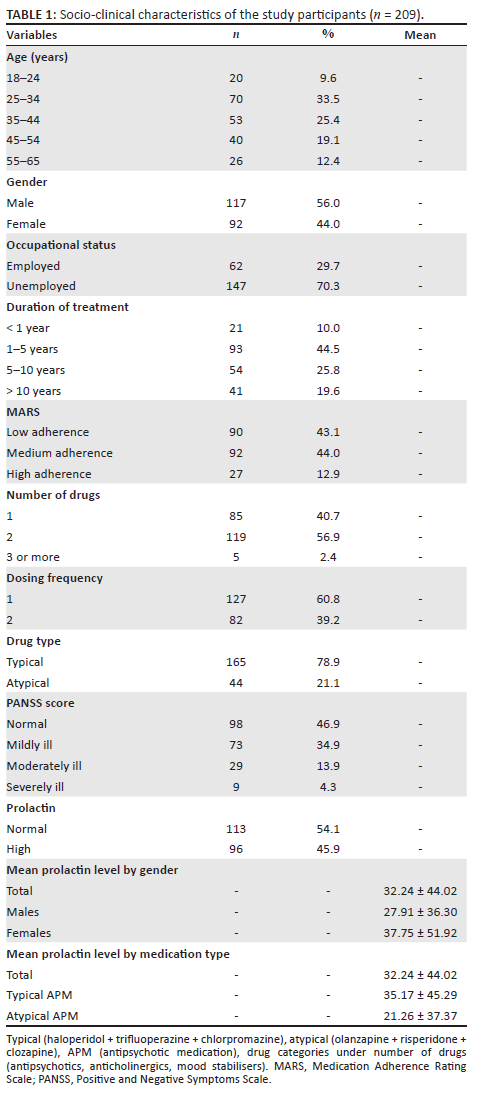
The mean prolactin level was 32.24 ± 44.02. The mean prolactin levels for typical and atypical antipsychotics were 35.17 ± 45.29 and 21.26 ± 37.37, respectively, and the mean levels for males and females were 27.91 ± 36.30 and 37.75 ± 51.92, respectively. Close to 60% of the population were between the ages of 25-34 and 35-44 years. Males constituted 56% of the population, 70.3% were unemployed, 78.9% were on typical antipsychotic medications and 54.1% had high prolactin levels as presented in Table 1.
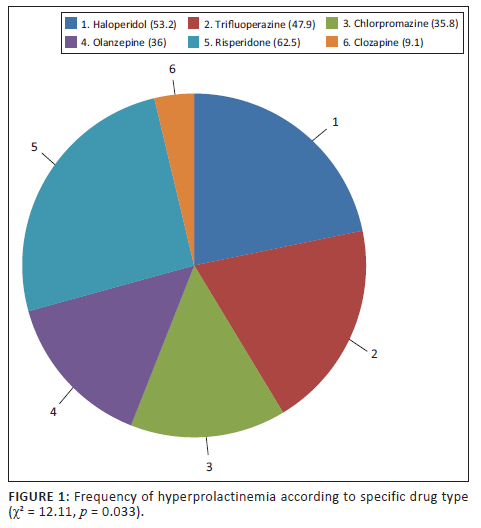
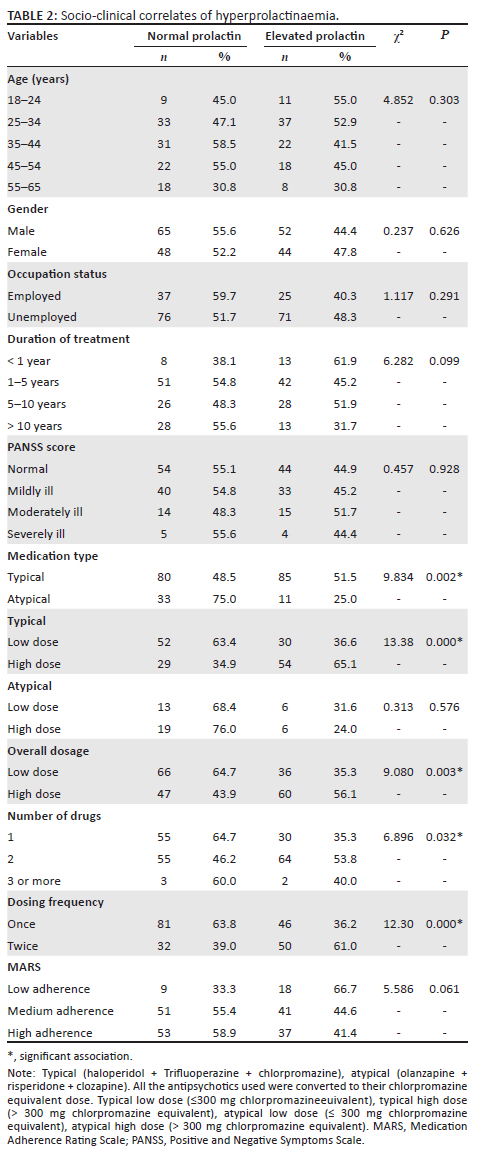
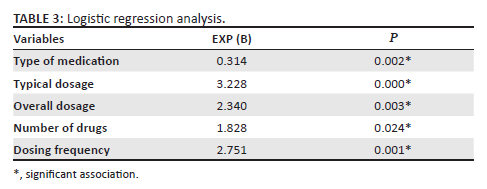
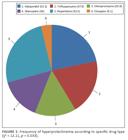
The significant differences in the frequency of hyperprolactinaemia according to drug types are shown in Figure 1 (χ2р = 0.033), and Table 2 shows that none of the socio-demographic variables were associated with hyperprolactinaemia. The clinical variables of significance were the type of medications, dosage of medication, number of drugs and frequency of dosing. Hyperprolactinaemia was observed among 51.5% of those on typical antipsychotics compared with 25% of those on atypical antipsychotics (χ2p = 0.002), 56.1% of those on high medication dosage (χ2p = 0.003) compared with 35.3% on low dose, 61.0% of those on twice daily dosing frequency (χ2p = 0.000) compared with 36.2% once-daily dosing frequency and with use of two or more drugs (χ2p = 0.0032) compared with one drug. All the significant variables subjected to logistic regression analysis remained statistically significant (Table 3).
Discussion
The study showed that 45.9% of patients with schizophrenia on antipsychotic medications had hyperprolactinaemia. This study found a higher prevalence of hyperprolactinaemia (45.9%) than a previous report from soutrhern Nigeria, which found a frequency of 30%. The reason for the differences could be due to variations in sample size, patient characteristics and treatment length, as prolactin was measured only 8 weeks after starting antipsychotic medications in drug naive individuals in their study. Theprevalence of hyperprolactinaemia in this study is higher than previous report in southern Nigeria of 30%.128,24151325267,2725,26
In keeping with current literature, this study showed a significant association between hyperprolactinaemia and antipsychotic medications with a twofold difference in the prevalence of hyperprolactinaemia among patients placed on typical antipsychotics (51.5%) compared with atypical antipsychotics (25%). Furthermore, risperidone had the greatest increase in prolactin levels (62.5%), followed by haloperidol (57.3%) and least with clozapine (9.1%). The finding is consistent with prior randomised longitudinal double-blind clinical trials and cross-sectional studies showing greater effects of haloperidol and risperidone on prolactin levels than other antipsychotic medications.2,28,29p = 0.000) than those on low dose. This is consistent with the accumulating evidence of the antipsychotic dose-dependent proneness for hyperprolactinaemia.1525p = 0.03).
As with prior studies,6,773,11,3031
The study has several strengths, namely, it is the first study to examine the prevalence and associated risk factors of hyperprolactinaemia in North-Eastern Nigeria in a fairly modest sample size. The study further explored the prevalence of hyperprolactinaemia of the commonly available antipsychotics. Some of the limitations include its cross-sectional nature making it difficult to establish causality and no baseline prolactin measurement. Pituitary gland disease and hypothyroidism were only ruled out; through clinical evaluation and not radiologically using computed tomography and magnetic resonance imaging, which are the gold standard. Symptoms of hyperprolactinaemia were not explored; thus individuals with hyperprolactinaemia with and without symptoms were not distinguished. The skewed distribution of typical over atypical antipsychotics is a limitation of this study. Another possible limitation is that based on the low socio-economic status of the majority of the study population, it may not be feasible to routinely measure serum prolactin level in all patients.
Conclusion
We found a high prevalence of hyperprolactinaemia among patients with schizophrenia on antipsychotic medications. Therefore, measurement of serum prolactin level should routinely be incorporated among patients placed on antipsychotics especially those on prolactin-raising antipsychotics, high doses of medications, polypharmacy and more than once daily dosing of medication to optimise adherence and improve quality of life.
Competing interests
The authors have declared that no competing interest exist.
Authors' contributions
F.B.S.: Conceptualisation, design of the study, data collection, data analysis and manuscript writing; M.A.W., T.L.S., and M.A.: Design of the study, interpretation and review of the manuscript; A.W.: Drafting and review of the manuscript; O.B.: Data analysis. All authors approved the final manuscript.
Funding information
This research was not funded by any funding agency in the public, commercial or not-for-profit sectors.
Data availability
Data will be made available upon reasonable request from the corresponding author F.B.S.
Disclaimer
The views and opinions expressed in this article are those of the authors and are the product of professional research. It does not necessarily reflect the official policy or position of any affiliated institution, funder, agency, or that of the publisher. The authors are responsible for this article's results, findings, and content.
Acknowledgements
The authors would like to express their profound gratitude to the study participants and the entire staffs of the outpatient department of Federal Neuropsychiatric Hospital Maiduguri for their cooperation and enormous support rendered throughout the study period.
References
-
1.Milano W, D'Acunto CW, De Rosa M, et al. Recent clinical aspects of hyperprolactinemia induced by antipsychotics. Rev Recent Clin Trials. 2011 Jan 1;6(1):52-64. https://doi.org/10.2174/157488711793980138
» https://doi.org/10.2174/157488711793980138 -
2.Dehelean L, Romosan AM, Papava I, et al. Prolactin response to antipsychotics: An inpatient study. PLoS One. 2020 Feb 4;15(2):e0228648. https://doi.org/10.1371/journal.pone.0228648
» https://doi.org/10.1371/journal.pone.0228648 -
3.Ajmal A, Joffe H, Nachtigall LB. Psychotropic-induced hyperprolactinemia: A clinical review. Psychosomatics. 2014 Jan 1;55(1):29-36. https://doi.org/10.1016/j.psym.2013.08.008
» https://doi.org/10.1016/j.psym.2013.08.008 -
4.Milano W, Colletti C, Capasso A. Hyperprolactinemia induced by antipsychotics: From diagnosis to treatment approach. Endocr Metab Immune Disord Drug Targets. 2017 Mar 1;17(1):38-55. https://doi.org/10.2174/1871530317666170424102332
» https://doi.org/10.2174/1871530317666170424102332 -
5.Ates MA, Tutuncu R, Oner I, et al. Relationship between plasma levels of prolactin and the severity of negative symptoms in patients with schizophrenia. Klin Psikofarmakol B. 2015 Mar 1;25(1):27-37. https://doi.org/10.5455/bcp.20141212113905
» https://doi.org/10.5455/bcp.20141212113905 -
6.Kapur S, Zipursky R, Jones C, Remington G, Houle S. Relationship between dopamine D2 occupancy, clinical response, and side effects: A double-blind PET study of first-episode schizophrenia. Am J Psychiatry. 2000 Apr 1;157(4):514-520. https://doi.org/10.1176/appi.ajp.157.4.514
» https://doi.org/10.1176/appi.ajp.157.4.514 -
7.Peuskens J, Pani L, Detraux J, De Hert M. The effects of novel and newly approved antipsychotics on serum prolactin levels: A comprehensive review. CNS Drugs. 2014 May;28(5):421-453. https://doi.org/10.1007/s40263-014-0157-3
» https://doi.org/10.1007/s40263-014-0157-3 -
8.Lally J, Ajnakina O, Stubbs B, et al. Hyperprolactinaemia in first episode psychosis - A longitudinal assessment. Schizophr Res. 2017 Nov 1;189:117-125. https://doi.org/10.1016/j.schres.2017.07.037
» https://doi.org/10.1016/j.schres.2017.07.037 -
9.Haddad PM, Wieck A. Antipsychotic-induced hyperprolactinaemia: Mechanisms, clinical features and management. Drugs. 2004 Oct;64(20):2291-2314. https://doi.org/10.2165/00003495-200464200-00003
» https://doi.org/10.2165/00003495-200464200-00003 -
10.Yoshida K, Takeuchi H. Dose-dependent effects of antipsychotics on efficacy and adverse effects in schizophrenia. Behav Brain Res. 2021 Mar 26;402:113098. https://doi.org/10.1016/j.bbr.2020.113098
» https://doi.org/10.1016/j.bbr.2020.113098 -
11.Arakawa R, Okumura M, Ito H, et al. Positron emission tomography measurement of dopamine D2 receptor occupancy in the pituitary and cerebral cortex: Relation to antipsychotic-induced hyperprolactinemia. J Clin Psychiatry. 2010 Feb 23;71(9):14740. https://doi.org/10.4088/JCP.08m04307yel
» https://doi.org/10.4088/JCP.08m04307yel - 12.Olose EO, Chukwujekwu CD, Busari CO, Igwe MN. Hyperprolactinemia in psychiatric patients taking antipsychotic medications: A longitudinal study in a tertiary hospital in South-South, Nigeria. Biol Med. 2021;13(9):100-292.
-
13.Bonete Llacer JM, Martinez Hortelano A, Richart Albelda B. Hyperprolactinemia in psychotic patients treated in monotherapy with long-acting injectable antipsychotics. Int J Psychiatry Clin Pract. 2019 Jul 3;23(3):189-193. https://doi.org/10.1080/13651501.2019.1576905
» https://doi.org/10.1080/13651501.2019.1576905 -
14.Herceg M. Correlation between prolactin and symptom profile in acute admitted women with recurrent schizophrenia. Psychiatr Danub. 2020;32(3-4):367-372. https://doi.org/10.24869/psyd.2020.367
» https://doi.org/10.24869/psyd.2020.367 -
15.Wang ZM, Xiang YT, An FR, et al. Frequency of hyperprolactinemia and its associations with demographic and clinical characteristics and antipsychotic medications in psychiatric inpatients in China. Perspect Psychiatr Care. 2014 Oct;50(4):257-263. https://doi.org/10.1111/ppc.12050
» https://doi.org/10.1111/ppc.12050 -
16.Delgado-Alvarado M, Tordesillas-Gutierrez D, Ayesa-Arriola R, et al. Plasma prolactin levels are associated with the severity of illness in drug-naive first-episode psychosis female patients. Arch Womens Ment Health. 2019 Jun;22(3):367-373. https://doi.org/10.1007/s00737-018-0899-x
» https://doi.org/10.1007/s00737-018-0899-x -
17.Del Cacho N, Butjosa A, Vila-Badia R, et al. Prolactin levels in drug-naïve first-episode nonaffective psychosis patients compared with healthy controls. Sex differences. Psychiatry Res. 2019 Jun 1;276:218-222. https://doi.org/10.1016/j.psychres.2019.03.027
» https://doi.org/10.1016/j.psychres.2019.03.027 -
18.Wasnik V, Khess CR, Munda S, Bijali S. Serum prolactin level and its correlation with psychopathology in drug free/drug naive schizophrenia a case control study. Asian J Psychiatry. 2019 Jan 1;39:1-5. https://doi.org/10.1016/j.ajp.2018.11.002
» https://doi.org/10.1016/j.ajp.2018.11.002 - 19.Tietz N. Clinical guide to laboratory test. 2nd ed. Philadelphia, PA: WB Saunders; 1992.
-
20.Kay SR, Fiszbein A, Opler LA. The Positive and Negative Syndrome Scale (PANSS) for schizophrenia. Schizophr Bull. 1987;13(2):261-76. https://doi.org/10.1093/schbul/13.2.261
» https://doi.org/10.1093/schbul/13.2.261 -
21.Odinka PC, Ndukuba AC, Muomah RC, et al. Positive and negative symptoms of schizophrenia as correlates of help-seeking behaviour and the duration of untreated psychosis in South-East Nigeria. S Afr J Psychiatry. 2014;20(4):166. https://doi.org/10.4102/sajpsychiatry.v20i4.536
» https://doi.org/10.4102/sajpsychiatry.v20i4.536 -
22.Thompson K, Kulkarni J, Sergejew AA. Reliability and validity of a new Medication Adherence Rating Scale (MARS) for the psychoses. Schizophr Res. 2000;42(3):241-247. https://doi.org/10.1016/S0920-9964(99)00130-9
» https://doi.org/10.1016/S0920-9964(99)00130-9 -
23.Owie GO, Olotu SO, James BO. Reliability and validity of the Medication Adherence Rating Scale in a cohort of patients with schizophrenia from Nigeria. Trends Psychiatry Psychother. 2018 May 14;40(2):85-92. https://doi.org/10.1590/2237-6089-2017-0077
» https://doi.org/10.1590/2237-6089-2017-0077 -
24.Kelly DL, Wehring HJ, Earl AK, et al. Treating symptomatic hyperprolactinemia in women with schizophrenia: Presentation of the ongoing DAAMSEL clinical trial (Dopamine partial Agonist, Aripiprazole, for the Management of Symptomatic ELevated prolactin). BMC Psychiatry. 2013;13:214. https://doi.org/10.1186/1471-244X-13-214
» https://doi.org/10.1186/1471-244X-13-214 -
25.Alosaimi FD, Fallata EO, Abalhassan M, et al. Prevalence and risk factors of hyperprolactinemia among patients with various psychiatric diagnoses and medications. Int J Psychiatry Clin Pract. 2018 Oct 2;22(4):274-281. https://doi.org/10.1080/13651501.2018.1425459
» https://doi.org/10.1080/13651501.2018.1425459 -
26.Kikuchi T, Iwamoto K, Sasada K, Aleksic B, Yoshida K, Ozaki N. Sexual dysfunction and hyperprolactinemia in Japanese schizophrenic patients taking antipsychotics. Prog Neuropsychopharmacol Biol Psychiatry. 2012 Apr 27;37(1):26-32. https://doi.org/10.1016/j.pnpbp.2011.11.016
» https://doi.org/10.1016/j.pnpbp.2011.11.016 -
27.Retief M, Chiliza B, Phahladira L, Emsley R, Asmal L. Prolactin, flupenthixol decanoate and first episode schizophrenia-clinical and laboratory correlates. Metab Brain Dis. 2019 Dec;34(6):1679-1687. https://doi.org/10.1007/s11011-019-00474-5
» https://doi.org/10.1007/s11011-019-00474-5 -
28.Volavka J, Czobor P, Cooper TB, et al. Prolactin levels in schizophrenia and schizoaffective disorder patients treated with clozapine, olanzapine, risperidone, or haloperidol. J Clin Psychiatry. 2004 Jan 1;65(1):57-61. https://doi.org/10.4088/JCP.v65n0109
» https://doi.org/10.4088/JCP.v65n0109 -
29.Melkersson K. Differences in prolactin elevation and related symptoms of atypical antipsychoties in schizophrenic patients. J Clin Psychiatry. 2005 Jun 1;66(6):761-767. https://doi.org/10.4088/JCP.v66n0614
» https://doi.org/10.4088/JCP.v66n0614 -
30.Stojkovic M, Radmanovic B, Jovanovic M, Janjic V, Muric N, Ristic DI. Risperidone induced hyperprolactinemia: From basic to clinical studies. Front Psychiatry. 2022;13:874705. https://doi.org/10.3389/fpsyt.2022.874705
» https://doi.org/10.3389/fpsyt.2022.874705 -
31.Holt RI, Peveler RC. Antipsychotics and hyperprolactinaemia: Mechanisms, consequences and management. Clin Endocrinol. 2011 Feb;74(2):141-147. https://doi.org/10.1111/j.1365-2265.2010.03814.x
» https://doi.org/10.1111/j.1365-2265.2010.03814.x

Accepted: 10 Nov. 2023
Published: 01 Feb. 2024