The influence of parents' history of alcohol use on their university-going children's drinking habits: A comparative study of students' drinking habits
Abstract
BACKGROUND: Parents with a history of alcohol consumption contribute to their children's drinking behaviour. AIM: This study aimed to investigate the influence of parents' history of alcohol use on their children's drinking habits. SETTING: The study was conducted at a contact learning university in South Africa. METHODS: A cross-sectional quantitative study with 350 undergraduate university students was conducted. RESULTS: The independent samples t-test results revealed that students who had parents with a history of alcohol use (M = 4.20, standard deviation [s.d.] = 2.95) scored significantly higher on hazardous alcohol use compared to their counterparts whose parents did not have a history of alcohol use (M = 2.47, s.d. = 2.70). The results also showed that students who had parents with a history of alcohol use (M = 5.78, s.d. = 4.48) scored significantly higher on harmful alcohol use compared to students with parents who did not have a history of alcohol use (M = 2.98, s.d. = 3.66). Moreover, students who had parents with a history of alcohol use (M = 4.42, s.d. = 3.20) scored significantly higher on alcohol dependence symptoms than those whose parents did not have a history of alcohol use (M = 1.95, s.d. = 2.61). CONCLUSION: Parents with a history of alcohol use influence their children's drinking habits. The observed drinking habits can affect children's health and interrupt their university studies. CONTRIBUTION: Investing in university alcohol prevention programmes could reduce the surge of alcohol abuse among students and promote healthy drinking habits.
Alcohol abuse; alcohol dependence symptoms; children; harmful alcohol use; hazardous alcohol use; parents; students; university
Introduction
Alcohol abuse has pervasive health implications. An estimated 2.6 million deaths recorded globally in 2019 were attributed to alcohol consumption.1234,5 Similarly, the consumption of alcohol has been linked to respiratory infections such as tuberculosis and pneumonia, which partly contributed to '360 000 deaths and 13 million disability-adjusted life years lost (DALYs) in 2016'.6
Alcohol abuse has also been associated with social ills. Moss789,10 Alcohol abuse can lead to poor decision-making and put a strain on occupational, social and family relationships, which may lead to long-term psychological distress.
Studies have shown that a maladaptive use of alcohol is prominent among university students in Kenya and Uganda.11,12 Similarly, research has indicated that alcohol use among higher education students in South Africa is a growing concern.13,14 Kyei et al. revealed that while 65% of South African university students used alcohol, 49% of them abused it.151617
South Africa is considered to have one of the highest alcohol consumption rates globally,181920721
Research conducted in South African universities has revealed that students consumed alcohol in varying patterns, including hazardous and harmful alcohol use.22,23 Research has also revealed that students showed dependence symptoms.1424252426
By considering the risk factor of parental drinking on their children's drinking behaviour, this study sought to investigate the influence of parents' history of alcohol use on hazardous alcohol use, harmful alcohol use and alcohol dependence symptoms among students. The study also aimed to establish whether there were significant differences in students' hazardous alcohol use, harmful alcohol use and dependence symptoms based on their parents' history of alcohol use. It is envisaged that the study could assist in highlighting the risk of parental alcohol use on their children's alcohol use habits and university studies. In addition, it is envisaged that the study could help in proposing suitable intervention programmes for students who abuse alcohol because of exposure to their parents' alcohol use.
Literature review on parental history of alcohol use on children's drinking habits
Literature has linked parents' alcohol use with their children's alcohol use. Sondhi et al. argued that while some parents develop ways of passing subtle messages about drinking by introducing samples of alcohol to their children, other children only learn by observation.272829
South Africa is characterised by widespread substance use among those of a parenting age,30313233
Alcohol consumption at university has become a ritual that students consider to be part of the experience of higher education.343536
Students consume alcohol in varying quantities. Inaç et al.22373839403441
Alcohol 'is a widely used psychoactive substance with dependence properties'.42434344
University students' heavy alcohol use leads to a variety of alcohol-related problems, such as psychological distress, suicide, poor academic performance characterised by missing classes, inability to complete assignments and high dropout rates.45
Research methods and design
This study was conducted with undergraduate students from a contact learning university in South Africa. The university was classified as traditional at the time of the study and most of the students were black females. The convenient sample included 350 students. Of the sample, n = 164 (46.86%) were male and n = 186 (53.13%) were female. The ages of participants ranged from 18 years to 32 years (M = 23.22 years, standard deviation [s.d.] = 3.03 years).
Data collection
The participants were approached conveniently at their campus residences and asked to complete a paper-based survey. Before completing the survey, R.M. explained the purpose of the study and the contents of the research consent form to the participants. The participants were also allowed to ask questions about the study and the consent form. After they had established what participating in the study would entail, the participants signed the consent form and proceeded to complete the survey.
Measures
Alcohol consumption and/or use
The Alcohol Use Disorder Identification Test (AUDIT) developed by Babor et al.46Never) to 4 (4 times or more a week). The overall score of the AUDIT ranges from 0 to 7 (low risk), 8 to 15 (increasing risk), 16 to 19 (higher risk) and 20 or more (possible dependence). In this study, the reliability coefficients of the AUDIT were as follows: Hazardous alcohol use (α = 0.93), harmful alcohol use (α = 0.80) and dependence symptoms (α = 0.90). The overall measure was found to have a reliability coefficient of α = 0.93.
Parents' history of alcohol use
Parents' history of alcohol use was measured using a nominal variable. Two categories were used and responded to as follows: Yes = parents with a history of alcohol use; No = parents without a history of alcohol use. Dummy coding was used to assign numerical values to the categories. The 'Yes' response was assigned a value of 1, whereas 'No' was assigned a value of 0.
Data analysis
Statistical Package for the Social Sciences Version 29 was employed to analyse the data. The data analyses in the study included descriptive statistics, linear regression and independent samples t-tests. The descriptive statistics comprised sample characteristics and correlation analysis, which focused on the association between hazardous drinking, harmful drinking and dependence symptoms. The linear regression model was used to assess the predictive effect of parents' history of alcohol use on hazardous and harmful alcohol use and dependence symptoms. The independent samples t-test analysis entailed assessing differences in students' hazardous and harmful alcohol use and dependence symptoms based on their parents' history of alcohol use (i.e., comparisons between parents with a history of alcohol use and parents without a history of alcohol use).
Ethical considerations
Ethics approval for the study was obtained from the North-West University's Human Sciences Research Ethics Committee (Ref: NWU-00336-17-A9). Before taking part in the study, participants were made aware that their participation in the study was voluntary and assured of their right to withdraw their participation before data analysis. In addition, they were assured of anonymity and that the information collected would be treated as confidential. The participants who participated in the study signed a consent form before completing the questionnaire.
Results
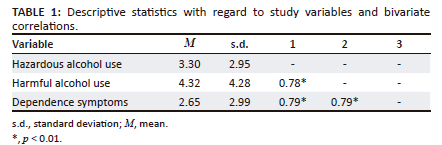
The descriptive statistics and bivariate correlations of hazardous alcohol use, harmful alcohol use and dependence symptoms are presented in Table 1. Firstly, the results revealed that hazardous alcohol use significantly and positively correlated with harmful alcohol use (r = 0.78, p < 0.01). Secondly, the results demonstrated that hazardous alcohol use significantly and positively correlated with dependence symptoms (r = 0.79, p < 0.01). Finally, the results showed that harmful alcohol use significantly and positively correlated with dependence symptoms (r = 0.79, p < 0.01).
Linear regression
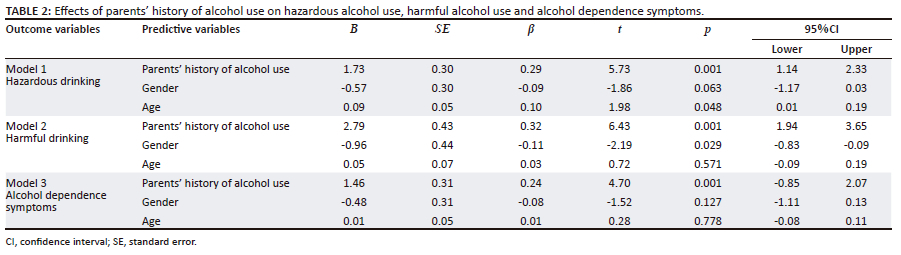
Linear regression analyses were conducted to determine whether parents' history of alcohol use could significantly predict hazardous alcohol use, harmful alcohol use and alcohol dependence symptoms. Firstly, hazardous alcohol use was regressed onto parents' history of alcohol use. Gender and age were controlled to rule out alternative explanations. The model was found to be statistically significant, F(1348) = 32.927, p < 0.001, and explained 8.6% of the variance in hazardous alcohol use. In addition, parents' history of alcohol use (B = 1.73, t = 5.73, p < 0.001) significantly predicted hazardous alcohol use among students (Table 2; Model 1). Secondly, harmful alcohol use was regressed onto parents' history of alcohol use while gender and age were controlled. The results revealed a statistically significant model, F(1347) = 41.373, p < 0.001, which explained 10.7% of the variance in harmful alcohol use. Additionally, the results revealed that parents' history of alcohol use (B = 2.79, t = 6.43, p < 0.001) significantly predicted harmful alcohol use among students (Table 2; Model 2). Lastly, alcohol dependence symptoms were regressed onto parents' history of alcohol use while gender and age were controlled. The results revealed a statistically significant model, F(1348) = 22.156, p < 0.001, which explained 6% of the variance in alcohol dependence symptoms. Furthermore, the results revealed that parents' history of alcohol use (B = 1.46, t = 4.70, p < 0.001) significantly predicted alcohol dependence symptoms (Table 2; Model 3).
Independent samples t-test
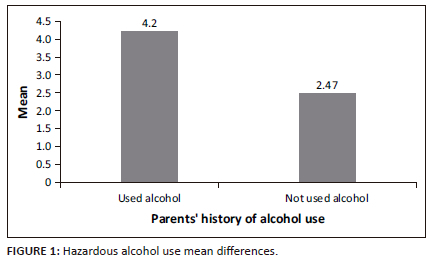
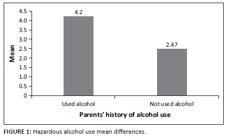
The first hypothesis tested whether there are variations in students' levels of hazardous alcohol use based on their parents' history of alcohol use. Therefore, the levels of hazardous alcohol use between students whose parents had a history of alcohol use and those who did not have a history of alcohol use were compared. The independent samples t-test results showed that students who had parents with a history of alcohol use (n = 168, M = 4.20, s.d. = 2.95) scored slightly higher on hazardous alcohol use than students with parents who did not have a history of alcohol use (n = 182, M = 2.47, s.d. = 2.70). The observed differences were statistically significant, t (338) = 5.71, p < 0.01. The results, therefore, suggest that students who have parents with a history of alcohol use are likely to have greater levels of hazardous alcohol use than those with parents without a history of alcohol use. The graphical representation of mean scores is shown in Figure 1.
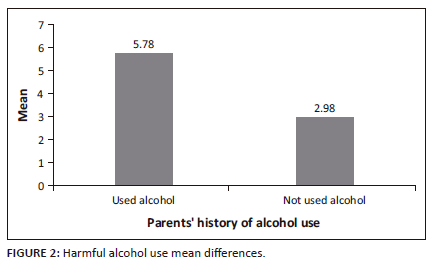
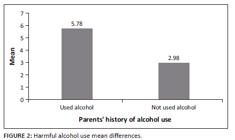
The second hypothesis tested whether there are variations in students' levels of harmful alcohol use based on their parents' history of alcohol use. Hence, the levels of harmful alcohol use between students whose parents have a history of alcohol use and those who do not have a history of alcohol use were measured. The independent samples t-test results revealed that students who had parents with a history of alcohol use (n = 167, M = 5.78, s.d. = 4.48) scored slightly higher on harmful alcohol use than students with parents who did not have a history of alcohol use (n = 182, M = 2.98, s.d. = 3.66). The observed differences were statistically significant, t (323) = 6.38, p < 0.01. The results, therefore, imply that students who have parents with a history of alcohol use tend to have higher levels of harmful alcohol use than those who have parents without a history of alcohol use. The graphical representation of mean scores is depicted in Figure 2.
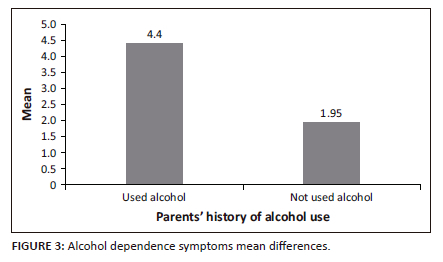
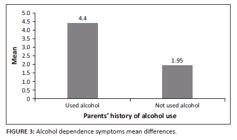
The third hypothesis tested whether there are differences in students' levels of alcohol dependence symptoms based on their parents' history of alcohol use. Accordingly, the levels of alcohol dependence symptoms between students whose parents had a history of alcohol use and those with parents who did not have a history of alcohol use were measured. The independent samples t-test results showed that students who had parents with a history of alcohol use (n = 168, M = 4.42, s.d. = 3.20) scored slightly higher on alcohol dependence symptoms than those with parents without a history of alcohol use (n = 182, M = 1.95, s.d. = 2.61). The observed differences were statistically significant, t (323) = 4.67, p < 0.01. These results suggest that students who have parents with a history of alcohol use tend to have higher levels of alcohol dependence symptoms than those who have parents without a history of alcohol use. The graphical representation of mean scores is displayed in Figure 3.
Discussion
Alcohol use has serious psychosocial implications for the user and significant others close to the user. Children are vulnerable and susceptible to parental influence.38,47 Similarly, the drinking behaviours of parents can be passed down to children and adversely influence their drinking patterns as they transition to adulthood. Therefore, suggesting that parents' history of alcohol use can play a crucial role in children's drinking behaviour. The results of the study revealed that parents' history of alcohol use significantly predicted hazardous alcohol use, harmful alcohol use and alcohol dependence symptoms. Therefore, corroborating findings from a previous study, which found higher alcohol misuse patterns among children with parents who used alcohol compared to children with parents who do not use alcohol.48
This study revealed that students whose parents had a history of alcohol use demonstrated a higher hazardous alcohol use than those whose parents did not have a history of alcohol use, in accordance with previous studies.38,48 This implies that parents who drink alcohol have an influence and impose a risk on their children's drinking behaviour. In addition, the results suggest that when children are exposed to environments and people of influence who drink alcohol, such as parents, their likelihood of becoming hazardous drinkers as they transition to adulthood during university years increases. Ay et al.3836,49 Therefore, this study highlights the pervasive repercussions of alcohol use by parents and its deleterious influence on children and their alcohol-use-related behaviours that can manifest during university. Students' hazardous alcohol use may also have negative educational outcomes45
Students whose parents had a history of alcohol use were found to have harmful alcohol use patterns in comparison to those whose parents did not have a history of alcohol use. These results are similar to those of previous studies, such as LaBrie et al.,505051,52 Thus, it is crucial to understand the contributory role of familial factors, specifically parental or family history of alcohol use, towards harmful alcohol use among university students in order to devise appropriate support interventions.
The results of the study revealed differences in alcohol dependence symptoms of students whose parents had a history of alcohol use, scoring significantly higher than those whose parents did not have a history of alcohol use. These findings are similar to those of Knight et al.,4314
Implications for practice
Alcohol abuse and unsafe drinking behaviours are common among university students.5345
To address the problem of alcohol abuse in higher learning, it is important that university health centres have dedicated alcohol abuse prevention and educational programmes to increase awareness about alcohol abuse. These educational programmes could focus on promoting moderate and healthy drinking.51
It is also imperative for universities to regulate drinking behaviour on campus. This could be achieved by establishing a code of conduct or guidelines to minimise unsafe alcohol consumption. Similarly, universities could develop alcohol and substance consumption policies. Rhodes University in South Africa implemented an alcohol policy to promote responsible drinking among students.5454
It is of paramount importance to promote safe drinking through student orientations. This could be facilitated by members of the university health centres when students attend university induction programmes. In addition, safe drinking tutorials could form part of the first-year university curriculum, during which students could be taught about substance abuse and associated risks. This could help curb unsafe alcohol consumption among students, promote positive health and yield study success.
Limitations and recommendations
The study has a few limitations. Firstly, a cross-sectional survey design was employed. It is recommended that future studies replicate the study but utilise a longitudinal design to understand students' drinking behaviours over a longer period so as to devise more suitable alcohol abuse intervention measures. Secondly, self-report measures, which are often susceptible to self-report bias, were used to collect data from the participants. It is recommended that future research employ different data sources to minimise the self-report bias. Thirdly, convenience sampling, which is a non-probability sampling method, was used to recruit participants in this study. Convenience sampling has limited representativeness and generalisability. It is recommended that future research replicate the study using probability sampling methods to increase representativeness and the generalisability of the results. Finally, this study was carried out at a single university in South Africa. It is recommended that future research replicate the study but conduct it at several universities to increase its generalisability.
Conclusion
The results of the study highlight the influence of parents' history of alcohol abuse on their children's drinking behaviour. In particular, the study indicates that the risk of engaging in hazardous, harmful alcohol use and developing dependence symptoms among university students is greater when they have been exposed to alcohol use by parents. The study, therefore, contributes to the literature on parenting practices and alcohol consumption. In addition, the study contributes to the literature on responsible alcohol consumption among students, student health and study success. Although it is acknowledged that institutions of higher learning cannot control students' pre-university or domestic life, they have a critical responsibility to prevent substance abuse among students and educate them about safe alcohol consumption practices.
Competing interests
The authors declare that they have no financial interests that may have inappropriately influenced them in writing this article.
Authors' contributions
R.M. contributed to the conceptualisation of the study, data collection and writing of the results. B.V.M was involved in data analysis, writing of results and discussions.
Funding information
The authors received no financial support for the publication of this article.
Data availability
The data supporting this study's findings are available upon reasonable request from the corresponding author, B.V.M. The full data set is not publicly available because no written approval was granted by participants to make the data public.
Disclaimer
The views and opinions expressed in this article are those of the authors and are the product of professional research. They do not necessarily reflect the official policy or position of any affiliated institution, funder, agency or that of the publisher. The authors are responsible for this article's results, findings and content.
Acknowledgements
The authors would like to thank all the participants who participated in this study.
References
-
1. World Health Organisation. Alcohol [home page on the Internet]. 2024 [cited 2025 Jan 15]. Available from: https://www.who.int/news-room/fact-sheets/detail/alcohol
» https://www.who.int/news-room/fact-sheets/detail/alcohol -
2. Shield KD, Parry C, Rehm J. Chronic diseases and conditions related to alcohol use. Alcohol Res: Curr Rev [serial online]. 2014;35(2):155-171 [cited 2025 March 30]. Available from: https://pmc.ncbi.nlm.nih.gov/articles/PMC3908707/
» https://pmc.ncbi.nlm.nih.gov/articles/PMC3908707/ -
3. American Psychological Association. Understanding alcohol use disorders and their treatment [home page on the Internet]. 2012 [cited 2025 Jan 12]. Available from: https://www.apa.org/topics/substance-use-abuse-addiction/alcohol-disorders
» https://www.apa.org/topics/substance-use-abuse-addiction/alcohol-disorders -
4. Llamosas-Falcón L, Hasan OS, Shuper P A, Rehm J. A systematic review on the impact of alcohol use on sexually transmitted infections. Int J Alcohol Drug Res [serial online]. 2023;11(1):3-12 [cited 2025 March 30]. Available from: https://pmc.ncbi.nlm.nih.gov/articles/PMC10270666/
» https://pmc.ncbi.nlm.nih.gov/articles/PMC10270666/ -
5. Morejele NK, Nkosi S, Kekwaletse KT, Saban A, Parry CDH. Review of research on alcohol and HIV in sub-Saharan Africa [home page on the Internet]. 2013 [cited 2025 Jan 13]. Available from: https://www.samrc.ac.za/sites/default/files/attachments/2022-07/AlcoholSubSaharan.pdf
» https://www.samrc.ac.za/sites/default/files/attachments/2022-07/AlcoholSubSaharan.pdf -
6. Morojele NK, Shenoi SV, Shuper PA, Braithwaite RA, Rehm J. Alcohol use and the risk of communicable disease. Nutrients. 2021;13(10): 3317. https://doi.org/10.3390/nu13103317
» https://doi.org/10.3390/nu13103317 -
7. Moss HB. The impact of alcohol on society: A brief overview. Soc Work Public Health. 2013;28(3-4):175-177. https://doi.org/10.1080/19371918.2013.758987
» https://doi.org/10.1080/19371918.2013.758987 -
8. Chikritzhs T, Livingston M. Alcohol and the risk of injury. Nutrients. 2021;13(8): 2777. https://doi.org/10.3390/nu13082777
» https://doi.org/10.3390/nu13082777 -
9. Davis EC, Rotheram-Borus MJ, Weichle TW, Rezai R, Tomlinson M. Patterns of alcohol abuse, depression, and intimate partner violence among township mothers in South Africa over 5 years. AIDS Behav. 2017;21(2):174-182. https://doi.org/10.1007/s10461-017-1927-y
» https://doi.org/10.1007/s10461-017-1927-y -
10. Setlalentoa BMP, Pisa PT, Thekisho GN, Ryke EH, Loots Du T. The social aspects of alcohol misuse/abuse in South Africa. S Afr J Clin Nutr. 2010;23(2):S11-S15. https://doi.org/10.1080/16070658.2010.11734296
» https://doi.org/10.1080/16070658.2010.11734296 -
11. Kamulegeya LH, Kitonsa PJ, Okolimong E, Kaudha G, Maria S, Nakimuli-Mpungu E. Prevalence and associated factors of alcohol use patterns among university students in Uganda. Pan Afr Med J. 2020;37:339. https://doi.org/10.11604/pamj.2020.37.339.21136
» https://doi.org/10.11604/pamj.2020.37.339.21136 -
12. Mbuthia G, Wanzala P, Ngugi CW, Nyamogoba HDN. A qualitative study on alcohol and drug abuse among undergraduate (university students) in the coastal region of Kenya. Afr J Health Sci [serial online]. 2020;33(1):38-48 [cited 2025 March 30]. Available from: https://www.ajol.info/index.php/ajhs/article/view/197772
» https://www.ajol.info/index.php/ajhs/article/view/197772 -
13. Mandeya A, Ter Goon D. The relationship between patterns of alcohol use and knowledge of alcohol-attributable health conditions: A survey among students at a south African university. Open Public Health J. 2019;12(1):455-464. https://doi.org/10.2174/1874944501912010455
» https://doi.org/10.2174/1874944501912010455 -
14. Mbuqa B, Ducasse R, Ferreira M, Danielkutty L, Radebe B, Jacob N. Knowledge, attitudes and practices regarding alcohol use among undergraduate students at a South African university. Undergrad Res Health J [serial online]. 2024;2(1):4-11 [cited 2025 March 30]. Available from: https://samajournals.co.za/index.php/urhj/article/view/1650
» https://samajournals.co.za/index.php/urhj/article/view/1650 -
15. Kyei K A, Ramagoma M. Alcohol consumption in South African universities: Prevalence and factors at the University of Venda, Limpopo province. J Soc Sci. 2013 [serial online];36(1):77-86 [cited 2025 March 30]. Available from: http://krepublishers.com/02-Journals/JSS/JSS-36-0-000-13-Web/JSS-36-1-000-13-Abst-PDF/JSS-36-1-077-13-1345-Kyei-K-A/JSS-36-1-077-13-1345-Kyei-K-A-Tx%5B9%5D.pmd.pdf
» http://krepublishers.com/02-Journals/JSS/JSS-36-0-000-13-Web/JSS-36-1-000-13-Abst-PDF/JSS-36-1-077-13-1345-Kyei-K-A/JSS-36-1-077-13-1345-Kyei-K-A-Tx%5B9%5D.pmd.pdf -
16. Blows S, Isaacs S. Prevalence and factors associated with substance use among university students in South Africa: Implications for prevention. BMC Psychol. 2020;10(1):309. https://doi.org/10.1186/s40359-022-00987-2
» https://doi.org/10.1186/s40359-022-00987-2 -
17. Maphisa JM, Young C. Risk of alcohol use disorder among South African university students: The role of drinking motives. Addict Behav. 2018;82:44-49. https://doi.org/10.1016/j.addbeh.2018.02.016
» https://doi.org/10.1016/j.addbeh.2018.02.016 -
18. Filby, S. Drink up, it's closing time: South African study calculates that limiting opening hours will save lives [homepage on the Internet]. 2023 [cited 2025 Jan 15]. Available from: https://theconversation.com/drink-up-its-closing-time-south-african-study-calculates-that-limiting-opening-hours-will-save-lives-205700
» https://theconversation.com/drink-up-its-closing-time-south-african-study-calculates-that-limiting-opening-hours-will-save-lives-205700 -
19. Choi KW, Watt MH, Skinner D, Kalichman SC, Sikkema KJ. 'Wine you get every day, but a child you can't replace': The perceived impact of parental drinking on child outcomes in a South African township. J Child Adolesc Men Health. 2015;27(3):173-187. https://doi.org/10.2989/17280583.2015.1113974
» https://doi.org/10.2989/17280583.2015.1113974 -
20. Brown-Rice KA, Scholl JL, Fercho KA, et al. Neural and psychological characteristics of college students with alcoholic parents differ depending on current alcohol use. Prog Neuro-Psychopharmacol Biol Psychiatry. 2018;81:284-296. https://doi.org/10.1016/j.pnpbp.2017.09.010
» https://doi.org/10.1016/j.pnpbp.2017.09.010 -
21. Hansson H, Rundberg J, Zetterlind U, Johnsson KO, Berglund M. An intervention programme for university students who have parents with alcohol problems: A randomised controlled trial. Alcohol Alcohol. 2006;41(6):655-663. https://doi.org/10.1093/alcalc/agl057
» https://doi.org/10.1093/alcalc/agl057 -
22. Inaç Y, Larivière Y, Hoque M, Van Hal G. Risk factors for hazardous drinking in university students from South Africa and Belgium: A cross-cultural comparison study. Afr Health Sci. 2021;21(1):123-131. https://doi.org/10.4314/ahs.v21i1.17
» https://doi.org/10.4314/ahs.v21i1.17 -
23. Pengpid S, Peltzer K, Van Der Heever H, Skaal L. Screening and brief interventions for hazardous and harmful alcohol use among university students in South Africa: Results from a randomised controlled trial. Int J Environ Res Public Health. 2013;10(5):2043-2057. https://doi.org/10.3390/ijerph10052043
» https://doi.org/10.3390/ijerph10052043 -
24. O'Connor EO, Perdue LA, Senger CAa,. Screening and behavioral counseling interventions to reduce unhealthy alcohol use in adolescents and adults: An updated systematic review for the U.S. preventive services task force [homepage on the Internet]. 2018 [cited 2025 Jan 13]. Available from: https://www.ncbi.nlm.nih.gov/books/NBK534916/
» https://www.ncbi.nlm.nih.gov/books/NBK534916/ -
25. Friesen EL, Bailey J, Hyett S, et al. Hazardous alcohol use and alcohol-related harm in rural and remote communities: A scoping review. Lancet Public Health. 2022;7(2):e177-e187. https://doi.org/10.1016/S2468-2667(21)00159-6
» https://doi.org/10.1016/S2468-2667(21)00159-6 -
26. National Cancer Institute. Alcohol dependence [homepage on the Internet]. 2024 [cited 2025 Jan 14]. Available from: https://www.cancer.gov/publications/dictionaries/cancer-terms/def/alcohol-dependence
» https://www.cancer.gov/publications/dictionaries/cancer-terms/def/alcohol-dependence -
27. Sondhi A, Turner C. The influence of family and friends on young people's drinking [homepage on the Internet]. 2011 [cited 2025 Jan 15]. Available from: https://alcoholireland.ie/wp-content/uploads/2011/02/the-influence-of-family-and-friends-on-young-peoples-drinking.pdf
» https://alcoholireland.ie/wp-content/uploads/2011/02/the-influence-of-family-and-friends-on-young-peoples-drinking.pdf -
28. Homel J, Warren D. Parental influences on adolescents' alcohol use [homepage on the Internet]. 2017 [cited 2025 Jan 15]. Available from: https://growingupinaustralia.gov.au/research-findings/annual-statistical-report-2016/parental-influences-adolescents-alcohol-use
» https://growingupinaustralia.gov.au/research-findings/annual-statistical-report-2016/parental-influences-adolescents-alcohol-use -
29. Jiang Y. The association between parental alcohol-related behaviors and children's drinking. Drug Alcohol Depend. 2003; 69(3):253-262. https://doi.org/10.1016/S0376-8716(02)00324-1
» https://doi.org/10.1016/S0376-8716(02)00324-1 - 30. Miles AC. Substance use, parenting stress and child maltreatment: Exploring these relationships in a sample of at-risk mothers [Unpublished dissertation]. University of Cape Town; 2010.
- 31. Rabotata NE. Risk factors contributing towards alcohol abuse amongst the youths of Solomondale Community of Ga-Dikgale Traditional Authority, Limpopo Province [Unpublished dissertation]. University of Limpopo; 2019.
-
32. Ngepah R, Saba CS. Parental health risk preferences, socio-economic status and offspring's alcohol behavior in South Africa. Heliyon. 2024; 10(13):e33517. https://doi.org/10.1016/j.heliyon.2024.e33517
» https://doi.org/10.1016/j.heliyon.2024.e33517 -
33. Carels C, Florence M, Adams S, Sinclair DL, Savahl S. Youths' perceptions of the relation between alcohol consumption and risky sexual behaviour in the Western Cape, South Africa: A qualitative study. Child Indic Res. 2022; 15(4): 1269-1293. https://doi.org/10.1007/s12187-022-09913-9
» https://doi.org/10.1007/s12187-022-09913-9 -
34. National Institute on Alcohol and Alcoholism. Alcohol's effects on health: Research-based information on drinking and its impact [homepage on the Internet]. 2025 [cited 2025 Jan 24]. Available from: https://www.niaaa.nih.gov/publications/brochures-and-fact-sheets/college-drinking
» https://www.niaaa.nih.gov/publications/brochures-and-fact-sheets/college-drinking -
35. Gambles N, Porcellato L, Fleming KM, Quigg Z. 'If you don't drink at university, you're going to struggle to make friends': Prospective students' perceptions around alcohol use at universities in the United Kingdom. Subst Use Misuse. 2022;57(2): 249-255. https://doi.org/10.1080/10826084.2021.2002902
» https://doi.org/10.1080/10826084.2021.2002902 -
36. Mathabela RTH, Van Der Heever H. Patterns of alcohol use amongst undergraduate students at a health science-es university, South Africa. J Drug Alcohol Res. 2021;10(7):236127 [cited 2025 March 30]. Available from: https://www.researchgate.net/profile/Hendry-Van-Der-Heever/publication/356914643_Patterns_of_Alcohol_Use_amongst_Undergraduate_Students_at_a_Health_Science-_es_University_South_Africa/links/61b301da086e3e217d37940a/Patterns-of-Alcohol-Use-amongst-Undergra
» https://www.researchgate.net/profile/Hendry-Van-Der-Heever/publication/356914643_Patterns_of_Alcohol_Use_amongst_Undergraduate_Students_at_a_Health_Science-_es_University_South_Africa/links/61b301da086e3e217d37940a/Patterns-of-Alcohol-Use-amongst-Undergra -
37. Davoren MP, Shiely F, Byrne M, Perry IJ. Hazardous alcohol consumption among university students in Ireland: A cross-sectional study. BMJ Open. 2015;5(1):e006045. https://doi.org/10.1136/bmjopen-2014-006045
» https://doi.org/10.1136/bmjopen-2014-006045 -
38. Ay A, Çam C, Kilinç A, Fatih Önsüz M, Metintaş S. Prevalence of hazardous alcohol consumption and evaluation of associated factors in university students. Soc Psychiatry Psychiatr Epidemiol. 2024;60:223-233. https://doi.org/10.1007/s00127-024-02680-8
» https://doi.org/10.1007/s00127-024-02680-8 -
39. Hallett J, Howat PM, Maycock BR, McManus A, Kypri K, Dhaliwal SS. Undergraduate student drinking and related harms at an Australian university: Web-based survey of a large random sample. BMC Public Health. 2012;12:37. https://doi.org/10.1186/1471-2458-12-37
» https://doi.org/10.1186/1471-2458-12-37 -
40. Tembo C, Burns S, Kalembo F. The association between levels of alcohol consumption and mental health problems and academic performance among young university students. PLoS One. 2017;12(6):e0178142. https://doi.org/10.1371/journal.pone.0178142
» https://doi.org/10.1371/journal.pone.0178142 -
41. Corney T, Du Plessis K. Australian first-year university college residents' alcohol consumption and alcohol-related harms. Nord Stud Alcohol Drugs. 2022;39(4):406-417. https://doi.org/10.1177/14550725221090037
» https://doi.org/10.1177/14550725221090037 - 42. Tesfai AH. Alcohol and substance abuse among students at University of KwaZulu-Natal, South Africa: The protective role of psychological capital and health promoting lifestyle [Unpublished master's dissertation]. University of Kwa-Zulu Natal; 2012.
-
43. Knight JR, Wechsler H, Kuo M, Seibring M, Weitzman ER, Schuckit MA. Alcohol abuse and dependence among US college students. J Stud Alcohol. 2002;63(3):263-270. https://doi.org/10.15288/jsa.2002.63.263
» https://doi.org/10.15288/jsa.2002.63.263 -
44. Hoeppner BB, Barnett NP, Jackson KM, et al. Daily college student drinking patterns across the first year of college. J Stud Alcohol Drugs. 2012;73(4):613-624. https://doi.org/10.15288/jsad.2012.73.613
» https://doi.org/10.15288/jsad.2012.73.613 -
45. Govender I, Nel K, Sibuyi XM. An exploration of alcohol use amongst undergraduate female psychology students at a South African university. S Afr J Psychiatry. 2017;23:a1022. https://doi.org/10.4102/sajpsychiatry.v23i0.1022
» https://doi.org/10.4102/sajpsychiatry.v23i0.1022 -
46. Babor TF, Higgins-Biddle JC, Saunders JB, Monteiro MG. AUDIT - The alcohol use disorders identification test: Guidelines for use in primary health care [homepage on the Internet] 2001 [cited 2025 Jan 18]. Available from: https://apps.who.int/iris/bitstream/10665/67205/1/WHO_MSD_MSB_01.6a.pdf
» https://apps.who.int/iris/bitstream/10665/67205/1/WHO_MSD_MSB_01.6a.pdf -
47. Van Der Wath AE, Moagi MM, Van Der Wath E. Risk factors for harm caused by alcohol use among students at higher education institutions: An integrative literature review. J Subst Use. 2024;29(5):927-938. https://doi.org/10.1080/14659891.2023.2217249
» https://doi.org/10.1080/14659891.2023.2217249 -
48. Haugland SH, Holmen TL, Ravndal E, Bratberg GH. Parental alcohol misuse and hazardous drinking among offspring in a general teenage population: Gender-specific findings from the Young-HUNT 3 study. BMC Public Health. 2013;12:1-10. https://doi.org/10.1186/1471-2458-13-1140
» https://doi.org/10.1186/1471-2458-13-1140 -
49. Mathibe M, Cele L, Modjadji P. Alcohol use among high school learners in the peri-urban areas, South Africa: A descriptive study on accessibility, motivations and effects. Children. 2022;9(9): 1342. https://doi.org/10.3390/children9091342
» https://doi.org/10.3390/children9091342 -
50. LaBrie JW, Migliuri S, Kenney SR, Lac A. Family history of alcohol abuse associated with problematic drinking among college students. Addict Behav. 2010;35(7):721-725. https://doi.org/10.1016/j.addbeh.2010.03.009
» https://doi.org/10.1016/j.addbeh.2010.03.009 -
51. Du Preez R, Pentz CD, Lategan BW. Why students drink: A study of South African University students' drinking behaviour. S Afr J High Educ. 2016;30(2):73-93. https://doi.org/10.20853/30-2-582
» https://doi.org/10.20853/30-2-582 -
52. Lategan B, Du Preez R, Pentz C. Socio-demographic insights into South African student drinking behaviour. S Afr J High Educ. 2017;31(5):90-115. https://doi.org/10.20853/31-5-1512
» https://doi.org/10.20853/31-5-1512 -
53. Chen C, Mpinganjira MG, Motilal A, et al. Prevalence and correlates of alcohol use and risky drinking among undergraduate students in Johannesburg, South Africa: A cross-sectional study. BMC Psychiatry. 2023;23(553). https://doi.org/10.1186/s12888-023-05043-w
» https://doi.org/10.1186/s12888-023-05043-w -
54. Rhodes University. Draft alcohol policy [homepage on the Internet]. 2010 [cited 2025 Jan 17]. Available from: https://www.ru.ac.za/media/rhodesuniversity/content/studentrepresentativecouncil/documents/Alchohol_Misuse[1].pdf
» https://www.ru.ac.za/media/rhodesuniversity/content/studentrepresentativecouncil/documents/Alchohol_Misuse[1].pdf

Accepted: 29 July 2025
Published: 03 Oct. 2025