Exploring burnout among psychiatric trainees at a South African university
Abstract
BACKGROUND: The mental health of doctors is increasingly topical, internationally and locally. Of importance is the phenomenon of burnout, a far-reaching repercussion of chronic work-related stress. Psychiatrists are more vulnerable to stress, burnout and suicide in comparison with other medical specialities. There is a void in published research relating to South African psychiatric traineesAIM: The study aimed to investigate burnout and associated factors among psychiatric registrars at a South African universitySETTING: Department of Psychiatry at the University of the WitwatersrandMETHODS: This was a cross-sectional study via an anonymous self-administered questionnaire. The questionnaire comprised three sections: demographics; the Maslach Burnout Inventory Human Services Survey (MBI-HSS) and questions relating to contributing factors, protective factors and consequences of burnout. The MBI-HSS is recognised as the leading measure of burnout, consisting of three subscales: emotional exhaustion (EE), depersonalisation (DP) and personal accomplishment (PARESULTS: The questionnaire was completed by 33 out of 55 psychiatric registrars (60.0% response rate). Data from 31 registrars were used in the analyses, as two registrars did not provide informed consent. Among participants, EE was the most commonly affected, followed by DP and lastly PA. The majority (67.8% or n = 21) had scores in the high category for any one of the three subscales (EE/DP/PA). Significant factors associated with burnout included poor work and non-professional life balance (p = 0.017), utilising annual leave days for work-related tasks (p < 0.001), irregular holidays (p = 0.003) and financial debt (p = 0.026). A possible protective factor was an amicable relationship with fellow psychiatric registrarsCONCLUSION: There is evidence of some degree of burnout in more than two-thirds of participants. Associated factors lie largely at an organisational level, and while optimising individual resilience is important, systemic support plays a key role
burnout; doctors' mental health; psychiatry; trainees; stress; South African doctors; Maslach Burnout Inventory; residents
Introduction
The mental health of doctors is increasingly topical, both internationally and locally. Of importance is the phenomenon of burnout, a far-reaching repercussion of chronic work-related stress.11,2 There is a void in published research relating to South African psychiatric trainees.
American psychoanalyst Herbert Freudenberger coined the term burnout in 1974.345
[A] syndrome conceptualized as resulting from chronic workplace stress that has not been successfully managed. It is characterized by three dimensions: feelings of energy depletion or exhaustion; increased mental distance from one's job, or feelings of negativism or cynicism related to one's job; and reduced professional efficacy. Burn-out refers specifically to phenomena in the occupational context and should not be applied to describe experiences in other areas of life.6
Various instruments have been developed to measure burnout, including the Maslach Burnout Inventory (MBI), the Oldenburg Burnout Inventory, the Physician Work-Life Study's single item and the Copenhagen Burnout Inventory.78
The burnout rate among doctors varies from 17.6% - 82.0%, subject to speciality, setting, methods and subscales measured.91011
The current literature describes internal and external contributing factors to burnout. Internal factors refer to individual and personality-related factors, while external factors include the environment and situational influences.12
Regarding individual factors, age is the demographic variable most consistently related to burnout. Maslach et al. found that younger employees (< 40 years) and single individuals are more prone.13black tax may play a role. It has been shown that even when minorities achieve faculty rank, they report lower career satisfaction and higher social isolation.14black tax is recognised in African ethnic populations and refers to the financial obligation experienced by black professionals to support their extended families.1516
External contributing factors were identified by Fothergill et al. in a systematic review: patient and family negative characteristics, administrative and organisational inadequacies, lack of resources, staff conflicts, lack of encouraging feedback, disproportionate supervisory duties, long working hours, excessive workload, violence and suicide perpetrated by patients, low pay and role conflict (between work and personal life).1718
In low- and middle-income countries, psychiatrists are scarce and disproportionately distributed.1920,21 Policymakers are often at a provincial or national level, leaving doctors alienated from decisions having a major impact on themselves.22
Moderators of burnout, described by Fothergill et al., include supportive personal relationships (community support, relationships with family and friends and private therapy), attention to non-professional life, regular holidays and designated time for medical training.1723
The consequences of burnout extend from personal to healthcare system outcomes. Personal outcomes of burnout include depression, adverse effects on relationships, substance abuse, physical illness and increased suicide risk.17242517,25 The WHO highlighted that work stress contributes to cardiovascular, gastrointestinal and musculoskeletal disorders.2627
The outcomes of burnout in healthcare systems are recruitment and retention issues, lowered productivity and efficiency (including absenteeism), suboptimum patient care, medical errors, higher medical aid expenditure and decreased patient satisfaction.25,26 Burnout has been identified as a cause of medical migration in South Africa, and failure to address it may result in the loss of skills to the global labour market.21282825
The former president of the South African Society of Psychiatrists, Professor Janse van Rensburg, highlighted the responsibility, at an organisational level, to recognise burnout as a problem.29
Aim and objectives
This research study aimed to investigate burnout among psychiatric registrars (trainees) at the University of the Witwatersrand.
The study objectives were as follows:
to determine the scores of the three subscales of burnout, EE, DP and PA, using the MBI-HSS (MP)
to ascertain the demographic and work-related profiles of participants and their associations with MBI-HSS (MP) scores
to ascertain potential contributing and protective factors, as well as potential consequences of burnout.
Research methods and design
Study setting
The study participants were registrars in the Department of Psychiatry at the University of the Witwatersrand (WITS), South Africa.
Study design
This study was a cross-sectional investigation of burnout and its associated factors.
Study population and sampling strategy
There were 55 registrars in the WITS Department of Psychiatry at the time of the study.30 All registrars who provided informed consent to participate in the study were included. In order to ensure anonymity, unidentifiable questionnaires were distributed and returned, via the WITS Department of Psychiatry's internal mail, to the department secretary in October 2018.
Data collection and instrument
The questionnaires (based on a literature review) were self-administered by the participants and comprised of three sections:
demographics and work-related variables
the MBI-HSS (MP)
contributing factors, protective factors and possible consequences of burnout.
Permission to use the MBI instrument was obtained, and copies thereof purchased from www.mindgarden.com. Human services are divided into social service, medical, mental health and other.888
Data analysis
Data were analysed using MicrosoftTM Excel and STATISTICA 7.1 statistical software (www.statsoft.com). The dataset did not meet the assumptions of normality; therefore, non-parametric analyses were used. All statistical tests were two-tailed, and alpha was set at 0.05.
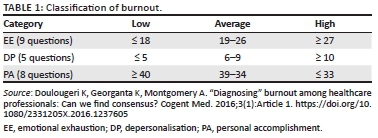
Objective 1: Descriptive statistics for EE, DP and PA were generated. Scores were categorised as high based on a threshold as per the cut-off score published in the third edition of the MBI manual8Table 1). These cut-off scores correlate with the scores predominantly used in burnout research.318
Objective 2: Demographics and work-related profiles of participants were tabulated. The Mann-Whitney U and Kruskal-Wallis tests were used to analyse significant associations between participants' demographic and work-related profiles and their MBI results.
Objective 3: Contributing, protective factors and possible consequences of burnout were analysed using the Mann-Whitney U and Kruskal-Wallis tests.
Ethical considerations
Permission to conduct the study was obtained from the Deputy Registrar of WITS, WITS Head of Department of Psychiatry and the WITS Human Research Ethics Committee (Medical) - clearance number M180556. A distress protocol was included in the questionnaire.
Results
Out of 55 psychiatric registrars, 33 completed and returned the questionnaire (a 60.0% response rate). Data from 31 registrars were used in the analyses, as two registrars did not provide informed consent.
Objective 1
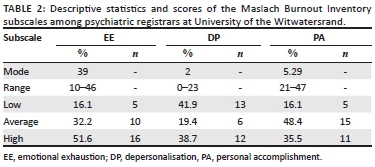
Among the participants, EE was the most commonly affected, followed by DP and PA (Table 2). The majority (67.7% or n = 21) had scores in the high category for any one of the three subscales (EE/DP/PA).
Objective 2
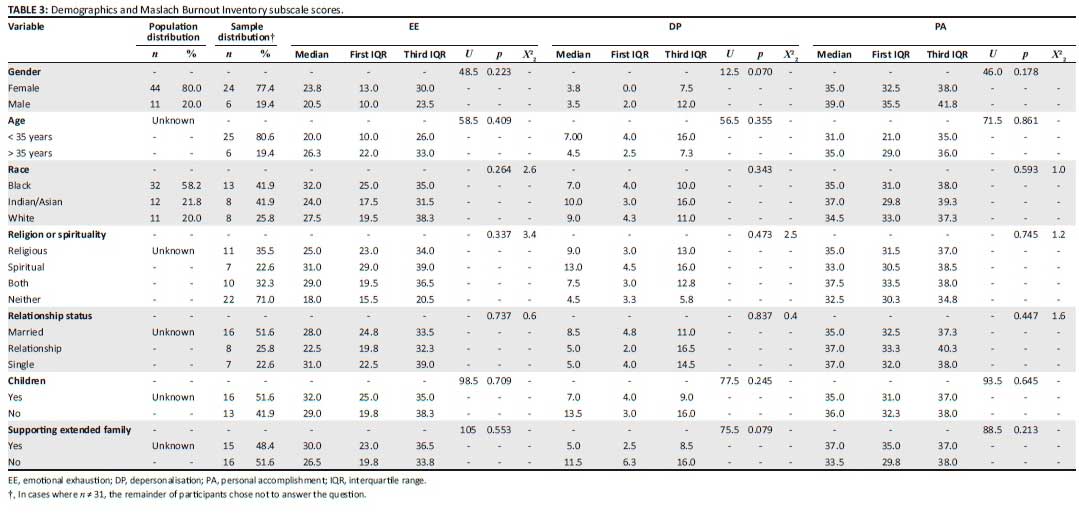
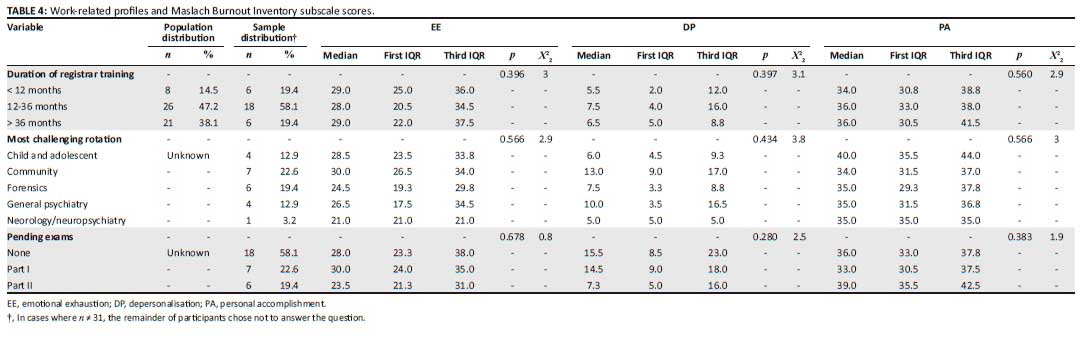
None of the demographic factors (Table 3) or work-related profiles (Table 4) were significant predictors for the EE, DP and PA subscales.
Objective 3
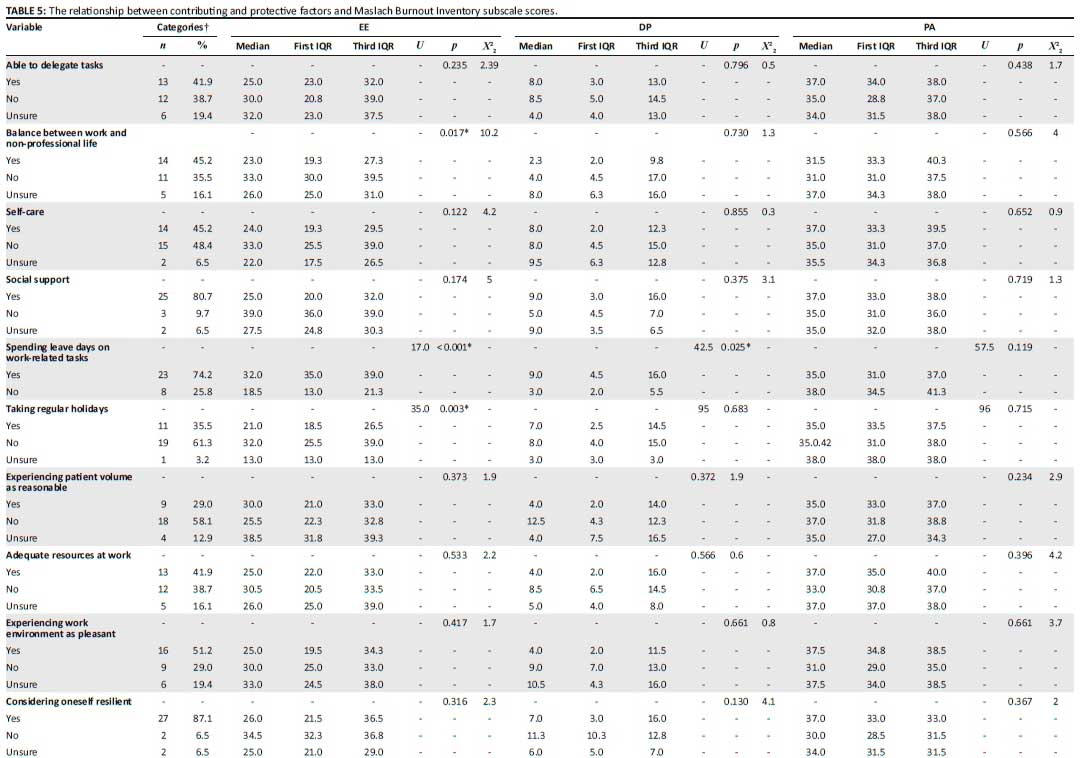
Factors associated with higher EE scores were as follows (Table 5):
poor work and non-professional life balance
utilising leave days for work-related tasks
not taking regular holidays
debt
attending therapy.
Utilising leave days for work-related tasks was the only factor associated with higher DP scores, while a good relationship with fellow psychiatric registrars was associated with higher PA scores (Table 5).
Discussion
Key findings
A 60.0% response rate is in keeping with average response rates of 52.7% in surveys collected from individuals and used for organisational research.32
Objective 1
Participants scored highest in the EE category, followed by DP and lastly PA. Higher EE and DP scores, and lower PA scores, correlate to greater experienced burnout.81833
Jovanović et al. found a 60.0% prevalence rate of high burnout among South African psychiatric registrars in 2010 using the DP and EE subscales (second highest in the world after Hong Kong), and this study found a rate of 67.7% using all the three subscales. South Africa was also the country with the second longest working hours after Hong Kong.1134
Objective 2
None of the demographic or work-related factors were significant predictors of burnout, and this may have been because of the small study sample. Another explanation is that burnout is an organisational complication rather than an individual circumstance.
Objective 3
Significant factors associated with burnout included poor work and non-professional life balance, using leave days for work-related tasks, not taking regular holidays and financial debt, and are similar to those identified by Fothergill et al.1723
Strengths and limitations
Burnout among doctors is increasingly topical, and studies of this nature form the foundation for planned interventions and, hence, are imperative. However, these results should be interpreted critically, especially with regards to generalisability as the sample size was small. It was a cross-sectional study, which infers that causation cannot be established. The ethics of dual agency should be considered as one of the researchers was a psychiatric registrar at the time of the study;35
Implications and recommendations
The results of this study may create a platform for further research studies. It is also recommended that this study's findings influence the university's policy in terms of sufficient protected academic time (recommended 8h/week according to the HPCSA guidelines) and support.3637
Conclusion
Evidence of burnout was found in more than two-thirds of WITS psychiatric trainees. Associated factors were found at an organisational level. While optimising individual resilience is important, systemic support plays a key role.
Competing interests
The authors declare that they have no financial or personal relationships that may have inappropriately influenced them in writing this article.
Authors' contributions
All authors contributed to the research design. T.M. and B.M. conceptualised and developed the initial draft, collected and analysed the data, and interpreted the results. All authors critically reviewed, revised and approved the final draft.
Funding information
The research work was funded by the research investigator. This work received no specific grant from any funding agency in the public, commercial or not-for-profit sectors.
Data availability
The data that support the findings of this study are available from the corresponding author, T.M., upon reasonable request.
Disclaimer
The views expressed in the article are those of the authors and not an official position of the University of the Witwatersrand.
Acknowledgements
The following contributions are gratefully acknowledged: the participants, those involved in ethics and other research clearance processes, the University of the Witwatersrand, Mind Garden for permission to use the Maslach Burnout Inventory, Professor Smith for her involvement in the distress protocol, Mrs Lambert for distribution of the questionnaires, Dr Stancheva for assistance in the development of the protocol and Professor Pillay for his contributions to statistics and data analysis.
References
- 1. Kumar S. Burnout in psychiatrists. World Psychiatry. 2007;6(3):186-189.
-
2. Thomsen S, Soares J, Nolan P, Dallender J, Arnetz B. Feelings of professional fulfilment and exhaustion in mental health personnel: The importance of organisational and individual factors. Psychother Psychosom. 1999;68(3):157-164. https://doi.org/10.1159/000012325
» https://doi.org/10.1159/000012325 -
3. American Psychiatric Association. Freudenberger HJ. Staff burn-out. J Soc Issues. 1974;30(1):159-165. https://doi.org/10.1111/j.1540-4560.1974.tb00706.x
» https://doi.org/10.1111/j.1540-4560.1974.tb00706.x - 4. Diagnostic and statistical manual of mental disorders (DSM-5), 5th ed. Arlington, VA: American Psychiatric Association; 2013.
- 5. World Health Organization. The ICD-10 classification of mental and behavioural disorders. Geneva: World Health Organization; 1992.
-
6. World Health Organization. Burnout an "occupational phenomenon": International Classification of Diseases [homepage on the Internet]. c2019 [updated 2019 May 28; cited 2020 Mar 01]. Available from: https://www.who.int/mental_health/evidence/burn-out/en/
» https://www.who.int/mental_health/evidence/burn-out/en/ -
7. National Academy of Medicine. Valid and reliable survey instruments to measure burnout, well-being, and other work-related dimensions [homepage on the Internet]. n.d. [cited 2019 Dec 30]. Available from: https://nam.edu/valid-reliable-survey-instruments-measure-burnout-well-workrelated-dimensions/
» https://nam.edu/valid-reliable-survey-instruments-measure-burnout-well-workrelated-dimensions/ - 8. Maslach C, Jackson SE, Leiter MP. Maslach burnout inventory manual. 4th ed. Menlo Park, CA: Mind Garden, Inc; 2016.
-
9. Prins JT, Gazendam-Donofrio SM, Tubben BJ, Van Der Heijden FMMA, Van De Wiel HBM, Hoekstra-Weebers JEHM. Burnout in medical residents: A review. Med Educ. 2007;41(8):788-800. https://doi.org/10.1111/j.1365-2923.2007.02797.x
» https://doi.org/10.1111/j.1365-2923.2007.02797.x -
10. Umene-Nakano W, Kato TA, Kikuchi S, et al. Nationwide survey of work environment, work-life balance and burnout among psychiatrists in Japan. PLoS One. 2013;8(2):e55189. https://doi.org/10.1371/journal.pone.0055189
» https://doi.org/10.1371/journal.pone.0055189 -
11. Jovanović N, Podlesek A, Volpe U, et al. Burnout syndrome among psychiatric trainees in 22 countries: Risk increased by long working hours, lack of supervision, and psychiatry not being first career choice. Eur Psychiatry. 2016;32(2016):34-41. https://doi.org/10.1016/j.eurpsy.2015.10.007
» https://doi.org/10.1016/j.eurpsy.2015.10.007 -
12. Kaschka WP, Korczak D, Broich K. Burnout: A fashionable diagnosis. Dtsch Arztebl Int. 2011;108(46):781-787. https://doi.org/10.3238/arztebl.2011.0781
» https://doi.org/10.3238/arztebl.2011.0781 -
13. Maslach C, Schaufeli WB, Leiter MP. Job burnout. Annu Rev Psychol. 2001;52:397-422. https://doi.org/10.1146/annurev.psych.52.1.397
» https://doi.org/10.1146/annurev.psych.52.1.397 -
14. Cyrus KD. Medical education and the minority tax. JAMA. 2017;317(18):1833-1834. https://doi.org/10.1001/jama.2017.0196
» https://doi.org/10.1001/jama.2017.0196 - 15. Magubane NN. Black tax: The emerging middle class reality [dissertation]. Gordon Institute of Business Science: University of Pretoria; 2017.
- 16. Semmer NK. Individual differences, work stress and health. In: Schabracq MJ, Winnubst JAM, Cooper CL, editors. The handbook of work and health psychology. West Sussex: John Wiley & Sons Ltd.; 1996, p. 83-120.
-
17. Fothergill A, Edwards D, Burnard P. Stress, burnout, coping and stress management in psychiatrists: Findings from a systematic review. Int J Soc Psychiatry. 2004;50(1):54-65. https://doi.org/10.1177/0020764004040953
» https://doi.org/10.1177/0020764004040953 -
18. Gouveia PAC, Neta MHCR, Aschoff CAM, Gomes DP, Da Silva NAF, Cavalcanti HAF. Factors associated with burnout syndrome in medical residents of a university hospital. Rev Assoc Med Bras. 2017;63(6):504-511. https://doi.org/10.1590/1806-9282.63.06.504
» https://doi.org/10.1590/1806-9282.63.06.504 -
19. Parker JS, Allen RR, Lund C. Are we training our psychiatrists adequately as public mental health practitioners? S Afr J Psychiatr. 2013;19(1):2-3. https://doi.org/10.4102/sajpsychiatry.v19i1.431
» https://doi.org/10.4102/sajpsychiatry.v19i1.431 -
20. Manyisa ZM, Van Aswegen EJ. Factors affecting working conditions in public hospitals: A literature review. Int J Afr Nurs Sci. 2017;6:28-38. https://doi.org/10.1016/j.ijans.2017.02.002
» https://doi.org/10.1016/j.ijans.2017.02.002 -
21. Stodel JM, Stewart-Smith A. The influence of burnout on skills retention of junior doctors at Red Cross War Memorial Children's Hospital: A case study. S Afr Med J. 2011;101(2):115-118. https://doi.org/10.7196/SAMJ.4431
» https://doi.org/10.7196/SAMJ.4431 - 22. Thomas LS, Valli A. Levels of occupational stress in doctors working in a South African public-sector hospital. S Afr Med J. 2006;96(11):1162-1168.
-
23. Fischer J, Kumar S, Hatcher S. What makes psychiatry such a stressful profession? A qualitative study. Australas Psychiatry. 2007;15(5):417-421. https://doi.org/10.1080/10398560701439699
» https://doi.org/10.1080/10398560701439699 -
24. Van der Bijl H, Oosthuizen P. Anxiety, depression, health attitudes and coping strategies in doctors and teachers in a Cape Town setting. S Afr J Psychiatr. 2007;13(2):46-51. https://doi.org/10.4102/sajpsychiatry.v13i2.27
» https://doi.org/10.4102/sajpsychiatry.v13i2.27 -
25. Wallace JE, Lemaire JB, Ghali WA. Physician wellness: A missing quality indicator. Lancet. 2009;374(9702):1714-1721. https://doi.org/10.1016/S0140-6736(09)61424-0
» https://doi.org/10.1016/S0140-6736(09)61424-0 -
26. De Beer L, Pienaar J, Rothmann S, Jr. Linking employee burnout to medical aid provider expenditure. S Afr Med J. 2013;103(2):89-93. https://doi.org/10.7196/SAMJ.6060
» https://doi.org/10.7196/SAMJ.6060 -
27. Eckleberry-Hunt J, Lick D, Boura J, et al. An exploratory study of resident burnout and wellness. Acad Med. 2009;84(2):269-277. https://doi.org/10.1097/ACM.0b013e3181938a45
» https://doi.org/10.1097/ACM.0b013e3181938a45 - 28. Pepper MS, Slabbert MN. Is South Africa on the verge of a medical malpractice litigation storm? S Afr J Bioeth Law. 2011;4(1):29-35.
-
29. South African Society of Psychiatrists: Overloaded medical professionals in danger of burnout [homepage on the Internet]. n.d. [cited 2020 Mar 03]. Available from: https://www.sasop.co.za/overloaded-medical-professionals
» https://www.sasop.co.za/overloaded-medical-professionals - 30. University of the Witwatersrand. Department of Psychiatry. Telephone list Jul-Dec 2018. Johannesburg: Faculty of Health Sciences.
-
31. Doulougeri K, Georganta K, Montgomery A. "Diagnosing" burnout among healthcare professionals: Can we find consensus? Cogent Med. 2016;3(1):Article 1. https://doi.org/10.1080/2331205X.2016.1237605
» https://doi.org/10.1080/2331205X.2016.1237605 -
32. Baruch Y, Holtom BC. Survey response rate levels and trends in organizational research. Hum Relat. 2008;61(8):1139-1160. https://doi.org/10.1177/0018726708094863
» https://doi.org/10.1177/0018726708094863 -
33. Shanafelt TD, Bradley KA, Wipf JE, Back AL. Burnout and self-reported patient care in an internal medicine residency program. Ann Intern Med. 2002;136(5):358-367. https://doi.org/10.7326/0003-4819-136-5-200203050-00008
» https://doi.org/10.7326/0003-4819-136-5-200203050-00008 -
34. Zeijlemaker C, Moosa S. The prevalence of burnout among registrars in the School of Clinical Medicine at the University of the Witwatersrand, Johannesburg, South Africa. S Afr Med J. 2019;109(9):668-672. https://doi.org/10.7196/SAMJ.2019.v109i9.13667
» https://doi.org/10.7196/SAMJ.2019.v109i9.13667 -
35. Ferguson LM, Yonge O, Myrick F. Students' involvement in faculty research: Ethical and methodological issues. Int J Qual Methods. 2004;3(4):56-68. https://doi.org/10.1177/160940690400300405
» https://doi.org/10.1177/160940690400300405 -
36. Health Professions Council of South Africa: Guideline on the minimum conditions of service, education and training of registrars and subspecialist trainees in South Africa [homepage on the Internet]. c2010 [updated 2010 Jan 20; cited 2020 Mar 03]. Available from: https://isystems.hpcsa.co.za/uploads/editor/UserFiles/PETM%20-%20Guideline%20-%20Conditions%20of%20Service%20Education%20and%20Training%2020%20Jan%202010.pdf
» https://isystems.hpcsa.co.za/uploads/editor/UserFiles/PETM%20-%20Guideline%20-%20Conditions%20of%20Service%20Education%20and%20Training%2020%20Jan%202010.pdf -
37. Wiederhold BK, Cipresso P, Pizzioli D, Wiederhold M, Riva G. Intervention for physician burnout: A systematic review. Open Med. 2018;13(1):253-263. https://doi.org/10.1515/med-2018-0039
» https://doi.org/10.1515/med-2018-0039

Accepted: 06 Sept. 2021
Published: 25 Feb. 2022